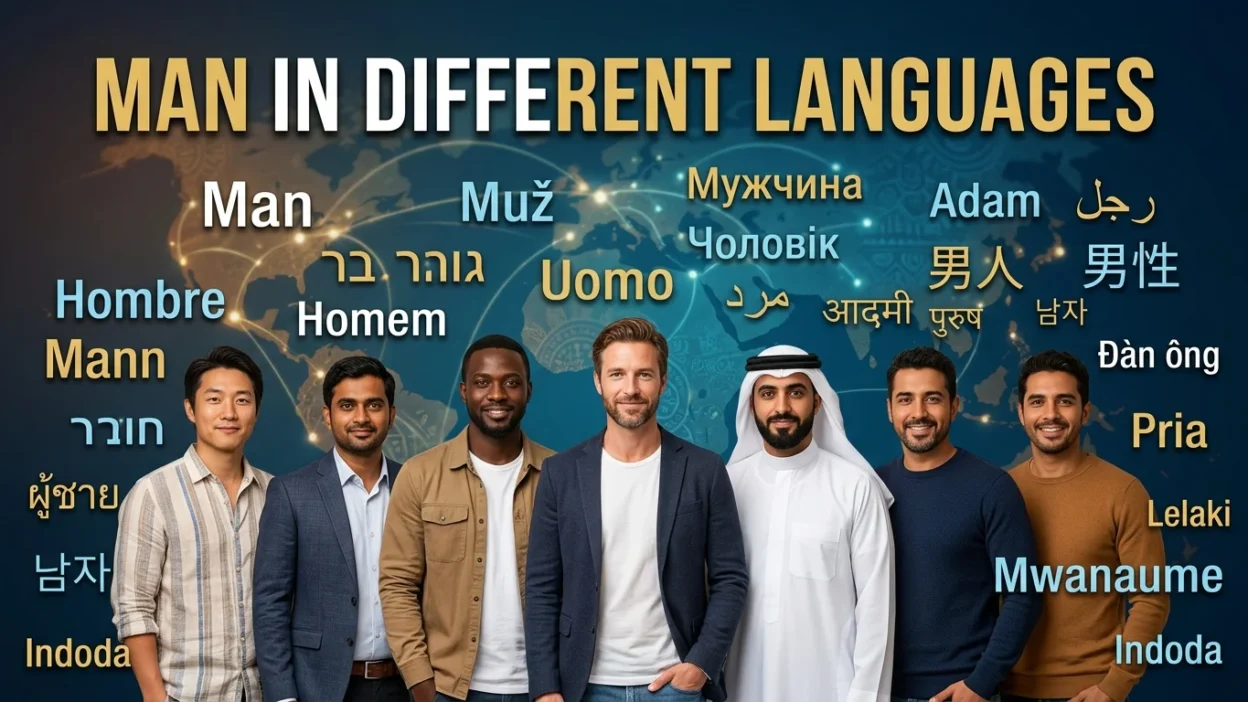
The word “man” is a basic and widely used word, but its translation can change significantly from one language to another. Depending on the language and context, it may refer to an adult male, a male person, a husband, or sometimes humanity in a broader sense.
If you are searching for man in different languages, this guide provides translations in a simple, easy-to-read format. Each entry includes the native word, an easy English pronunciation, a short everyday example sentence, and the English meaning of that sentence.
Whether you are learning a new language, travelling, studying vocabulary, researching translations, or simply curious about man in different languages around the world, this list gives you a useful multilingual reference.
Man in Different Languages
| Language | Native Phrase | Easy English Pronunciation | Example Sentence | English Meaning |
| English | Man | MAN | The man is waiting outside. | The male person is waiting outside. |
| Spanish | Hombre | OM-breh | El hombre está aquí. | The man is here. |
| French | Homme | OM | L’homme est ici. | The man is here. |
| German | Mann | MAHN | Der Mann wartet hier. | The man is waiting here. |
| Italian | Uomo | WOH-moh | L’uomo è qui. | The man is here. |
| Portuguese | Homem | OH-men | O homem está aqui. | The man is here. |
| Dutch | Man | MAHN | De man staat buiten. | The man is outside. |
| Afrikaans | Man | MAHN | Die man is hier. | The man is here. |
| Swedish | Man | MAHN | Mannen står där. | The man is standing there. |
| Norwegian | Mann | MAHN | Mannen står her. | The man is standing here. |
| Danish | Mand | MAN | Manden står her. | The man is standing here. |
| Finnish | Mies | MEE-ehs | Mies on täällä. | The man is here. |
| Icelandic | Maður | MAH-thur | Maðurinn er hér. | The man is here. |
| Irish | Fear | FAR | Tá an fear anseo. | The man is here. |
| Scottish Gaelic | Fear | FAR | Tha an duine seo an seo. | This man is here. |
| Welsh | Dyn | DEEN | Mae’r dyn yma. | The man is here. |
| Polish | Mężczyzna | men-SHCHIZ-nah | Mężczyzna jest tutaj. | The man is here. |
| Czech | Muž | MOOSH | Muž je tady. | The man is here. |
| Slovak | Muž | MOOSH | Muž je tu. | The man is here. |
| Slovenian | Moški | MOHSH-kee | Moški je tukaj. | The man is here. |
| Croatian | Muškarac | MOOSH-kah-rahts | Muškarac je ovdje. | The man is here. |
| Serbian | Мушкарац | MOOSH-kah-rahts | Мушкарац је овде. | The man is here. |
| Bosnian | Muškarac | MOOSH-kah-rahts | Muškarac je ovdje. | The man is here. |
| Macedonian | Маж | MAZH | Мажот е тука. | The man is here. |
| Bulgarian | Мъж | MUZH | Мъжът е тук. | The man is here. |
| Russian | Мужчина | moosh-CHEE-nah | Мужчина здесь. | The man is here. |
| Ukrainian | Чоловік | cho-loh-VEEK | Чоловік тут. | The man is here. |
| Belarusian | Мужчына | moosh-CHIH-nah | Мужчына тут. | The man is here. |
| Lithuanian | Vyras | VEE-rahs | Vyras yra čia. | The man is here. |
| Latvian | Vīrietis | VEE-ree-eh-tis | Vīrietis ir šeit. | The man is here. |
| Estonian | Mees | MEHS | Mees on siin. | The man is here. |
| Hungarian | Férfi | FAIR-fee | A férfi itt van. | The man is here. |
| Romanian | Bărbat | bur-BAHT | Bărbatul este aici. | The man is here. |
| Greek | Άντρας | AHN-dras | Ο άντρας είναι εδώ. | The man is here. |
| Albanian | Burrë | BOOR | Burri është këtu. | The man is here. |
| Maltese | Raġel | RAH-jel | Ir-raġel qiegħed hawn. | The man is here. |
| Turkish | Adam | AH-dahm | Adam burada. | The man is here. |
| Arabic | رجل | RA-jul | الرجل هنا. | The man is here. |
| Hebrew | גבר | GEH-ver | הגבר כאן. | The man is here. |
| Persian | مرد | MARD | مرد اینجاست. | The man is here. |
| Urdu | مرد | MARD | وہ مرد یہاں ہے۔ | That man is here. |
| Hindi | आदमी | AAD-mee | वह आदमी यहाँ है। | That man is here. |
| Bengali | পুরুষ | POO-roosh | পুরুষটি এখানে আছে। | The man is here. |
| Punjabi | ਆਦਮੀ | AA-dah-mee | ਉਹ ਆਦਮੀ ਇੱਥੇ ਹੈ। | That man is here. |
| Gujarati | માણસ | MAA-nas | એ માણસ અહીં છે. | That man is here. |
| Marathi | पुरुष | POO-roosh | तो पुरुष इथे आहे. | That man is here. |
| Nepali | मानिस | MAA-nis | त्यो मानिस यहाँ छ। | That man is here. |
| Sinhala | මිනිසා | mee-nee-SAA | මිනිසා මෙහි සිටී. | The man is here. |
| Tamil | ஆண் | AAN | அந்த ஆண் இங்கே இருக்கிறார். | That man is here. |
| Telugu | పురుషుడు | poo-roo-SHOO-doo | ఆ పురుషుడు ఇక్కడ ఉన్నాడు. | That man is here. |
| Kannada | ಪುರುಷ | poo-ROO-sha | ಆ ಪುರುಷ ಇಲ್ಲಿ ಇದ್ದಾನೆ. | That man is here. |
| Malayalam | പുരുഷൻ | poo-roo-SHAN | ആ പുരുഷൻ ഇവിടെ ഉണ്ട്. | That man is here. |
| Odia | ପୁରୁଷ | poo-ROOSH | ସେହି ପୁରୁଷ ଏଠାରେ ଅଛନ୍ତି। | That man is here. |
| Assamese | পুৰুষ | POO-roosh | মানুহজন ইয়াত আছে। | The man is here. |
| Mandarin Chinese | 男人 | nán rén | 那个男人在这里。 | That man is here. |
| Japanese | 男性 | dan-sei | その男性はここにいます。 | That man is here. |
| Korean | 남자 | nam-ja | 그 남자는 여기 있어요. | That man is here. |
| Vietnamese | Đàn ông | dan ONG | Người đàn ông ở đây. | The man is here. |
| Thai | ผู้ชาย | phûu-chaai | ผู้ชายคนนั้นอยู่ที่นี่ | That man is here. |
| Indonesian | Pria | PREE-ah | Pria itu di sini. | That man is here. |
| Malay | Lelaki | leh-LAH-kee | Lelaki itu di sini. | That man is here. |
| Filipino | Lalaki | la-LA-kee | Nandito ang lalaki. | The man is here. |
| Javanese | Lanang | LAH-nahng | Wong lanang kuwi ana ing kene. | That man is here. |
| Swahili | Mwanaume | mwah-NOW-meh | Mwanaume yuko hapa. | The man is here. |
| Amharic | ወንድ | WEND | ወንዱ እዚህ ነው። | The man is here. |
| Somali | Nin | NEEN | Ninku halkan ayuu joogaa. | The man is here. |
| Yoruba | Ọkùnrin | oh-KOON-reen | Ọkùnrin náà wà níbí. | That man is here. |
| Igbo | Nwoke | NWOH-keh | Nwoke ahụ nọ ebe a. | That man is here. |
| Zulu | Indoda | in-DOH-dah | Indoda ilapha. | The man is here. |
| Xhosa | Indoda | in-DOH-dah | Indoda ilapha. | The man is here. |
| Haitian Creole | Gason | gah-SON | Gason an la. | The man is here. |
How to Say Man in Different Languages
There are many ways to translate man depending on the language and the exact meaning intended.
In Spanish, the word is hombre, while French uses homme. Italian uses uomo, and Portuguese uses homem. These words are historically connected through the Romance language family, although their pronunciation differs.
German uses Mann, Dutch uses man, Swedish uses man, and Norwegian uses mann. These examples show how related languages can sometimes have words that look and sound surprisingly similar.
In Slavic languages, the differences can be more noticeable. Polish uses mężczyzna, Czech and Slovak use muž, while Russian uses мужчина and Ukrainian uses чоловік.
Asian languages provide another interesting comparison. Mandarin Chinese commonly uses 男人, Japanese uses 男性, Korean uses 남자, and Vietnamese uses đàn ông.
Man in Different Languages Around the World
The concept of an adult male exists in every society, but languages do not always divide the meaning in exactly the same way.
Some languages have a general word for a male person. Others distinguish between man, male, husband, boy, and person using different vocabulary.
For example, English can use “man” in several contexts. It can describe an adult male, refer to a particular person, or appear in expressions with broader meanings.
This is why man in different languages translations should always be considered in context.
Man vs Male: What Is the Difference?
The words man and male are related but are not always interchangeable.
Man normally refers to an adult human male. It is a noun and can be used to identify a person.
Male is more general and can function as an adjective or noun. It can describe humans and animals.
For example:
- The man is standing outside.
- The male student answered the question.
- The male lion is resting.
When translating into another language, the correct word may depend on whether you mean an adult man, a male person, or the biological category of male.
Man vs Person in Different Languages
Another important distinction is between man and person.
In English, “person” is gender-neutral, while “man” specifically identifies an adult male.
Many languages have separate words for these concepts. For example, Spanish uses hombre for man and persona for person. French uses homme and personne.
Understanding this difference helps language learners avoid using a gender-specific word when a general word is required.
Why Learn the Word Man in Other Languages?
Learning how to say simple everyday words can make language study more practical.
The word man can appear in conversations about people, descriptions, stories, news, travel, family, work, and everyday situations.
It is also useful when learning related vocabulary such as:
- Woman
- Boy
- Girl
- Father
- Husband
- Brother
- Son
- Friend
- Person
- People
Learning these words together can help you create simple sentences and understand basic conversations more quickly.
Man in European Languages
European languages show a wide range of words for man.
Romance languages include forms such as hombre, homme, uomo, and homem. These words have historical connections but have developed different pronunciations.
Germanic languages include Mann, man, and mand, while northern European languages such as Finnish use the very different word mies.
Slavic languages provide another fascinating group, with words such as muž, mężczyzna, мужчина, and чоловік.
This variety makes European languages particularly interesting for anyone researching how to say man in different languages.
Man in Asian Languages
Asian languages use a diverse collection of words for man.
Mandarin Chinese uses 男人, which literally combines characters associated with “male” and “person”. Japanese commonly uses 男性 in more formal contexts, while other Japanese words can be used depending on the situation.
Korean uses 남자, Vietnamese uses đàn ông, Thai uses ผู้ชาย, and Indonesian commonly uses pria.
South Asian languages also have several different forms. Hindi uses आदमी, Urdu uses مرد, Bengali uses পুরুষ, and Marathi uses पुरुष.
Man in African Languages
African languages also offer a rich variety of translations.
Swahili uses mwanaume, while Somali uses nin. Yoruba uses ọkùnrin, Igbo uses nwoke, and Zulu and Xhosa use indoda.
These examples demonstrate that man in different languages around the world can have very different spellings, sounds, and linguistic structures.
Learning these words can also provide a small introduction to the enormous linguistic diversity of Africa.
How Context Changes the Translation of Man
A direct dictionary translation is not always enough.
The English word “man” can have several meanings depending on the sentence. It may refer to an adult male, a husband, a male worker, or a person in a particular social role.
For example, “a young man” is different from “my husband”, even though both refer to an adult male in certain situations.
Similarly, “man” in a phrase such as “synthetic” does not necessarily have the same meaning as “the man is here”.
For accurate translation, always consider the complete sentence rather than translating one word in isolation.
Common Related Words for Man
If you are learning vocabulary around the word man, several related terms are especially useful.
Woman refers to an adult female, while boy generally refers to a male child or young male. Girl refers to a female child or young female.
Other useful relationship words include father, husband, brother, son, uncle, and grandfather.
Learning these words alongside man can make it much easier to describe people and relationships in a new language.
How to Remember Man Translations More Easily
A simple way to memorise translations is to group languages together.
Start with familiar-looking words such as man, Mann, and mand. Then learn contrasting examples such as hombre, uomo, mies, and muž.
You can also create short sentences rather than memorising isolated vocabulary. For example, learning “The man is here” gives you a practical context for remembering the word.
Writing the word in its native script can also help you recognise it when reading.
FAQs
1. How do you say man in different languages?
The translation depends on the language. Some examples include hombre in Spanish, homme in French, Mann in German, uomo in Italian, aile is not correct for man but means family in Turkish, while Turkish uses adam for man. Japanese commonly uses 男性, Korean uses 남자, and Mandarin Chinese uses 男人.
2. What is the word for man in Spanish?
The Spanish word for man is hombre. It is commonly pronounced approximately “OM-breh”.
3. How do you say man in French?
In French, man is homme. The final consonant is not pronounced in the usual pronunciation, making it sound approximately like “OM”.
4. What is man in Japanese?
A common Japanese term for man or male is 男性 (dansei), particularly in formal or neutral contexts. Other Japanese terms can be used depending on age, social context, and the intended meaning.
5. Why are there different words for man in different languages?
Languages develop independently and through different historical influences. Some words share ancient roots, while others developed separately. In addition, languages may distinguish between man, male, husband, gentleman, and person in different ways.
Conclusion
The word man has dozens of different forms around the world. From hombre in Spanish and uomo in Italian to Mann in German, muž in Czech, мужчина in Russian, 男性 in Japanese, and 남자 in Korean, each language gives the concept its own linguistic identity.
Learning man in different languages is useful for vocabulary building, travel, translation, cultural exploration, and language study. By learning the word together with a simple example sentence, you can understand not only the translation but also how it is naturally used.