The word “stop” is one of the most useful words to know when communicating across languages. It can be used to ask someone to pause, prevent an action, end movement, or tell someone not to continue.
If you are learning a new language, travelling abroad, studying translation, or simply curious about world languages, knowing how to say stop in different languages is a practical place to start.
In this guide, you will find stop translations in languages, along with easy English pronunciations and short examples showing how each expression can be used naturally.
Stop in Different Languages
The exact translation of “stop” can change depending on context. Some languages use a direct imperative verb, while others use a phrase that means “stop it,” “halt,” or “do not continue.”
The table below gives commonly understood forms used to tell someone to stop or halt an action.
| Language | Correct Native Phrase | Easy English Pronunciation | Real-Life Example Sentence | English Meaning |
| English | Stop! | stop | Stop talking, please. | Stop talking, please. |
| Spanish | ¡Para! | PAH-rah | ¡Para ahora mismo! | Stop right now! |
| French | Arrête ! | ah-RET | Arrête de courir ! | Stop running! |
| German | Stopp! | shtop | Stopp, bitte! | Stop, please! |
| Italian | Smettila! | smet-TEE-lah | Smettila di urlare! | Stop shouting! |
| Portuguese | Pare! | PAH-reh | Pare o carro! | Stop the car! |
| Dutch | Stop! | stop | Stop met praten! | Stop talking! |
| Swedish | Sluta! | SLOO-tah | Sluta springa! | Stop running! |
| Norwegian | Stopp! | stop | Stopp bilen! | Stop the car! |
| Danish | Stop! | stop | Stop med det! | Stop that! |
| Finnish | Lopeta! | LOH-peh-tah | Lopeta nyt! | Stop now! |
| Icelandic | Hættu! | HAIHT-too | Hættu þessu! | Stop this! |
| Irish | Stop! | stop | Stop ag caint! | Stop talking! |
| Welsh | Stop! | stop | Stop nawr! | Stop now! |
| Scottish Gaelic | Stad! | stat | Stad an-dràsta! | Stop now! |
| Polish | Przestań! | PSHEH-stahn | Przestań biegać! | Stop running! |
| Czech | Přestaň! | PSHES-tahn | Přestaň s tím! | Stop that! |
| Slovak | Prestaň! | PREH-stahn | Prestaň hovoriť! | Stop talking! |
| Slovenian | Nehaj! | NEH-hai | Nehaj zdaj! | Stop now! |
| Croatian | Prestani! | pres-TAH-nee | Prestani pričati! | Stop talking! |
| Serbian | Престани! | pres-TAH-nee | Престани да вичеш! | Stop shouting! |
| Bosnian | Prestani! | pres-TAH-nee | Prestani odmah! | Stop immediately! |
| Bulgarian | Спри! | spree | Спри сега! | Stop now! |
| Macedonian | Престани! | pres-TAH-nee | Престани да се смееш! | Stop laughing! |
| Russian | Стой! | stoy | Стой! Не двигайся! | Stop! Don’t move! |
| Ukrainian | Стій! | stee-y | Стій! | Stop! |
| Belarusian | Стой! | stoy | Стой зараз! | Stop now! |
| Lithuanian | Sustok! | soo-STOHK | Sustok dabar! | Stop now! |
| Latvian | Apstājies! | ap-STAH-yee-yes | Apstājies tūlīt! | Stop immediately! |
| Estonian | Lõpeta! | LUH-peh-tah | Lõpeta kohe! | Stop immediately! |
| Hungarian | Állj! | ahy | Állj meg! | Stop! |
| Romanian | Oprește-te! | oh-PRESH-teh-teh | Oprește-te acum! | Stop now! |
| Albanian | Ndal! | ndahl | Ndal tani! | Stop now! |
| Greek | Σταμάτα! | sta-MAH-ta | Σταμάτα τώρα! | Stop now! |
| Turkish | Dur! | door | Dur hemen! | Stop immediately! |
| Azerbaijani | Dayan! | dah-YAHN | Dayan, zəhmət olmasa! | Stop, please! |
| Georgian | გაჩერდი! | gah-CHEHR-dee | გაჩერდი ახლა! | Stop now! |
| Armenian | Կանգ առ! | kahng ahrr | Կանգ առ հիմա! | Stop now! |
| Persian | وایسا! | VAI-sah | وایسا اینجا! | Stop here! |
| Arabic | توقّف! | taw-QAF | توقّف الآن! | Stop now! |
| Hebrew | עצור! | ah-TSOR | עצור מיד! | Stop immediately! |
| Hindi | रुको! | ROO-koh | अभी रुको! | Stop now! |
| Urdu | رکو! | ROO-koh | ابھی رکو! | Stop now! |
| Bengali | থামো! | THAH-moh | এখন থামো! | Stop now! |
| Punjabi | ਰੁਕੋ! | ROO-koh | ਹੁਣ ਰੁਕੋ! | Stop now! |
| Gujarati | રોકો! | ROH-koh | હવે રોકો! | Stop now! |
| Marathi | थांबा! | THAHM-bah | आता थांबा! | Stop now! |
| Nepali | रोक! | rohk | अहिले रोक! | Stop now! |
| Sinhala | නවත්වන්න! | na-wat-WAN-nah | දැන් නවත්වන්න! | Stop now! |
| Tamil | நிறுத்து! | ni-RUT-thoo | இப்போது நிறுத்து! | Stop now! |
| Telugu | ఆపు! | AA-poo | ఇప్పుడే ఆపు! | Stop right now! |
| Kannada | ನಿಲ್ಲಿಸು! | nil-LI-soo | ಈಗ ನಿಲ್ಲಿಸು! | Stop now! |
| Malayalam | നിർത്തൂ! | nir-THOO | ഇപ്പോൾ നിർത്തൂ! | Stop now! |
| Odia | ରୁହ! | roo-hoh | ଏବେ ରୁହ! | Stop now! |
| Assamese | ৰবা! | roh-bah | এতিয়া ৰবা! | Stop now! |
| Mandarin Chinese | 停下! | tíng xià | 停下! | Stop! |
| Cantonese | 停! | ting | 停! | Stop! |
| Japanese | 止まって! | toh-MAHT-teh | 止まって! | Stop! |
| Korean | 멈춰! | meom-chwo | 지금 멈춰! | Stop now! |
| Vietnamese | Dừng lại! | zoong lie | Dừng lại ngay! | Stop immediately! |
| Thai | หยุด! | yoot | หยุดเดี๋ยวนี้! | Stop right now! |
| Indonesian | Berhenti! | ber-HEN-tee | Berhenti sekarang! | Stop now! |
| Malay | Berhenti! | ber-HEN-tee | Berhenti sekarang! | Stop now! |
| Filipino | Tumigil ka! | too-mee-GEEL kah | Tumigil ka na! | Stop it now! |
| Swahili | Acha! | AH-chah | Acha kufanya hivyo! | Stop doing that! |
| Zulu | Yima! | YEE-mah | Yima manje! | Stop now! |
| Afrikaans | Stop! | stop | Stop nou! | Stop now! |
| Amharic | ቁም! | koom | አሁን ቁም! | Stop now! |
| Yoruba | Dúró! | DOO-roh | Dúró báyìí! | Stop now! |
| Hausa | Tsaya! | TSAH-yah | Tsaya yanzu! | Stop now! |
| Somali | Joogso! | JOHG-soh | Hadda joogso! | Stop now! |
| Malagasy | Ajanony! | ah-jah-NOO-nee | Ajanony izao! | Stop now! |
| Latin | Desine! | DEH-see-neh | Desine loqui! | Stop speaking! |
| Esperanto | Ĉesu! | CHEH-soo | Ĉesu nun! | Stop now! |
How to Say Stop in Different Languages
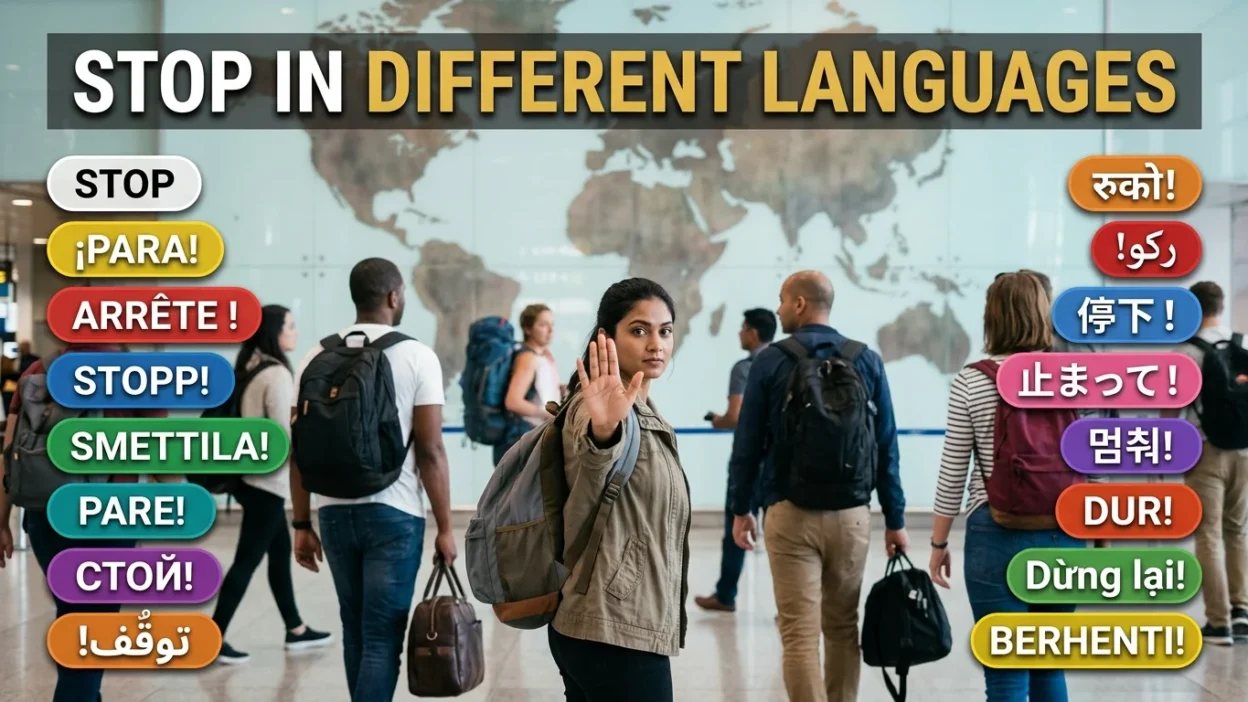
The word stop is expressed in many different ways around the world. In Spanish, you can say “¡Para!”, while French commonly uses “Arrête !”. German and Dutch have the familiar “Stopp!”, whereas Italian uses “Smettila!” when telling someone to stop an action.
In many Asian languages, the expression changes considerably. Mandarin Chinese uses “停下!”, Japanese uses “止まって!”, Korean uses “멈춰!”, and Vietnamese uses “Dừng lại!”.
This variety makes learning stop in different languages especially interesting because the same basic idea can be expressed through completely different words and sounds.
Stop in All Languages: Common Examples
If you search for stop in all languages, it is important to remember that a literal dictionary translation is not always the most natural expression.
For example, English “stop!” can mean:
- Stop moving.
- Stop talking.
- Stop doing something.
- Stop a vehicle.
- Stop an activity.
- Halt immediately.
Some languages use different words depending on which meaning is intended. Therefore, the examples in the table use natural imperative forms where possible.
Stop Translations Around the World
The word “stop” is particularly useful for travellers because it can be needed in urgent or everyday situations.
For example, someone might need to ask a driver to stop, tell a child to stop running, ask a friend to stop joking, or warn someone to stop moving.
Here are some familiar forms:
- Spanish: ¡Para!
- French: Arrête !
- German: Stopp!
- Italian: Smettila!
- Portuguese: Pare!
- Russian: Стой!
- Arabic: توقّف!
- Hindi: रुको!
- Urdu: رکو!
- Chinese: 停下!
- Japanese: 止まって!
- Korean: 멈춰!
- Turkish: Dur!
- Swahili: Acha!
These examples show how widely the concept of “stop” appears in everyday communication.
How to Say Stop Politely
The direct imperative form of “stop” can sometimes sound strong or commanding. In many situations, especially when speaking to strangers or people you do not know well, adding a polite expression is better.
For example, instead of simply saying “Stop!”, you might use the equivalent of:
- “Please stop.”
- “Please stop doing that.”
- “Could you stop, please?”
- “Please stop the car.”
- “Please stop here.”
The appropriate form depends on the language, relationship between speakers, and situation.
Stop vs. Halt: What Is the Difference?
“Stop” and “halt” have similar meanings, but they are not always interchangeable.
Stop is the everyday English word and works in many ordinary conversations. Halt sounds more formal and is often associated with commands, official situations, military language, or written instructions.
For example:
- “Stop the car.” — normal everyday English.
- “Halt!” — strong, formal command.
- “The train stopped.” — describes movement ending.
- “The project was halted.” — often sounds more formal.
When translating “stop” into another language, context is therefore important.
Why Learn Stop in Different Languages?
Learning basic commands such as “stop” can be useful for several reasons.
Travel
Travellers may need to communicate with taxi drivers, tour guides, hotel staff, or people in public places.
Language Learning
Simple imperative words are useful vocabulary for beginners because they appear frequently in everyday conversations.
Safety
Knowing how to tell someone to stop can be especially valuable in an unfamiliar environment.
Cultural Understanding
Different languages use different grammatical structures and levels of politeness. Learning these differences gives you a better understanding of how people communicate.
How to Remember Stop in Different Languages
A simple way to remember new translations is to group them by language family or region.
For example, several European languages have forms that may look or sound familiar to English speakers, while Asian and African languages often have completely different forms.
You can also practise each word inside a short sentence rather than memorising isolated vocabulary. This helps you understand when and how the expression is actually used.
FAQs
1. How do you say “stop” in Spanish?
“Stop” in Spanish can be said as “¡Para!” when directly telling someone to stop. Other forms can be used depending on the situation and region.
2. What is “stop” in French?
“Stop” in French is commonly “Arrête !” when telling someone to stop an action. The exact form can change according to grammar and context.
3. How do you say “stop” in Japanese?
A common way to tell someone to stop in Japanese is “止まって!”. The appropriate expression can vary depending on whether you mean stopping movement or stopping an action.
4. What is the word for “stop” in Arabic?
A commonly used Arabic expression is “توقّف!”. Arabic has different grammatical forms depending on the person being addressed.
5. How can I learn “stop” in different languages?
Start with a few common languages, practise the native spelling and pronunciation, and then use each word in a short sentence. The language table above provides an easy starting point for learning and comparison.
Conclusion
Learning how to say stop in different languages is a useful way to build practical vocabulary and understand how commands work across cultures. From “¡Para!” in Spanish and “Arrête !” in French to “停下!” in Mandarin and “멈춰!” in Korean, the same basic idea has many different linguistic forms.
Whether you are travelling, learning a new language, studying translations, or simply exploring languages around the world, these 70 translations give you a useful collection of everyday expressions.