Apparel is a word used to describe clothing, garments, and items people wear for everyday activities, work, celebrations, and special occasions. Although clothing is a universal part of life, different languages use their own words to describe it.
Learning how to say apparel in different languages can help you communicate while travelling, understand international fashion terminology, and explore how people around the world talk about clothing. It can also be useful for students, writers, translators, and fashion businesses working with international audiences.
In this guide, you will discover apparel translations in 70 languages, along with easy English pronunciations and practical example sentences. The table includes native words and their English meanings to make learning simple.
How Do You Say Apparel in Different Languages?
The English word apparel generally refers to clothing or garments. Many languages use a word equivalent to clothing, clothes, or garments rather than a direct translation of the formal English term.
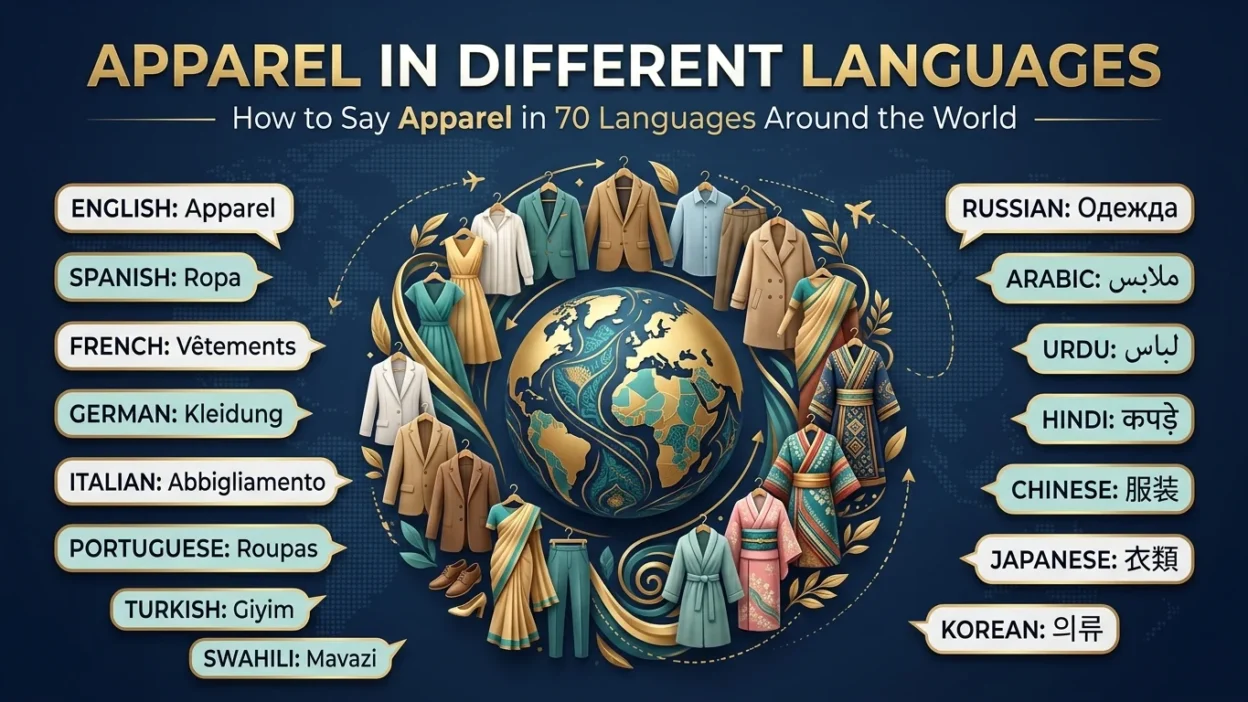
For example, apparel is ropa in Spanish, vêtements in French, Kleidung in German, and ملابس in Arabic. The best translation depends on the language and context.
Apparel in Different Languages
| Language | Native Phrase | Easy English Pronunciation | Example Sentence | English Meaning |
| English | Apparel | uh-PAIR-uhl | The store sells apparel. | The store sells clothing. |
| Spanish | Ropa | ROH-pah | Compro ropa nueva. | I buy new clothes. |
| French | Vêtements | vet-MAHN | Ces vêtements sont beaux. | These clothes are beautiful. |
| German | Kleidung | KLY-dung | Ich kaufe Kleidung. | I am buying clothes. |
| Italian | Abbigliamento | ab-beel-yah-MEN-toh | L’abbigliamento è elegante. | The clothing is elegant. |
| Portuguese | Roupas | HOH-pahs | Preciso de roupas novas. | I need new clothes. |
| Dutch | Kleding | KLAY-ding | Deze kleding is mooi. | These clothes are beautiful. |
| Swedish | Kläder | KLAY-der | Jag köper kläder. | I am buying clothes. |
| Norwegian | Klær | KLAIR | Jeg trenger nye klær. | I need new clothes. |
| Danish | Tøj | TOY | Jeg køber nyt tøj. | I am buying new clothes. |
| Finnish | Vaatteet | VAHT-teet | Tarvitsen uudet vaatteet. | I need new clothes. |
| Icelandic | Fatnaður | FAT-na-thur | Fatnaðurinn er fallegur. | The clothing is beautiful. |
| Irish | Éadaí | AY-dee | Tá éadaí nua agam. | I have new clothes. |
| Welsh | Dillad | DIL-ad | Mae’r dillad yn newydd. | The clothes are new. |
| Polish | Odzież | OH-jesh | Ta odzież jest wygodna. | These clothes are comfortable. |
| Czech | Oblečení | ob-leh-CHEH-nee | Kupuji nové oblečení. | I am buying new clothes. |
| Slovak | Oblečenie | ob-leh-CHEH-nyeh | Potrebujem nové oblečenie. | I need new clothes. |
| Slovenian | Oblačila | ob-lah-CHEE-lah | Kupujem nova oblačila. | I am buying new clothes. |
| Croatian | Odjeća | OD-yeh-cha | Odjeća je moderna. | The clothing is modern. |
| Serbian | Одећа | OH-deh-cha | Купујем нову одећу. | I am buying new clothes. |
| Bulgarian | Облекло | ob-LEK-loh | Облеклото е удобно. | The clothing is comfortable. |
| Macedonian | Облека | ob-LEH-kah | Купувам нова облека. | I am buying new clothes. |
| Russian | Одежда | ah-DYEZH-dah | Я покупаю одежду. | I am buying clothes. |
| Ukrainian | Одяг | oh-DYAH | Я купую новий одяг. | I am buying new clothes. |
| Belarusian | Адзенне | ad-ZYEN-nye | Я купляю новае адзенне. | I am buying new clothes. |
| Greek | Ρούχα | ROO-kha | Αγοράζω καινούρια ρούχα. | I am buying new clothes. |
| Albanian | Veshje | VESH-yeh | Blej veshje të reja. | I am buying new clothes. |
| Romanian | Îmbrăcăminte | um-bruh-kuh-MEEN-teh | Caut îmbrăcăminte nouă. | I am looking for new clothing. |
| Hungarian | Ruházat | ROO-hah-zaht | A ruházat kényelmes. | The clothing is comfortable. |
| Estonian | Rõivad | RUH-ee-vad | Need rõivad on uued. | These clothes are new. |
| Latvian | Apģērbs | ap-GYAIRBS | Man vajag jaunu apģērbu. | I need new clothing. |
| Lithuanian | Drabužiai | dra-boo-ZHAY | Perku naujus drabužius. | I am buying new clothes. |
| Turkish | Giyim | gee-YEEM | Giyim tarzı modern. | The clothing style is modern. |
| Azerbaijani | Geyim | geh-YEEM | Yeni geyim alıram. | I am buying new clothes. |
| Kazakh | Киім | kee-YEEM | Мен жаңа киім сатып аламын. | I am buying new clothes. |
| Uzbek | Kiyim | kee-YEEM | Men yangi kiyim sotib olaman. | I am buying new clothes. |
| Kyrgyz | Кийим | kee-YEEM | Мен жаңы кийим сатып алам. | I am buying new clothes. |
| Persian | پوشاک | poo-SHAHK | پوشاک جدید خریدم. | I bought new clothing. |
| Arabic | ملابس | ma-LAA-bis | أشتري ملابس جديدة. | I am buying new clothes. |
| Hebrew | בגדים | beh-gah-DEEM | אני קונה בגדים חדשים. | I am buying new clothes. |
| Urdu | لباس | li-BAAS | مجھے نیا لباس چاہیے۔ | I need new clothing. |
| Hindi | कपड़े | KAP-ray | मुझे नए कपड़े चाहिए। | I need new clothes. |
| Bengali | পোশাক | poh-SHAK | আমি নতুন পোশাক কিনি। | I buy new clothes. |
| Punjabi | ਕੱਪੜੇ | KAP-ray | ਮੈਨੂੰ ਨਵੇਂ ਕੱਪੜੇ ਚਾਹੀਦੇ ਹਨ। | I need new clothes. |
| Gujarati | કપડાં | KUP-daan | મારે નવા કપડાં જોઈએ છે. | I need new clothes. |
| Marathi | कपडे | kuh-PUH-day | मला नवीन कपडे हवे आहेत. | I need new clothes. |
| Nepali | लुगा | LOO-gah | मलाई नयाँ लुगा चाहिन्छ। | I need new clothes. |
| Sinhala | ඇඳුම් | AN-dum | මට අලුත් ඇඳුම් අවශ්යයි. | I need new clothes. |
| Tamil | ஆடைகள் | AA-dai-gal | எனக்குப் புதிய ஆடைகள் வேண்டும். | I need new clothes. |
| Telugu | దుస్తులు | DOOS-too-loo | నాకు కొత్త దుస్తులు కావాలి. | I need new clothes. |
| Kannada | ಬಟ್ಟೆಗಳು | BUT-tay-guh-loo | ನನಗೆ ಹೊಸ ಬಟ್ಟೆಗಳು ಬೇಕು. | I need new clothes. |
| Malayalam | വസ്ത്രങ്ങൾ | VAS-thra-ngal | എനിക്ക് പുതിയ വസ്ത്രങ്ങൾ വേണം. | I need new clothes. |
| Thai | เสื้อผ้า | seu-a-phaa | ฉันซื้อเสื้อผ้าใหม่ | I am buying new clothes. |
| Lao | ເຄື່ອງນຸ່ງ | khueang-noong | ຂ້ອຍຊື້ເຄື່ອງນຸ່ງໃໝ່ | I am buying new clothes. |
| Khmer | សម្លៀកបំពាក់ | som-lee-ak-bom-peak | ខ្ញុំទិញសម្លៀកបំពាក់ថ្មី។ | I am buying new clothes. |
| Vietnamese | Quần áo | kwun-ow | Tôi mua quần áo mới. | I am buying new clothes. |
| Indonesian | Pakaian | pah-KAI-an | Saya membeli pakaian baru. | I am buying new clothes. |
| Malay | Pakaian | pah-KAI-an | Saya membeli pakaian baharu. | I am buying new clothes. |
| Filipino (Tagalog) | Damit | DAH-mit | Bumili ako ng bagong damit. | I bought new clothes. |
| Chinese (Mandarin) | 服装 | foo-JWANG | 我买了新服装。 | I bought new clothing. |
| Japanese | 衣類 | ee-ROO-ee | 新しい衣類を買います。 | I am buying new clothes. |
| Korean | 의류 | ee-ryoo | 새 의류를 구매해요. | I am buying new clothing. |
| Mongolian | Хувцас | khoov-tsas | Би шинэ хувцас авна. | I will buy new clothes. |
| Swahili | Mavazi | mah-VAH-zee | Ninahitaji mavazi mapya. | I need new clothes. |
| Amharic | ልብስ | libs | አዲስ ልብስ እፈልጋለሁ። | I want new clothes. |
| Somali | Dhar | DHAR | Waxaan iibsanayaa dhar cusub. | I am buying new clothes. |
| Yoruba | Aṣọ | ah-SHAW | Mo ra aṣọ tuntun. | I bought new clothes. |
| Zulu | Izingubo | ee-zeen-GOO-boh | Ngithenga izingubo ezintsha. | I am buying new clothes. |
| Afrikaans | Klere | KLEE-ruh | Ek koop nuwe klere. | I am buying new clothes. |
Note: Pronunciation guides are approximate and designed for English speakers. Some languages distinguish between general clothing, garments, and formal apparel, so the most natural expression may depend on context.
What Does Apparel Mean?
Apparel is a noun that refers to clothing or garments worn on the body. It can describe everyday outfits, professional clothing, sportswear, formal wear, and fashion products.
The word is commonly used in retail, fashion, manufacturing, and business. For example, a company might sell outdoor apparel, children’s apparel, or women’s apparel.
Although apparel and clothes have similar meanings, apparel often sounds more formal or business-oriented.
Why Do Apparel Translations Differ Between Languages?
Languages develop their own expressions based on culture, history, and everyday communication. Some languages have one common word for clothing, while others use different words for garments, outfits, or specific types of apparel.
Here are three useful distinctions:
- General clothing: Words such as Spanish ropa and Indonesian pakaian commonly refer to clothes in general.
- Garments and apparel: Words such as French vêtements and Mandarin 服装 can be used when discussing clothing as a category.
- Formal or specialised clothing: Certain expressions are more appropriate for business attire, traditional dress, uniforms, or ceremonial garments.
Understanding these differences helps you choose a translation that sounds natural rather than relying on a literal word-for-word equivalent.
Common Types of Apparel Around the World
Apparel includes many different categories of clothing. Learning these terms can make it easier to discuss fashion and shopping in another language.
- Casual apparel: Everyday clothing such as T-shirts, jeans, jumpers, and shorts.
- Formal apparel: Suits, evening dresses, gowns, and other clothing worn at formal events.
- Sportswear: Clothing designed for exercise, training, and athletic activities.
- Traditional apparel: Clothing associated with a region, community, or cultural tradition.
- Workwear: Uniforms and garments worn for professional or practical purposes.
- Seasonal apparel: Clothing selected for hot weather, cold weather, rain, or changing seasons.
The exact names for these categories vary across languages, particularly when traditional clothing has a specific cultural meaning.
How to Use Apparel in Everyday Sentences
You can use the word apparel when discussing clothing in a general or professional context. Here are a few simple examples:
- Retail: The shop offers affordable apparel for the whole family.
- Fashion: The designer creates modern apparel for young adults.
- Business: The company specialises in sustainable apparel.
- Shopping: I am looking for winter apparel.
- Travel: Pack lightweight apparel for warm weather.
In casual conversation, clothes or clothing may sound more natural. In product descriptions, business names, and fashion industry writing, apparel is often a suitable choice.
Tips for Learning Apparel Translations
Learning 70 translations can feel challenging, but a few simple techniques can make the process easier.
- Start with familiar languages. Learn the translations you are most likely to encounter first.
- Practise with complete sentences. A word is easier to remember when you understand how it is used.
- Read the native script. Matching the original spelling with its meaning helps you recognise the word later.
- Use pronunciation guides as a starting point. Listen to native speakers when possible, because English-based pronunciation guides cannot represent every sound perfectly.
- Learn related vocabulary. Words for shirts, trousers, dresses, shoes, and jackets can help you build a wider fashion vocabulary.
Regular practice with short sentences can improve both your vocabulary and confidence.
Conclusion
Apparel is a useful word for discussing clothing, garments, and fashion in everyday life and professional settings. From ropa in Spanish to Kleidung in German and ملابس in Arabic, the translations show how different languages express the same general idea.
Use this list of 70 apparel translations to expand your vocabulary, prepare for travel, communicate about fashion, or learn how clothing is described around the world. Remember that the most natural translation depends on the language and the situation.
FAQs
1. How do you say apparel in different languages?
Apparel has different translations across languages. Examples include ropa in Spanish, vêtements in French, Kleidung in German, roupas in Portuguese, and ملابس in Arabic.
2. What is the meaning of apparel in English?
Apparel means clothing or garments worn on the body. It is often used in fashion, retail, and business contexts.
3. Is apparel the same as clothing?
Yes, the words have very similar meanings. However, apparel is often more formal and frequently appears in fashion industry terminology, product categories, and business writing.
4. What is the difference between apparel and garments?
Apparel generally refers to clothing as a broad category, while garments often refers to individual items of clothing, such as shirts, dresses, jackets, or trousers. Their meanings can overlap.
5. Why is learning apparel translations useful?
Learning apparel translations can help with travel, language learning, international shopping, fashion communication, translation work, and understanding clothing-related content in other languages.