The word “please” is one of the most useful words to learn when communicating with people from different cultures. It helps you make requests politely, show respect, and create a friendly impression in everyday conversations.
Although English speakers commonly use “please” to sound courteous, other languages express politeness in different ways. Some have a direct equivalent, while others use particular expressions depending on the situation, the relationship between speakers, or the level of formality.
In this guide, you’ll discover how to say please in different languages, with native translations, easy English pronunciations, practical example sentences, and their English meanings. Whether you are travelling, learning a new language, or communicating with international friends, these translations can help you speak more politely.
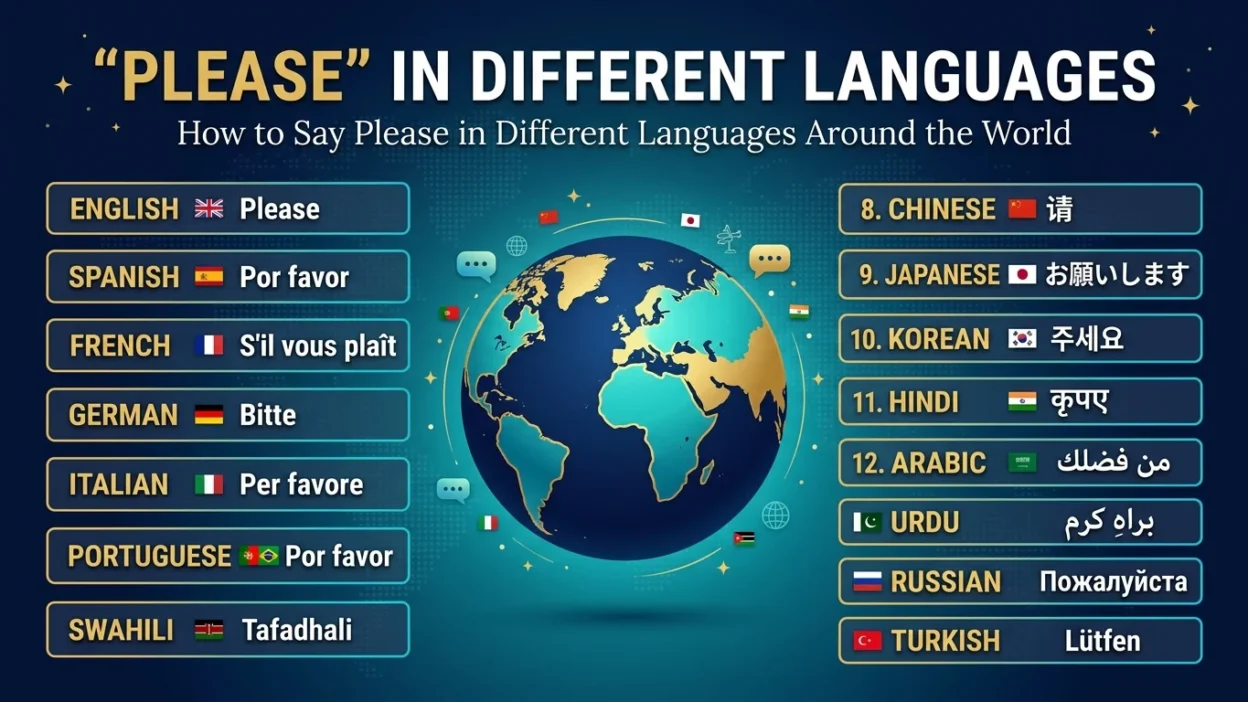
Please in Different Languages
| Language | Native Phrase | Easy English Pronunciation | Example Sentence | English Meaning |
| English | Please | Pleez | Please help me. | Please help me. |
| Spanish | Por favor | Por fah-VOR | Agua, por favor. | Water, please. |
| French | S’il vous plaît | Seel voo pleh | Un café, s’il vous plaît. | A coffee, please. |
| German | Bitte | BIT-tuh | Helfen Sie mir bitte. | Please help me. |
| Italian | Per favore | Pehr fah-VOH-reh | Un’acqua, per favore. | Water, please. |
| Portuguese | Por favor | Poor fah-VOR | Ajude-me, por favor. | Help me, please. |
| Dutch | Alstublieft | AHL-stoo-bleeft | Een koffie, alstublieft. | A coffee, please. |
| Swedish | Snälla | SNEL-lah | Snälla, hjälp mig. | Please help me. |
| Norwegian | Vær så snill | Vair soh sneel | Hjelp meg, vær så snill. | Help me, please. |
| Danish | Vær venlig | Vair VEN-lee | Vent, vær venlig. | Please wait. |
| Finnish | Ole hyvä | OH-leh HÜ-vah | Ole hyvä, auta minua. | Please help me. |
| Icelandic | Vinsamlegast | VIN-sam-leh-gast | Vinsamlegast bíddu. | Please wait. |
| Irish | Le do thoil | Leh duh hull | Cabhair, le do thoil. | Help, please. |
| Welsh | Os gwelwch yn dda | Oss GWEH-looch un thah | Helpwch fi, os gwelwch yn dda. | Please help me. |
| Polish | Proszę | PROH-sheh | Wodę, proszę. | Water, please. |
| Czech | Prosím | PROH-seem | Pomozte mi, prosím. | Please help me. |
| Slovak | Prosím | PROH-seem | Počkajte, prosím. | Please wait. |
| Slovenian | Prosim | PROH-seem | Pomagajte mi, prosim. | Please help me. |
| Croatian | Molim | MOH-leem | Vodu, molim. | Water, please. |
| Serbian | Молим (Molim) | MOH-leem | Помозите ми, молим. | Please help me. |
| Bulgarian | Моля (Molya) | MOH-lyah | Вода, моля. | Water, please. |
| Macedonian | Ве молам (Ve molam) | Veh MOH-lahm | Вода, ве молам. | Water, please. |
| Russian | Пожалуйста (Pozhaluysta) | Pah-ZHAH-loo-stah | Воду, пожалуйста. | Water, please. |
| Ukrainian | Будь ласка (Bud laska) | Bood LAHS-kah | Воду, будь ласка. | Water, please. |
| Greek | Παρακαλώ (Parakaló) | Pa-rah-kah-LOH | Νερό, παρακαλώ. | Water, please. |
| Romanian | Vă rog | Vuh rohg | Apă, vă rog. | Water, please. |
| Hungarian | Kérem | KAY-rem | Vizet kérek, kérem. | Water, please. |
| Albanian | Ju lutem | Yoo LOO-tem | Ujë, ju lutem. | Water, please. |
| Lithuanian | Prašau | PRAH-show | Vandens, prašau. | Water, please. |
| Latvian | Lūdzu | LOO-dzoo | Ūdeni, lūdzu. | Water, please. |
| Estonian | Palun | PAH-loon | Vett, palun. | Water, please. |
| Turkish | Lütfen | LOOT-fen | Su, lütfen. | Water, please. |
| Arabic | من فضلك (Min fadlak/fadlik) | Min FAD-lak / FAD-lik | الماء من فضلك. | Water, please. |
| Hebrew | בבקשה (Bevakasha) | Beh-vah-kah-SHAH | מים, בבקשה. | Water, please. |
| Persian | لطفاً (Lotfan) | LOT-fan | آب لطفاً. | Water, please. |
| Urdu | براہِ کرم (Barah-e-karam) | Bah-rah-eh ka-RAM | پانی، براہِ کرم۔ | Water, please. |
| Hindi | कृपया (Kripaya) | KRIH-pah-yah | कृपया मेरी मदद करें। | Please help me. |
| Bengali | অনুগ্রহ করে (Onugroho kore) | Oh-noo-GROH-hoh koh-reh | অনুগ্রহ করে সাহায্য করুন। | Please help me. |
| Punjabi | ਕਿਰਪਾ ਕਰਕੇ (Kirpa karke) | KEER-pah KAR-keh | ਕਿਰਪਾ ਕਰਕੇ ਮੇਰੀ ਮਦਦ ਕਰੋ। | Please help me. |
| Gujarati | કૃપા કરીને (Krupa karine) | KROO-pah KAH-ree-neh | કૃપા કરીને મદદ કરો. | Please help me. |
| Marathi | कृपया (Krupaya) | KRIH-pah-yah | कृपया मला मदत करा. | Please help me. |
| Tamil | தயவுசெய்து (Dayavu seithu) | THAH-yah-voo SAY-thoo | தயவுசெய்து உதவுங்கள். | Please help me. |
| Telugu | దయచేసి (Dayachesi) | DAH-yah CHAY-see | దయచేసి నాకు సహాయం చేయండి. | Please help me. |
| Kannada | ದಯವಿಟ್ಟು (Dayavittu) | DAH-yah-vit-too | ದಯವಿಟ್ಟು ಸಹಾಯ ಮಾಡಿ. | Please help me. |
| Malayalam | ദയവായി (Dayavayi) | DAH-yah-vah-yee | ദയവായി സഹായിക്കൂ. | Please help me. |
| Sinhala | කරුණාකර (Karunakara) | Kah-roo-nah-kah-rah | කරුණාකර මට උදව් කරන්න. | Please help me. |
| Nepali | कृपया (Kripaya) | KRIH-pah-yah | कृपया मलाई मद्दत गर्नुहोस्। | Please help me. |
| Chinese (Mandarin) | 请 (Qǐng) | Ching | 请给我水。 | Please give me water. |
| Japanese | お願いします (Onegaishimasu) | Oh-neh-guy-shee-mahs | お水をお願いします。 | Water, please. |
| Korean | 주세요 (Juseyo) | Joo-seh-yoh | 물 주세요. | Water, please. |
| Vietnamese | Làm ơn | Lahm uhn | Làm ơn giúp tôi. | Please help me. |
| Thai | กรุณา (Karuna) | Kah-roo-nah | กรุณารอสักครู่ | Please wait a moment. |
| Indonesian | Tolong | TOH-long | Tolong bantu saya. | Please help me. |
| Malay | Sila | SEE-lah | Sila duduk. | Please sit down. |
| Filipino (Tagalog) | Pakiusap / Paki- | Pah-kee-oo-SAP / pah-kee | Pakiabot ng tubig. | Please pass the water. |
| Swahili | Tafadhali | Tah-fah-DHAH-lee | Tafadhali nisaidie. | Please help me. |
| Amharic | እባክዎ (Ibakwo) | Ih-bah-KWOH | እባክዎ እርዳኝ። | Please help me. |
| Somali | Fadlan | FAD-lan | Fadlan i caawi. | Please help me. |
| Hausa | Don Allah | Don ah-LAH | Don Allah, taimake ni. | Please help me. |
| Yoruba | Jọ̀wọ́ | Jaw-WAW | Jọ̀wọ́, ràn mí lọ́wọ́. | Please help me. |
| Zulu | Ngiyacela | Ngee-yah-KEH-lah | Ngiyacela, ngisize. | Please help me. |
| Xhosa | Ndicela | Ndee-KEH-lah | Ndicela undincede. | Please help me. |
| Afrikaans | Asseblief | AH-suh-bleef | Water, asseblief. | Water, please. |
| Māori | Tēnā koa | TEH-nah KOH-ah | Āwhina mai, tēnā koa. | Please help me. |
| Hawaiian | E ʻoluʻolu | Eh oh-loo-OH-loo | E ʻoluʻolu, kōkua mai. | Please help me. |
| Haitian Creole | Tanpri | TAHN-pree | Tanpri, ede m. | Please help me. |
| Esperanto | Bonvolu | Bon-VOH-loo | Bonvolu helpi min. | Please help me. |
| Latin | Quaeso | KWY-soh | Adiuva me, quaeso. | Please help me. |
Why Is “Please” Important in Different Languages?
“Please” is a small word with an important role in everyday communication. It can make a request sound considerate rather than demanding.
Using the appropriate expression can help you:
- Show respect when speaking to strangers or older people.
- Make requests politely in shops, restaurants, hotels, and public places.
- Communicate more comfortably while travelling abroad.
- Build positive relationships with colleagues, classmates, and friends.
- Understand cultural differences in manners and etiquette.
Although the meaning is similar across languages, the most natural expression depends on the situation. A phrase used with a friend may sound too informal in a business meeting, while a highly formal expression may sound unnatural in casual conversation.
How to Say Please in Different Languages in Everyday Situations
Learning a translation is a good start, but knowing when to use it is equally important.
At a restaurant or café
When ordering food or drinks, a polite phrase can make your request sound friendly.
- Spanish: Un café, por favor. — A coffee, please.
- French: Un café, s’il vous plaît. — A coffee, please.
- Italian: Un caffè, per favore. — A coffee, please.
- Japanese: お水をお願いします。 — Water, please.
When asking someone for help
Use a polite request when you need directions, assistance, or information.
- German: Helfen Sie mir bitte. — Please help me.
- Hindi: कृपया मेरी मदद करें। — Please help me.
- Urdu: براہِ کرم میری مدد کریں۔ — Please help me.
- Swahili: Tafadhali nisaidie. — Please help me.
When asking someone to wait
A courteous expression can make it easier to ask someone to pause or give you a moment.
- Spanish: Espere, por favor. — Please wait.
- Russian: Подождите, пожалуйста. — Please wait.
- Thai: กรุณารอสักครู่ — Please wait a moment.
These examples show how “please” can be used in practical conversations rather than simply memorised as a vocabulary word.
Formal and Informal Ways to Say Please
Some languages have one common expression for many situations, while others distinguish between formal and informal speech.
In French, s’il vous plaît is commonly used for formal requests or when addressing more than one person. S’il te plaît is generally used when speaking informally to one person.
In Spanish, por favor is widely used in both formal and informal conversations. The form of the verb and the way you address someone can make the whole request more or less formal.
In Japanese, お願いします (onegaishimasu) is a common polite expression, while ください (kudasai) is often used when asking for something. The best choice depends on the sentence and situation.
In Arabic, expressions such as min fadlak and min fadlik vary according to the gender of the person being addressed in many varieties of Arabic.
The key lesson is to learn a phrase together with its context. This will help you sound more natural and respectful.
Common Mistakes When Learning Please Translations
Even a simple word can be confusing when translated across languages. Keep these points in mind:
1. Assuming every language uses “please” in the same way. Some languages rely on verb forms, respectful wording, or sentence structure to communicate politeness.
2. Using an expression without considering formality. A phrase suitable for a close friend might not be the best option when speaking to a stranger or a professional contact.
3. Relying entirely on English pronunciation guides. These guides are approximations. They cannot always represent unfamiliar sounds, tones, or regional accents accurately.
4. Forgetting the surrounding sentence. A request often sounds more natural when the whole sentence is translated rather than adding a standalone word mechanically.
5. Ignoring regional differences. People may use different expressions in different countries or communities, even when they speak the same language.
For better results, practise the native phrase alongside a short example sentence and listen to native speakers whenever possible.
Please in Different Languages Around the World
The translations for “please” reflect the diversity of languages and cultures worldwide. European languages such as Spanish, French, German, and Italian have their own established polite expressions. South Asian languages, including Urdu, Hindi, Bengali, and Punjabi, use expressions that can communicate respect and courtesy. East Asian languages often express politeness through conventional phrases and sentence structures.
In African languages such as Swahili, Yoruba, and Zulu, commonly used polite expressions also play an important part in everyday requests. In Pacific languages, including Māori and Hawaiian, traditional expressions of courtesy are part of natural communication.
These differences demonstrate that politeness is universal, but the words and conventions used to express it are not always identical.
Tips for Remembering “Please” in Different Languages
You do not need to memorise all 70 translations at once. A simple learning plan can help you retain the expressions more effectively.
- Learn five phrases at a time. Start with the languages you are most likely to use.
- Practise complete sentences. Remembering “Water, please” can be easier than memorising a translation in isolation.
- Say each phrase aloud. Repeating the expression helps you become more familiar with its pronunciation.
- Group similar languages together. Compare related expressions to identify patterns and differences.
- Review regularly. Revisit the phrases after one day, three days, and one week.
- Learn the appropriate level of politeness. Understand whether an expression is formal, informal, or suitable for general use.
Small, regular practice sessions can help you remember useful phrases and use them with greater confidence.
Conclusion
Learning how to say “please” in different languages is a simple way to improve your communication and show respect for other cultures. From por favor in Spanish to s’il vous plaît in French, bitte in German, and kripaya in Hindi, each language offers its own way to make a polite request.
Use this list of 70 translations as a starting point. Practise the native phrases, learn their pronunciation, and pay attention to how speakers use them in real conversations. Even one polite word can help make an interaction warmer and more positive.
FAQs
1. How do you say “please” in different languages?
“Please” has different translations around the world. Common examples include por favor in Spanish, s’il vous plaît in French, bitte in German, per favore in Italian, por favor in Portuguese, and कृपया (kripaya) in Hindi.
2. What is the most common word for please in other languages?
There is no single expression that is most common across all languages. Some widely recognised examples are por favor, bitte, please, s’il vous plaît, lütfen, and お願いします (onegaishimasu). The best expression depends on the language and situation.
3. How do you say please in Spanish?
In Spanish, “please” is por favor. For example, Agua, por favor means “Water, please.” It is commonly used in shops, restaurants, and everyday conversations.
4. Why do some languages have more than one translation for please?
Languages use different expressions according to formality, context, and the relationship between speakers. Some distinguish between formal and informal requests, while others use different phrases when asking for an object, requesting assistance, or showing respect.
5. What is the easiest way to learn please in languages?
Start with five languages, practise each phrase with a simple sentence, and review the expressions regularly. Use pronunciation guides as a starting point, and listen to native speakers to improve accuracy.