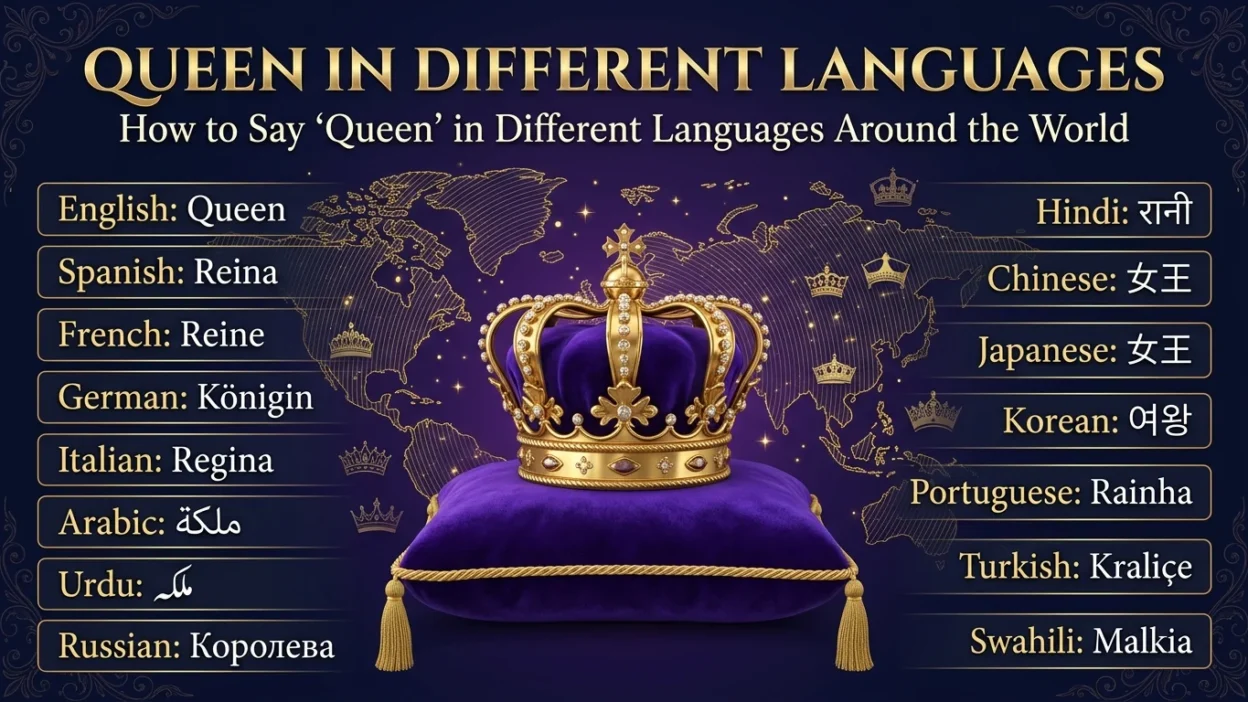
The word “queen” represents royalty, leadership, power, dignity, and elegance. Across the world, different languages have their own words for a queen, whether they refer to a female monarch, a royal consort, or a powerful woman in a story.
If you want to learn how to say queen in different languages, this guide provides translations in 70 languages, easy English pronunciations, and simple example sentences. It is useful for language learners, travellers, writers, students, and anyone interested in words from different cultures.
From Spanish reina to French reine and Arabic ملكة, these translations show how the meaning of queen is expressed around the world.
Queen in Different Languages
| Language | Queen in Native Language | Easy English Pronunciation | Example Sentence | English Meaning |
| 1. Spanish | Reina | RAY-nah | La reina vive en el palacio. | The queen lives in the palace. |
| 2. French | Reine | REN | La reine porte une couronne. | The queen wears a crown. |
| 3. German | Königin | KUR-nig-in | Die Königin lächelt freundlich. | The queen smiles kindly. |
| 4. Italian | Regina | reh-JEE-nah | La regina visita la città. | The queen visits the city. |
| 5. Portuguese | Rainha | rah-EEN-yah | A rainha chegou ao palácio. | The queen arrived at the palace. |
| 6. Dutch | Koningin | KOH-ning-in | De koningin spreekt tot het volk. | The queen speaks to the people. |
| 7. Russian | Королева | kah-rah-LYE-vah | Королева живёт во дворце. | The queen lives in the palace. |
| 8. Ukrainian | Королева | kah-rah-LYE-vah | Королева приветствует гостей. | The queen welcomes the guests. |
| 9. Polish | Królowa | kroo-LOH-vah | Królowa nosi koronę. | The queen wears a crown. |
| 10. Czech | Královna | KRAH-lov-nah | Královna navštívila město. | The queen visited the city. |
| 11. Slovak | Kráľovná | KRAH-lyov-nah | Kráľovná sedí na tróne. | The queen sits on the throne. |
| 12. Slovenian | Kraljica | krah-YEE-tsah | Kraljica pozdravlja ljudi. | The queen greets the people. |
| 13. Croatian | Kraljica | KRAHL-yee-tsah | Kraljica živi u dvorcu. | The queen lives in the castle. |
| 14. Serbian | Краљица | KRAH-lyee-tsah | Краљица носи круну. | The queen wears a crown. |
| 15. Bulgarian | Кралица | KRAH-lee-tsah | Кралицата поздравява народа. | The queen greets the people. |
| 16. Macedonian | Кралица | KRAH-lee-tsah | Кралицата живее во дворецот. | The queen lives in the palace. |
| 17. Romanian | Regină | reh-JEE-nuh | Regina vorbește cu oamenii. | The queen speaks with the people. |
| 18. Greek | Βασίλισσα | vah-SEE-lee-sah | Η βασίλισσα φοράει στέμμα. | The queen wears a crown. |
| 19. Swedish | Drottning | DROT-ning | Drottningen bor i ett slott. | The queen lives in a castle. |
| 20. Norwegian | Dronning | DRON-ning | Dronningen hilser på folket. | The queen greets the people. |
| 21. Danish | Dronning | DRON-ning | Dronningen besøger byen. | The queen visits the city. |
| 22. Icelandic | Drottning | DROHT-ning | Drottningin er í höllinni. | The queen is in the palace. |
| 23. Finnish | Kuningatar | KOO-ning-ah-tar | Kuningatar asuu linnassa. | The queen lives in the castle. |
| 24. Estonian | Kuninganna | KOO-ning-an-nah | Kuninganna tervitab külalisi. | The queen welcomes the guests. |
| 25. Latvian | Karaliene | kah-rah-lee-EH-neh | Karaliene apmeklē pilsētu. | The queen visits the city. |
| 26. Lithuanian | Karalienė | kah-rah-lee-EH-neh | Karalienė dėvi karūną. | The queen wears a crown. |
| 27. Hungarian | Királynő | kee-RAHY-nuh | A királynő a palotában él. | The queen lives in the palace. |
| 28. Albanian | Mbretëreshë | mbreh-tuh-REH-shuh | Mbretëresha përshëndet popullin. | The queen greets the people. |
| 29. Turkish | Kraliçe | kah-rah-lee-CHEH | Kraliçe sarayda yaşıyor. | The queen lives in the palace. |
| 30. Azerbaijani | Kraliça | kah-rah-lee-CHAH | Kraliça xalqı salamlayır. | The queen greets the people. |
| 31. Persian (Farsi) | ملکه | ma-leh-KEH | ملکه در قصر زندگی میکند. | The queen lives in the palace. |
| 32. Arabic | ملكة | MA-li-kah | الملكة تعيش في القصر. | The queen lives in the palace. |
| 33. Hebrew | מלכה | mal-KAH | המלכה גרה בארמון. | The queen lives in the palace. |
| 34. Urdu | ملکہ | MAL-kah | ملکہ محل میں رہتی ہے۔ | The queen lives in the palace. |
| 35. Hindi | रानी | RAA-nee | रानी महल में रहती है। | The queen lives in the palace. |
| 36. Bengali | রানি | RAH-nee | রানি প্রাসাদে থাকেন। | The queen lives in the palace. |
| 37. Punjabi | ਰਾਣੀ | RAA-nee | ਰਾਣੀ ਮਹਿਲ ਵਿੱਚ ਰਹਿੰਦੀ ਹੈ। | The queen lives in the palace. |
| 38. Gujarati | રાણી | RAA-nee | રાણી મહેલમાં રહે છે. | The queen lives in the palace. |
| 39. Marathi | राणी | RAA-nee | राणी राजवाड्यात राहते. | The queen lives in the palace. |
| 40. Nepali | रानी | RAA-nee | रानी दरबारमा बस्छिन्। | The queen lives in the palace. |
| 41. Sinhala | රැජින | reh-JEE-nah | රැජින මාලිගාවේ සිටී. | The queen is in the palace. |
| 42. Tamil | ராணி | RAA-nee | ராணி அரண்மனையில் வாழ்கிறார். | The queen lives in the palace. |
| 43. Telugu | రాణి | RAA-nee | రాణి రాజభవనంలో నివసిస్తుంది. | The queen lives in the palace. |
| 44. Kannada | ರಾಣಿ | RAA-nee | ರಾಣಿ ಅರಮನೆಯಲ್ಲಿ ವಾಸಿಸುತ್ತಾಳೆ. | The queen lives in the palace. |
| 45. Malayalam | രാജ്ഞി | RAA-jnee | രാജ്ഞി കൊട്ടാരത്തിൽ താമസിക്കുന്നു. | The queen lives in the palace. |
| 46. Thai | ราชินี | raa-chin-nee | ราชินีอยู่ในพระราชวัง | The queen is in the palace. |
| 47. Lao | ພະລາຊິນີ | pha-laa-see-nee | ພະລາຊິນີຢູ່ໃນພະລາຊະວັງ | The queen is in the palace. |
| 48. Khmer | មហាក្សត្រី | mo-haak-sat-trey | មហាក្សត្រីរស់នៅក្នុងព្រះរាជវាំង។ | The queen lives in the royal palace. |
| 49. Vietnamese | Nữ hoàng | noo hwahng | Nữ hoàng sống trong cung điện. | The queen lives in the palace. |
| 50. Indonesian | Ratu | RAH-too | Ratu tinggal di istana. | The queen lives in the palace. |
| 51. Malay | Ratu | RAH-too | Ratu tinggal di istana. | The queen lives in the palace. |
| 52. Filipino (Tagalog) | Reyna | RAY-nah | Ang reyna ay nasa palasyo. | The queen is in the palace. |
| 53. Chinese (Mandarin) | 女王 | nyoo-wahng | 女王住在王宫里。 | The queen lives in the royal palace. |
| 54. Japanese | 女王 | jo-oh | 女王は宮殿に住んでいます。 | The queen lives in the palace. |
| 55. Korean | 여왕 | yuh-wang | 여왕은 궁전에 살아요. | The queen lives in the palace. |
| 56. Mongolian | Хатан хаан | kha-tan khaan | Хатан хаан ордонд амьдардаг. | The queen lives in the palace. |
| 57. Kazakh | Патшайым | pat-sha-YEEM | Патшайым сарайда тұрады. | The queen lives in the palace. |
| 58. Uzbek | Qirolicha | kee-roh-lee-CHAH | Qirolicha saroyda yashaydi. | The queen lives in the palace. |
| 59. Swahili | Malkia | mal-KEE-ah | Malkia anaishi ikulu. | The queen lives in the palace. |
| 60. Zulu | Indlovukazi | een-dloh-voo-KAH-zee | Indlovukazi ihlala esigodlweni. | The queen lives in the palace. |
| 61. Xhosa | Ukumkanikazi | oo-koo-mkah-nee-KAH-zee | Ukumkanikazi uhlala ebhotwe. | The queen lives in the palace. |
| 62. Afrikaans | Koningin | KOH-ning-in | Die koningin woon in die paleis. | The queen lives in the palace. |
| 63. Yoruba | Ayaba | ah-YAH-bah | Ayaba ngbe ninu aafin. | The queen lives in the palace. |
| 64. Igbo | Eze nwanyị | EH-zeh wah-NYEE | Eze nwanyị bi n’obí eze. | The queen lives in the royal palace. |
| 65. Amharic | ንግሥት | ning-ist | ንግሥቷ በቤተ መንግሥት ትኖራለች። | The queen lives in the palace. |
| 66. Somali | Boqorad | boh-koh-RAHD | Boqoraddu waxay ku nooshahay qasriga. | The queen lives in the palace. |
| 67. Irish | Banríon | bahn-REE-un | Tá an bhanríon sa phálás. | The queen is in the palace. |
| 68. Welsh | Brenhines | bren-HIN-es | Mae’r frenhines yn byw yn y palas. | The queen lives in the palace. |
| 69. Basque | Erregina | eh-rreh-GHEE-nah | Erregina jauregian bizi da. | The queen lives in the palace. |
| 70. Esperanto | Reĝino | reh-JHEE-noh | La reĝino loĝas en la palaco. | The queen lives in the palace. |
Note: Translations can vary according to context. Some languages distinguish between a reigning queen, a queen consort, a queen mother, and a queen in a chess game or playing card. The words listed here generally refer to a female royal ruler or queen, depending on the language.
What Does “Queen” Mean?
A queen is traditionally a woman who rules a kingdom or holds a recognised position within a royal family. The word can refer to a female monarch who governs in her own right or to the wife of a king.
In everyday English, queen can also describe a woman admired for her talent, confidence, influence, or achievements. For example, someone might call a successful singer the “queen of pop” or a talented athlete the “queen of the court.”
The exact meaning depends on the sentence and cultural context.
How to Say Queen in Different Languages
Learning how to say queen in different languages is a simple way to expand your vocabulary and discover how cultures express royalty.
Here are some familiar examples:
- Spanish: Reina
- French: Reine
- German: Königin
- Italian: Regina
- Arabic: ملكة
- Urdu: ملکہ
- Hindi: रानी
- Chinese: 女王
- Japanese: 女王
- Korean: 여왕
- Swahili: Malkia
- Turkish: Kraliçe
Some words look similar because languages share historical roots or have influenced one another. Others, such as the words used in Asian and African languages, may look and sound very different.
Queen Translations Around the World
Queen translations around the world reflect the history, traditions, and writing systems of individual languages.
European languages such as Spanish, Italian, and Romanian use words related to reina or regina. Other European languages, including German and Dutch, use different forms such as Königin and koningin.
In South Asian languages, words such as Hindi रानी, Urdu ملکہ, and Punjabi ਰਾਣੀ are common ways to express the idea of a queen. The exact word can depend on whether the context is historical, literary, or contemporary.
In East Asia, Chinese uses 女王, while Japanese also uses 女王. Korean uses 여왕. Although these terms may share related written characters or historical influences, their pronunciation differs.
African languages also offer distinctive translations. Swahili uses malkia, Yoruba uses ayaba, and Zulu uses indlovukazi. These examples demonstrate the variety of ways the idea of a queen is represented across the world.
Different Meanings of the Word Queen
The word “queen” does not always refer to the same role. Understanding the context helps you choose the most suitable translation.
1. A reigning queen
A reigning queen is a woman who rules a kingdom in her own right. She may inherit the throne or become monarch according to the country’s laws and traditions.
2. A queen consort
A queen consort is the wife of a reigning king. She holds a royal title through marriage, but she does not necessarily rule the country herself.
3. A queen mother
A queen mother is commonly the mother of a reigning monarch who holds a recognised royal title or position. The specific meaning varies among monarchies and cultural traditions.
4. Queen in chess
In chess, the queen is the most mobile piece on the board. A translation used for a royal woman may also be used for the chess piece, although some languages have specialised terms.
5. Queen as a figurative expression
In informal English, queen can be a compliment for someone admired for confidence, skill, or influence. Expressions such as “queen of music” or “queen of fashion” are figurative rather than official royal titles.
Why Do Queen Translations Differ by Language?
Languages develop through different histories, cultural traditions, and patterns of communication. As a result, there is no single word for queen that sounds the same in every language.
Some languages use words related to kingship, while others have distinct feminine forms for royal titles. Grammar also affects how the word appears in sentences.
Writing systems make another difference. The word may be written using the Latin alphabet, Arabic script, Devanagari, Cyrillic, Chinese characters, Hangul, or other scripts. Pronunciation can vary considerably even when two languages use similar-looking words.
These differences make learning queen in different languages a useful way to explore vocabulary, culture, and language history.
Tips for Learning Queen in Languages
You do not need to memorise all 70 translations at once. A few simple strategies can make learning easier.
- Start with familiar languages. Learn the words in languages you already recognise, such as Spanish, French, or Urdu.
- Practise native scripts. Look at how the word is written, not just how it sounds.
- Read each word aloud. Pronunciation guides are helpful starting points, but listening to native speakers can improve accuracy.
- Use short sentences. Practise with examples such as “The queen lives in the palace.”
- Group similar words together. Words such as reina, regina, and regina in related languages can be easier to remember when studied together.
- Pay attention to context. Check whether a translation refers to a monarch, a queen consort, or a figurative use of the word.
Conclusion
The word “queen” has many forms across the world’s languages, from Spanish reina and French reine to Arabic ملكة, Hindi रानी, and Chinese 女王. Each translation reflects the vocabulary and linguistic traditions of its language.
This list of 70 queen translations, pronunciation guides, and example sentences provides a useful starting point for language learners, students, writers, and curious readers. Practising the words in context will help you understand how to use them more naturally.
FAQs
1. How do you say queen in different languages?
The word queen is reina in Spanish, reine in French, Königin in German, regina in Italian, ملكة in Arabic, and रानी in Hindi. Other languages use their own words and pronunciations.
2. What is the word for queen in the most commonly spoken languages?
Some examples include reina in Spanish, reine in French, Königin in German, 女王 in Chinese, 女王 in Japanese, 여왕 in Korean, rani in Hindi, and malika in Swahili.
3. How do you write queen in Urdu and Hindi?
In Urdu, queen is written as ملکہ. In Hindi, a common word for queen is रानी. Both words can be used in appropriate royal or historical contexts.
4. Is the word queen the same in every language?
No. Every language has its own vocabulary, pronunciation, and grammatical rules. Some words have similar origins, while thers are completely different in appearance and sound.
5. Can the word queen have meanings other than royalty?
Yes. In English, queen can refer to a chess piece, a playing card, or a woman admired for her talent or influence. The correct translation depends on the intended meaning and context.