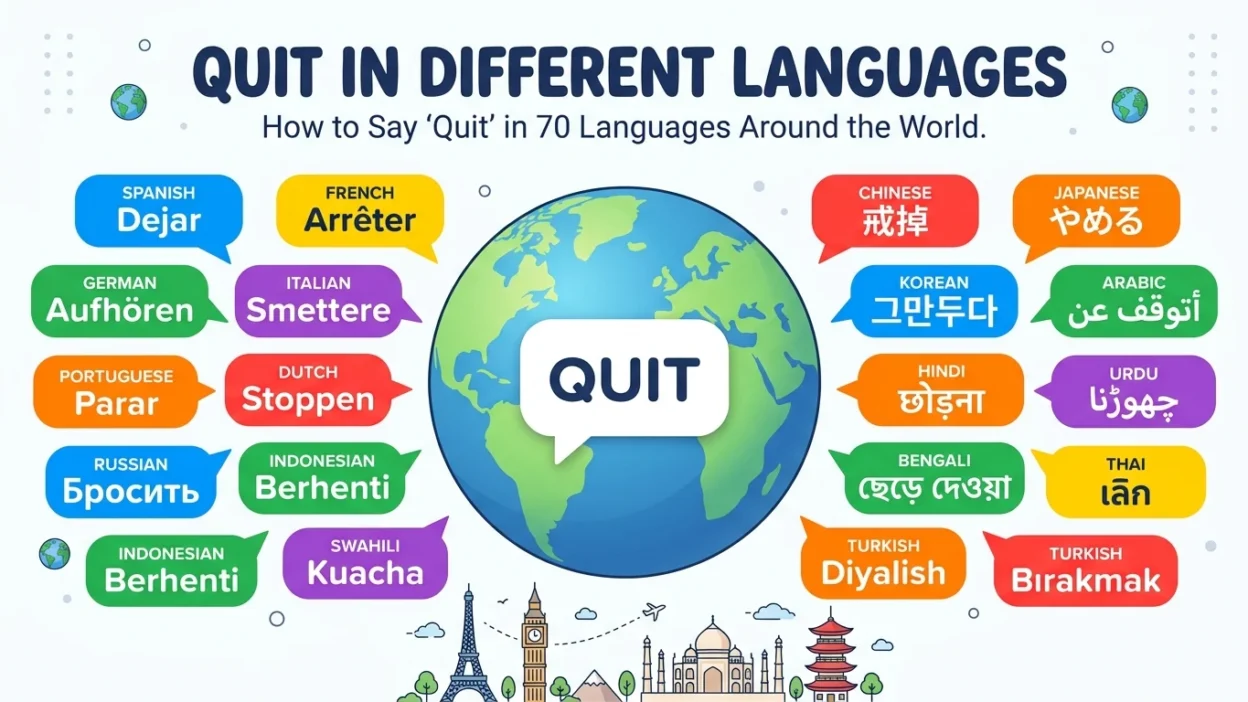
The word “quit” is used when someone wants to stop doing something, leave a job, give up an activity, or end a habit. Although the word is short, its translation can change depending on the situation and the language being spoken.
Learning how to say quit in different languages helps you communicate more naturally when travelling, learning a foreign language, or talking with people from different cultures. Some languages use one word for stopping an activity, while others use different expressions for leaving a job, giving up, or telling someone to stop.
In this guide, you will discover quit in different languages, including native translations, easy English pronunciations, practical example sentences, and their English meanings.
How to Say Quit in Different Languages
The translation of “quit” depends on its context. For example, quitting smoking means stopping a habit, while quitting a job means leaving your employment. Telling someone to quit may mean asking them to stop an action.
The table below uses common translations and expressions that communicate the idea of stopping, giving up, or quitting. Pronunciations are simplified guides for English speakers.
Quit in Different Languages
| Language | Native Translation | Easy English Pronunciation | Example Sentence | English Meaning |
| 1. Spanish | Dejar | deh-HAR | Quiero dejar de fumar. | I want to quit smoking. |
| 2. French | Arrêter | ah-reh-TAY | Je veux arrêter de fumer. | I want to quit smoking. |
| 3. German | Aufhören | OUF-huh-ren | Ich möchte mit dem Rauchen aufhören. | I want to quit smoking. |
| 4. Italian | Smettere | ZMEHT-teh-reh | Voglio smettere di fumare. | I want to quit smoking. |
| 5. Portuguese | Parar | pah-RAHR | Quero parar de fumar. | I want to quit smoking. |
| 6. Dutch | Stoppen | STOP-pen | Ik wil stoppen met roken. | I want to quit smoking. |
| 7. Swedish | Sluta | SLOO-tah | Jag vill sluta röka. | I want to quit smoking. |
| 8. Norwegian | Slutte | SLOOT-teh | Jeg vil slutte å røyke. | I want to quit smoking. |
| 9. Danish | Stoppe | STOH-peh | Jeg vil stoppe med at ryge. | I want to quit smoking. |
| 10. Finnish | Lopettaa | loh-peht-TAH | Haluan lopettaa tupakoinnin. | I want to quit smoking. |
| 11. Icelandic | Hætta | HAIHT-ah | Ég vil hætta að reykja. | I want to quit smoking. |
| 12. Irish | Éirí as | AY-ree uss | Ba mhaith liom éirí as an tobac. | I want to quit tobacco. |
| 13. Welsh | Rhoi’r gorau i | roy-r GOW-ry ee | Dw i eisiau rhoi’r gorau i ysmygu. | I want to quit smoking. |
| 14. Polish | Rzucić | ZHOO-cheech | Chcę rzucić palenie. | I want to quit smoking. |
| 15. Czech | Přestat | PSHES-taht | Chci přestat kouřit. | I want to quit smoking. |
| 16. Slovak | Prestať | PRES-taht | Chcem prestať fajčiť. | I want to quit smoking. |
| 17. Slovenian | Prenehati | preh-neh-HAH-tee | Želim prenehati kaditi. | I want to quit smoking. |
| 18. Croatian | Prestati | PRES-tah-tee | Želim prestati pušiti. | I want to quit smoking. |
| 19. Serbian | Престати | PRES-tah-tee | Желим да престанем да пушим. | I want to quit smoking. |
| 20. Bulgarian | Спра | sprah | Искам да спра да пуша. | I want to quit smoking. |
| 21. Russian | Бросить | BRAH-seet | Я хочу бросить курить. | I want to quit smoking. |
| 22. Ukrainian | Кинути | KIH-noo-tee | Я хочу кинути палити. | I want to quit smoking. |
| 23. Greek | Σταματώ | stah-mah-TOH | Θέλω να σταματήσω το κάπνισμα. | I want to quit smoking. |
| 24. Romanian | A renunța | ah reh-noon-TSAH | Vreau să renunț la fumat. | I want to quit smoking. |
| 25. Hungarian | Abbahagyni | AHB-bah-hahj-nee | Abba akarom hagyni a dohányzást. | I want to quit smoking. |
| 26. Albanian | Lë | luh | Dua të lë duhanin. | I want to quit smoking. |
| 27. Turkish | Bırakmak | buh-rahk-MAHK | Sigarayı bırakmak istiyorum. | I want to quit smoking. |
| 28. Arabic | أتوقف عن | ah-tah-waq-qaf an | أريد أن أتوقف عن التدخين. | I want to quit smoking. |
| 29. Hebrew | להפסיק | leh-haf-SEEK | אני רוצה להפסיק לעשן. | I want to quit smoking. |
| 30. Persian | ترک کردن | tark kar-DAN | میخواهم سیگار را ترک کنم. | I want to quit smoking. |
| 31. Urdu | چھوڑنا | chhor-NAH | میں سگریٹ نوشی چھوڑنا چاہتا ہوں۔ | I want to quit smoking. |
| 32. Hindi | छोड़ना | chhor-NAH | मैं धूम्रपान छोड़ना चाहता हूँ। | I want to quit smoking. |
| 33. Bengali | ছেড়ে দেওয়া | chhe-re de-o-ya | আমি ধূমপান ছেড়ে দিতে চাই। | I want to quit smoking. |
| 34. Punjabi | ਛੱਡਣਾ | chhaḍ-ṇā | ਮੈਂ ਸਿਗਰਟ ਪੀਣੀ ਛੱਡਣੀ ਚਾਹੁੰਦਾ ਹਾਂ। | I want to quit smoking. |
| 35. Gujarati | છોડી દેવું | chho-dee deh-voo | મારે ધૂમ્રપાન છોડી દેવું છે. | I want to quit smoking. |
| 36. Marathi | सोडणे | soh-DUH-neh | मला धूम्रपान सोडायचे आहे. | I want to quit smoking. |
| 37. Nepali | छोड्नु | chhod-noo | म धूम्रपान छोड्न चाहन्छु। | I want to quit smoking. |
| 38. Sinhala | නවත්වනවා | nah-wath-wah-nah-wah | මට දුම්පානය නවත්වන්න ඕනෑ. | I want to quit smoking. |
| 39. Tamil | நிறுத்து | nee-rooth-too | நான் புகைபிடிப்பதை நிறுத்த விரும்புகிறேன். | I want to quit smoking. |
| 40. Telugu | మానేయడం | mah-neh-yah-dam | నేను ధూమపానం మానేయాలనుకుంటున్నాను. | I want to quit smoking. |
| 41. Kannada | ಬಿಡುವುದು | bee-doo-voo | ನಾನು ಧೂಮಪಾನ ಬಿಡಲು ಬಯಸುತ್ತೇನೆ. | I want to quit smoking. |
| 42. Malayalam | നിർത്തുക | neer-thoo-kah | എനിക്ക് പുകവലി നിർത്തണം. | I want to quit smoking. |
| 43. Thai | เลิก | loerk | ฉันอยากเลิกสูบบุหรี่ | I want to quit smoking. |
| 44. Lao | ເຊົາ | sao | ຂ້ອຍຢາກເຊົາສູບຢາ. | I want to quit smoking. |
| 45. Khmer | ឈប់ | chhop | ខ្ញុំចង់ឈប់ជក់បារី។ | I want to quit smoking. |
| 46. Vietnamese | Bỏ | baw | Tôi muốn bỏ hút thuốc. | I want to quit smoking. |
| 47. Indonesian | Berhenti | ber-HEN-tee | Saya ingin berhenti merokok. | I want to quit smoking. |
| 48. Malay | Berhenti | ber-HEN-tee | Saya mahu berhenti merokok. | I want to quit smoking. |
| 49. Filipino | Tumigil | too-mee-GEEL | Gusto kong tumigil sa paninigarilyo. | I want to quit smoking. |
| 50. Mandarin Chinese | 戒掉 | jiè diào | 我想戒掉抽烟的习惯。 | I want to quit smoking. |
| 51. Japanese | やめる | yameru | タバコをやめたいです。 | I want to quit smoking. |
| 52. Korean | 그만두다 | geuman-duda | 담배를 끊고 싶어요. | I want to quit smoking. |
| 53. Mongolian | Болих | boh-likh | Би тамхи татахаа болимоор байна. | I want to quit smoking. |
| 54. Kazakh | Тоқтату | tohk-tah-too | Мен темекі шегуді тоқтатқым келеді. | I want to quit smoking. |
| 55. Uzbek | Tashlamoq | tash-lah-MOQ | Men chekishni tashlamoqchiman. | I want to quit smoking. |
| 56. Azerbaijani | Tərgitmək | ter-geet-MEK | Mən siqaret çəkməyi tərgitmək istəyirəm. | I want to quit smoking. |
| 57. Georgian | შეწყვეტა | shehts-kveh-TAH | მინდა მოწევას თავი დავანებო. | I want to quit smoking. |
| 58. Armenian | Թողնել | togh-NEL | Ես ուզում եմ թողնել ծխելը։ | I want to quit smoking. |
| 59. Amharic | ማቆም | mah-kohm | ማጨስን ማቆም እፈልጋለሁ። | I want to quit smoking. |
| 60. Swahili | Kuacha | koo-AH-chah | Ninataka kuacha kuvuta sigara. | I want to quit smoking. |
| 61. Zulu | Ukuyeka | oo-koo-YEH-kah | Ngifuna ukuyeka ukubhema. | I want to quit smoking. |
| 62. Xhosa | Ukuyeka | oo-koo-YEH-kah | Ndifuna ukuyeka ukutshaya. | I want to quit smoking. |
| 63. Afrikaans | Ophou | OP-how | Ek wil ophou rook. | I want to quit smoking. |
| 64. Yoruba | Dáwọ́ dúró | dah-WOH DOO-roh | Mo fẹ́ dáwọ́ sìgá mímu dúró. | I want to quit smoking. |
| 65. Igbo | Ịkwụsị | ee-kwoo-SHEE | Achọrọ m ịkwụsị ịṅụ sịga. | I want to quit smoking. |
| 66. Hausa | Daina | DAI-nah | Ina son daina shan taba. | I want to quit smoking. |
| 67. Malagasy | Mitsahatra | meet-sah-HAH-trah | Te hitsahatra amin’ny fifohana sigara aho. | I want to quit smoking. |
| 68. Haitian Creole | Sispann | sees-PAN | Mwen vle sispann fimen. | I want to quit smoking. |
| 69. Luxembourgish | Ophale | OP-hah-leh | Ech wëll mam Fëmmen ophalen. | I want to quit smoking. |
| 70. Esperanto | Ĉesi | CHEH-see | Mi volas ĉesi fumi. | I want to quit smoking. |
Translation note: These are common equivalents for quitting or stopping, often illustrated through the specific context of smoking. Some phrases change with the speaker’s gender, formality, dialect, or intended meaning. In languages with several possible translations, the most natural word may depend on whether someone is stopping an activity, leaving a job, or giving something up.
What Does “Quit” Mean?
The English word “quit” generally means to stop doing something, give up an activity, or leave a position or place. It can be used in everyday conversations, professional settings, and personal discussions.
For example:
- Quit a habit: She decided to quit smoking.
- Quit a job: He plans to quit his job next month.
- Quit an activity: Please quit making so much noise.
- Quit trying: He refused to quit when the work became difficult.
The right translation depends on which meaning you intend to communicate.
Different Ways to Use Quit in Everyday Conversation
There are several common ways to use “quit” in English. Understanding these differences makes it easier to choose the correct translation in another language.
1. Quit a Habit
This expression means to stop doing something regularly, such as smoking, drinking, or biting your nails.
Example: “I want to quit smoking.”
Many languages use a verb equivalent to “stop” or “give up” in this context.
2. Quit a Job
When someone quits a job, they voluntarily leave their employment.
Example: “She decided to quit her job.”
In many languages, this meaning requires an expression such as “leave my job” or “resign” rather than the general word for stopping.
3. Tell Someone to Quit
The word can also be used to tell another person to stop an action.
Example: “Quit bothering your brother.”
Depending on the language and situation, a natural translation may mean “stop,” “leave him alone,” or “don’t do that any more.”
4. Quit Trying or Give Up
Sometimes, “quit” means to stop making an effort to achieve something.
Example: “Never quit pursuing your dreams.”
In this context, expressions meaning “give up” or “stop trying” may be more appropriate than a literal translation.
Why Learn Quit in Different Languages?
Learning quit in different languages is useful for communication, travel, education, and language study.
Better everyday communication: You can understand common expressions about stopping activities, changing habits, and leaving situations.
Improved vocabulary: Learning translations alongside example sentences helps you understand how verbs work in real conversations.
Cultural awareness: Languages do not always express the idea of quitting in the same way. Some rely on a direct verb, while others use a phrase.
Practical language learning: Short, useful examples help you remember new vocabulary more easily than memorising isolated words.
How to Learn Quit Translations More Easily
Use these simple strategies to remember the translations of quit around the world.
- Learn words in context. Memorise a complete sentence rather than only a single translation.
- Practise pronunciation. Read the native word aloud and listen to a reliable speaker when possible.
- Compare similar expressions. Notice which words mean stopping, leaving, resigning, or giving up.
- Review regularly. Practise a few languages at a time instead of trying to memorise all 70 immediately.
- Use real-life situations. Make your own examples about quitting a habit, leaving a job, or stopping an activity.
Common Mistakes When Translating Quit
One common mistake is assuming that every language has a single word that covers all meanings of “quit.” A translation that works for stopping a habit may sound unnatural when discussing employment.
Another mistake is overlooking grammar. Some languages change verbs according to tense, person, or sentence structure. Others use different expressions depending on whether the speaker is giving a command or describing a personal decision.
Pronunciation can also be challenging. Native spelling systems may represent sounds that do not exist in English, so the simplified pronunciation guides in the table should be treated as starting points.
For the most natural result, consider the context before choosing a translation.
Conclusion
Learning how to say quit in different languages is a practical way to expand your vocabulary and communicate across cultures. This guide covers 70 languages, with native expressions, easy pronunciation guides, and everyday examples.
Remember that “quit” can mean stopping a habit, leaving a job, ending an activity, or giving up. Choosing the correct expression for your situation will help you speak more naturally and understand other languages more confidently.
FAQs
1. How do you say quit in different languages?
The word has different translations around the world. Examples include dejar in Spanish, arrêter in French, aufhören in German, やめる in Japanese, and berhenti in Indonesian and Malay.
2. What is the most common meaning of quit?
“Quit” usually means to stop doing something, give up an activity, or leave a job or position. Its exact meaning depends on the sentence.
3. How do you say quit in Spanish?
A common Spanish translation is dejar. For example, “Quiero dejar de fumar” means “I want to quit smoking.” The verb dejar can also mean to leave or let something be, depending on the context.
4. Is quit the same as stop in every language?
No. Although “quit” and “stop” overlap in meaning, some languages use different words for stopping an activity, resigning from employment, or giving up an attempt. The context determines the best translation.
5. What is the best way to memorise quit translations?
Practise each translation in a short sentence, learn its pronunciation, and review it regularly. Focus on a few languages at a time and compare how each language expresses stopping, leaving, or giving up.