The word “present” can have different meanings depending on context. It can describe something that exists or is happening now, refer to a gift, or describe the act of giving something to someone. In this article, we focus on the meaning “present” as a gift.
If you are learning languages, travelling, writing multilingual content, or simply curious about vocabulary, knowing how to say present in different languages is a useful way to understand how cultures express the idea of giving and receiving gifts.
Below, you will find present in all languages in one easy-to-read table, including the native word, a simple English pronunciation, and a short example sentence.
Present in Different Languages
| Language | Correct Native Phrase | Easy English Pronunciation | Example Sentence | English Meaning |
| English | Present | PREZ-uhnt | I bought a present for her. | I bought a gift for her. |
| Spanish | Regalo | reh-GAH-loh | Compré un regalo para ella. | I bought a gift for her. |
| French | Cadeau | kah-DOH | J’ai acheté un cadeau. | I bought a gift. |
| German | Geschenk | geh-SHENK | Ich habe ein Geschenk gekauft. | I bought a gift. |
| Italian | Regalo | reh-GAH-loh | Ho comprato un regalo. | I bought a gift. |
| Portuguese | Presente | preh-ZEN-teh | Comprei um presente. | I bought a gift. |
| Dutch | Cadeau | kah-DOH | Ik heb een cadeau gekocht. | I bought a gift. |
| Afrikaans | Geskenk | gheh-SKENK | Ek het ‘n geskenk gekoop. | I bought a gift. |
| Swedish | Present | preh-SENT | Jag köpte en present. | I bought a gift. |
| Danish | Gave | GAH-veh | Jeg købte en gave. | I bought a gift. |
| Norwegian | Gave | GAH-veh | Jeg kjøpte en gave. | I bought a gift. |
| Finnish | Lahja | LAH-hyah | Ostin lahjan hänelle. | I bought a gift for her. |
| Icelandic | Gjöf | gyurf | Ég keypti gjöf. | I bought a gift. |
| Irish | Bronntanas | BRUN-tuh-nus | Cheannaigh mé bronntanas. | I bought a gift. |
| Welsh | Anrheg | AN-rheg | Prynais anrheg iddi. | I bought a gift for her. |
| Scottish Gaelic | Tiodhlac | CHEE-uh-lak | Cheannaich mi tiodhlac. | I bought a gift. |
| Polish | Prezent | PREH-zent | Kupiłem prezent. | I bought a gift. |
| Czech | Dárek | DAH-rek | Koupil jsem dárek. | I bought a gift. |
| Slovak | Darček | DAR-chek | Kúpil som darček. | I bought a gift. |
| Slovenian | Darilo | dah-REE-loh | Kupil sem darilo. | I bought a gift. |
| Croatian | Poklon | POHK-lon | Kupio sam poklon. | I bought a gift. |
| Serbian | Poklon | POHK-lon | Kupio sam poklon. | I bought a gift. |
| Bosnian | Poklon | POHK-lon | Kupio sam poklon. | I bought a gift. |
| Bulgarian | Подарък | poh-dah-RUK | Купих подарък. | I bought a gift. |
| Macedonian | Подарок | poh-DAH-rok | Купив подарок. | I bought a gift. |
| Russian | Подарок | pah-DAH-ruk | Я купил подарок. | I bought a gift. |
| Ukrainian | Подарунок | poh-dah-NOO-nok | Я купив подарунок. | I bought a gift. |
| Belarusian | Падарунак | pah-dah-ROO-nak | Я купіў падарунак. | I bought a gift. |
| Lithuanian | Dovana | doh-VAH-nah | Aš nupirkau dovaną. | I bought a gift. |
| Latvian | Dāvana | DAA-vah-nah | Es nopirku dāvanu. | I bought a gift. |
| Estonian | Kingitus | KING-ee-toos | Ostsin kingituse. | I bought a gift. |
| Hungarian | Ajándék | EYE-ahn-dayk | Vettem egy ajándékot. | I bought a gift. |
| Romanian | Cadou | kah-DOH | Am cumpărat un cadou. | I bought a gift. |
| Albanian | Dhuratë | dhoo-RAH-teh | Bleva një dhuratë. | I bought a gift. |
| Greek | Δώρο | THOH-roh | Αγόρασα ένα δώρο. | I bought a gift. |
| Turkish | Hediye | heh-dee-YEH | Bir hediye aldım. | I bought a gift. |
| Maltese | Rigal | ree-GAHL | Xtrajt rigal. | I bought a gift. |
| Arabic | هدية | HA-dee-yah | اشتريت هدية. | I bought a gift. |
| Hebrew | מתנה | mah-tah-NAH | קניתי מתנה. | I bought a gift. |
| Persian | هدیه | hed-YEH | یک هدیه خریدم. | I bought a gift. |
| Urdu | تحفہ | TUHF-fah | میں نے ایک تحفہ خریدا۔ | I bought a gift. |
| Hindi | उपहार | oo-pah-HAAR | मैंने एक उपहार खरीदा। | I bought a gift. |
| Bengali | উপহার | oo-poh-HAAR | আমি একটি উপহার কিনেছি। | I bought a gift. |
| Punjabi | ਤੋਹਫ਼ਾ | toh-FAH | ਮੈਂ ਇੱਕ ਤੋਹਫ਼ਾ ਖਰੀਦਿਆ। | I bought a gift. |
| Gujarati | ભેટ | BHAIT | મેં ભેટ ખરીદી. | I bought a gift. |
| Marathi | भेट | BHAIT | मी एक भेटवस्तू घेतली. | I bought a gift. |
| Nepali | उपहार | oo-pah-HAAR | मैले उपहार किनेँ। | I bought a gift. |
| Sinhala | තෑග්ග | TAEG-gah | මම තෑග්ගක් ගත්තා. | I bought a gift. |
| Tamil | பரிசு | pah-ree-soo | நான் ஒரு பரிசு வாங்கினேன். | I bought a gift. |
| Telugu | బహుమతి | ba-hoo-MAH-ti | నేను బహుమతి కొన్నాను. | I bought a gift. |
| Kannada | ಉಡುಗೊರೆ | oo-doo-goh-reh | ನಾನು ಉಡುಗೊರೆ ಖರೀದಿಸಿದೆ. | I bought a gift. |
| Malayalam | സമ്മാനം | sam-MAA-nam | ഞാൻ ഒരു സമ്മാനം വാങ്ങി. | I bought a gift. |
| Thai | ของขวัญ | khong-KHWAN | ฉันซื้อของขวัญ | I bought a gift. |
| Vietnamese | Quà | kwah | Tôi mua một món quà. | I bought a gift. |
| Indonesian | Hadiah | hah-dee-AH | Saya membeli hadiah. | I bought a gift. |
| Malay | Hadiah | hah-dee-AH | Saya membeli hadiah. | I bought a gift. |
| Filipino | Regalo | reh-GAH-loh | Bumili ako ng regalo. | I bought a gift. |
| Chinese | 礼物 | lǐwù | 我买了一件礼物。 | I bought a gift. |
| Japanese | プレゼント | puh-REH-zen-toh | プレゼントを買いました。 | I bought a gift. |
| Korean | 선물 | seon-mul | 선물을 샀어요. | I bought a gift. |
| Mongolian | Бэлэг | beh-LEG | Би бэлэг худалдаж авсан. | I bought a gift. |
| Burmese | လက်ဆောင် | let-saung | လက်ဆောင်တစ်ခု ဝယ်ခဲ့တယ်။ | I bought a gift. |
| Khmer | អំណោយ | am-NOY | ខ្ញុំបានទិញអំណោយ។ | I bought a gift. |
| Lao | ຂອງຂວັນ | khong-KHWAN | ຂ້ອຍຊື້ຂອງຂວັນ. | I bought a gift. |
| Swahili | Zawadi | zah-WAH-dee | Nimenunua zawadi. | I bought a gift. |
| Zulu | Isipho | ee-SEE-poh | Ngithenge isipho. | I bought a gift. |
| Xhosa | Isipho | ee-SEE-poh | Ndithenge isipho. | I bought a gift. |
| Amharic | ስጦታ | sih-TOH-tah | ስጦታ ገዛሁ። | I bought a gift. |
| Somali | Hadiyad | hah-dee-YAHD | Waxaan iibsaday hadiyad. | I bought a gift. |
| Hausa | Kyauta | kyow-TAH | Na sayi kyauta. | I bought a gift. |
| Yoruba | Ẹ̀bùn | eh-BOON | Mo ra ẹ̀bùn kan. | I bought a gift. |
| Igbo | Onyinye | oh-NYIN-yeh | Azụtara m onyinye. | I bought a gift. |
| Māori | Koha | KOH-hah | I hokona e au he koha. | I bought a gift. |
| Hawaiian | Makana | mah-KAH-nah | Ua kūʻai au i makana. | I bought a gift. |
| Latin | Donum | DOH-noom | Donum emi. | I bought a gift. |
What Does “Present” Mean?
As a noun, present commonly means something given to another person as a gift. It is often associated with birthdays, weddings, holidays, anniversaries, celebrations, and special occasions.
For example:
“She gave me a present for my birthday.”
In this sentence, “present” means a gift.
The word can also have other meanings. As an adjective, present can mean something that exists or happens now. As a verb, it can mean to give, show, introduce, or formally offer something.
This article focuses specifically on the gift meaning.
How to Say Present in Different Languages
If you are searching for how to say present in different languages, the translations above provide a useful starting point. Many European languages have words that look or sound similar, while languages from other regions use completely different vocabulary.
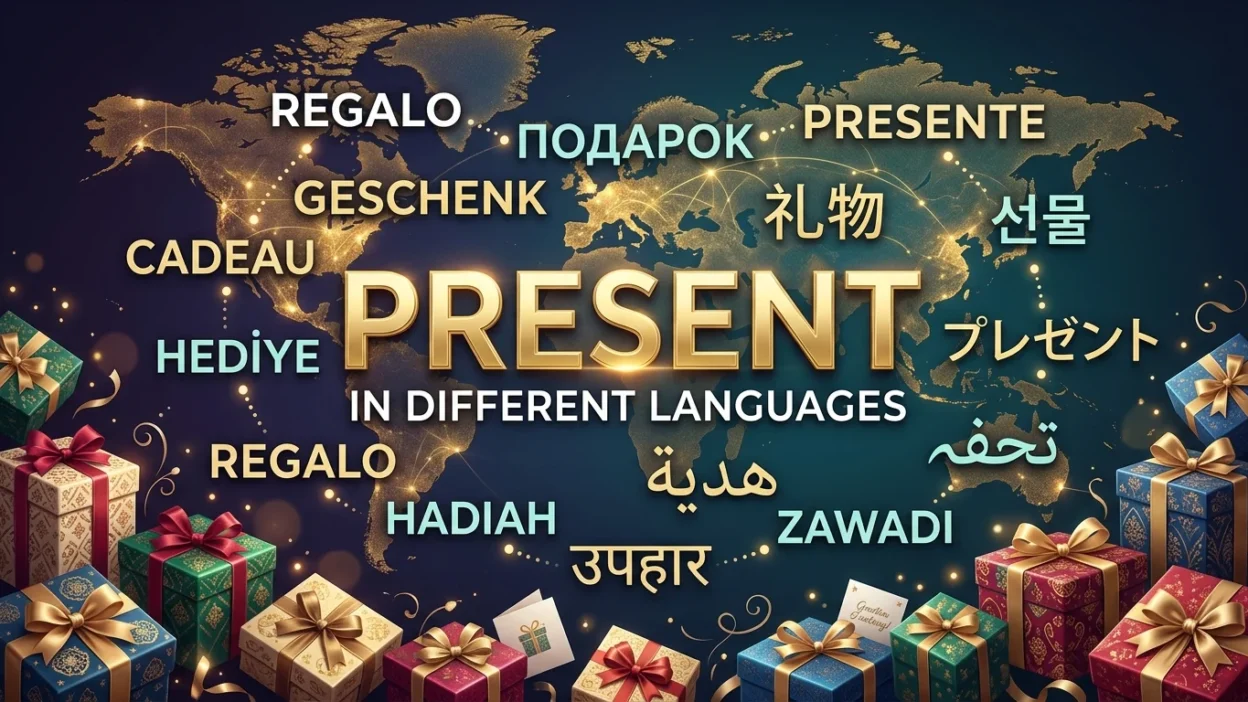
For example, Spanish uses regalo, German uses Geschenk, French uses cadeau, Arabic uses هدية, Hindi uses उपहार, Chinese uses 礼物, Japanese uses プレゼント, and Korean uses 선물.
These differences make vocabulary learning more interesting because a single English word can have dozens of distinct forms around the world.
Present in Different Languages Around the World
The concept of giving a present is found in many cultures. People exchange gifts to celebrate important occasions, show appreciation, strengthen relationships, welcome guests, or express affection.
Although the customs surrounding gifts can differ, the basic idea is familiar across many societies.
Learning present translations can therefore be useful when travelling or communicating with people from different linguistic backgrounds.
Common Ways to Use the Word “Present”
The word “present” as a gift can appear in several everyday expressions.
Birthday Present
A birthday present is a gift given to someone on or around their birthday.
Example:
“I bought my sister a birthday present.”
Christmas Present
A Christmas present is a gift exchanged during Christmas celebrations.
Example:
“He opened his Christmas present.”
Wedding Present
A wedding present is traditionally given to a newly married couple.
Example:
“We bought them a wedding present.”
Special Present
A special present is a gift chosen for an important or meaningful occasion.
Example:
“She gave him a special present.”
Present vs Gift: What Is the Difference?
In everyday English, present and gift usually have the same meaning when referring to something given to another person.
For example:
- “I bought her a present.”
- “I bought her a gift.”
Both sentences communicate essentially the same idea.
“Gift” can sometimes sound slightly broader or more formal, while “present” is very common in everyday conversations, especially in phrases such as “birthday present” and “Christmas present”.
Why Learn Present in Different Languages?
Learning the word present in other languages can help expand vocabulary and make communication more natural.
It can also be useful for:
- Language learners
- Travellers
- Teachers
- Students
- Multilingual writers
- Translation learners
- International communication
- Cultural research
Simple words such as “present” are often useful when discussing celebrations and relationships.
Present Translations for Language Learners
When learning vocabulary, it is helpful to study a word in context rather than memorising a translation alone.
The example sentences in the table show how the word can be used naturally. This makes it easier to understand both the vocabulary and its grammatical role.
For example, learning the Arabic word هدية alongside a sentence is more useful than memorising the word without context.
The same principle applies to regalo in Spanish, cadeau in French, Geschenk in German, and zawadi in Swahili.
Interesting Patterns in Present Translations
Some languages share similar-looking words because of historical or cultural connections.
For example, several languages use forms that are related to words meaning gift, offering, or something given. Other languages have vocabulary that developed independently.
Japanese is particularly interesting because プレゼント is a commonly used borrowed word for a present, alongside native Japanese vocabulary used in particular contexts.
This shows how languages naturally adopt and adapt words over time.
How to Remember “Present” in all Languages
A useful way to remember these translations is to group them by region instead of trying to memorise all 70 words at once.
Start with five or ten languages. Practise the word aloud, write a short sentence, and then gradually add more languages.
You can also create vocabulary cards using:
English → Native word → Pronunciation → Example sentence
This simple structure makes multilingual vocabulary easier to review.
Present in All Languages: Quick Reference
If you need a quick answer to “How do you say present in different languages?”, remember some of the most widely recognised translations:
- Spanish — Regalo
- French — Cadeau
- German — Geschenk
- Italian — Regalo
- Portuguese — Presente
- Russian — Подарок
- Arabic — هدية
- Hindi — उपहार
- Urdu — تحفہ
- Chinese — 礼物
- Japanese — プレゼント
- Korean — 선물
- Turkish — Hediye
- Swahili — Zawadi
These are useful starting points for everyday multilingual communication.
Conclusion
The word present is a simple but useful piece of vocabulary that appears in conversations about birthdays, celebrations, holidays, relationships, and special occasions. While the English word is familiar worldwide, each language has its own way of expressing the idea.
This list of present in different languages gives you translations, pronunciations, and practical examples to make learning easier. Whether you are studying languages, travelling, teaching, or exploring vocabulary around the world, these translations provide a convenient multilingual reference.
FAQs
1. How do you say “present” in different languages?
“Present” meaning a gift has different translations across languages. For example, Spanish uses regalo, French uses cadeau, German uses Geschenk, Arabic uses هدية, Chinese uses 礼物, Japanese uses プレゼント, and Korean uses 선물.
2. What is the Spanish word for present?
The Spanish word for present, meaning a gift, is regalo. For example, “Compré un regalo” means “I bought a gift.”
3. What is the French word for present?
The French word for present is cadeau. It is commonly used when talking about a gift given to someone.
4. What is the difference between present and gift?
When referring to something given to another person, present and gift generally have the same meaning. Both describe something given as a gesture of appreciation, celebration, or affection.
5. Why should I learn present in different languages?
Learning present in different languages can improve vocabulary, support travel and communication, and help learners understand how different cultures express the idea of giving and receiving gifts.