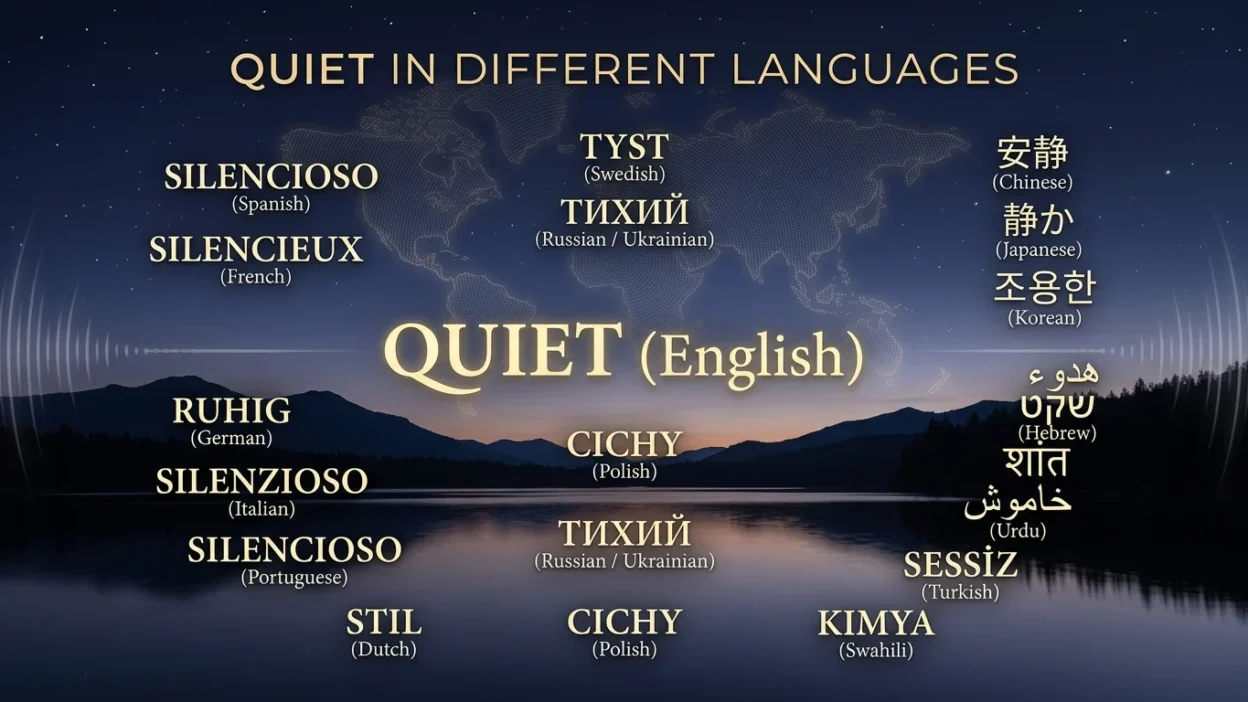
Learning how to say “quiet” in different languages is useful for travellers, language learners, teachers, writers, and anyone interested in communicating naturally across cultures. The word “quiet” can describe a peaceful place, a person who is not making noise, or a request for someone to remain silent.
Below, you will find quiet in all languages in a simple language table. Each entry includes the native translation, an easy English pronunciation, a short real-life example, and the English meaning of that example.
Quiet in Different Languages
The exact translation of “quiet” can change slightly depending on context. Some languages use an adjective meaning peaceful or silent, while others use a phrase that means “be quiet” or “stay quiet.” The translations below focus mainly on the adjective or natural expression used to describe something or someone as quiet.
How to Say Quiet in Different Languages
| Language | Correct Native Phrase | Easy English Pronunciation | Example Sentence | English Meaning |
| English | Quiet | KWY-uht | The room is quiet. | The room has little or no noise. |
| Spanish | Silencioso | see-len-see-OH-soh | The room is quiet. | The room is peaceful and not noisy. |
| French | Silencieux | see-lahn-SYUH | The street is quiet. | The street has very little noise. |
| German | Ruhig | ROO-ikh | The house is quiet. | The house is peaceful. |
| Italian | Silenzioso | see-len-TSEE-oh-zoh | The library is quiet. | The library has little noise. |
| Portuguese | Silencioso | see-len-see-OH-zoo | The room is quiet. | The room is not noisy. |
| Dutch | Stil | steel | The classroom is quiet. | The classroom is silent. |
| Swedish | Tyst | toost | The house is quiet. | The house is silent. |
| Danish | Stille | STEEL-uh | The room is quiet. | The room is peaceful and silent. |
| Norwegian | Stille | STEEL-leh | The cabin is quiet. | The cabin is peaceful. |
| Finnish | Hiljainen | HEEL-yah-ee-nen | The street is quiet. | The street is not noisy. |
| Icelandic | Hljóðlátur | hlyohd-LAU-tur | The village is quiet. | The village is peaceful and calm. |
| Irish | Ciúin | kyoo-in | The room is quiet. | The room is silent. |
| Welsh | Tawel | TOW-el | The village is quiet. | The village is peaceful. |
| Scottish Gaelic | Sàmhach | SAH-vakh | The house is quiet. | The house is peaceful and silent. |
| Polish | Cichy | CHEE-hih | The street is quiet. | The street is not noisy. |
| Czech | Tichý | TEE-khee | The room is quiet. | The room is silent. |
| Slovak | Tichý | TEE-khee | The village is quiet. | The village is peaceful. |
| Slovenian | Tih | teekh | The room is quiet. | The room is silent. |
| Croatian | Tih | teekh | The park is quiet. | The park is peaceful. |
| Serbian | Тих | teekh | The street is quiet. | The street is not noisy. |
| Bosnian | Tih | teekh | The room is quiet. | The room is peaceful. |
| Macedonian | Тивок | TEE-vok | The village is quiet. | The village is peaceful. |
| Bulgarian | Тих | teekh | The room is quiet. | The room is silent. |
| Russian | Тихий | TEE-khee | The street is quiet. | The street is peaceful and not noisy. |
| Ukrainian | Тихий | TEE-khyi | The house is quiet. | The house is peaceful. |
| Belarusian | Ціхі | TSEE-khee | The room is quiet. | The room is silent. |
| Lithuanian | Tylus | TEE-loos | The room is quiet. | The room is silent. |
| Latvian | Kluss | klooss | The street is quiet. | The street is not noisy. |
| Estonian | Vaikne | VYKE-neh | The house is quiet. | The house is peaceful. |
| Romanian | Liniștit | lee-neesh-TEET | The village is quiet. | The village is peaceful. |
| Hungarian | Csendes | CHEHN-dehsh | The room is quiet. | The room is silent. |
| Greek | Ήσυχος | EE-see-khos | The street is quiet. | The street is peaceful. |
| Albanian | I qetë | ee CHEH-tuh | The room is quiet. | The room is calm and silent. |
| Turkish | Sessiz | seh-SIZ | The room is quiet. | The room has little noise. |
| Azerbaijani | Sakit | sah-KEET | The street is quiet. | The street is peaceful. |
| Georgian | მშვიდი | MSHVEED-ee | The village is quiet. | The village is peaceful. |
| Armenian | Լուռ | loor | The room is quiet. | The room is silent. |
| Persian | ساکت | SAA-ket | The room is quiet. | The room is silent. |
| Arabic | هادئ | HAA-dee | The street is quiet. | The street is peaceful. |
| Hebrew | שקט | SHEH-ket | The room is quiet. | The room is silent. |
| Hindi | शांत | shaant | The room is quiet. | The room is peaceful. |
| Urdu | خاموش | kha-MOSH | The room is quiet. | The room is silent. |
| Bengali | শান্ত | shaan-to | The village is quiet. | The village is peaceful. |
| Punjabi | ਸ਼ਾਂਤ | shaant | The room is quiet. | The room is peaceful. |
| Gujarati | શાંત | shaant | The street is quiet. | The street is peaceful. |
| Marathi | शांत | shaant | The room is quiet. | The room is peaceful. |
| Nepali | शान्त | shaant | The village is quiet. | The village is peaceful. |
| Sinhala | නිහඬ | nih-HAND | The room is quiet. | The room is silent. |
| Tamil | அமைதியான | uh-MAI-dhee-yaa-na | The street is quiet. | The street is peaceful. |
| Telugu | నిశ్శబ్దమైన | nish-SHAB-da-mai-na | The room is quiet. | The room is silent. |
| Kannada | ಶಾಂತ | shaanta | The village is quiet. | The village is peaceful. |
| Malayalam | ശാന്തമായ | SHAAN-tha-ma-ya | The room is quiet. | The room is peaceful. |
| Odia | ଶାନ୍ତ | shaanta | The street is quiet. | The street is peaceful. |
| Assamese | শান্ত | shaanto | The room is quiet. | The room is peaceful. |
| Chinese (Mandarin) | 安静 | ān jìng | The room is quiet. | The room is silent. |
| Japanese | 静か | shizuka | The library is quiet. | The library is silent. |
| Korean | 조용한 | jo-yong-han | The room is quiet. | The room is peaceful and silent. |
| Vietnamese | Yên tĩnh | yen ting | The street is quiet. | The street is peaceful. |
| Thai | เงียบ | ngîap | The room is quiet. | The room is silent. |
| Indonesian | Tenang | tuh-nahng | The village is quiet. | The village is peaceful. |
| Malay | Senyap | seh-nyap | The room is quiet. | The room is silent. |
| Filipino | Tahimik | ta-HEE-mik | The street is quiet. | The street is peaceful. |
| Javanese | Sepi | suh-pee | The village is quiet. | The village is peaceful and empty. |
| Khmer | ស្ងាត់ | sngat | The room is quiet. | The room is silent. |
| Lao | ງຽບ | nyiap | The room is quiet. | The room is silent. |
| Burmese | တိတ်ဆိတ် | tate-sate | The street is quiet. | The street is peaceful and silent. |
| Swahili | Kimya | KEEM-yah | The room is quiet. | The room is silent. |
| Afrikaans | Stil | steel | The house is quiet. | The house is peaceful. |
| Zulu | Thule | TOO-leh | The room is quiet. | The room is silent. |
| Xhosa | Cwaka | CHWAH-kah | The village is quiet. | The village is peaceful. |
| Amharic | ጸጥ ያለ | tse-t YA-leh | The room is quiet. | The room is silent. |
| Somali | Aamusnaan | aa-moos-NAAN | The room is quiet. | The room has silence. |
| Malagasy | Mangina | man-GEE-na | The house is quiet. | The house is silent. |
Quiet in All Languages: Understanding the Meaning
The English word quiet has several related meanings. It can refer to a lack of noise, a peaceful environment, or a person who does not speak much.
For example:
- A quiet room means a room with very little noise.
- A quiet street means a street with little activity or traffic.
- A quiet person can mean someone who speaks very little.
- A quiet evening can describe a peaceful and relaxing evening.
Because languages divide these meanings differently, there is not always one perfect translation for every situation.
How to Say “Quiet” in Different Languages for Everyday Situations
If you are learning how to say quiet in different languages, context is important.
When describing a peaceful place, words such as “calm,” “peaceful,” or “silent” may be more natural in some languages.
When asking someone to stop making noise, the expression can be completely different.
For example, English speakers may say “Be quiet!”, while a translation for the adjective “quiet” may not be the natural expression for a direct command.
Quiet Translations Around the World
The translations in the table show how the idea of quiet appears across European, Asian, Middle Eastern, African, and other languages.
Several languages have closely related words. For instance, many Slavic languages use forms related to the idea of being quiet or silent. South Asian languages also commonly use words associated with peace, silence, and calmness.
In East Asian languages, context and grammatical structure can affect how the idea is expressed. This is why a dictionary translation may differ from the phrase naturally used in conversation.
Quiet vs Silent: What Is the Difference?
Although quiet and silent are similar, they are not always interchangeable.
Quiet usually means that there is little noise. A quiet room may still have some sounds.
Silent usually suggests a complete or nearly complete absence of sound.
For example:
- “The library is quiet” means people are keeping noise low.
- “The room became silent” suggests that everyone stopped making noise.
Understanding this difference can help you choose a more natural translation.
Quiet in Different Languages for Travel
Knowing the word “quiet” can be useful while travelling.
You may want to describe a peaceful hotel room, ask for a quiet table at a restaurant, or talk about a calm neighbourhood.
Learning even one simple word in the local language can make everyday communication easier and more natural.
Why Learn Quiet in Different Languages?
There are several reasons to learn this useful word:
- It helps with everyday conversations.
- It improves your travel vocabulary.
- It makes language learning more practical.
- It helps you understand cultural differences in communication.
- It can make requests sound more natural.
- It gives you useful vocabulary for describing places and people.
The word quiet is especially useful because it can describe both people and surroundings.
Common Ways to Use “Quiet”
Here are a few common English expressions:
Quiet place:
A location with little noise or activity.
Quiet person:
Someone who does not talk very much.
Quiet evening:
A peaceful evening without much activity.
Keep quiet:
An instruction to remain silent or avoid talking.
Be quiet:
A direct request or command to stop making noise.
The appropriate translation depends on which meaning you intend.
Quiet in Different Languages in Daily Conversation
When learning quiet in different languages, try to learn the word together with a short sentence rather than memorising it alone.
For example, instead of learning only “quiet,” learn a phrase such as:
“The room is quiet.”
This makes it easier to remember how the word works in a real sentence.
It also helps you understand whether the word changes according to gender, number, tense, or grammatical structure.
Conclusion
Learning quiet in different languages is a simple way to expand your everyday vocabulary and communicate more naturally around the world. The word can describe peaceful places, silent environments, and people who speak very little.
The 70 translations above give you a useful starting point for understanding how different languages express the idea of quiet.
FAQs
1. How do you say quiet in different languages?
The word “quiet” has different translations depending on the language. Common examples include silencioso in Spanish, silencieux in French, ruhig in German, silenzioso in Italian, 静か (shizuka) in Japanese, and 조용한 (joyonghan) in Korean.
2. What is the most common translation of quiet?
There is no single universal translation because “quiet” can mean silent, peaceful, calm, or not talkative. The correct word depends on the language and the context.
3. How do you say quiet in Japanese?
“Quiet” can be expressed as 静か (shizuka) in Japanese. It is commonly used when describing a quiet or peaceful place.
4. How do you say quiet in Spanish?
“Quiet” can be translated as silencioso in Spanish when describing something silent or not noisy. The form can change depending on grammatical gender and context.
5. Is quiet the same as silent in every language?
No. Many languages distinguish between being quiet, being silent, being calm, and being peaceful. The most natural translation depends on the situation.