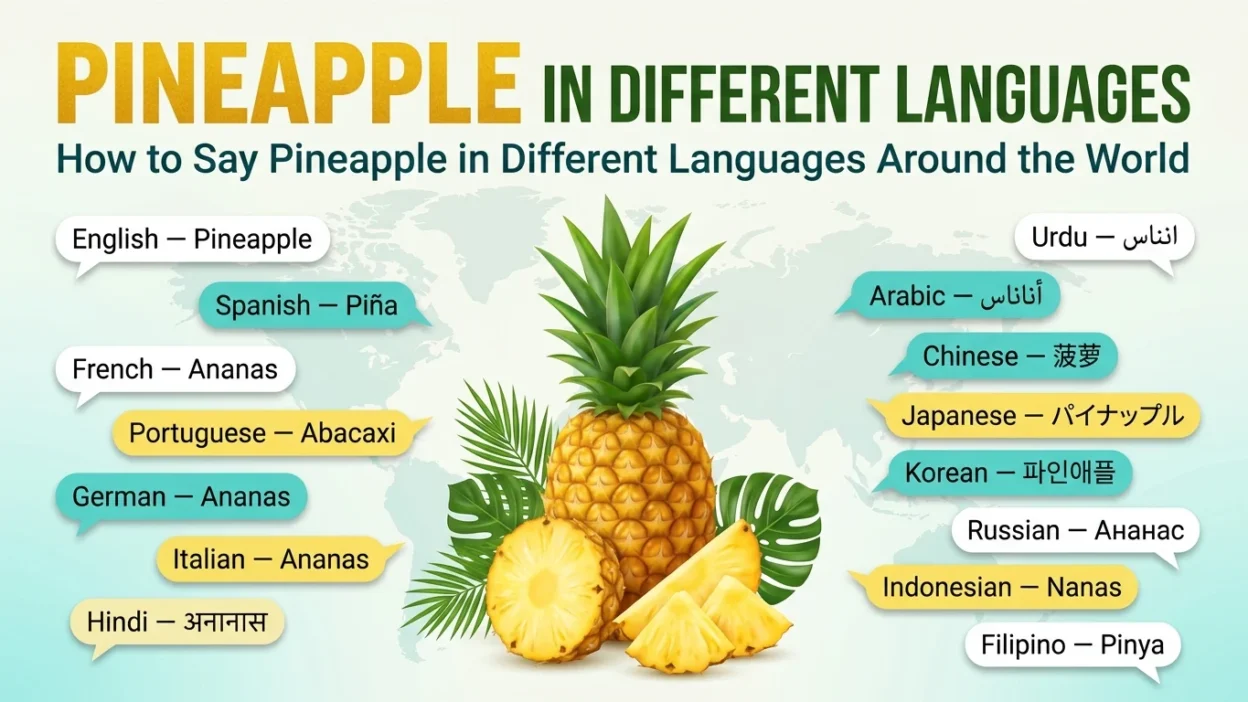
Pineapple is a sweet, juicy tropical fruit enjoyed around the world. It is used in fruit salads, smoothies, desserts, juices, and many savoury dishes. Although the fruit is recognised in many countries, its name changes from one language to another.
Learning how to say pineapple in different languages is useful for travellers, language learners, food lovers, students, and anyone curious about how people around the world describe everyday foods.
In English, the fruit is called pineapple. In Spanish, it is commonly known as piña, while French speakers call it ananas. Many other languages use forms of ananas, making this fruit an interesting example of how words travel between cultures.
In this guide, you will discover pineapple translations in languages, along with native spellings, easy English pronunciation guides, practical example sentences, and their English meanings.
Pineapple in Different Languages
| Language | Native Word | Easy English Pronunciation | Example Sentence | English Meaning |
| English | Pineapple | PINE-ap-uhl | I bought a pineapple. | I bought a pineapple. |
| Spanish | Piña | PEE-nyah | Me gusta la piña. | I like pineapple. |
| French | Ananas | Ah-nah-NAHSS | J’aime l’ananas. | I like pineapple. |
| German | Ananas | AH-nah-nahs | Ich esse gern Ananas. | I like eating pineapple. |
| Italian | Ananas | AH-nah-nahs | Mi piace l’ananas. | I like pineapple. |
| Portuguese | Abacaxi | Ah-bah-kah-SHEE | Eu gosto de abacaxi. | I like pineapple. |
| Dutch | Ananas | AH-nah-nahs | Ik eet graag ananas. | I like eating pineapple. |
| Swedish | Ananas | AH-nah-nahs | Jag gillar ananas. | I like pineapple. |
| Norwegian | Ananas | AH-nah-nahs | Jeg liker ananas. | I like pineapple. |
| Danish | Ananas | AH-nah-nahs | Jeg kan lide ananas. | I like pineapple. |
| Finnish | Ananas | AH-nah-nahs | Pidän ananaksesta. | I like pineapple. |
| Icelandic | Ananas | AH-nah-nahs | Mér finnst ananas góður. | I think pineapple tastes good. |
| Polish | Ananas | AH-nah-nahs | Lubię ananasa. | I like pineapple. |
| Czech | Ananas | AH-nah-nahs | Mám rád ananas. | I like pineapple. |
| Slovak | Ananás | AH-nah-naas | Mám rád ananás. | I like pineapple. |
| Slovenian | Ananas | AH-nah-nahs | Rad imam ananas. | I like pineapple. |
| Croatian | Ananas | AH-nah-nahs | Volim ananas. | I like pineapple. |
| Serbian | Ананас (Ananas) | AH-nah-nahs | Волим ананас. | I like pineapple. |
| Bulgarian | Ананас (Ananas) | AH-nah-nahs | Обичам ананас. | I like pineapple. |
| Macedonian | Ананас (Ananas) | AH-nah-nahs | Сакам ананас. | I like pineapple. |
| Russian | Ананас (Ananas) | Ah-nah-NAHS | Я люблю ананас. | I love pineapple. |
| Ukrainian | Ананас (Ananas) | Ah-nah-NAHS | Я люблю ананас. | I love pineapple. |
| Greek | Ανανάς (Ananás) | Ah-nah-NAHS | Μου αρέσει ο ανανάς. | I like pineapple. |
| Romanian | Ananas | Ah-nah-NAHS | Îmi place ananasul. | I like pineapple. |
| Hungarian | Ananász | AH-nah-naas | Szeretem az ananászt. | I like pineapple. |
| Albanian | Ananas | Ah-nah-NAHS | Më pëlqen ananasi. | I like pineapple. |
| Lithuanian | Ananasas | Ah-nah-NAH-sahs | Aš mėgstu ananasus. | I like pineapple. |
| Latvian | Ananass | Ah-nah-nahs | Man garšo ananass. | I like pineapple. |
| Estonian | Ananass | AH-nah-nahs | Mulle meeldib ananass. | I like pineapple. |
| Turkish | Ananas | Ah-nah-NAHS | Ananası seviyorum. | I like pineapple. |
| Arabic | أناناس (Ananas) | Ah-nah-NAAS | أحب الأناناس. | I like pineapple. |
| Hebrew | אננס (Ananas) | Ah-nah-NAHS | אני אוהב אננס. | I like pineapple. |
| Persian | آناناس (Ananas) | Ah-nah-NAAS | من آناناس دوست دارم. | I like pineapple. |
| Urdu | انناس (Ananas) | Ah-nah-NAAS | مجھے انناس پسند ہے۔ | I like pineapple. |
| Hindi | अनानास (Ananas) | Uh-nah-NAAS | मुझे अनानास पसंद है। | I like pineapple. |
| Bengali | আনারস (Anarosh) | Ah-nah-rosh | আমি আনারস পছন্দ করি। | I like pineapple. |
| Punjabi | ਅਨਾਨਾਸ (Ananas) | Ah-nah-NAAS | ਮੈਨੂੰ ਅਨਾਨਾਸ ਪਸੰਦ ਹੈ। | I like pineapple. |
| Gujarati | અનાનસ (Ananas) | Ah-nah-nuhs | મને અનાનસ ગમે છે. | I like pineapple. |
| Marathi | अननस (Ananas) | Uh-nuh-nuhs | मला अननस आवडतो. | I like pineapple. |
| Tamil | அன்னாசிப்பழம் (Annாசிப்பழம்) | An-naa-see-puh-zham | எனக்கு அன்னாசிப்பழம் பிடிக்கும். | I like pineapple. |
| Telugu | అనాస (Anāsa) | Uh-naa-sah | నాకు అనాస పండు ఇష్టం. | I like pineapple. |
| Kannada | ಅನಾನಸ್ (Ananas) | Ah-nah-nahs | ನನಗೆ ಅನಾನಸ್ ಇಷ್ಟ. | I like pineapple. |
| Malayalam | കൈതച്ചക്ക (Kaithachakka) | Kai-thah-chah-kah | എനിക്ക് കൈതച്ചക്ക ഇഷ്ടമാണ്. | I like pineapple. |
| Sinhala | අන්නාසි (Annāsi) | An-naa-see | මම අන්නාසිවලට කැමතියි. | I like pineapple. |
| Nepali | भुइँकटहर (Bhuinkatahar) | Bhooin-kuh-tuh-hur | मलाई भुइँकटहर मन पर्छ। | I like pineapple. |
| Chinese (Mandarin) | 菠萝 (Bōluó) | BWOH-lwoh | 我喜欢菠萝。 | I like pineapple. |
| Japanese | パイナップル (Painappuru) | Pie-nap-puh-roo | パイナップルが好きです。 | I like pineapple. |
| Korean | 파인애플 (Painaepeul) | Pie-neh-puhl | 파인애플을 좋아해요. | I like pineapple. |
| Vietnamese | Dứa | ZUH-uh | Tôi thích dứa. | I like pineapple. |
| Thai | สับปะรด (Sapparot) | Sap-pah-ROHT | ฉันชอบสับปะรด | I like pineapple. |
| Indonesian | Nanas | NAH-nahs | Saya suka nanas. | I like pineapple. |
| Malay | Nanas | NAH-nahs | Saya suka nanas. | I like pineapple. |
| Filipino (Tagalog) | Pinya | PEEN-yah | Gusto ko ang pinya. | I like pineapple. |
| Swahili | Nanasi | Nah-NAH-see | Ninapenda nanasi. | I like pineapple. |
| Amharic | አናናስ (Ananas) | Ah-nah-NAHS | አናናስ እወዳለሁ። | I like pineapple. |
| Somali | Cananaas | Cah-nah-NAAS | Waxaan jeclahay cananaaska. | I like pineapple. |
| Hausa | Abarba | Ah-bar-bah | Ina son abarba. | I like pineapple. |
| Yoruba | Ọ̀pẹ̀ oyinbo | Aw-peh oh-YEEN-baw | Mo fẹ́ràn ọ̀pẹ̀ oyinbo. | I like pineapple. |
| Zulu | Uphayinaphu | Oo-pie-yah-NAH-poo | Ngiyawuthanda uphayinaphu. | I like pineapple. |
| Xhosa | Iphayinaphu | Ee-pie-yah-NAH-poo | Ndiyalithanda iphayinaphu. | I like pineapple. |
| Afrikaans | Pynappel | PINE-ah-puhl | Ek hou van pynappel. | I like pineapple. |
| Māori | Paināporo | Pie-NAH-paw-raw | He pai ki ahau te paināporo. | I like pineapple. |
| Hawaiian | Hala kahiki | HAH-lah kah-HEE-kee | Makemake au i ka hala kahiki. | I like pineapple. |
| Haitian Creole | Anana | Ah-nah-NAH | Mwen renmen anana. | I like pineapple. |
| Esperanto | Ananaso | Ah-nah-NAH-soh | Mi ŝatas ananason. | I like pineapple. |
| Latin | Ananasus | Ah-nah-NAH-soos | Ananasum amo. | I love pineapple. |
Note: Pronunciation guides are approximate and may vary by region. Some languages have alternative regional names for pineapple. Tamil and other languages may also use different spellings or expressions depending on local usage.
What Is Pineapple Called in Different Languages?
Pineapple has several names around the world. In many European languages, including French, German, Italian, and Dutch, the fruit is called a form of ananas. This word is also used in many languages across Asia and Eastern Europe.
Other languages use distinctive names. Spanish speakers generally say piña, Portuguese speakers commonly use abacaxi, and English speakers use pineapple. In Mandarin Chinese, the word is bōluó (菠萝), while Japanese uses painappuru (パイナップル).
These differences make pineapple a useful word for exploring vocabulary, pronunciation, and cultural connections between languages.
How to Say Pineapple in Different Languages in Everyday Conversations
Knowing the word for pineapple can be especially helpful when ordering food, shopping at a market, or talking about your favourite fruit.
At a shop or market
You can use the local word when asking whether pineapple is available.
- Spanish: ¿Tiene piña? — Do you have pineapple?
- French: Avez-vous de l’ananas ? — Do you have pineapple?
- German: Haben Sie Ananas? — Do you have pineapple?
- Urdu: کیا آپ کے پاس انناس ہے؟ — Do you have pineapple?
Talking about food preferences
Use these simple examples to tell someone that you enjoy pineapple.
- Italian: Mi piace l’ananas. — I like pineapple.
- Indonesian: Saya suka nanas. — I like pineapple.
- Japanese: パイナップルが好きです。 — I like pineapple.
- Hindi: मुझे अनानास पसंद है। — I like pineapple.
Ordering a pineapple drink
If you are ordering juice or another drink, the fruit’s name can help you communicate your preference. You may need to add the local word for “juice” or “drink” to form a complete request.
Learning the fruit name first gives you a useful starting point for building longer sentences.
Why Is Pineapple Called Ananas in Many Languages?
The word ananas appears in many languages because the name spread across cultures through trade and contact between speakers. It is widely associated with forms of the word used in Indigenous South American languages, especially in the Tupi language family.
As the fruit travelled around the world, many languages adopted similar forms of its name. English developed the distinctive word pineapple, while Spanish commonly uses piña and Portuguese uses abacaxi.
This is a good example of how food, travel, and trade influence vocabulary. A fruit can have very different names in some languages and closely related names in others.
Pineapple Translations Around the World: Interesting Facts
Here are a few facts that make pineapple vocabulary especially interesting.
- Similar words: Many European languages use ananas or a closely related form.
- Different naming traditions: Spanish uses piña, while Portuguese commonly uses abacaxi.
- Local variation: Some languages have more than one accepted name depending on the region.
- Different writing systems: Pineapple can be written in Latin, Arabic, Devanagari, Chinese, Japanese, Korean, and other scripts.
- Useful for travellers: Knowing the local fruit name can make grocery shopping and ordering food easier.
Learning these differences can also help language students recognise shared vocabulary and understand how languages borrow words from one another.
Tips for Learning Pineapple in 70 Languages
Learning 70 translations may seem difficult at first, but breaking them into small groups makes the process easier.
- Start with familiar languages. Learn the words in languages you already know or are interested in studying.
- Group similar words together. Compare languages that use ananas with those that use a different name.
- Practise with complete sentences. Remembering “I like pineapple” helps you understand how the word works in context.
- Read the native spelling aloud. Use pronunciation guides as a starting point, but remember that they are approximate.
- Review a few words daily. Regular practice is more effective than trying to memorise every translation at once.
With consistent practice, you can build a useful multilingual fruit vocabulary and improve your confidence when speaking with people from other countries.
Conclusion
Pineapple has many names around the world, from piña in Spanish and abacaxi in Portuguese to ananas in French and German. These 70 translations show how different languages express the same everyday idea through their own words and writing systems.
Use this guide to practise pronunciation, learn example sentences, and discover how pineapple is named in different cultures. Whether you are learning a language, travelling, or simply curious about world vocabulary, this list is a useful place to start.
FAQs
1. How do you say pineapple in different languages?
Pineapple has different names depending on the language. Examples include piña in Spanish, ananas in French and German, abacaxi in Portuguese, nanas in Indonesian and Malay, and 菠萝 (bōluó) in Mandarin Chinese.
2. What is pineapple called in Spanish?
Pineapple is commonly called piña in Spanish. For example, Me gusta la piña means “I like pineapple.”
3. Why is pineapple called ananas in many languages?
Many languages use ananas or a similar word because the name spread through language contact and international trade. English developed the different term pineapple, while Spanish commonly uses piña and Portuguese uses abacaxi.
4. What is pineapple called in Hindi and Urdu?
In Hindi, pineapple is called अनानास (ananas). In Urdu, it is called انناس (ananas). The words are very similar in pronunciation.
5. Which languages use a different word for pineapple?
English uses pineapple, Spanish uses piña, Portuguese uses abacaxi, Mandarin Chinese uses bōluó (菠萝), and Vietnamese commonly uses dứa. These examples show how the same fruit can have different names across languages.