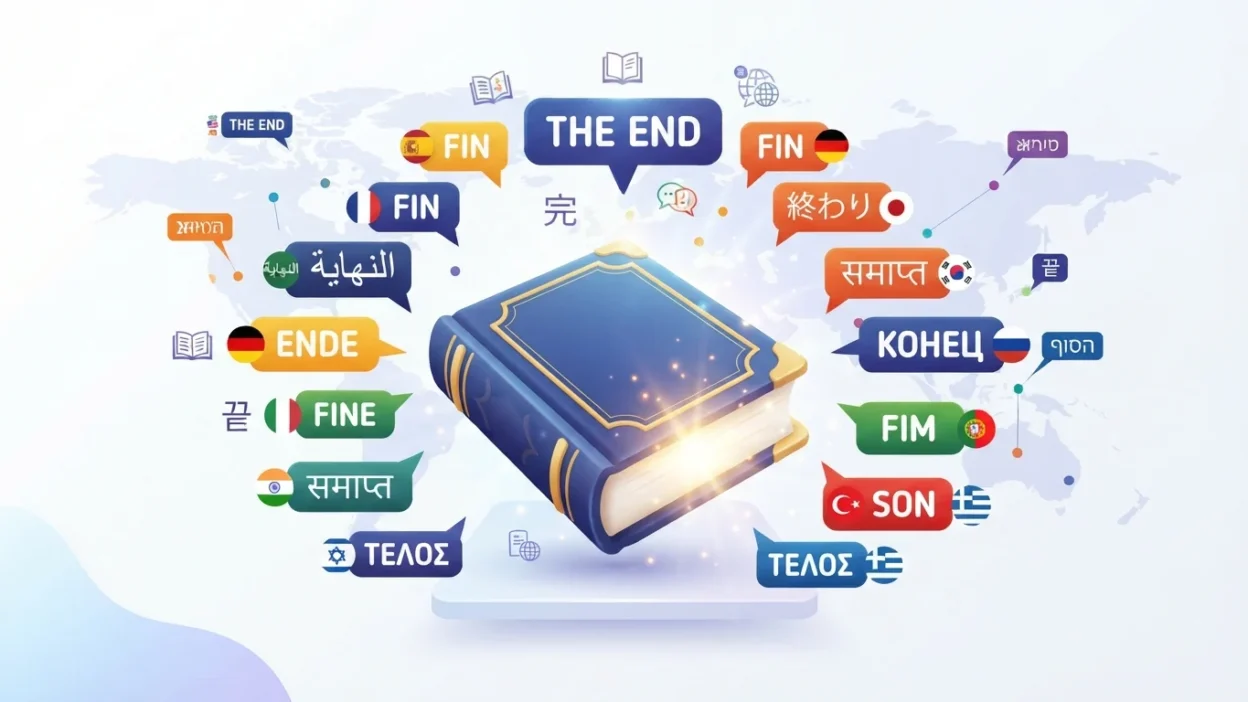
Have you ever finished reading a book, watching a movie, or completing a presentation and wondered how people say “The End” in different languages? This simple phrase marks the conclusion of a story, film, speech, or creative work, yet it appears in many unique forms across the world. Every language expresses the idea of an ending in its own way, reflecting its culture, writing system, and linguistic traditions.
Learning the end in different languages is useful for language enthusiasts, students, travelers, writers, filmmakers, and anyone interested in world cultures. Whether you’re creating multilingual content, designing subtitles, writing a story, or simply expanding your vocabulary, knowing these translations can make your work more authentic and engaging.
In this guide, you’ll discover the end in all languages through an easy-to-read table. You’ll also learn how to say the end in different languages, explore interesting facts, and understand why the phrase varies across cultures. By the end of this article, you’ll have a handy resource for the end translations around the world and a better appreciation of global languages.
What Is “The End” in Different Languages?
“The End” is a phrase used to indicate that a story, movie, book, presentation, or other piece of content has reached its conclusion. While the meaning remains the same worldwide, the words, pronunciation, and writing differ from one language to another, making each translation unique.
Why “The End” Looks Different Across Languages
Although the meaning of “The End” is universal, its translation changes because every language has its own vocabulary, grammar, and writing system. Some languages use alphabetic scripts like English and Spanish, while others use characters, symbols, or entirely different scripts such as Chinese, Japanese, Arabic, or Hindi.
Here are a few reasons why the end in different languages varies around the world:
- Every language has its own unique words and sentence structure.
- Different writing systems create visually distinct translations.
- Cultural traditions influence how endings are expressed in books and films.
- Some languages use formal expressions, while others prefer shorter or simpler phrases.
- Translators often adapt the phrase to sound natural for native speakers instead of translating it word for word.
Because of these differences, learning how to say the end in different languages is an interesting way to understand both language and culture.
When Is “The End” Commonly Used?
The phrase “The End” appears in many situations beyond movies. It is commonly used whenever a piece of content reaches its conclusion.
Some of the most common uses include:
- Movies and Films – Classic films often display “The End” on the final screen.
- Books and Novels – Authors may place the phrase after the last chapter.
- Short Stories – Children’s stories and creative writing frequently end with it.
- Presentations – Speakers sometimes use it on their final slide.
- School Projects – Students may include it to clearly indicate the conclusion.
- Animations and Cartoons – Many traditional animated films finish with a closing title.
- Video Editing – Editors use the phrase as an ending screen for videos and documentaries.
- Creative Projects – It adds a polished finish to scripts, comics, digital stories, and multimedia content.
No matter where it appears, “The End” signals that the content has reached its final moment. This is why so many people search for the end in different languages, especially when creating multilingual projects or learning new languages.
The End in Different Languages
| Language | Native Phrase | English Pronunciation | Example Sentence |
| English | The End | thee end | The End appeared on the final screen. |
| Spanish | Fin | feen | Fin apareció al final de la película. |
| French | Fin | fan | Fin est affiché à la fin du film. |
| German | Ende | EN-duh | Ende erschien am Schluss des Films. |
| Italian | Fine | FEE-nay | Fine compare alla fine del film. |
| Portuguese | Fim | feem | Fim apareceu no final do filme. |
| Dutch | Einde | EYN-duh | Einde verscheen aan het einde van de film. |
| Swedish | Slut | sloot | Slut visas i slutet av filmen. |
| Norwegian | Slutt | sloot | Slutt vises på slutten av filmen. |
| Danish | Slut | sloot | Slut vises til sidst i filmen. |
| Finnish | Loppu | LOP-poo | Loppu näkyy elokuvan lopussa. |
| Icelandic | Endir | EN-dir | Endir birtist í lok myndarinnar. |
| Irish | Deireadh | JER-uh | Deireadh le feiceáil ag deireadh an scannáin. |
| Welsh | Diwedd | DEE-weth | Diwedd ymddangosodd ar ddiwedd y ffilm. |
| Scottish Gaelic | Crìoch | kree-och | Crìoch nochd aig deireadh an fhilm. |
| Polish | Koniec | KO-nyets | Koniec pojawił się na końcu filmu. |
| Czech | Konec | KO-nets | Konec se objevil na konci filmu. |
| Slovak | Koniec | KO-nyets | Koniec sa objavil na konci filmu. |
| Slovenian | Konec | KO-nets | Konec se je prikazal na koncu filma. |
| Croatian | Kraj | kry | Kraj se pojavio na kraju filma. |
| Serbian | Крај | krai | Крај се појавио на крају филма. |
| Bosnian | Kraj | kry | Kraj se pojavio na kraju filma. |
| Romanian | Sfârșit | sfur-SHEET | Sfârșit apare la finalul filmului. |
| Hungarian | Vége | VAY-ghe | Vége megjelent a film végén. |
| Bulgarian | Край | krai | Край се появи в края на филма. |
| Russian | Конец | ka-NYETS | Конец появился в конце фильма. |
| Ukrainian | Кінець | KEE-nets | Кінець з’явився наприкінці фільму. |
| Belarusian | Канец | ka-NYETS | Канец з’явіўся ў канцы фільма. |
| Greek | Τέλος | TE-los | Τέλος εμφανίστηκε στο τέλος της ταινίας. |
| Albanian | Fund | foond | Fund u shfaq në fund të filmit. |
| Turkish | Son | son | Son filmin sonunda göründü. |
| Arabic | النهاية | an-ni-HA-ya | النهاية ظهرت في نهاية الفيلم. |
| Hebrew | הסוף | ha-sof | הסוף הופיע בסוף הסרט. |
| Persian | پایان | pa-YAN | پایان در پایان فیلم نمایش داده شد. |
| Urdu | اختتام | ikh-ti-TAAM | اختتام فلم کے آخر میں دکھایا گیا۔ |
| Hindi | समाप्त | samaapt | समाप्त फिल्म के अंत में दिखाई दिया। |
| Bengali | সমাপ্ত | sho-MAP-to | সমাপ্ত সিনেমার শেষে দেখা গেল। |
| Punjabi | ਸਮਾਪਤ | sa-MAAP-at | ਸਮਾਪਤ ਫ਼ਿਲਮ ਦੇ ਅੰਤ ਵਿੱਚ ਦਿਖਾਇਆ ਗਿਆ। |
| Gujarati | સમાપ્ત | sa-MAAPT | સમાપ્ત ફિલ્મના અંતે દેખાયું. |
| Marathi | समाप्त | samaapt | समाप्त चित्रपटाच्या शेवटी दिसले. |
| Nepali | समाप्त | samaapt | समाप्त चलचित्रको अन्त्यमा देखियो। |
| Sinhala | අවසානය | a-va-SA-na-ya | අවසානය චිත්රපටය අවසානයේ දිස් විය. |
| Tamil | முடிவு | mu-DI-vu | முடிவு திரைப்படத்தின் முடிவில் வந்தது. |
| Telugu | ముగింపు | mu-GIM-poo | ముగింపు సినిమా చివరలో కనిపించింది. |
| Kannada | ಅಂತ್ಯ | an-thya | ಅಂತ್ಯ ಚಿತ್ರದ ಕೊನೆಯಲ್ಲಿ ಕಾಣಿಸಿತು. |
| Malayalam | അവസാനം | ava-SA-nam | അവസാനം സിനിമയുടെ അവസാനം പ്രത്യക്ഷപ്പെട്ടു. |
| Thai | จบ | jop | จบ ปรากฏตอนท้ายของภาพยนตร์ |
| Vietnamese | Kết thúc | ket took | Kết thúc xuất hiện ở cuối bộ phim. |
| Indonesian | Tamat | TA-mat | Tamat muncul di akhir film. |
| Malay | Tamat | TA-mat | Tamat muncul pada penghujung filem. |
| Filipino (Tagalog) | Wakas | WA-kas | Wakas lumabas sa dulo ng pelikula. |
| Chinese (Simplified) | 结束 | jie-shoo | 结束 出现在电影最后。 |
| Chinese (Traditional) | 結束 | jie-shoo | 結束 出現在電影最後。 |
| Japanese | 終わり | o-WA-ri | 終わり が映画の最後に表示された。 |
| Korean | 끝 | kkeut | 끝 이 영화 마지막에 나왔습니다. |
| Mongolian | Төгсөв | tog-sov | Төгсөв киноны төгсгөлд гарсан. |
| Kazakh | Соңы | so-NUH | Соңы фильмнің соңында көрсетілді. |
| Uzbek | Tugadi | too-GA-di | Tugadi film oxirida ko‘rsatildi. |
| Kyrgyz | Аягы | a-YA-ghy | Аягы тасманын аягында көрсөтүлдү. |
| Azerbaijani | Son | son | Son filmin sonunda göstərildi. |
| Georgian | დასასრული | da-sa-SRU-li | დასასრული ფილმის ბოლოს გამოჩნდა. |
| Armenian | Վերջ | verj | Վերջ հայտնվեց ֆիլմի վերջում։ |
| Swahili | Mwisho | mwee-SHO | Mwisho ulionekana mwisho wa filamu. |
| Zulu | Isiphetho | isi-PET-ho | Isiphetho savela ekugcineni kwefilimu. |
| Xhosa | Isiphelo | isi-PE-lo | Isiphelo savela ekupheleni kwefilimu. |
| Afrikaans | Einde | AYN-duh | Einde het aan die einde van die rolprent verskyn. |
| Somali | Dhammaad | dham-MAAD | Dhammaad ayaa ka muuqday dhammaadka filimka. |
| Amharic | መጨረሻ | me-cha-re-SHA | መጨረሻ በፊልሙ መጨረሻ ታየ። |
| Yoruba | Ipari | ee-PA-ri | Ipari han ni opin fiimu. |
| Hausa | Ƙarshe | KAR-she | Ƙarshe ya bayyana a ƙarshen fim ɗin. |
| Igbo | Ọgwụgwụ | og-WOO-gwoo | Ọgwụgwụ pụtara na njedebe fim ahụ. |
| Maori | Whakamutunga | fa-ka-moo-TOO-nga | Whakamutunga i puta i te mutunga o te kiriata. |
| Hawaiian | Ka Hopena | ka ho-PE-na | Ka Hopena i hōʻike ʻia ma ka hopena o ke kiʻiʻoniʻoni. |
| Latin | Finis | FEE-nis | Finis in fine fabulae scriptum est. |
How to Say “The End” in Different Languages Around the World
The phrase “The End” may seem simple, but it carries the same important meaning across cultures—it tells the audience that a story, movie, book, or presentation has reached its conclusion. While the idea is universal, every language expresses it in its own unique way through different words, scripts, and pronunciation.
When exploring the end in different languages, you’ll notice that some translations are very short, such as Fin in Spanish and French, while others use longer words or phrases, like النهاية in Arabic or Whakamutunga in Māori. These differences reflect each language’s history, grammar, and cultural identity.
Learning how to say the end in different languages is useful for many reasons. Writers can create more authentic multilingual stories, filmmakers can design accurate closing screens, students can improve language projects, and travelers can gain a deeper appreciation of local languages and traditions. It is also a fun way for language learners to expand their vocabulary and recognize writing systems from around the world.
Whether you’re reading an international novel, watching a foreign film, or creating content for a global audience, understanding the end translations helps you connect with different cultures. From Europe and Asia to Africa, the Middle East, and the Americas, every language offers its own distinctive way to mark the final chapter of a story.
As globalization continues to bring people together, learning the end in all languages has become more valuable than ever. It not only improves communication but also highlights the beauty and diversity of the world’s languages.
Interesting Facts About “The End” Around the World
Did you know that the phrase “The End” has evolved differently across cultures? Here are some fascinating facts:
- Many classic Hollywood movies ended with the words “The End,” but modern films often display only the credits.
- French and Spanish both commonly use “Fin,” making it one of the shortest translations.
- Japanese, Chinese, Arabic, Hindi, and Korean use completely different writing systems, giving their translations a unique appearance.
- Some languages have multiple ways to express an ending depending on whether the context is formal or informal.
- Silent films frequently displayed “The End” on the final frame because there was no spoken dialogue.
- Publishers sometimes omit the phrase entirely in modern books, ending instead with the final sentence or chapter.
- Translators often adapt the phrase naturally rather than translating it word for word to suit native readers.
- Learning common ending phrases is a great introduction to understanding a new language and its writing system.
Common Uses of “The End”
The phrase “The End” is widely used in creative and professional settings to clearly indicate that something has finished. Some of its most common uses include:
- Movies and Films: Displayed on the final screen before or after the credits.
- Books and Novels: Used after the last chapter to signal the conclusion of the story.
- Short Stories: Helps readers know they have reached the end of the narrative.
- Presentations: Added to the final slide to close a speech or meeting professionally.
- School Assignments: Students often use it in storytelling and creative writing projects.
- Video Editing: Included as a closing title in documentaries, YouTube videos, and animations.
- Digital Storytelling: Used in comics, visual novels, and interactive media to indicate completion.
No matter the language or medium, “The End” remains one of the most recognizable ways to signal that a story has come to its conclusion.
Conclusion
Learning the end in different languages is an enjoyable way to explore the diversity of cultures and languages around the world. Although every language has its own spelling, pronunciation, and writing system, they all communicate the same universal idea—a story, film, book, or presentation has reached its conclusion.
Whether you’re a language learner, traveler, writer, teacher, or content creator, knowing how to say the end in different languages can make your work more authentic and engaging. We hope this collection of the end translations around the world helps you discover new languages while appreciating the unique ways people express the end of a journey.
FAQs
1. How do you say “The End” in different languages?
“The End” is translated differently in every language. For example, it is Fin in French and Spanish, Ende in German, Fine in Italian, 終わり in Japanese, and 结束 in Chinese.
2. Why is “The End” different in every language?
Each language has its own vocabulary, grammar, pronunciation, and writing system. These differences naturally result in unique translations for the same phrase.
3. Where is the phrase “The End” commonly used?
It is commonly used in movies, books, novels, short stories, presentations, documentaries, animations, and other creative projects to indicate that the content has finished.
4. Is “The End” translated literally in every language?
Not always. Some languages use a direct translation, while others prefer a more natural or culturally appropriate expression that conveys the same meaning.
5. Why do people search for “the end in different languages”?
People search for these translations for language learning, travel, creative writing, filmmaking, subtitle creation, educational projects, and general curiosity about world languages.