The word “quick” is commonly used to describe something that happens fast, takes little time, or moves at a high speed. Whether you are travelling, learning a new language, chatting with international friends, or improving your vocabulary, knowing how to say quick in different languages can be surprisingly useful.
Translations can vary depending on whether “quick” means fast, rapid, swift, or immediately. The translations below focus mainly on the common meaning of quick/fast and provide a simple example to show how each word can be used naturally.
If you are searching for quick in different languages in all languages, this guide gives you 70 useful translations in one easy-to-read table.
Quick in Different Languages
| Language | Native Word for “Quick” | Easy English Pronunciation | Example Sentence | English Meaning |
| English | Quick | kwik | Be quick, please. | Please be quick. |
| Spanish | Rápido | RAH-pee-doh | ¡Sé rápido! | Be quick! |
| French | Rapide | rah-PEED | Il est rapide. | He is quick. |
| German | Schnell | shnell | Sei schnell! | Be quick! |
| Italian | Veloce | veh-LOH-cheh | È molto veloce. | He is very quick. |
| Portuguese | Rápido | RAH-pee-doo | Seja rápido! | Be quick! |
| Dutch | Snel | snel | Wees snel! | Be quick! |
| Swedish | Snabb | snahb | Var snabb! | Be quick! |
| Danish | Hurtig | HOO-tee | Vær hurtig! | Be quick! |
| Norwegian | Rask | rahsk | Vær rask! | Be quick! |
| Finnish | Nopea | NOH-peh-ah | Ole nopea! | Be quick! |
| Icelandic | Fljótur | FLYOH-tur | Vertu fljótur! | Be quick! |
| Irish | Tapa | TAP-uh | Bíg tapa! | Be quick! |
| Welsh | Cyflym | KUV-lim | Bydd yn gyflym! | Be quick! |
| Scottish Gaelic | Luath | LOO-uh | Bi luath! | Be quick! |
| Polish | Szybki | SHIB-kee | Bądź szybki! | Be quick! |
| Czech | Rychlý | RIKH-lee | Buď rychlý! | Be quick! |
| Slovak | Rýchly | REEKH-lee | Buď rýchly! | Be quick! |
| Slovenian | Hiter | HEE-ter | Bodi hiter! | Be quick! |
| Croatian | Brz | brz | Budi brz! | Be quick! |
| Serbian | Брз | brz | Буди брз! | Be quick! |
| Bosnian | Brz | brz | Budi brz! | Be quick! |
| Macedonian | Брз | brz | Биди брз! | Be quick! |
| Bulgarian | Бърз | burz | Бъди бърз! | Be quick! |
| Russian | Быстрый | BYST-ree | Будь быстрым! | Be quick! |
| Ukrainian | Швидкий | shvyd-KEE | Будь швидким! | Be quick! |
| Belarusian | Хуткі | KHOO-tkee | Будзь хуткім! | Be quick! |
| Lithuanian | Greitas | GRAY-tas | Būk greitas! | Be quick! |
| Latvian | Ātrs | AHTRS | Esi ātrs! | Be quick! |
| Estonian | Kiire | KEE-reh | Ole kiire! | Be quick! |
| Romanian | Rapid | rah-PEED | Fii rapid! | Be quick! |
| Hungarian | Gyors | dyorsh | Légy gyors! | Be quick! |
| Greek | Γρήγορος | GREE-go-ros | Γίνε γρήγορος! | Be quick! |
| Albanian | I shpejtë | ee SHPAY-tuh | Ji i shpejtë! | Be quick! |
| Turkish | Hızlı | HUZ-luh | Hızlı ol! | Be quick! |
| Azerbaijani | Sürətli | soo-RAHT-lee | Sürətli ol! | Be quick! |
| Georgian | სწრაფი | skrah-pee | სწრაფად იყავი! | Be quick! |
| Armenian | Արագ | ah-RAHG | Արագ եղիր! | Be quick! |
| Persian | سریع | sa-REE | سریع باش! | Be quick! |
| Arabic | سريع | saree’ | كن سريعًا! | Be quick! |
| Hebrew | מהיר | mah-HEER | היה מהיר! | Be quick! |
| Hindi | तेज़ | tez | जल्दी करो! | Hurry up! |
| Urdu | تیز | tez | جلدی کرو! | Hurry up! |
| Bengali | দ্রুত | DROO-to | দ্রুত করো! | Be quick! |
| Punjabi | ਤੇਜ਼ | tez | ਤੇਜ਼ ਕਰੋ! | Be quick! |
| Gujarati | ઝડપી | JHUP-dee | ઝડપી બનો! | Be quick! |
| Marathi | जलद | juh-LUD | लवकर कर! | Do it quickly! |
| Nepali | छिटो | CHHEE-toh | छिटो गर! | Do it quickly! |
| Sinhala | ඉක්මන් | IK-man | ඉක්මන් වෙන්න! | Be quick! |
| Tamil | விரைவான | vee-rah-vaa-nah | விரைவாக செய்! | Do it quickly! |
| Telugu | వేగంగా | VAY-gun-gah | వేగంగా చేయి! | Do it quickly! |
| Kannada | ವೇಗವಾದ | VAY-ga-vah-dah | ಬೇಗ ಮಾಡು! | Do it quickly! |
| Malayalam | വേഗത്തിലുള്ള | VAY-gah-moo-lla | വേഗം ചെയ്യൂ! | Do it quickly! |
| Odia | ଶୀଘ୍ର | SHEE-ghra | ଶୀଘ୍ର କର! | Do it quickly! |
| Assamese | দ্ৰুত | DROO-t | দ্ৰুত কৰা! | Do it quickly! |
| Chinese (Mandarin) | 快 | kuài | 快一点! | A little quicker! |
| Japanese | 速い | hayai | 速くして! | Make it quicker! |
| Korean | 빠른 | ppa-reun | 빨리 해! | Do it quickly! |
| Vietnamese | Nhanh | nyahn | Nhanh lên! | Hurry up! |
| Thai | เร็ว | reo | เร็วหน่อย! | A little quicker! |
| Indonesian | Cepat | cheh-paht | Cepatlah! | Be quick! |
| Malay | Cepat | cheh-paht | Cepatlah! | Be quick! |
| Filipino | Mabilis | mah-BEE-lis | Bilisan mo! | Hurry up! |
| Javanese | Cepet | CHEH-pet | Cepet! | Quick! |
| Khmer | លឿន | ləən | លឿនឡើង! | Hurry up! |
| Lao | ໄວ | wai | ໄວໆ! | Quickly! |
| Burmese | မြန် | myan | မြန်မြန်လုပ်! | Do it quickly! |
| Swahili | Haraka | ha-RAH-ka | Fanya haraka! | Hurry up! |
| Afrikaans | Vinnig | FIN-ikh | Wees vinnig! | Be quick! |
| Zulu | Shesha | SHEH-sha | Shesha! | Hurry! |
| Xhosa | Khawuleza | kha-woo-LEH-za | Khawuleza! | Hurry! |
| Amharic | ፈጣን | feh-tahn | ፈጣን ሁን! | Be quick! |
| Somali | Degdeg | DEG-deg | Degdeg! | Quickly! |
| Malagasy | Haingana | HIGH-ngah-na | Haingana! | Quickly! |
What Does “Quick” Mean?
Quick generally means moving, happening, or being completed in a short amount of time. It can describe speed, action, reaction, or a short period.
For example:
- “She is a quick runner.”
- “Give me a quick answer.”
- “Take a quick look.”
- “Be quick or we will be late.”
The exact translation can change according to the sentence. In some languages, the most natural translation may mean fast, while in another context it may be closer to quickly, rapidly, or hurry.
How to Say Quick in Different Languages
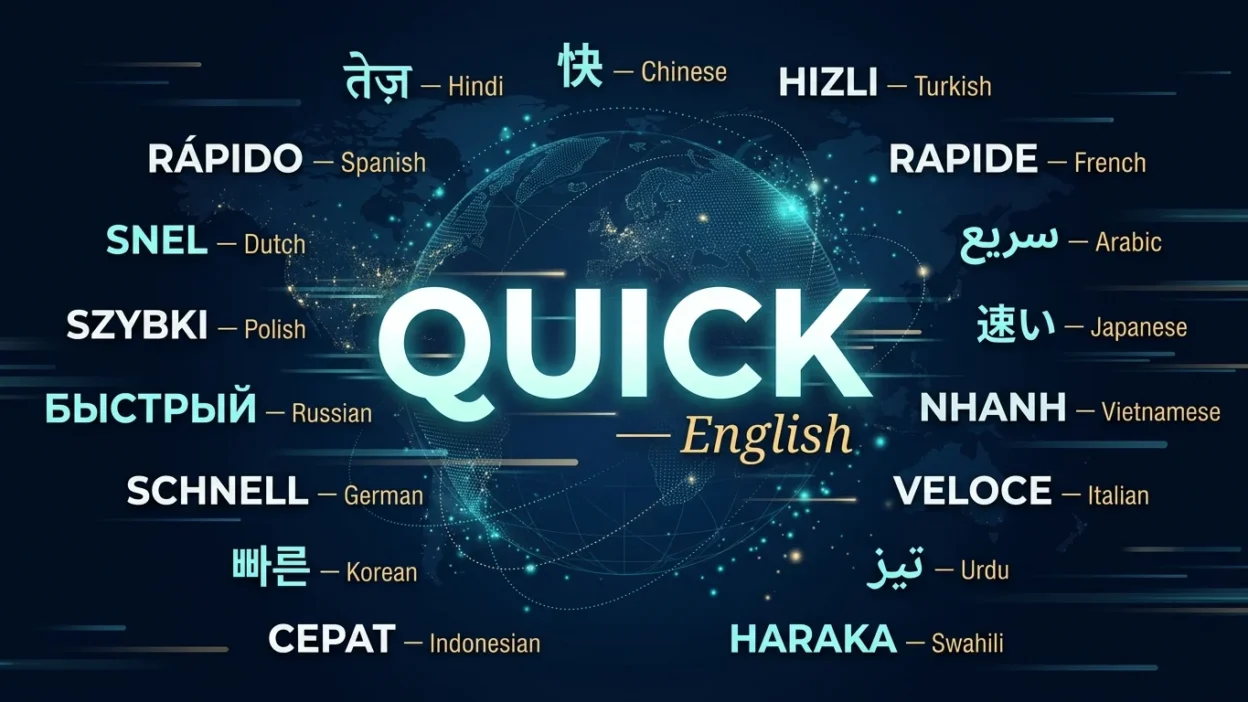
If you want to know how to say quick in different languages, the most common translations include:
- Spanish: rápido
- French: rapide
- German: schnell
- Italian: veloce
- Portuguese: rápido
- Dutch: snel
- Russian: быстрый
- Turkish: hızlı
- Arabic: سريع
- Hindi: तेज़
- Chinese: 快
- Japanese: 速い
- Korean: 빠른
- Vietnamese: nhanh
- Indonesian: cepat
- Swahili: haraka
These words are useful when discussing speed, movement, timing, or fast actions.
Quick in Different Languages Around the World
The idea of speed is expressed in many different ways around the world. European languages often use words related to fast or rapid, while Asian and African languages may use different grammatical forms depending on whether the word is being used as an adjective, adverb, or command.
For example, Mandarin Chinese uses 快 (kuài) for “fast” or “quick”, while Japanese commonly uses 速い (hayai) when describing something as fast. In everyday commands, however, the grammatical form can change.
This is why a direct dictionary translation is not always enough. Learning the word together with a short example sentence gives you a better understanding of natural usage.
Quick in European Languages
There are many familiar ways to express “quick” across Europe.
Spanish uses rápido, French uses rapide, German uses schnell, Italian uses veloce, and Portuguese uses rápido. Several Slavic languages also have closely related concepts, although pronunciation and grammatical endings differ.
For travellers, students, and language learners, these words are especially useful because speed-related expressions appear frequently in everyday conversations.
Quick in Asian Languages
Asian languages often express the idea of quickness differently depending on the grammatical context.
Mandarin Chinese uses 快, Japanese commonly uses 速い, Korean uses 빠른, Vietnamese uses nhanh, and Indonesian uses cepat.
In many Asian languages, a phrase equivalent to “hurry up” may be more natural in a conversation when someone wants another person to act quickly.
Quick in Arabic, Hindi and Urdu
In Arabic, سريع means “quick” or “fast”. Hindi commonly uses तेज़, while Urdu uses تیز.
Hindi and Urdu also frequently use expressions meaning quickly or hurry up, especially in spoken conversation. This demonstrates an important point: translating “quick” naturally requires considering the complete sentence rather than translating a single word in isolation.
Quick vs Quickly
“Quick” and “quickly” are related but they do not always have the same grammatical function.
Quick is commonly used as an adjective:
She is a quick learner.
Quickly is commonly used as an adverb:
She learns quickly.
In informal English, however, “quick” can sometimes be used adverbially:
Come quick!
When learning translations, always consider whether you need the adjective quick, the adverb quickly, or the command hurry up.
Quick vs Fast
“Quick” and “fast” are often interchangeable, but there can be subtle differences.
Fast commonly describes speed:
He drives a fast car.
Quick can describe speed, a short amount of time, or a rapid response:
Give me a quick answer.
This distinction is important when looking for quick in different languages translations, because another language may use separate words for these meanings.
Common Phrases With Quick
Learning common phrases can make the word easier to remember.
Some useful English expressions include:
- Quick answer
- Quick response
- Quick look
- Quick meal
- Quick visit
- Quick decision
- Quick movement
- Quick learner
- Quick change
- Quick break
These expressions are useful for everyday conversations and can help you understand how the concept of quickness works in context.
Why Learn “Quick” in Different Languages?
Learning the word “quick” in other languages can be useful for several reasons.
Travel
You may need to ask someone to hurry or describe something that needs to happen quickly.
Language Learning
Speed-related vocabulary is common in everyday speech and is useful for building practical vocabulary.
Communication
Knowing simple words such as “quick” can make basic conversations easier when communicating internationally.
Cultural Understanding
Different languages organise words according to their own grammatical systems. Learning these differences gives you a better understanding of how people naturally communicate.
Tips for Remembering Quick in Different Languages
A simple way to remember translations is to connect each word with an action.
For example, imagine someone running quickly while saying the word in the target language. This creates a stronger memory association than memorising a word from a list alone.
You can also practise each word in a short sentence. Repeating the word in context helps you remember both its meaning and its natural usage.
Quick in All Languages: What Should You Remember?
There is no single universal translation for “quick” because languages handle adjectives, adverbs, commands, and expressions differently.
The safest approach is to learn:
- The basic translation.
- Its pronunciation.
- A natural example sentence.
- Whether the word means “quick”, “fast”, “quickly”, or “hurry”.
This makes your vocabulary more practical and reduces the chance of using a technically correct word in an unnatural way.
Conclusion
Learning quick in different languages is a useful way to expand your everyday vocabulary and communicate more confidently across cultures. From rápido in Spanish and schnell in German to 快 in Chinese, 速い in Japanese, cepat in Indonesian, and haraka in Swahili, each language has its own natural way of expressing speed and urgency.
The key is to learn the translation together with a real-life example. This helps you understand not only what “quick” means, but also how the word is naturally used around the world.
FAQs
1. How do you say “quick” in different languages?
“Quick” can be translated as rápido in Spanish, rapide in French, schnell in German, veloce in Italian, 快 in Mandarin Chinese, 速い in Japanese, 빠른 in Korean, and haraka in Swahili.
2. What is “quick” in Spanish?
“Quick” in Spanish is commonly rápido. For example, “Be quick!” can be expressed as ¡Sé rápido!
3. What is “quick” in French?
“Quick” in French is rapide. It can describe something that is fast or happens at a high speed.
4. What is “quick” in Japanese?
A common Japanese translation for “quick” or “fast” is 速い (hayai). The exact form can change depending on how the word is used in a sentence.
5. What is the difference between “quick” and “quickly”?
“Quick” is usually an adjective, while “quickly” is an adverb. For example, “a quick answer” uses quick, while “answer quickly” uses quickly.