A simple greeting can brighten someone’s day, and good afternoon is one of the most common and polite expressions used across different cultures. Whether you’re traveling, learning a new language, attending an international meeting, or simply greeting a friend, knowing good afternoon in different languages helps you communicate with confidence and respect.
Every language has its own unique way of saying “good afternoon.” Some greetings are formal and commonly used in business settings, while others are warm and friendly enough for everyday conversations. Learning these expressions not only improves your language skills but also helps you understand the customs and traditions of people around the world.
In today’s global world, being able to greet someone in their native language creates a positive first impression. Whether you’re speaking with international clients, making new friends while traveling, studying foreign languages, or communicating online, using the local afternoon greeting shows politeness and cultural appreciation.
In this complete guide, you’ll discover good afternoon in different languages in all languages, learn how to say good afternoon in different languages, explore accurate good afternoon in different languages translations, and see how people greet one another during the afternoon around the world. Every language includes the correct native phrase, an easy English pronunciation, a practical example sentence, and its English meaning, making this guide useful for beginners and advanced learners alike.
By the end of this article, you’ll have a valuable collection of afternoon greetings that you can use in everyday conversations, international travel, business communication, and language learning.
Why Learn Good Afternoon in Different Languages?
Learning good afternoon in different languages offers many practical benefits beyond simply expanding your vocabulary. It’s one of the most useful greetings because it’s used in daily conversations, professional meetings, and social interactions around the world.
Here are some reasons why learning these greetings is worthwhile:
- Improve your everyday communication skills.
- Make a positive impression while traveling abroad.
- Show respect for different cultures and traditions.
- Build stronger relationships with international friends and colleagues.
- Practice useful vocabulary that native speakers use every day.
- Increase your confidence when speaking a foreign language.
- Enhance your cultural awareness and language-learning journey.
Even if you’re just beginning to learn a new language, “good afternoon” is an easy and practical phrase that you’ll use frequently in real-life situations.
What You’ll Find in This Guide
This guide is designed to be a complete resource for anyone searching for good afternoon in different languages.
Inside this article, you’ll find:
- Correct native spellings for every greeting.
- Easy English pronunciations.
- Short real-life example sentences.
- English meanings of each example.
- Helpful pronunciation tips.
- Cultural insights about afternoon greetings around the world.
- Practical techniques for remembering foreign greetings.
- Answers to the most commonly searched questions.
Whether you’re a traveler, student, teacher, language enthusiast, or business professional, this guide will help you confidently greet people in dozens of languages while expanding your knowledge of world cultures.
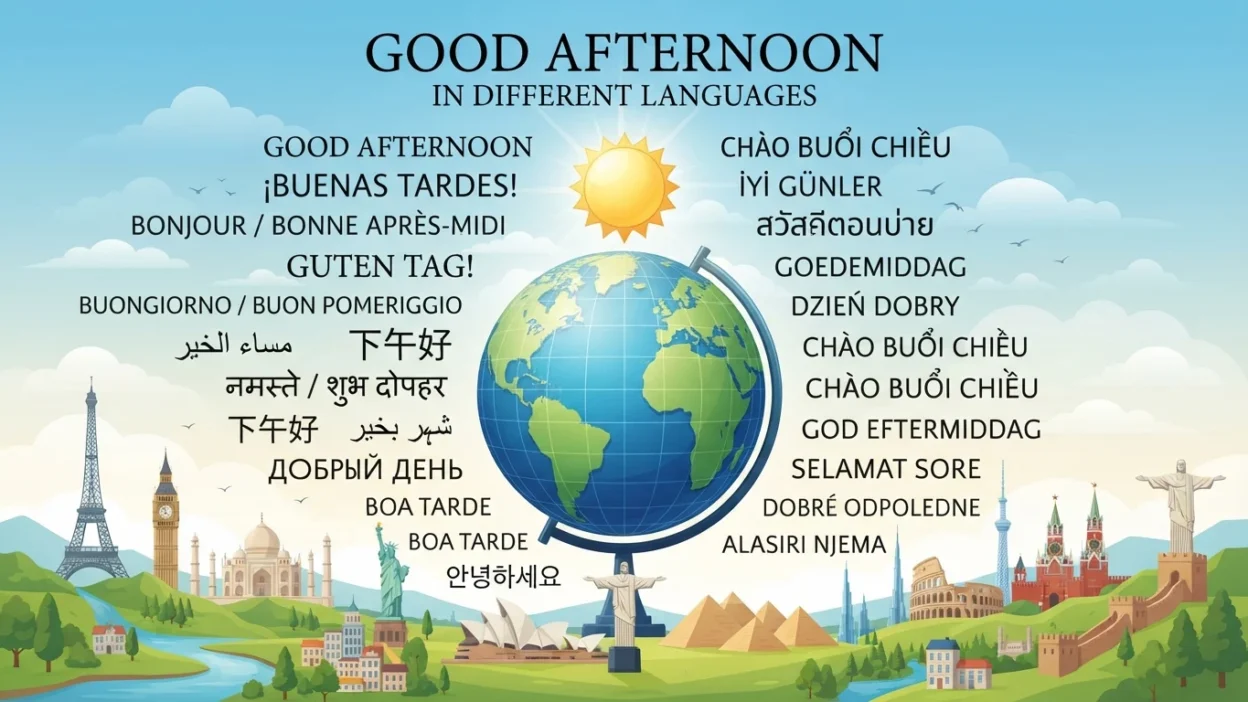
Good Afternoon in Different Languages
| Language | Native Phrase | Easy English Pronunciation | Example Sentence | English Meaning |
| English | Good afternoon | Good Af-ter-NOON | Good afternoon! How are you today? | A polite afternoon greeting. |
| Spanish | Buenas tardes | BWEH-nas TAR-des | Buenas tardes, ¿cómo está? | Good afternoon, how are you? |
| French | Bon après-midi | Bon Ah-pray Mee-DEE | Bon après-midi! | Good afternoon! |
| German | Guten Tag | GOO-ten Tahk | Guten Tag! Schön, Sie zu sehen. | Good afternoon! Nice to see you. |
| Italian | Buon pomeriggio | Bwon Po-me-RIJ-jo | Buon pomeriggio! Come sta? | Good afternoon! How are you? |
| Portuguese | Boa tarde | BO-ah TAR-jee | Boa tarde! Como vai? | Good afternoon! How are you? |
| Dutch | Goedemiddag | HOO-duh-MID-dakh | Goedemiddag! Alles goed? | Good afternoon! Everything well? |
| Swedish | God eftermiddag | God EF-ter-mid-dag | God eftermiddag! | Good afternoon! |
| Norwegian | God ettermiddag | God ET-ter-mid-dag | God ettermiddag! | Good afternoon! |
| Danish | God eftermiddag | God EF-ter-mid-dag | God eftermiddag! | Good afternoon! |
| Finnish | Hyvää iltapäivää | HOO-va IL-ta-pie-va | Hyvää iltapäivää! | Good afternoon! |
| Icelandic | Góðan daginn | GO-than DA-gin | Góðan daginn! | Good afternoon! |
| Irish | Tráthnóna maith | TRAH-no-na Mah | Tráthnóna maith! | Good afternoon! |
| Welsh | Prynhawn da | PRUN-hown Dah | Prynhawn da! | Good afternoon! |
| Scottish Gaelic | Feasgar math | FES-gar Mah | Feasgar math! | Good afternoon! |
| Polish | Dzień dobry | Jen DOH-bri | Dzień dobry! Miło cię widzieć. | Good afternoon! Nice to see you. |
| Czech | Dobré odpoledne | DO-breh ODP-po-led-ne | Dobré odpoledne! | Good afternoon! |
| Slovak | Dobré popoludnie | DO-breh PO-po-lud-nye | Dobré popoludnie! | Good afternoon! |
| Slovenian | Dober dan | DO-ber Dan | Dober dan! | Good afternoon! |
| Croatian | Dobar dan | DO-bar Dan | Dobar dan! | Good afternoon! |
| Serbian | Добар дан | DO-bar Dan | Добар дан! | Good afternoon! |
| Bosnian | Dobar dan | DO-bar Dan | Dobar dan! | Good afternoon! |
| Romanian | Bună ziua | BOO-na ZI-wa | Bună ziua! Ce mai faceți? | Good afternoon! How are you? |
| Hungarian | Jó napot | Yo NA-pot | Jó napot! | Good afternoon! |
| Greek | Καλησπέρα | Ka-lee-SPE-ra | Καλησπέρα! | Good afternoon! |
| Russian | Добрый день | DOB-ri Den | Добрый день! | Good afternoon! |
| Ukrainian | Добрий день | DO-bry Den | Добрий день! | Good afternoon! |
| Belarusian | Добры дзень | DO-bri Dzen | Добры дзень! | Good afternoon! |
| Bulgarian | Добър ден | DO-bar Den | Добър ден! | Good afternoon! |
| Macedonian | Добар ден | DO-bar Den | Добар ден! | Good afternoon! |
| Albanian | Mirëdita | Mee-re-DEE-ta | Mirëdita! | Good afternoon! |
| Turkish | Tünaydın | Too-NIGH-dun | Tünaydın! Nasılsınız? | Good afternoon! How are you? |
| Arabic | مساء الخير | Ma-sa Al-Khair | مساء الخير | Good afternoon. |
| Persian (Farsi) | عصر بخیر | Asr Be-Kheyr | عصر بخیر | Good afternoon. |
| Hebrew | אחר הצהריים טובים | A-khar Ha-Tso-ho-RA-yim To-vim | אחר הצהריים טובים! | Good afternoon! |
| Hindi | शुभ दोपहर | Shubh Dopehar | शुभ दोपहर! आपका दिन कैसा है? | Good afternoon! How is your day? |
| Urdu | دوپہر بخیر | Dopehar Bakhair | دوپہر بخیر! آپ کیسے ہیں؟ | Good afternoon! How are you? |
| Punjabi | ਸ਼ੁੱਭ ਦੁਪਹਿਰ | Shubh Dupehar | ਸ਼ੁੱਭ ਦੁਪਹਿਰ! | Good afternoon! |
| Bengali | শুভ অপরাহ্ন | Shubho Oporahno | শুভ অপরাহ্ন! | Good afternoon! |
| Gujarati | શુભ બપોર | Shubh Bapor | શુભ બપોર! | Good afternoon! |
| Marathi | शुभ दुपार | Shubh Dupaar | शुभ दुपार! | Good afternoon! |
| Nepali | शुभ दिउँसो | Shubha Diunso | शुभ दिउँसो! | Good afternoon! |
| Sinhala | සුභ දහවල් | Suba Dahawal | සුභ දහවල්! | Good afternoon! |
| Tamil | இனிய மதியம் | Iniya Mathiyam | இனிய மதியம்! | Good afternoon! |
| Telugu | శుభ మధ్యాహ్నం | Shubha Madhyahnam | శుభ మధ్యాహ్నం! | Good afternoon! |
| Kannada | ಶುಭ ಮಧ್ಯಾಹ್ನ | Shubha Madhyahna | ಶುಭ ಮಧ್ಯಾಹ್ನ! | Good afternoon! |
| Malayalam | ശുഭ ഉച്ചതിരിഞ്ഞ് | Shubha Uchathirinj | ശുഭ ഉച്ചതിരിഞ്ഞ്! | Good afternoon! |
| Thai | สวัสดีตอนบ่าย | Sa-wat-dee Ton Bai | สวัสดีตอนบ่าย | Good afternoon. |
| Vietnamese | Chào buổi chiều | Chao Booi Chieu | Chào buổi chiều! | Good afternoon! |
| Indonesian | Selamat siang | Seh-LA-mat SEE-ang | Selamat siang! | Good afternoon! |
| Malay | Selamat tengah hari | Seh-LA-mat TENG-ah Ha-ri | Selamat tengah hari! | Good afternoon! |
| Filipino (Tagalog) | Magandang hapon | Ma-GAN-dang HA-pon | Magandang hapon! | Good afternoon! |
| Chinese (Mandarin) | 下午好 | Sya Woo Hao | 下午好! | Good afternoon! |
| Japanese | こんにちは | Kon-ni-chi-wa | こんにちは! | Good afternoon! |
| Korean | 안녕하세요 | An-nyeong-ha-se-yo | 안녕하세요! | Good afternoon! |
| Mongolian | Өдрийн мэнд | Ur-drin Mend | Өдрийн мэнд! | Good afternoon! |
| Khmer | សួស្តីពេលរសៀល | Suor-sdei Pel Re-siel | សួស្តីពេលរសៀល | Good afternoon. |
| Lao | ສະບາຍດີຕອນບ່າຍ | Sa-bai-dee Ton Bai | ສະບາຍດີຕອນບ່າຍ | Good afternoon. |
| Burmese | မင်္ဂလာနေ့လယ်ခင်းပါ | Mingalar Nay-lal Khin-ba | မင်္ဂလာနေ့လယ်ခင်းပါ | Good afternoon. |
| Swahili | Habari za mchana | Ha-BA-ri Za Mcha-na | Habari za mchana! | Good afternoon! |
| Zulu | Sawubona ntambama | Sa-woo-BO-na Ntam-ba-ma | Sawubona ntambama! | Good afternoon! |
| Xhosa | Molo emva kwemini | MO-lo Em-va Kwe-mee-nee | Molo emva kwemini! | Good afternoon! |
| Afrikaans | Goeiemiddag | HOO-ee-mid-dakh | Goeiemiddag! | Good afternoon! |
| Hausa | Barka da rana | BAR-ka Da Ra-na | Barka da rana! | Good afternoon! |
| Amharic | እንደምን አመሸህ | En-de-min A-me-sheh | እንደምን አመሸህ | Good afternoon. |
| Somali | Galab wanaagsan | Ga-lab Wa-naag-san | Galab wanaagsan! | Good afternoon! |
| Estonian | Tere päevast | TE-re PAY-vast | Tere päevast! | Good afternoon! |
| Latvian | Labdien | Lab-DYEN | Labdien! | Good afternoon! |
| Lithuanian | Laba diena | LA-ba Dye-na | Laba diena! | Good afternoon! |
| Esperanto | Bonan posttagmezon | BO-nan Post-tag-ME-zon | Bonan posttagmezon! | Good afternoon! |
How to Say Good Afternoon in Different Languages
Learning how to say good afternoon in different languages is one of the easiest ways to improve your communication skills and show respect for different cultures. Afternoon greetings are commonly used when meeting someone after lunchtime, welcoming guests, starting business meetings, or having casual conversations during the day.
Although the pronunciation and writing vary from one language to another, the purpose remains the same—to greet someone politely and wish them a pleasant afternoon.
Here are some simple tips to help you pronounce these greetings correctly:
- Listen to native speakers whenever possible.
- Practice each greeting slowly before speaking at a natural pace.
- Learn the pronunciation together with the native script.
- Repeat each phrase daily to improve your accent.
- Use these greetings in real-life conversations whenever you can.
With regular practice, you’ll quickly become comfortable using afternoon greetings in many different languages.
Why Learn Good Afternoon in Different Languages?
Knowing good afternoon in different languages is useful for travelers, students, professionals, and anyone interested in learning foreign languages.
Improve Your Travel Experience
Greeting people in their native language shows respect and helps create a friendly first impression. Even a simple afternoon greeting can make interactions more enjoyable.
Communicate Professionally
Many international meetings and business conversations take place during the afternoon. Using a local greeting demonstrates professionalism and cultural awareness.
Strengthen International Relationships
Whether you’re chatting with online friends, international colleagues, or exchange students, greeting someone in their native language makes conversations feel more personal and welcoming.
Support Language Learning
Everyday greetings are among the first phrases learned in any language. They build confidence, improve pronunciation, and provide a strong foundation for future learning.
Discover New Cultures
Every language reflects its culture and traditions. Learning afternoon greetings gives you a deeper appreciation of how people communicate politely around the world.
Good Afternoon Around the World
People across the globe greet each other differently during the afternoon, depending on their language and customs.
In many European countries, afternoon greetings are commonly used in both formal and informal situations. Asian cultures often use respectful greetings accompanied by polite gestures, while Middle Eastern countries emphasize warmth and hospitality in daily conversations. African cultures also place great importance on friendly greetings, making them an essential part of social interaction.
No matter where you travel, learning the local afternoon greeting is a simple yet meaningful way to show courtesy and respect.
Tips for Remembering Foreign Greetings
Learning multiple greetings becomes much easier when you practice consistently.
Try these simple techniques:
- Learn five new greetings every day.
- Create flashcards with the native phrase and pronunciation.
- Practice speaking each greeting aloud.
- Watch native speakers to improve pronunciation.
- Group similar languages together for easier memorization.
- Use greetings in everyday conversations.
- Review previously learned phrases every week.
Small daily practice sessions will help you remember greetings more effectively than studying them all at once.
Conclusion
Learning good afternoon in different languages is a practical and enjoyable way to improve your communication skills while exploring cultures from around the world. Whether you’re traveling, studying a foreign language, meeting international clients, or making new friends online, these greetings help you communicate politely and confidently.
Keep practicing the native phrases, pronunciations, and example sentences in this guide. With time, you’ll be able to greet people naturally in dozens of languages and make every conversation more welcoming.
FAQs
1. How do you say good afternoon in different languages?
Every language has its own expression for “good afternoon.” For example, Spanish uses Buenas tardes, French says Bon après-midi, German uses Guten Tag, Italian says Buon pomeriggio, and Japanese commonly uses こんにちは (Konnichiwa) during the afternoon.
2. Why should I learn good afternoon in different languages?
Learning afternoon greetings improves communication skills, helps you connect with people from different cultures, and is useful for travel, education, business, and everyday conversations.
3. Is “good afternoon” considered a formal greeting?
Yes. In most languages, “good afternoon” is a polite greeting suitable for both formal and informal situations, including workplaces, schools, hotels, and public places.
4. Which languages have the easiest afternoon greetings to pronounce?
Many learners find greetings like Good afternoon (English), Boa tarde (Portuguese), Selamat siang (Indonesian), Buenas tardes (Spanish), and Buon pomeriggio (Italian) relatively easy to pronounce with regular practice.
5. Can I use these good afternoon translations while traveling?
Absolutely. Using local afternoon greetings is a respectful way to communicate with native speakers, build positive relationships, and create a friendly first impression wherever you travel.