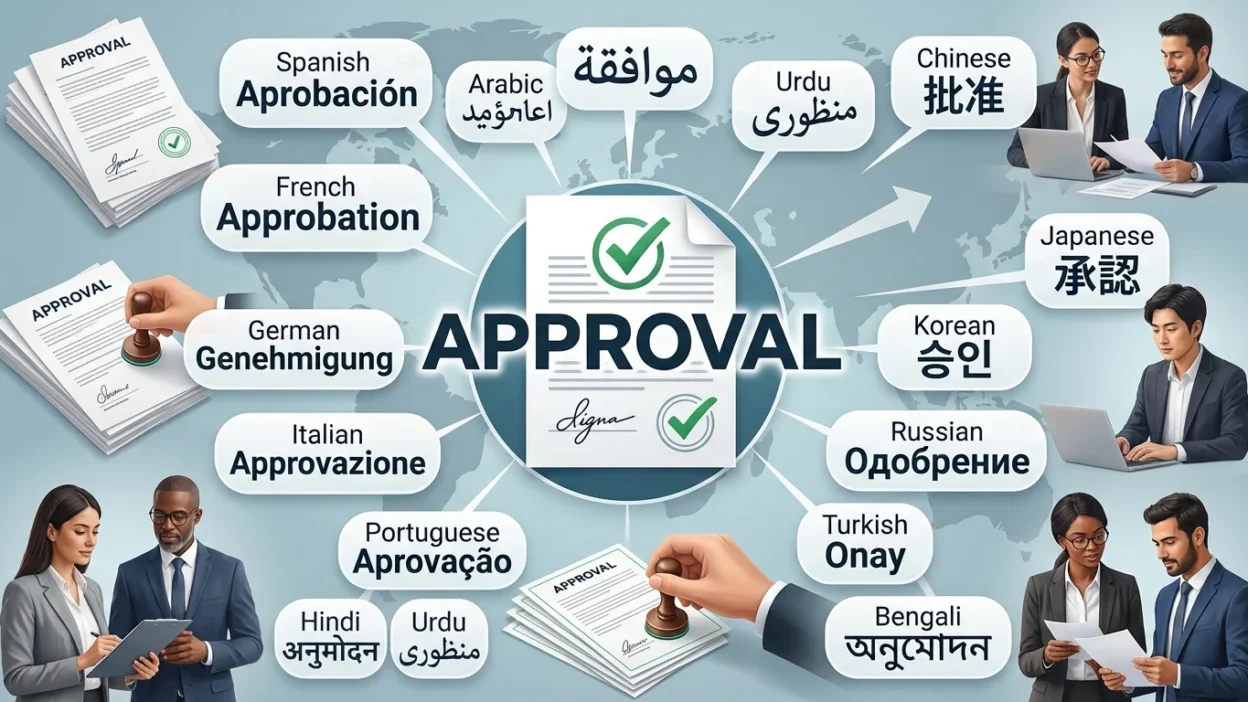
The word approval is used when someone agrees with, accepts, or officially permits something. It can describe personal agreement, support, permission, or formal authorisation from an organisation or authority.
Knowing how to say approval in different languages is useful for travellers, students, translators, international businesses, language learners, and anyone communicating with people from different cultures. The exact word can change depending on whether you mean personal support, permission, consent, or official authorisation.
Below, you will find approval in all languages in a simple language table. Each entry includes the native translation, an easy English pronunciation, and a practical example sentence with its English meaning.
Approval in Different Languages
| Language | Native phrase | Easy English pronunciation | Real-life example sentence | English meaning |
| Afrikaans | goedkeuring | khoot-KOY-ring | Ek wag vir goedkeuring. | I am waiting for approval. |
| Albanian | miratim | mee-RAH-teem | Ne kemi nevojë për miratim. | We need approval. |
| Arabic | موافقة | moo-WAA-fa-ka | نحتاج إلى موافقة المدير. | We need the manager’s approval. |
| Armenian | հաստատում | hahs-tah-TOOM | Մենք սպասում ենք հաստատմանը։ | We are waiting for approval. |
| Azerbaijani | təsdiq | tas-DEEK | Biz təsdiq gözləyirik. | We are waiting for approval. |
| Basque | onespena | oh-nes-PEH-na | Onespena behar dugu. | We need approval. |
| Belarusian | адабрэнне | ah-dah-BREN-nye | Нам патрэбна адабрэнне. | We need approval. |
| Bengali | অনুমোদন | oh-noo-mo-DHON | আমাদের অনুমোদন দরকার। | We need approval. |
| Bosnian | odobrenje | oh-doh-BREHN-yeh | Čekamo odobrenje. | We are waiting for approval. |
| Bulgarian | одобрение | oh-doh-BREH-nee-eh | Чакаме одобрение. | We are waiting for approval. |
| Catalan | aprovació | ah-proh-vah-see-OH | Necessitem aprovació. | We need approval. |
| Chinese (Mandarin) | 批准 | pīzhǔn | 我们需要批准。 | We need approval. |
| Croatian | odobrenje | oh-doh-BREHN-yeh | Čekamo odobrenje. | We are waiting for approval. |
| Czech | schválení | SKHVAH-leh-nee | Čekáme na schválení. | We are waiting for approval. |
| Danish | godkendelse | gohd-KEN-el-suh | Vi venter på godkendelse. | We are waiting for approval. |
| Dutch | goedkeuring | khoot-KOY-ring | We wachten op goedkeuring. | We are waiting for approval. |
| Estonian | heakskiit | HAKS-keet | Me ootame heakskiitu. | We are waiting for approval. |
| Filipino | pag-apruba | pag-ah-PROO-ba | Hinihintay namin ang pag-apruba. | We are waiting for approval. |
| Finnish | hyväksyntä | HYV-aksyn-tah | Odotamme hyväksyntää. | We are waiting for approval. |
| French | approbation | ah-proh-bah-SYON | Nous attendons l’approbation. | We are waiting for approval. |
| Galician | aprobación | ah-proh-bah-see-ON | Necesitamos aprobación. | We need approval. |
| Georgian | დამტკიცება | dam-TEE-tseh-bah | ჩვენ დამტკიცებას ველოდებით. | We are waiting for approval. |
| German | Genehmigung | geh-NAY-mee-goong | Wir warten auf die Genehmigung. | We are waiting for approval. |
| Greek | έγκριση | EN-gree-see | Περιμένουμε έγκριση. | We are waiting for approval. |
| Gujarati | મંજૂરી | man-ZOO-ree | અમને મંજૂરી જોઈએ. | We need approval. |
| Hebrew | אישור | ee-SHOOR | אנחנו מחכים לאישור. | We are waiting for approval. |
| Hindi | अनुमोदन | uh-noo-MOH-dun | हमें अनुमोदन चाहिए। | We need approval. |
| Hungarian | jóváhagyás | YOH-vah-hah-yahsh | Jóváhagyásra várunk. | We are waiting for approval. |
| Icelandic | samþykki | SAHM-thih-kee | Við bíðum eftir samþykki. | We are waiting for approval. |
| Indonesian | persetujuan | per-seh-too-JOO-an | Kami menunggu persetujuan. | We are waiting for approval. |
| Irish | ceadú | KYAD-oo | Táimid ag fanacht le ceadú. | We are waiting for approval. |
| Italian | approvazione | ah-proh-vah-TSYOH-neh | Aspettiamo l’approvazione. | We are waiting for approval. |
| Japanese | 承認 | shōnin | 承認を待っています。 | We are waiting for approval. |
| Kannada | ಅನುಮೋದನೆ | ah-noo-MOH-dah-neh | ನಮಗೆ ಅನುಮೋದನೆ ಬೇಕು. | We need approval. |
| Kazakh | мақұлдау | mah-kool-DAW | Біз мақұлдауды күтіп отырмыз. | We are waiting for approval. |
| Korean | 승인 | seung-in | 승인을 기다리고 있습니다. | We are waiting for approval. |
| Latvian | apstiprinājums | ahp-steep-ree-NAH-yooms | Mēs gaidām apstiprinājumu. | We are waiting for approval. |
| Lithuanian | patvirtinimas | pah-teer-tee-nee-mahs | Laukiame patvirtinimo. | We are waiting for approval. |
| Macedonian | одобрение | oh-doh-BREH-nee-eh | Чекаме одобрение. | We are waiting for approval. |
| Malay | kelulusan | keh-loo-LOO-sahn | Kami menunggu kelulusan. | We are waiting for approval. |
| Malayalam | അംഗീകാരം | an-gee-KAH-ram | ഞങ്ങൾ അംഗീകാരം കാത്തിരിക്കുന്നു. | We are waiting for approval. |
| Marathi | मान्यता | maan-YAH-ta | आम्हाला मान्यता हवी आहे. | We need approval. |
| Mongolian | зөвшөөрөл | tsohv-shuh-ROHL | Бид зөвшөөрөл хүлээж байна. | We are waiting for approval. |
| Nepali | अनुमोदन | ah-noo-MOH-dun | हामी अनुमोदनको प्रतीक्षा गर्दैछौं। | We are waiting for approval. |
| Norwegian | godkjenning | goo-SHYEN-ing | Vi venter på godkjenning. | We are waiting for approval. |
| Persian | تأیید | tah-YEED | ما منتظر تأیید هستیم. | We are waiting for approval. |
| Polish | zatwierdzenie | zah-tfyehr-DZEH-nyeh | Czekamy na zatwierdzenie. | We are waiting for approval. |
| Portuguese | aprovação | ah-proh-vah-SOWNG | Estamos à espera da aprovação. | We are waiting for approval. |
| Punjabi | ਮਨਜ਼ੂਰੀ | mun-ZOO-ree | ਸਾਨੂੰ ਮਨਜ਼ੂਰੀ ਚਾਹੀਦੀ ਹੈ। | We need approval. |
| Romanian | aprobare | ah-proh-BAH-reh | Așteptăm aprobarea. | We are waiting for approval. |
| Russian | одобрение | ah-dah-BREH-nee-yeh | Мы ждём одобрения. | We are waiting for approval. |
| Serbian | одобрење | oh-doh-BREHN-yeh | Čekamo odobrenje. | We are waiting for approval. |
| Slovak | schválenie | SKHVAH-leh-nee-eh | Čakáme na schválenie. | We are waiting for approval. |
| Slovenian | odobritev | oh-doh-BREE-tehv | Čakamo na odobritev. | We are waiting for approval. |
| Spanish | aprobación | ah-proh-bah-see-ON | Estamos esperando la aprobación. | We are waiting for approval. |
| Swahili | idhini | ee-DHEE-nee | Tunasubiri idhini. | We are waiting for approval. |
| Swedish | godkännande | good-SHEN-an-deh | Vi väntar på godkännande. | We are waiting for approval. |
| Tamil | ஒப்புதல் | ohp-poo-THAL | எங்களுக்கு ஒப்புதல் தேவை. | We need approval. |
| Telugu | ఆమోదం | aa-MOH-dam | మాకు ఆమోదం కావాలి. | We need approval. |
| Thai | การอนุมัติ | gaan ah-noo-MAT | เรากำลังรอการอนุมัติ | We are waiting for approval. |
| Turkish | onay | oh-NIGH | Onay bekliyoruz. | We are waiting for approval. |
| Ukrainian | схвалення | skhva-LEHN-nya | Ми чекаємо на схвалення. | We are waiting for approval. |
| Urdu | منظوری | man-ZOO-ree | ہمیں منظوری کا انتظار ہے۔ | We are waiting for approval. |
| Uzbek | tasdiq | tas-DEEK | Biz tasdiq kutyapmiz. | We are waiting for approval. |
| Vietnamese | sự chấp thuận | soo chap-thoo-AHN | Chúng tôi đang chờ sự chấp thuận. | We are waiting for approval. |
| Welsh | cymeradwyaeth | kuh-meh-rah-DOO-yeth | Rydym yn aros am gymeradwyaeth. | We are waiting for approval. |
| Yiddish | האַסקאָמע | HASK-oh-meh | מיר וואַרטן אויף האַסקאָמע. | We are waiting for approval. |
| Zulu | imvume | eem-VOO-meh | Silindele imvume. | We are waiting for approval. |
What Does “Approval” Mean?
Approval generally means agreement, acceptance, permission, or official authorisation.
For example:
- “The manager gave approval for the project.”
- “We need parental approval before travelling.”
- “The plan is waiting for official approval.”
- “She gave her approval to the proposal.”
The meaning depends on the situation. In business and government contexts, approval often refers to formal permission. In personal situations, it can mean support or agreement.
How to Say Approval in Different Languages
When learning how to say approval in different languages, it is important to remember that one English word may have several possible translations.
For example, the English word “approval” can refer to:
- official authorisation
- permission
- agreement
- acceptance
- support
- confirmation
- endorsement
This is why translations can differ between languages and situations.
The table above focuses mainly on words commonly used for official approval, authorisation, acceptance, or formal agreement.
Approval Translations Around the World
The idea of approval exists in virtually every culture, but languages express it in different ways.
In Spanish, aprobación is commonly used for approval or acceptance. In French, approbation can express agreement or approval, while autorisation may be more suitable when the meaning is permission.
German commonly uses Genehmigung when referring to formal permission or official approval. Italian uses approvazione, while Portuguese uses aprovação.
In Asian languages, the distinction between approval, permission, and authorisation can also depend heavily on context. Japanese uses 承認 (shōnin) for approval or recognition, while Korean uses 승인 (seung-in) for approval or authorisation.
Approval in Business and Professional Communication
Approval is a very common word in professional communication.
Companies may require approval before:
- launching a new product
- signing a contract
- spending money
- publishing a document
- changing a policy
- starting a project
- hiring an employee
- releasing a payment
For example, a business email might say, “We are waiting for management approval.”
When translating business documents, the context should always be considered. A formal word for approval may be more appropriate than a casual expression of agreement.
Approval, Permission and Consent: What Is the Difference?
These words are closely related but are not always interchangeable.
Approval usually means that someone accepts or agrees with something.
Permission means that someone allows an action to happen.
Consent generally means that a person agrees to something, often after being informed about what it involves.
For example:
- “The director approved the plan.”
- “The manager gave permission to leave early.”
- “The participant gave consent to take part.”
Understanding these differences helps you choose the right approval translation in another language.
Common Uses of Approval
The word “approval” can appear in many everyday and professional expressions.
Official approval
This refers to permission or acceptance from an authority.
Example: “The building plans received official approval.”
Management approval
This is commonly used in workplaces.
Example: “The purchase requires management approval.”
Final approval
This means the last stage of acceptance before something can proceed.
Example: “The document is ready for final approval.”
Public approval
This refers to support or acceptance from the public.
Example: “The proposal received public approval.”
Parental approval
This refers to permission or agreement from a parent or guardian.
Example: “The student needs parental approval.”
Why Learn Approval in Different Languages?
Learning approval in different languages can be useful in several situations.
International students may encounter approval-related vocabulary when completing applications. Travellers may need to understand permission or authorisation requirements. Employees working with international teams may use approval terms in emails, reports, contracts, and meetings.
Language learners can also use these translations to expand their vocabulary and understand how different languages express agreement and permission.
For businesses, knowing common approval translations can make international communication clearer and more professional.
How to Use Approval Naturally
The best translation depends on the sentence rather than the English word alone.
For example, “I approve of your decision” expresses personal agreement. However, “The government approved the application” refers to an official decision.
Likewise, “You need approval to enter” may actually be translated using a word meaning “permission” in some languages.
When translating documents, always consider the subject, relationship between speakers, and level of formality.
Approval in All Languages: Quick Reference
If you are searching for approval in all languages, the most useful approach is to compare the native word with a real sentence.
A dictionary translation gives you the basic equivalent, but an example sentence shows how the word behaves naturally.
This is particularly important for languages where approval, permission, consent, and authorisation are represented by different words.
The 70-language table provides both the translation and a practical example so that learners can understand the term in context.
Tips for Learning Approval Translations
Start with the languages that are most relevant to your work, travel, studies, or family communication.
Then practise the word in a complete sentence rather than memorising it alone. This makes it easier to remember the correct grammatical form.
It is also helpful to compare related terms such as “permission”, “consent”, “acceptance”, “agreement”, and “authorisation”. They may overlap with approval, but their meanings are not always identical.
For formal documents, always check the appropriate regional and professional usage before choosing a translation.
Conclusion
The word approval has an important role in everyday conversations, business communication, official documents, education, and international communication. Although the basic idea is similar around the world, different languages may use separate terms for approval, permission, consent, and authorisation.
This list of approval in different languages gives you 70 useful translations with pronunciation guides and real-life examples. Use the context of your sentence to choose the most natural translation and remember that formal and informal situations may require different expressions.
FAQs
1. How do you say “approval” in different languages?
“Approval” has different translations depending on the language. Examples include aprobación in Spanish, approvazione in Italian, approbation in French, Genehmigung in German, 承認 (shōnin) in Japanese, 승인 (seung-in) in Korean, and منظوری (manzoori) in Urdu.
2. What is the most common translation of approval?
There is no single universal translation because the correct word depends on the language and context. Many languages have separate expressions for official approval, permission, consent, and personal agreement.
3. How do you say “approval” in Spanish?
In Spanish, “approval” is commonly translated as aprobación. For example, “Estamos esperando la aprobación” means “We are waiting for approval.”
4. What is the difference between approval and permission?
Approval usually means accepting or agreeing with something, while permission means allowing someone to do something. In some languages, however, the same word may cover both meanings depending on context.
5. Why can approval have different translations in the same language?
The meaning of “approval” changes according to context. A business may need official authorisation, while a person may simply express agreement or support. As a result, different words can be more natural for different situations.