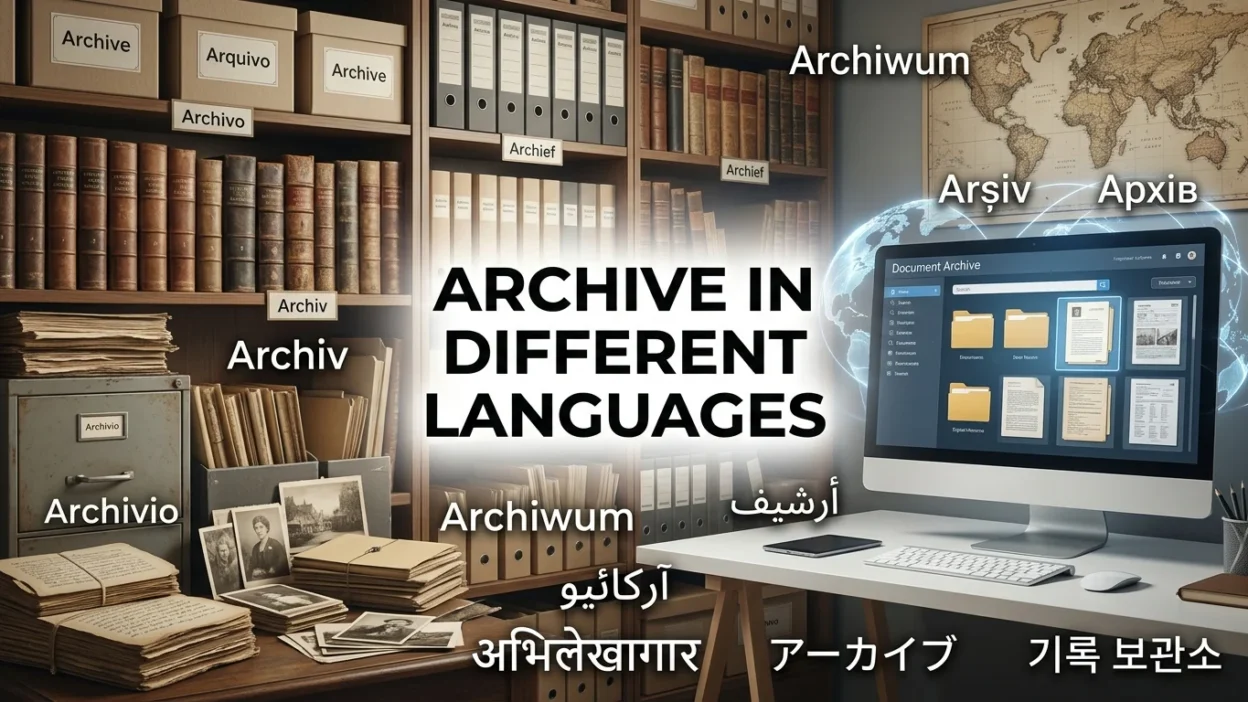
The word archive is used for a collection of historical documents, records, photographs, files, or other materials that are preserved for future reference. It can also refer to the place or system where these materials are stored.
Learning archive in different languages is useful for students, researchers, historians, translators, travellers, librarians, and anyone interested in international vocabulary. Although the basic meaning stays the same, each language may use a different word, spelling, or grammatical form.
In this guide, you will find archive in different languages in all languages, together with easy English pronunciation, a short example sentence, and its English meaning. This makes it easier to understand how to say archive in different languages and use the word naturally.
Archive in Different Languages
| Language | Correct Native Phrase | Easy English Pronunciation | Real-Life Example Sentence | English Meaning |
| English | Archive | AR-kive | The documents are in the archive. | The documents are stored in the archive. |
| Spanish | Archivo | ar-CHEE-boh | El documento está en el archivo. | The document is in the archive. |
| French | Archive | ar-SHEEV | Le document est dans les archives. | The document is in the archives. |
| German | Archiv | ar-KHEEF | Das Dokument ist im Archiv. | The document is in the archive. |
| Italian | Archivio | ar-KEE-vee-oh | Il documento è nell’archivio. | The document is in the archive. |
| Portuguese | Arquivo | ar-KEE-voh | O documento está no arquivo. | The document is in the archive. |
| Dutch | Archief | ar-KHEEF | Het document staat in het archief. | The document is in the archive. |
| Swedish | Arkiv | ar-KEEV | Dokumentet finns i arkivet. | The document is in the archive. |
| Norwegian | Arkiv | ar-KEEV | Dokumentet ligger i arkivet. | The document is in the archive. |
| Danish | Arkiv | ar-KEEV | Dokumentet er i arkivet. | The document is in the archive. |
| Finnish | Arkisto | AR-kis-toh | Asiakirja on arkistossa. | The document is in the archive. |
| Icelandic | Skjalasafn | SKYA-la-sapn | Skjalið er í skjalasafninu. | The document is in the archive. |
| Irish | Cartlann | KART-lan | Tá an doiciméad sa chartlann. | The document is in the archive. |
| Welsh | Archif | AR-khiv | Mae’r ddogfen yn yr archif. | The document is in the archive. |
| Scottish Gaelic | Tasglann | TAS-klan | Tha an sgrìobhainn anns an tasglann. | The document is in the archive. |
| Polish | Archiwum | ar-KHEE-voom | Dokument jest w archiwum. | The document is in the archive. |
| Czech | Archiv | AR-kheef | Dokument je v archivu. | The document is in the archive. |
| Slovak | Archív | AR-kheef | Dokument je v archíve. | The document is in the archive. |
| Slovenian | Arhiv | AR-kheef | Dokument je v arhivu. | The document is in the archive. |
| Croatian | Arhiv | AR-kheev | Dokument je u arhivu. | The document is in the archive. |
| Serbian | Архива | AR-khee-va | Документ је у архиви. | The document is in the archive. |
| Bosnian | Arhiv | AR-kheev | Dokument je u arhivu. | The document is in the archive. |
| Bulgarian | Архив | ar-KHEEF | Документът е в архива. | The document is in the archive. |
| Macedonian | Архива | ar-KHEE-va | Документот е во архивата. | The document is in the archive. |
| Russian | Архив | ar-KHEEF | Документ находится в архиве. | The document is in the archive. |
| Ukrainian | Архів | ar-KHEEV | Документ знаходиться в архіві. | The document is in the archive. |
| Belarusian | Архіў | ar-KHEEW | Дакумент знаходзіцца ў архіве. | The document is in the archive. |
| Lithuanian | Archyvas | ar-KHEE-vas | Dokumentas yra archyve. | The document is in the archive. |
| Latvian | Arhīvs | ar-KHEEVS | Dokuments ir arhīvā. | The document is in the archive. |
| Estonian | Arhiiv | ar-KHEEF | Dokument on arhiivis. | The document is in the archive. |
| Hungarian | Archívum | ar-KHEE-voom | A dokumentum az archívumban van. | The document is in the archive. |
| Romanian | Arhivă | ar-HEE-vuh | Documentul este în arhivă. | The document is in the archive. |
| Greek | Αρχείο | ar-KHEE-oh | Το έγγραφο είναι στο αρχείο. | The document is in the archive. |
| Albanian | Arkiv | ar-KEEV | Dokumenti është në arkiv. | The document is in the archive. |
| Turkish | Arşiv | ar-SHEEV | Belge arşivde. | The document is in the archive. |
| Azerbaijani | Arxiv | ar-KHEEV | Sənəd arxivdədir. | The document is in the archive. |
| Armenian | Արխիվ | ar-KHEEV | Փաստաթուղթը արխիվում է։ | The document is in the archive. |
| Georgian | არქივი | ar-KEE-vee | დოკუმენტი არქივშია. | The document is in the archive. |
| Persian | بایگانی | baa-yee-GAA-nee | سند در بایگانی است. | The document is in the archive. |
| Arabic | أرشيف | ar-SHEEF | الوثيقة في الأرشيف. | The document is in the archive. |
| Hebrew | ארכיון | ar-KHEE-yon | המסמך נמצא בארכיון. | The document is in the archive. |
| Hindi | अभिलेखागार | abhi-lay-khaa-GAAR | दस्तावेज़ अभिलेखागार में है। | The document is in the archive. |
| Urdu | آرکائیو | aar-KAI-voh | دستاویز آرکائیو میں ہے۔ | The document is in the archive. |
| Bengali | সংরক্ষণাগার | shong-ro-khon-aa-GAAR | নথিটি সংরক্ষণাগারে আছে। | The document is in the archive. |
| Punjabi | ਪੁਰਾਲੇਖ | poo-raa-LEKH | ਦਸਤਾਵੇਜ਼ ਪੁਰਾਲੇਖ ਵਿੱਚ ਹੈ। | The document is in the archive. |
| Gujarati | સંગ્રહાલય | sung-ra-HAA-lay | દસ્તાવેજ સંગ્રહાલયમાં છે. | The document is in the archive. |
| Marathi | अभिलेखागार | abhi-lay-khaa-GAAR | दस्तऐवज अभिलेखागारात आहे. | The document is in the archive. |
| Nepali | अभिलेखागार | abhi-lay-khaa-GAAR | कागजात अभिलेखागारमा छ। | The document is in the archive. |
| Sinhala | ලේඛනාගාරය | lay-kha-naa-GAA-ra-ya | ලේඛනය ලේඛනාගාරයේ ඇත. | The document is in the archive. |
| Tamil | காப்பகம் | KAA-pah-gam | ஆவணம் காப்பகத்தில் உள்ளது. | The document is in the archive. |
| Telugu | ఆర్కైవ్ | aar-KAIV | పత్రం ఆర్కైవ్లో ఉంది. | The document is in the archive. |
| Kannada | ಆರ್ಕೈವ್ | aar-KAIV | ದಾಖಲೆ ಆರ್ಕೈವ್ನಲ್ಲಿದೆ. | The document is in the archive. |
| Malayalam | ആർക്കൈവ് | aar-KAIV | രേഖ ആർക്കൈവിലുണ്ട്. | The document is in the archive. |
| Thai | หอจดหมายเหตุ | haw jot-MAI-hayt | เอกสารอยู่ในหอจดหมายเหตุ | The document is in the archive. |
| Vietnamese | Lưu trữ | loo TROO | Tài liệu nằm trong kho lưu trữ. | The document is in the archive. |
| Indonesian | Arsip | AR-seep | Dokumen itu ada di arsip. | The document is in the archive. |
| Malay | Arkib | AR-keeb | Dokumen itu ada dalam arkib. | The document is in the archive. |
| Filipino | Arkibo | ar-KEE-boh | Ang dokumento ay nasa arkibo. | The document is in the archive. |
| Javanese | Arsip | AR-seep | Dokumen kuwi ana ing arsip. | That document is in the archive. |
| Chinese (Mandarin) | 档案 | dàng àn | 文件在档案里。 | The document is in the archive. |
| Japanese | アーカイブ | AA-kaa-ibu | 文書はアーカイブにあります。 | The document is in the archive. |
| Korean | 기록 보관소 | gi-rok bo-gwan-so | 문서는 기록 보관소에 있습니다. | The document is in the archive. |
| Mongolian | Архив | ar-KHEEF | Баримт архивт байна. | The document is in the archive. |
| Kazakh | Мұрағат | moo-raa-GHAT | Құжат мұрағатта. | The document is in the archive. |
| Uzbek | Arxiv | ar-KHEEV | Hujjat arxivda. | The document is in the archive. |
| Swahili | Kumbukumbu | koom-boo-KOOM-boo | Hati iko kwenye kumbukumbu. | The document is in the archive. |
| Afrikaans | Argief | AR-kheef | Die dokument is in die argief. | The document is in the archive. |
| Zulu | Ingobo yomlando | in-GOH-boh yoh-MAHN-dloh | Umbhalo useyingobo yomlando. | The document is in the archive. |
| Amharic | መዝገብ ቤት | mez-GEB bet | ሰነዱ መዝገብ ቤት ውስጥ ነው። | The document is in the archive. |
| Latin | Archivum | ar-KHEE-voom | Documentum in archivo est. | The document is in the archive. |
What Does “Archive” Mean?
An archive is a collection or storage system used to preserve documents, records, photographs, manuscripts, digital files, historical materials, and other information.
For example, a museum may maintain an archive of old photographs. A university may have an archive containing research papers and historical documents. A website may also have an online archive containing older articles.
The word can refer to both the stored collection and the place or system used to store it, depending on the context.
How to Say “Archive” in Different Languages
If you are searching for how to say archive in different languages, you can see from the table that many European languages have closely related words.
For example, Spanish uses archivo, Italian uses archivio, German uses Archiv, French uses archive, and Polish uses archiwum.
Other languages have forms that developed through their own linguistic traditions. Persian uses بایگانی, Hindi uses अभिलेखागार, Tamil uses காப்பகம், and Kazakh uses Мұрағат.
In some languages, especially in modern digital contexts, a word related to the international term “archive” may also be commonly understood.
Archive Translations Around the World
The word archive is especially interesting because its translation can refer to either a physical collection or a digital storage system.
In European languages, many translations resemble one another. French archive, German Archiv, Italian archivio, Spanish archivo, Dutch archief, and English archive all share a recognisable historical connection.
In South Asian languages, the terminology can be more varied. Hindi uses अभिलेखागार, while Tamil uses காப்பகம் and Urdu commonly uses آرکائیو.
In East Asia, Mandarin Chinese uses 档案, Japanese commonly uses アーカイブ, and Korean uses 기록 보관소 for a records repository.
Physical Archives and Digital Archives
An archive does not have to be a physical building.
Physical Archive
A physical archive may contain:
- Historical documents
- Newspapers
- Photographs
- Letters
- Government records
- Manuscripts
- Maps
- Books
- Legal records
These materials are usually organised and preserved for future access.
Digital Archive
A digital archive stores information electronically. Examples include:
- Old website pages
- Digital photographs
- Electronic documents
- Videos
- Audio recordings
- Emails
- Scanned manuscripts
- Research databases
The word “archive” is therefore common in both historical and modern technology-related contexts.
Archive vs Library
An archive and a library are related but are not exactly the same.
A library generally collects published materials such as books, journals, magazines, and other resources for people to read or borrow.
An archive often preserves unique or historically important records, such as original letters, photographs, manuscripts, institutional documents, or personal papers.
For example, a university library may contain published books, while the university archive may preserve the institution’s original historical records.
Archive vs Record
The words archive and record are also closely related.
A record is an individual piece of information or documentation. An archive can contain a large collection of records preserved together.
For example:
- “This letter is an important record.”
- “The letter is stored in the historical archive.”
Understanding this distinction can make archive translations easier to use correctly.
Common Uses of “Archive”
The word archive appears in many everyday and professional contexts.
Historical archive:
“The museum has an extensive historical archive.”
Digital archive:
“The newspaper has a searchable digital archive.”
Online archive:
“You can find older articles in the online archive.”
Photo archive:
“The photographer keeps a large photo archive.”
Document archive:
“The company moved its old files to a secure archive.”
Archive as a verb:
“Please archive the old emails.”
The last example shows that “archive” can also function as a verb in English, particularly in computing and office environments.
Why Learn Archive in Different Languages?
Learning the word archive in different languages can be helpful in several situations.
For Students
Students researching history, literature, journalism, or cultural studies may encounter archive-related vocabulary frequently.
For Researchers
Researchers often work with national archives, university archives, libraries, museums, and digital collections.
For Travellers
Knowing the local word can help when visiting historical institutions, museums, libraries, and cultural centres.
For Language Learners
Learning practical nouns such as “archive” helps build vocabulary for education, technology, history, and professional communication.
For Digital Users
Modern websites, applications, email platforms, and social media services frequently use archive-related terminology.
How “Archive” Is Used in Technology
In modern technology, an archive can mean a place where older or inactive information is stored without necessarily deleting it.
For example, an email application may allow users to archive messages instead of deleting them. A website may maintain an archive of previous posts. A digital photo service may also provide archived files.
This technological meaning makes the word especially useful for anyone learning modern vocabulary.
Interesting Patterns in Archive Translations
Many European translations of “archive” have a similar appearance. Words such as Archiv, archivio, archivo, archief, and archiwum show how related vocabulary can develop across languages.
However, languages outside this group often use different terms. These differences make international vocabulary fascinating and demonstrate that translation is not always a simple word-for-word process.
The correct translation can depend on whether “archive” means a historical collection, a records repository, a digital archive, or the action of storing information.
Tips for Using Archive Translations Correctly
When learning archive in different languages, pay attention to context.
A word may refer to:
- A physical archive.
- A historical collection.
- A records repository.
- A digital archive.
- Archived files.
- The act of archiving information.
Some languages use different expressions depending on these meanings. Therefore, the most natural translation may change according to the sentence.
FAQs
1. What is archive in different languages?
“Archive” has different translations across the world. Examples include archivo in Spanish, archive in French, Archiv in German, archivio in Italian, arşiv in Turkish, آرکائیو in Urdu, 档案 in Chinese, and アーカイブ in Japanese.
2. How do you say archive in Spanish?
The Spanish word for archive is archivo. For example, “El documento está en el archivo” means “The document is in the archive.”
3. What is archive in French?
The French word is archive. In the plural, archives is commonly used when referring to archival collections or records.
4. What is archive in Japanese?
Japanese commonly uses アーカイブ for “archive,” particularly in modern digital contexts. Traditional or more specific archival terminology can vary according to context.
5. What is archive in Urdu?
In Urdu, “archive” is commonly expressed as آرکائیو. The word is frequently used for collections or systems where documents and historical materials are preserved.
Conclusion
The word archive has many fascinating translations around the world. While languages such as Spanish, French, German, Italian, Dutch, and Polish use closely related forms, other languages use distinctive words based on their own linguistic traditions.
This list of 70 archive translations can help language learners, researchers, students, travellers, and digital users understand how the concept is expressed internationally. Whether you are talking about historical documents, photographs, records, websites, or digital files, knowing the local word for archive can make communication more accurate and natural.