The word “woman” is one of the most useful everyday words to learn when exploring another language. Whether you are travelling, studying languages, communicating with people from different cultures, or simply curious about world languages, knowing how to say “woman” can help you understand basic conversations and vocabulary.
In this guide, you will find woman in different languages, including the native word, an easy English pronunciation, and a short example sentence. The table covers exactly languages from different regions around the world.
If you are searching for woman in all languages, wondering how to say woman in different languages, or looking for woman translations around the world, this list provides a simple reference.
Woman in Different Languages
| Language | Native Phrase | Easy English Pronunciation | Example Sentence | English Meaning |
| Afrikaans | vrou | froh | Die vrou is vriendelik. | The woman is kind. |
| Albanian | grua | GROO-ah | Gruaja është e sjellshme. | The woman is polite. |
| Arabic | امرأة | im-RA-ah | المرأة سعيدة. | The woman is happy. |
| Armenian | կին | keen | Կինը բարի է։ | The woman is kind. |
| Azerbaijani | qadın | gah-DUN | Qadın xoşbəxtdir. | The woman is happy. |
| Basque | emakume | eh-mah-KOO-meh | Emakumea atsegina da. | The woman is pleasant. |
| Belarusian | жанчына | zhan-CHEE-na | Жанчына ўсміхаецца. | The woman is smiling. |
| Bengali | নারী | NA-ree | নারীটি হাসছে। | The woman is smiling. |
| Bosnian | žena | ZHEH-nah | Žena je ljubazna. | The woman is kind. |
| Bulgarian | жена | zheh-NAH | Жената е добра. | The woman is good. |
| Catalan | dona | DOH-nah | La dona és amable. | The woman is kind. |
| Chinese (Mandarin) | 女人 | nǚ rén | 那个女人很友好。 | That woman is friendly. |
| Croatian | žena | ZHEH-nah | Žena je sretna. | The woman is happy. |
| Czech | žena | ZHEH-nah | Žena je milá. | The woman is nice. |
| Danish | kvinde | KVEEN-neh | Kvinden er venlig. | The woman is kind. |
| Dutch | vrouw | frow | De vrouw is aardig. | The woman is kind. |
| Estonian | naine | NAI-neh | Naine on lahke. | The woman is kind. |
| Finnish | nainen | NAI-nen | Nainen on ystävällinen. | The woman is friendly. |
| French | femme | fahm | La femme est gentille. | The woman is kind. |
| Georgian | ქალი | kah-lee | ქალი კეთილია. | The woman is kind. |
| German | Frau | frow | Die Frau ist freundlich. | The woman is friendly. |
| Greek | γυναίκα | yi-NEH-kah | Η γυναίκα είναι ευγενική. | The woman is polite. |
| Gujarati | સ્ત્રી | stree | સ્ત્રી દયાળુ છે. | The woman is kind. |
| Haitian Creole | fanm | fahm | Fanm nan janti. | The woman is kind. |
| Hebrew | אישה | ee-SHAH | האישה נחמדה. | The woman is nice. |
| Hindi | महिला | ma-HEE-la | महिला खुश है। | The woman is happy. |
| Hungarian | nő | nuh | A nő kedves. | The woman is kind. |
| Icelandic | kona | KOH-na | Konan er vingjarnleg. | The woman is friendly. |
| Indonesian | wanita | wah-NEE-tah | Wanita itu ramah. | That woman is friendly. |
| Irish | bean | ban | Tá an bhean cineálta. | The woman is kind. |
| Italian | donna | DON-nah | La donna è gentile. | The woman is kind. |
| Japanese | 女性 | josei | その女性は親切です。 | That woman is kind. |
| Kannada | ಮಹಿಳೆ | ma-hi-LAY | ಮಹಿಳೆ ಒಳ್ಳೆಯವಳು. | The woman is good. |
| Kazakh | әйел | ah-YEL | Әйел мейірімді. | The woman is kind. |
| Khmer | ស្ត្រី | srei | ស្ត្រីនោះសប្បាយចិត្ត។ | That woman is happy. |
| Korean | 여자 | yeo-ja | 그 여자는 친절해요. | That woman is kind. |
| Lao | ແມ່ຍິງ | mae-ying | ແມ່ຍິງໃຈດີ. | The woman is kind. |
| Latvian | sieviete | SYEH-vee-eh-teh | Sieviete ir laipna. | The woman is kind. |
| Lithuanian | moteris | moh-teh-RIS | Moteris yra maloni. | The woman is pleasant. |
| Macedonian | жена | ZHEH-nah | Жената е љубезна. | The woman is kind. |
| Malay | wanita | wah-NEE-tah | Wanita itu baik. | That woman is good. |
| Malayalam | സ്ത്രീ | stree | സ്ത്രീ ദയയുള്ളവളാണ്. | The woman is kind. |
| Maltese | mara | MAH-rah | Il-mara hija tajba. | The woman is good. |
| Marathi | स्त्री | stree | ती स्त्री दयाळू आहे. | That woman is kind. |
| Mongolian | эмэгтэй | eh-MEG-tai | Тэр эмэгтэй эелдэг. | That woman is polite. |
| Nepali | महिला | ma-HEE-la | महिला खुसी छिन्। | The woman is happy. |
| Norwegian | kvinne | KVIN-neh | Kvinnen er vennlig. | The woman is friendly. |
| Pashto | ښځه | khudza | ښځه مهربانه ده. | The woman is kind. |
| Persian | زن | zan | زن مهربان است. | The woman is kind. |
| Polish | kobieta | koh-BYEH-tah | Kobieta jest miła. | The woman is nice. |
| Portuguese | mulher | moo-LYEHR | A mulher é gentil. | The woman is kind. |
| Punjabi | ਔਰਤ | OR-at | ਔਰਤ ਦਿਆਲੂ ਹੈ। | The woman is kind. |
| Romanian | femeie | feh-MAY-eh | Femeia este amabilă. | The woman is kind. |
| Russian | женщина | ZHEN-shchi-na | Женщина добрая. | The woman is kind. |
| Serbian | жена | ZHEH-nah | Žena je ljubazna. | The woman is kind. |
| Slovak | žena | ZHEH-nah | Žena je milá. | The woman is nice. |
| Slovenian | ženska | ZHEN-skah | Ženska je prijazna. | The woman is friendly. |
| Spanish | mujer | moo-HER | La mujer es amable. | The woman is kind. |
| Swahili | mwanamke | mwah-NAHM-keh | Mwanamke ni mkarimu. | The woman is generous. |
| Swedish | kvinna | KVEEN-nah | Kvinnan är vänlig. | The woman is friendly. |
| Tamil | பெண் | pen | பெண் அன்பானவர். | The woman is kind. |
| Telugu | మహిళ | ma-hi-LA | మహిళ దయగలది. | The woman is kind. |
| Thai | ผู้หญิง | poo-ying | ผู้หญิงคนนั้นใจดี | That woman is kind. |
| Turkish | kadın | kah-DUN | Kadın çok nazik. | The woman is very polite. |
| Ukrainian | жінка | ZHEEN-kah | Жінка добра. | The woman is kind. |
| Urdu | عورت | OR-at | عورت مہربان ہے۔ | The woman is kind. |
| Uzbek | ayol | ah-YOL | Ayol mehribon. | The woman is kind. |
| Vietnamese | phụ nữ | foo noo | Người phụ nữ rất tốt. | The woman is very kind. |
| Welsh | menyw | MEN-oo | Mae’r fenyw yn garedig. | The woman is kind. |
| Yiddish | פֿרוי | froy | די פֿרוי איז ליב. | The woman is kind. |
| Zulu | owesifazane | oh-weh-see-fah-ZAH-neh | Owesifazane unomusa. | The woman is kind. |
What Does “Woman” Mean?
Woman refers to an adult female human. It is a common English noun used when talking about an adult female person.
The word can appear in everyday conversations, descriptions, stories, news, education, and formal writing. Different languages may use different forms depending on grammatical gender, number, case, or context.
For example:
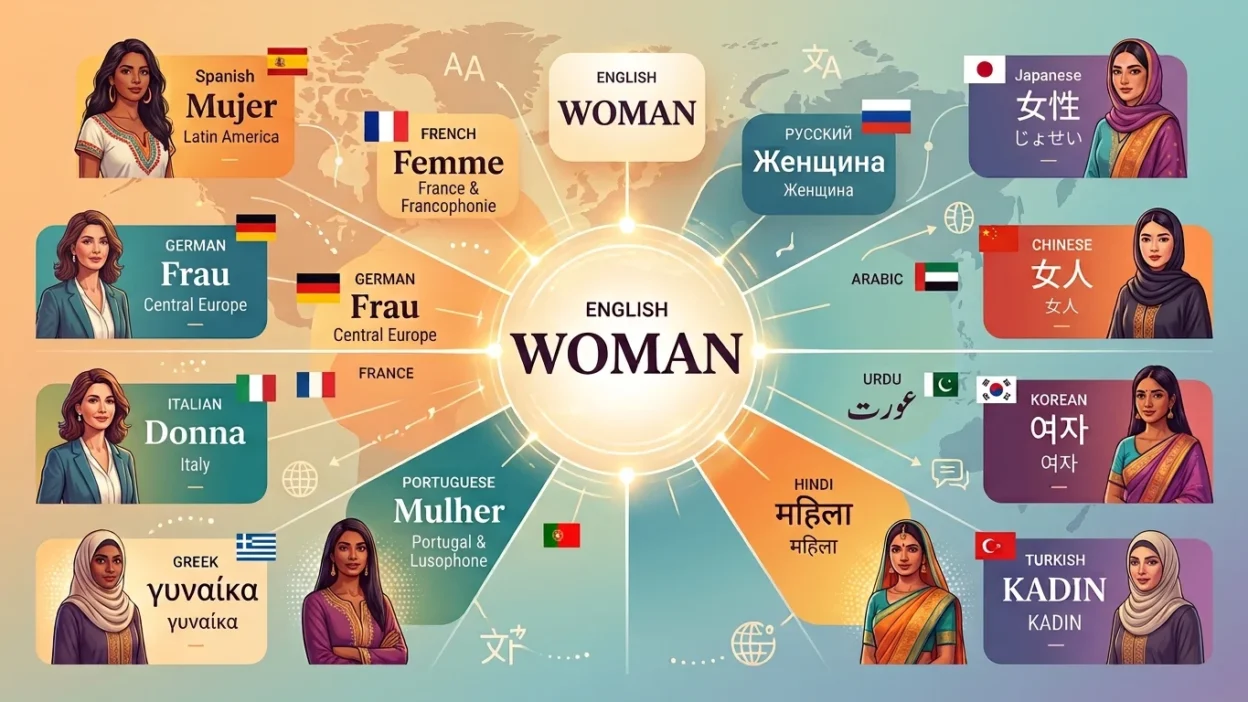
- English: woman
- French: femme
- Spanish: mujer
- German: Frau
- Italian: donna
- Japanese: 女性
- Arabic: امرأة
- Hindi: महिला
- Urdu: عورت
How to Say “Woman” in Different Languages
There are many ways to express woman in different languages. Some languages have one common everyday word, while others have several expressions depending on age, formality, social context, or the specific meaning intended.
For example, Japanese uses 女性 (josei) as a relatively neutral or formal expression for “woman”, while Korean commonly uses 여자 (yeoja) in everyday speech.
Similarly, English has related words such as “lady”, but “lady” and “woman” are not always interchangeable because they can carry different levels of formality and social meaning.
Woman Translations Around the World
The translations above show how one simple English word can look and sound very different across languages.
In Romance languages, you may encounter forms such as femme, mujer, donna, mulher, and dona. Germanic languages include forms such as Frau, vrouw, vrou, and kvinna.
Languages from South and East Asia also have their own distinct vocabulary. Hindi uses महिला, Urdu uses عورت, Mandarin Chinese uses 女人, Japanese uses 女性, and Korean uses 여자.
Learning these translations is useful for language students because it introduces not only vocabulary but also different writing systems and pronunciation patterns.
“Woman” in European Languages
European languages provide a wide variety of translations for the word woman.
For example:
- French: femme
- Spanish: mujer
- Italian: donna
- Portuguese: mulher
- German: Frau
- Dutch: vrouw
- Polish: kobieta
- Russian: женщина
- Greek: γυναίκα
- Swedish: kvinna
Although several European languages share historical roots, their modern words for “woman” can be surprisingly different.
“Woman” in Asian Languages
Asia contains thousands of languages and many different writing systems. The word “woman” therefore appears in numerous forms.
Some examples include:
- Hindi: महिला
- Bengali: নারী
- Punjabi: ਔਰਤ
- Urdu: عورت
- Persian: زن
- Mandarin Chinese: 女人
- Japanese: 女性
- Korean: 여자
- Thai: ผู้หญิง
- Vietnamese: phụ nữ
These translations demonstrate the linguistic diversity of the region.
Common Ways to Use the Word “Woman”
The word “woman” can be used in many everyday sentences.
Here are a few simple English examples:
- The woman is a teacher.
- That woman is my neighbour.
- I saw a woman at the shop.
- The woman helped me.
- She is a very kind woman.
When translating these sentences, the exact form of “woman” may change depending on grammatical rules in the target language.
Why Learn “Woman” in Different Languages?
Learning basic words in multiple languages can make communication easier and improve cultural awareness.
The word woman is especially useful because it appears frequently in conversations, descriptions, books, articles, films, and everyday situations.
Studying woman in different languages in all languages can also help learners recognise related vocabulary when travelling or studying a new language.
Woman in Different Languages: Key Takeaways
The English word woman has many different translations around the world. While some languages use a short everyday term, others have formal and informal alternatives.
The most useful translations to remember include:
- Spanish: mujer
- French: femme
- German: Frau
- Italian: donna
- Portuguese: mulher
- Arabic: امرأة
- Hindi: महिला
- Urdu: عورت
- Chinese: 女人
- Japanese: 女性
- Korean: 여자
- Russian: женщина
- Turkish: kadın
Remember that pronunciation can vary by region, and the most appropriate translation can depend on context.
Conclusion
Knowing how to say woman in different languages is a simple but useful way to expand your vocabulary and explore linguistic diversity. From femme in French and mujer in Spanish to 女性 in Japanese and 여자 in Korean, the same basic idea takes many fascinating forms around the world.
This language list provides a convenient starting point for language learners, travellers, students, and anyone interested in woman translations around the world.
FAQs
1. How do you say “woman” in different languages?
“Woman” has different translations depending on the language. For example, it is mujer in Spanish, femme in French, Frau in German, donna in Italian, mulher in Portuguese, and kadın in Turkish.
2. What is the word for woman in languages?
There are many translations for “woman” across the world’s languages. This article provides exactly examples, including the native word, easy pronunciation, and an example sentence for each language.
3. How do you say “woman” in the most common languages?
Some common translations include woman in English, mujer in Spanish, femme in French, Frau in German, donna in Italian, mulher in Portuguese, 女人 in Mandarin Chinese, and 女性 in Japanese.
4. What is “woman” in Hindi and Urdu?
In Hindi, “woman” can be expressed as महिला (mahila). In Urdu, a common word is عورت (aurat). The appropriate term can vary depending on context and register.
5. Why are there different words for “woman” in different languages?
Every language develops its own vocabulary and grammatical system. Historical development, culture, pronunciation, and grammatical rules all contribute to the different words used for the same basic concept.