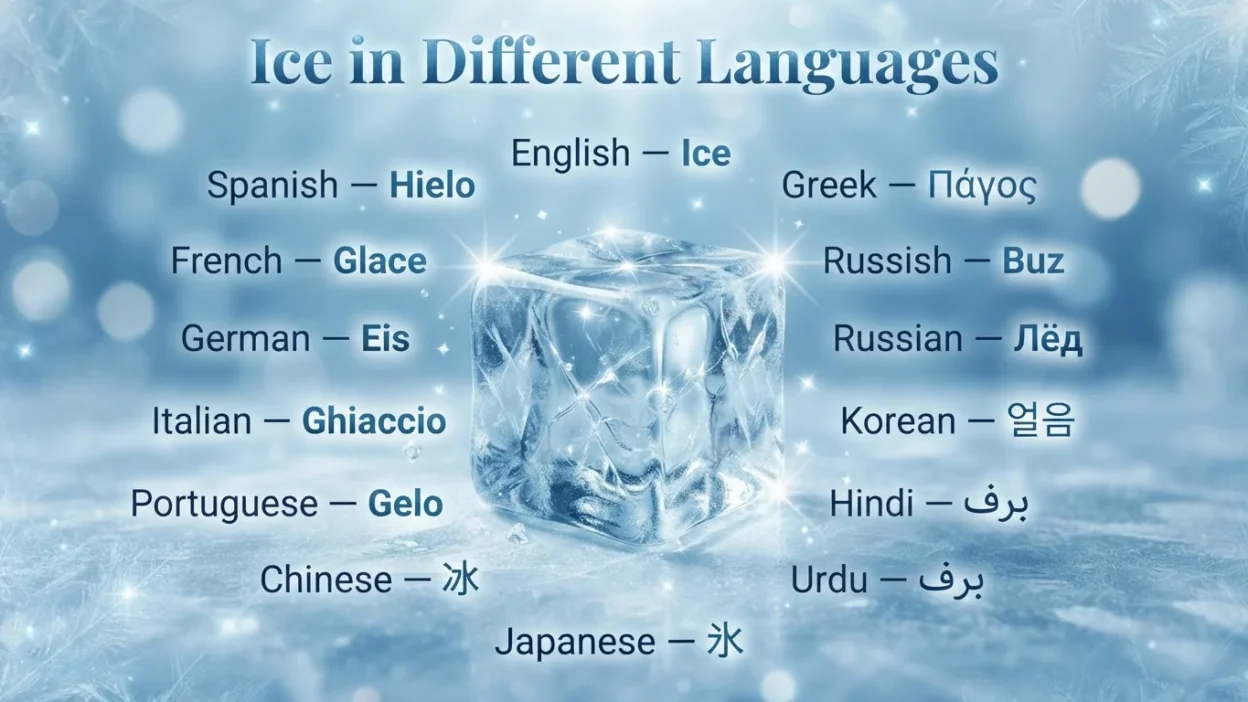
Ice is a simple everyday word, but its translation changes from one language to another. Whether you are learning a new language, travelling, studying vocabulary, or simply curious about world languages, knowing how to say “ice” can be a useful starting point.
In this guide, you will discover ice in different languages with the correct native word, an easy English pronunciation, and a short real-life example. The examples make it easier to understand how each translation can be used naturally in conversation.
The table below covers different languages, making it a useful reference for anyone searching for ice in different languages in all languages, ice translations, or how to say ice in different languages.
Ice in Different Languages
| Language | Correct Native Phrase | Easy English Pronunciation | Example Sentence | English Meaning of Example |
| Afrikaans | ys | ice | Ek sit ys in my drankie. | I put ice in my drink. |
| Albanian | akull | ah-KOOL | Dua akull në pije. | I want ice in the drink. |
| Arabic | ثلج | thalj | أريد بعض الثلج. | I want some ice. |
| Armenian | սառույց | sah-ROOYTS | Ես սառույց եմ ուզում։ | I want ice. |
| Azerbaijani | buz | booz | İçkimə buz istəyirəm. | I want ice in my drink. |
| Basque | izotz | ee-LOTS | Izotza nahi dut. | I want ice. |
| Belarusian | лёд | lyot | Мне патрэбен лёд. | I need ice. |
| Bengali | বরফ | bo-rof | আমার বরফ দরকার। | I need ice. |
| Bosnian | led | led | Želim led u piću. | I want ice in the drink. |
| Bulgarian | лед | let | Искам лед. | I want ice. |
| Catalan | gel | zhel | Vull gel a la beguda. | I want ice in the drink. |
| Chinese (Mandarin) | 冰 | bīng | 我要冰。 | I want ice. |
| Croatian | led | led | Želim led u piću. | I want ice in the drink. |
| Czech | led | let | Chci led. | I want ice. |
| Danish | is | ees | Jeg vil have is. | I want ice. |
| Dutch | ijs | eyes | Ik wil ijs in mijn drankje. | I want ice in my drink. |
| Estonian | jää | yeh | Ma tahan jääd. | I want ice. |
| Filipino | yelo | YEH-loh | Gusto ko ng yelo. | I want ice. |
| Finnish | jää | yeh | Haluan jäätä. | I want ice. |
| French | glace | glass | Je veux de la glace. | I want some ice. |
| Georgian | ყინული | q’inuli | ყინული მინდა. | I want ice. |
| German | Eis | ice | Ich möchte Eis. | I would like ice. |
| Greek | πάγος | PA-gos | Θέλω πάγο. | I want ice. |
| Gujarati | બરફ | bu-raf | મને બરફ જોઈએ છે. | I need ice. |
| Haitian Creole | glas | glass | Mwen vle glas. | I want ice. |
| Hausa | kankara | kan-KA-ra | Ina son kankara. | I want ice. |
| Hebrew | קרח | KEH-rahkh | אני רוצה קרח. | I want ice. |
| Hindi | बर्फ | barf | मुझे बर्फ चाहिए। | I need ice. |
| Hungarian | jég | yayg | Jeget kérek. | I would like ice. |
| Icelandic | ís | ees | Ég vil hafa ís. | I want ice. |
| Indonesian | es | ess | Saya mau es. | I want ice. |
| Irish | oighear | EE-er | Ba mhaith liom oighear. | I would like ice. |
| Italian | ghiaccio | GYAH-cho | Voglio del ghiaccio. | I want some ice. |
| Japanese | 氷 | kōri | 氷が欲しいです。 | I want ice. |
| Kannada | ಮಂಜುಗಡ್ಡೆ | man-ju-gad-de | ನನಗೆ ಮಂಜುಗಡ್ಡೆ ಬೇಕು. | I need ice. |
| Kazakh | мұз | mooz | Маған мұз керек. | I need ice. |
| Khmer | ទឹកកក | tuk-kok | ខ្ញុំចង់បានទឹកកក។ | I want ice. |
| Korean | 얼음 | eo-reum | 얼음을 주세요. | Please give me ice. |
| Lao | ນ້ຳກ້ອນ | nam-kon | ຂ້ອຍຕ້ອງການນ້ຳກ້ອນ. | I need ice. |
| Latin | glacies | GLAH-kee-es | Glaciem volo. | I want ice. |
| Latvian | ledus | LEH-doos | Es gribu ledu. | I want ice. |
| Lithuanian | ledas | LEH-das | Aš noriu ledo. | I want ice. |
| Macedonian | мраз | mraz | Сакам мраз. | I want ice. |
| Malay | ais | ice | Saya mahu ais. | I want ice. |
| Malayalam | മഞ്ഞ് | manj | എനിക്ക് മഞ്ഞ് വേണം. | I need ice. |
| Maltese | silġ | silch | Irrid silġ. | I want ice. |
| Marathi | बर्फ | barf | मला बर्फ हवा आहे. | I want ice. |
| Mongolian | мөс | moos | Надад мөс хэрэгтэй. | I need ice. |
| Nepali | बरफ | ba-raf | मलाई बरफ चाहिन्छ। | I need ice. |
| Norwegian | is | ees | Jeg vil ha is. | I want ice. |
| Pashto | یخ | yakh | زه یخ غواړم. | I want ice. |
| Persian | یخ | yakh | من یخ میخواهم. | I want ice. |
| Polish | lód | lood | Chcę lód. | I want ice. |
| Portuguese | gelo | ZHEH-lo | Quero gelo. | I want ice. |
| Punjabi | ਬਰਫ਼ | barf | ਮੈਨੂੰ ਬਰਫ਼ ਚਾਹੀਦੀ ਹੈ। | I need ice. |
| Romanian | gheață | GYATS-uh | Vreau gheață. | I want ice. |
| Russian | лёд | lyot | Я хочу лёд. | I want ice. |
| Serbian | лед | led | Želim led. | I want ice. |
| Slovak | ľad | lyat | Chcem ľad. | I want ice. |
| Slovenian | led | led | Želim led. | I want ice. |
| Somali | baraf | ba-raf | Waxaan rabaa baraf. | I want ice. |
| Spanish | hielo | YEH-loh | Quiero hielo. | I want ice. |
| Swahili | barafu | ba-RA-foo | Nataka barafu. | I want ice. |
| Swedish | is | ees | Jag vill ha is. | I want ice. |
| Tamil | பனி | pa-ni | எனக்கு பனி வேண்டும். | I need ice. |
| Telugu | మంచు | man-chu | నాకు మంచు కావాలి. | I need ice. |
| Thai | น้ำแข็ง | naam-khaeng | ฉันต้องการน้ำแข็ง | I need ice. |
| Turkish | buz | booz | Buz istiyorum. | I want ice. |
| Ukrainian | лід | leed | Я хочу льоду. | I want ice. |
| Urdu | برف | barf | مجھے برف چاہیے۔ | I need ice. |
| Uzbek | muz | mooz | Menga muz kerak. | I need ice. |
| Vietnamese | đá | dah | Tôi muốn đá. | I want ice. |
| Welsh | rhew | hrehw | Dw i eisiau rhew. | I want ice. |
| Yiddish | אייז | eyes | איך וויל אייז. | I want ice. |
| Zulu | iqhwa | ee-KHWA | Ngifuna iqhwa. | I want ice. |
How to Say Ice in Different Languages
The English word ice has many different forms around the world. Some translations are short, such as is in Danish, Norwegian, and Swedish, while others have completely different sounds and spellings.
For example, Spanish uses hielo, French uses glace, German uses Eis, Italian uses ghiaccio, and Portuguese uses gelo.
Asian languages also have distinctive words for ice. Mandarin Chinese uses 冰, Japanese uses 氷, Korean uses 얼음, and Thai uses น้ำแข็ง.
Learning these words can be particularly useful when ordering cold drinks, discussing weather, talking about winter, or travelling internationally.
Ice in Different Languages Around the World
The word for ice can vary considerably between language families.
In many European languages, related historical roots can sometimes be seen in modern vocabulary. German Eis, Dutch ijs, Danish is, Swedish is, Norwegian is, and Icelandic ís all have noticeably similar forms.
Romance languages have their own distinct vocabulary. French uses glace, Italian uses ghiaccio, Spanish uses hielo, Portuguese uses gelo, Romanian uses gheață, and Catalan uses gel.
Other languages use completely different words. Hindi, Urdu, Punjabi, Bengali, Marathi, and Gujarati use forms based around barf or closely related vocabulary. Turkish uses buz, while Persian and Pashto use yakh.
This variety makes ice in different languages around the world an interesting example of how languages express the same everyday idea in very different ways.
Ice Translations for Travel and Everyday Conversation
Knowing the local word for ice can be surprisingly helpful while travelling.
If you are ordering a cold drink, you may need to ask for ice or request extra ice. Learning the word alone is useful, but learning it in a short sentence is even better.
For example:
- Spanish: Quiero hielo.
- French: Je veux de la glace.
- German: Ich möchte Eis.
- Italian: Voglio del ghiaccio.
- Portuguese: Quero gelo.
- Turkish: Buz istiyorum.
- Japanese: 氷が欲しいです。
- Korean: 얼음을 주세요.
The sentence structure changes from language to language, but the key vocabulary remains easy to identify once you know the translation.
Ice in European Languages
European languages offer some fascinating similarities and differences.
German uses Eis, while Dutch uses ijs. Scandinavian languages are particularly interesting because Danish, Norwegian, and Swedish use is, whereas Icelandic uses ís.
Spanish uses hielo, while Portuguese uses gelo. Italian has the distinctive word ghiaccio, and French uses glace.
Eastern European languages also have several related-looking forms. Russian uses лёд, Ukrainian uses лід, Bulgarian uses лед, Serbian uses лед, Croatian uses led, and Slovenian uses led.
These differences show why studying ice translations can be a useful introduction to vocabulary patterns across related languages.
Ice in Asian Languages
Asian languages provide a wide range of words and writing systems for the concept of ice.
In Mandarin Chinese, ice is 冰. Japanese uses 氷, while Korean uses 얼음. These words look and sound very different even though they refer to the same everyday object.
Hindi uses बर्फ, Urdu uses برف, Punjabi uses ਬਰਫ਼, and Bengali uses বরফ. Several South Asian languages therefore have vocabulary that sounds closely related.
Turkish uses buz, Persian uses یخ, and Pashto uses یخ. Indonesian uses es, while Malay uses ais.
These translations are useful for language learners who want to understand how to say ice in different languages in practical situations.
Why Learn the Word Ice in Different Languages?
Learning a single everyday word in multiple languages can be a simple way to expand your vocabulary.
“Ice” is especially useful because it appears in conversations about drinks, food, weather, winter, refrigeration, travel, and everyday activities.
It can also help language learners recognise related words when reading menus, signs, recipes, or conversations.
For students, travellers, writers, and multilingual learners, a list of ice in all languages provides a convenient reference that can be revisited whenever needed.
Common Uses of the Word Ice
The word “ice” can describe frozen water, but its use extends into many everyday contexts.
You may hear it when someone asks for ice in a drink, talks about an icy road, describes a frozen lake, or discusses cold weather.
For example:
“Can I have some ice?” is useful when ordering a drink.
“The ice is melting.” describes frozen water becoming liquid.
“Be careful, there is ice on the road.” is useful when talking about slippery winter conditions.
The exact translation depends on the language and the context in which the word is being used.
Ice vs. Snow: Are They the Same?
Ice and snow are related because both involve frozen water, but they are not the same thing.
Ice is generally frozen water in a solid state. It can form in cubes, sheets, lakes, rivers, or other solid structures.
Snow consists of ice crystals that form in clouds and fall to the ground.
This distinction matters when learning vocabulary because most languages have separate words for ice and snow. Learning both words can make your conversations more accurate.
Tips for Remembering Ice Translations
A good way to remember translations is to connect each word with a practical situation.
For example, imagine ordering a cold drink in Spanish and saying Quiero hielo. For German, remember Eis when picturing an ice cube in a glass.
You can also group languages together. Danish, Norwegian, and Swedish all use is, which makes these three translations relatively easy to remember.
Writing each word in its native script can also improve recognition, especially for languages such as Arabic, Hindi, Japanese, Korean, Chinese, Thai, and Greek.
FAQs
1. How do you say ice in different languages?
The word “ice” changes from language to language. Some examples include hielo in Spanish, glace in French, Eis in German, ghiaccio in Italian, gelo in Portuguese, 氷 in Japanese, and 얼음 in Korean.
2. What is ice called in Spanish?
Ice is called hielo in Spanish. A common sentence is Quiero hielo, which means “I want ice.”
3. What is the word for ice in French?
The French word for ice is glace. For example, Je veux de la glace means “I want some ice.”
4. How do you say ice in Japanese?
Ice is 氷 in Japanese, commonly read as kōri. A useful sentence is 氷が欲しいです, meaning “I want ice.”
5. What is ice called in Hindi and Urdu?
In Hindi, ice is बर्फ, while in Urdu it is برف. Both are commonly pronounced approximately as “barf.”
Conclusion
The word “ice” may seem simple, but its translations reveal the incredible variety of languages spoken around the world. From hielo in Spanish and glace in French to 氷 in Japanese and برف in Urdu, each language gives this everyday concept its own form.
This collection of translations makes it easier to learn ice in different languages, understand common expressions, and explore vocabulary from different parts of the world. Whether you are studying languages, travelling, or simply expanding your vocabulary, these translations provide a useful starting point.