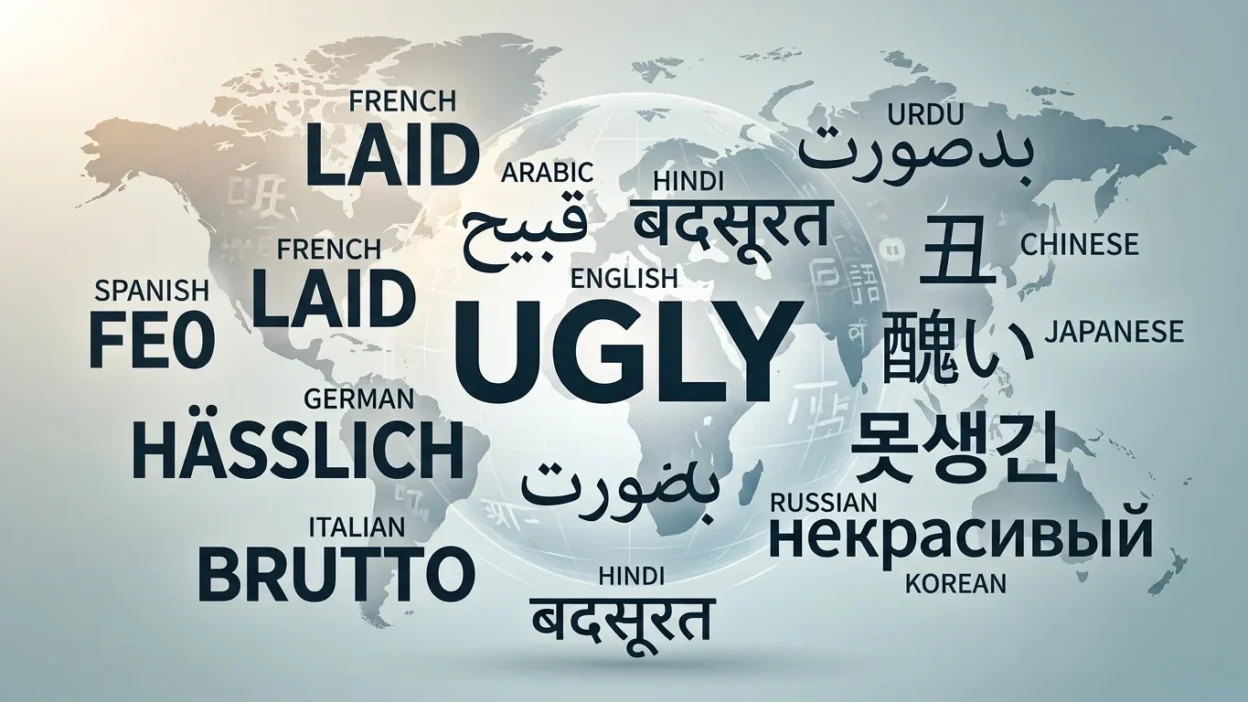
The word “ugly” is used to describe something that is unattractive, unpleasant to look at, or lacking beauty. Learning how to say ugly in different languages is useful for travellers, language learners, writers, translators, and anyone interested in how everyday descriptions change across cultures.
In this guide, you will find ugly in different languages in all languages, together with an easy English pronunciation and a short example sentence. The translations below focus on the common adjective meaning of “ugly”, although some languages change the form depending on gender, number, or grammatical context.
If you have ever wondered how to say ugly in different languages, the table below provides a quick reference to common translations from around the world.
Ugly in Different Languages
| Language | Correct native phrase | Easy English pronunciation | Example sentence | English meaning |
| English | ugly | UG-lee | The building looks ugly. | The building looks unattractive. |
| Spanish | feo | FEH-oh | Ese edificio es feo. | That building is ugly. |
| French | laid | lay | Ce bâtiment est laid. | This building is ugly. |
| German | hässlich | HESS-likh | Das Gebäude ist hässlich. | The building is ugly. |
| Italian | brutto | BROOT-toh | Quel bâtiment è brutto. | That building is ugly. |
| Portuguese | feio | FAY-oo | O prédio é feio. | The building is ugly. |
| Dutch | lelijk | LAY-lik | Het gebouw is lelijk. | The building is ugly. |
| Afrikaans | lelik | LEE-lik | Die gebou is lelik. | The building is ugly. |
| Swedish | ful | fool | Byggnaden är ful. | The building is ugly. |
| Danish | grim | grem | Bygningen er grim. | The building is ugly. |
| Norwegian | stygg | stug | Bygningen er stygg. | The building is ugly. |
| Finnish | ruma | ROO-mah | Rakennus on ruma. | The building is ugly. |
| Icelandic | ljótur | LYOH-tur | Byggingin er ljót. | The building is ugly. |
| Irish | gránna | GRAW-nuh | Tá an foirgneamh gránna. | The building is ugly. |
| Welsh | hyll | hill | Mae’r adeilad yn hyll. | The building is ugly. |
| Scottish Gaelic | grànda | GRAAN-duh | Tha an togalach grànda. | The building is ugly. |
| Polish | brzydki | BZHID-kee | Ten budynek jest brzydki. | This building is ugly. |
| Czech | ošklivý | OSH-klee-vee | Tato budova je ošklivá. | This building is ugly. |
| Slovak | škaredý | SHKAH-reh-dee | Tá budova je škaredá. | That building is ugly. |
| Slovenian | grd | gerd | Ta stavba je grda. | This building is ugly. |
| Croatian | ružan | ROO-zhan | Ova zgrada je ružna. | This building is ugly. |
| Serbian | ружан | ROO-zhahn | Ova zgrada je ružna. | This building is ugly. |
| Bosnian | ružan | ROO-zhahn | Ova zgrada je ružna. | This building is ugly. |
| Bulgarian | грозен | GROH-zen | Тази сграда е грозна. | This building is ugly. |
| Macedonian | грд | gerd | Оваа зграда е грда. | This building is ugly. |
| Russian | некрасивый | nye-kra-SEE-vy | Это здание некрасивое. | This building is unattractive. |
| Ukrainian | потворний | poh-TVOR-ny | Ця будівля потворна. | This building is ugly. |
| Belarusian | непрыгожы | nye-pree-HOH-zhy | Гэты будынак непрыгожы. | This building is ugly. |
| Lithuanian | bjaurus | BYOW-roos | Šis pastatas yra bjaurus. | This building is ugly. |
| Latvian | neglīts | NEG-leets | Šī ēka ir neglīta. | This building is ugly. |
| Estonian | kole | KOH-leh | See hoone on kole. | This building is ugly. |
| Hungarian | csúnya | CHOON-yah | Az épület csúnya. | The building is ugly. |
| Romanian | urât | oo-RUHT | Clădirea este urâtă. | The building is ugly. |
| Albanian | i shëmtuar | ee SHUM-too-ar | Ndërtesa është e shëmtuar. | The building is ugly. |
| Greek | άσχημος | ASH-hee-mos | Το κτίριο είναι άσχημο. | The building is ugly. |
| Turkish | çirkin | CHEER-keen | Bina çirkin. | The building is ugly. |
| Armenian | տգեղ | tuh-GHEGH | Շենքը տգեղ է։ | The building is ugly. |
| Georgian | მახინჯი | ma-KHIN-jee | შენობა მახინჯია. | The building is ugly. |
| Persian | زشت | zesht | این ساختمان زشت است. | This building is ugly. |
| Arabic | قبيح | qa-BEEH | هذا المبنى قبيح. | This building is ugly. |
| Hebrew | מכוער | me-kho-AR | הבניין מכוער. | The building is ugly. |
| Hindi | बदसूरत | bud-soo-rut | यह इमारत बदसूरत है। | This building is ugly. |
| Urdu | بدصورت | bad-soorat | یہ عمارت بدصورت ہے۔ | This building is ugly. |
| Bengali | কুৎসিত | KUT-shit | ভবনটি কুৎসিত। | The building is ugly. |
| Punjabi | ਬਦਸੂਰਤ | bad-SOO-rat | ਇਹ ਇਮਾਰਤ ਬਦਸੂਰਤ ਹੈ। | This building is ugly. |
| Gujarati | કદરૂપું | kuh-DROO-pun | આ મકાન કદરૂપું છે. | This building is ugly. |
| Marathi | कुरूप | koo-ROOP | ही इमारत कुरूप आहे. | This building is ugly. |
| Nepali | कुरूप | koo-ROOP | यो भवन कुरूप छ। | This building is ugly. |
| Sinhala | කැත | KAETH | මේ ගොඩනැගිල්ල කැතයි. | This building is ugly. |
| Tamil | அசிங்கமான | ah-SING-guh-mah-nah | இந்தக் கட்டிடம் அசிங்கமாக உள்ளது. | This building is ugly. |
| Telugu | అగ్లీ | uhg-lee | ఈ భవనం అగ్లీగా ఉంది. | This building is ugly. |
| Kannada | ಕುರೂಪ | koo-ROO-pa | ಈ ಕಟ್ಟಡ ಕುರೂಪವಾಗಿದೆ. | This building is ugly. |
| Malayalam | വൃത്തികെട്ട | VRIT-ti-ket-ta | ഈ കെട്ടിടം വൃത്തികെട്ടതാണ്. | This building is ugly. |
| Thai | น่าเกลียด | naa-GLEET | อาคารนี้น่าเกลียด | This building is ugly. |
| Vietnamese | xấu | sow | Tòa nhà này xấu. | This building is ugly. |
| Indonesian | jelek | JEH-lek | Bangunan itu jelek. | That building is ugly. |
| Malay | hodoh | HOH-doh | Bangunan itu hodoh. | That building is ugly. |
| Filipino | pangit | PANG-it | Pangit ang gusali. | The building is ugly. |
| Chinese (Mandarin) | 丑 | chǒu | 这座建筑很丑。 | This building is very ugly. |
| Japanese | 醜い | minikui | この建物は醜いです。 | This building is ugly. |
| Korean | 못생긴 | mot-saeng-gin | 그 건물은 못생겼어요. | That building is ugly. |
| Mongolian | муухай | MOO-khai | Энэ барилга муухай. | This building is ugly. |
| Kazakh | ұсқынсыз | oos-kun-SIZ | Бұл ғимарат ұсқынсыз. | This building is ugly. |
| Uzbek | xunuk | khoo-NOOK | Bu bino xunuk. | This building is ugly. |
| Azerbaijani | çirkin | cheer-KEEN | Bu bina çirkindir. | This building is ugly. |
| Swahili | mbaya | m-BAH-yah | Jengo hili ni baya. | This building is ugly. |
| Amharic | አስቀያሚ | as-kway-MEE | ሕንፃው አስቀያሚ ነው። | The building is ugly. |
| Zulu | mubi | MOO-bee | Lesi sakhiwo sibi. | This building is ugly. |
| Xhosa | mbi | m-BEE | Esi sakhiwo sibi. | This building is ugly. |
| Haitian Creole | lèd | led | Bilding lan lèd. | The building is ugly. |
| Latin | turpis | TOOR-pis | Aedificium turpe est. | The building is ugly. |
| Esperanto | malbela | mal-BEH-la | La konstruaĵo estas malbela. | The building is ugly. |
What Does “Ugly” Mean?
Ugly is an adjective used when something is considered unattractive, unpleasant, or lacking beauty. It can describe a person, object, building, picture, design, colour combination, or appearance.
The word can also have a broader figurative meaning. For example, people may describe an unpleasant situation as “ugly”, such as an ugly argument or an ugly dispute.
The exact strength of the word can vary according to context and culture. In some situations, “ugly” can sound direct or rude, particularly when it is used to describe a person’s appearance.
How to Say “Ugly” in Different Languages
The translations of ugly in different languages are not always exact one-word equivalents. Some languages have separate adjective forms according to gender, number, or grammatical case.
For example, Spanish uses feo for masculine nouns and fea for feminine nouns. Italian similarly uses forms such as brutto and brutta.
Other languages may use a single common form in a particular sentence, while the grammatical structure changes around it.
This is why learning the example sentence can be more useful than memorising the translation alone.
Ugly in Different Languages Around the World
The word appears in many different linguistic forms around the world.
In European languages, several translations have related meanings associated with being unattractive or unpleasant. Spanish uses feo, French uses laid, German uses hässlich, and Italian uses brutto.
Across South Asia, common translations include Hindi बदसूरत, Urdu بدصورت, Bengali কুৎসিত, and Punjabi ਬਦਸੂਰਤ.
In East Asia, Mandarin Chinese uses 丑, Japanese uses 醜い, and Korean commonly uses 못생긴 when describing something or someone as unattractive.
In Southeast Asia, Vietnamese uses xấu, Indonesian uses jelek, Malay uses hodoh, and Filipino uses pangit.
These differences show how the same basic idea can be expressed through very different sounds and writing systems.
Understanding “Ugly” in Different Contexts
The word “ugly” does not always refer only to physical appearance.
Describing a Person
When describing a person, “ugly” usually means physically unattractive. However, it can sound insulting or offensive, so softer alternatives such as “unattractive” may be more appropriate in polite conversation.
Describing an Object
The word can describe objects that do not look attractive.
For example:
That chair is ugly.
This simply expresses a negative opinion about the chair’s appearance.
Describing a Place or Building
“Ugly” can also describe architecture, interiors, streets, or buildings.
For example:
The old building looks ugly from the outside.
Figurative Meaning
“Ugly” can describe something unpleasant rather than something physically unattractive.
Examples include:
- an ugly argument
- an ugly situation
- an ugly conflict
- an ugly truth
- an ugly experience
In these expressions, the word refers to something unpleasant, difficult, or disturbing.
Why Learn Ugly in Different Languages?
Learning everyday descriptive words can make language study more practical.
Knowing ugly in different languages can help you:
- understand conversations while travelling
- recognise words in films and television
- improve vocabulary
- communicate basic descriptions
- understand foreign-language content
- compare expressions across cultures
- create multilingual educational content
Simple adjectives such as “beautiful”, “ugly”, “big”, “small”, “good”, and “bad” are particularly useful because they appear frequently in everyday speech.
Common Questions About Ugly Translations
The English word “ugly” has several possible translations depending on the language and context. A dictionary translation may not always be the most natural choice for every sentence.
For example, some languages distinguish between describing a person, an object, or an unpleasant situation. Grammar can also change the form of the adjective.
Therefore, when learning ugly in different languages translations, it is useful to learn both the individual word and a natural example sentence.
Tips for Using the Word “Ugly” Politely
Because “ugly” can be a strong negative description, use it carefully when talking about people.
If you want to sound more neutral, alternatives such as unattractive, not very attractive, or unappealing may be more suitable.
When talking about objects, designs, buildings, or colours, “ugly” is usually understood as a personal opinion.
For example:
I think the design is ugly.
This makes it clear that the statement is your personal judgement rather than an objective fact.
Conclusion
Learning ugly in different languages is a useful way to expand everyday vocabulary and understand how different languages express descriptions of appearance. The 70 translations above cover languages from Europe, Asia, Africa, the Middle East, and other parts of the world.
Remember that translations can change according to grammar, gender, context, and the thing being described. For the most natural communication, learn the word together with a simple example sentence.
FAQs
1. How do you say “ugly” in different languages?
“Ugly” has different translations depending on the language. Examples include feo in Spanish, laid in French, hässlich in German, brutto in Italian, 丑 in Mandarin Chinese, 醜い in Japanese, and بدصورت in Urdu.
2. What is the Spanish word for ugly?
The common Spanish word for “ugly” is feo for masculine contexts and fea for feminine contexts.
3. What is “ugly” in French?
The French word for “ugly” is laid. Its feminine form is laide.
4. What is the Japanese word for ugly?
A common Japanese translation is 醜い (minikui). It can describe something unattractive or unpleasant in appearance.
5. Is “ugly” rude to say about someone?
Yes, calling someone “ugly” can sound insulting or hurtful because it directly criticises their appearance. In polite situations, softer expressions such as “unattractive” or “not very attractive” may be more appropriate.