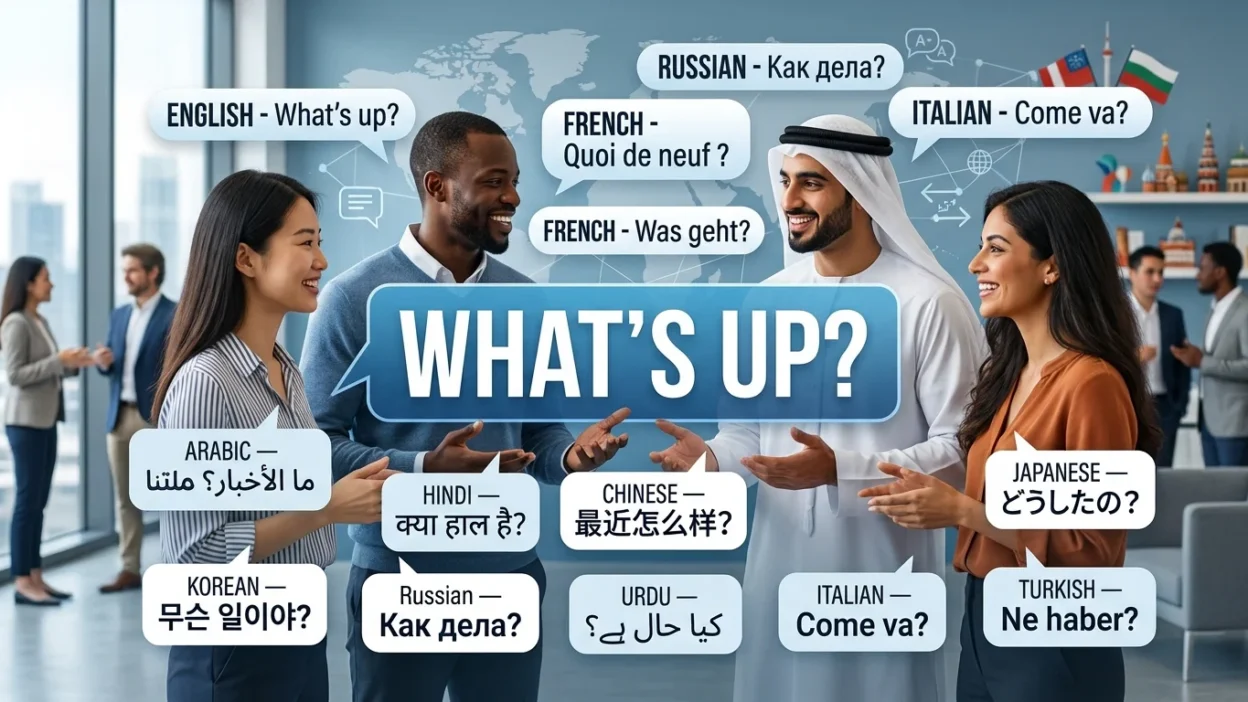
“What’s up?” is one of the most common casual greetings in English. It can mean “How are you?”, “What are you doing?”, or simply “What’s happening?” depending on the situation and tone. Because there is no single exact equivalent in every language, translations often use a natural local greeting that carries the same informal meaning.
If you want to learn what’s up in different languages, this guide gives you useful translations from around the world. Each entry includes the native phrase, an easy English pronunciation, and a short real-life example with its English meaning.
Whether you are learning a new language, chatting with international friends, travelling, or researching what’s up in all languages, these expressions can help you sound more natural in everyday conversations.
What Does “What’s Up?” Mean?
“What’s up?” is an informal English expression used mainly as a greeting or casual question. It can ask about someone’s current situation, mood, activities, or recent news.
For example:
“Hey, what’s up?”
A natural response might be:
“Not much. How about you?”
In other languages, speakers may use an expression closer to “How are you?”, “What are you doing?”, or “What’s happening?” rather than translating the English words literally.
What’s Up in Different Languages
| Language | Correct Native Phrase | Easy English Pronunciation | Real-Life Example Sentence | English Meaning |
| Afrikaans | Wat gaan aan? | Vat khahn ahn? | Hallo, wat gaan aan? | Hello, what’s up? |
| Albanian | Ç’kemi? | Chuh-keh-mee? | Hej, ç’kemi? | Hey, what’s up? |
| Arabic | ما الأخبار؟ | Ma al-akhbar? | مرحباً، ما الأخبار؟ | Hello, what’s up? |
| Armenian | Ի՞նչ կա։ | Inch ka? | Բարև, ի՞նչ կա։ | Hello, what’s up? |
| Azerbaijani | Nə var, nə yox? | Neh var, neh yokh? | Salam, nə var, nə yox? | Hi, what’s up? |
| Basque | Zer moduz? | Zer mo-dooz? | Kaixo, zer moduz? | Hello, how’s it going? |
| Belarusian | Як справы? | Yak spravy? | Прывітанне, як справы? | Hello, how are things? |
| Bengali | কী খবর? | Kee khobor? | হ্যালো, কী খবর? | Hello, what’s up? |
| Bosnian | Šta ima? | Shta ee-ma? | Hej, šta ima? | Hey, what’s up? |
| Bulgarian | Какво става? | Kak-vo sta-va? | Здрасти, какво става? | Hi, what’s up? |
| Catalan | Què tal? | Keh tal? | Hola, què tal? | Hello, how’s it going? |
| Chinese (Mandarin) | 最近怎么样? | Zuìjìn zěnmeyàng? | 嗨,最近怎么样? | Hi, how have you been? |
| Croatian | Šta ima? | Shta ee-ma? | Bok, šta ima? | Hi, what’s up? |
| Czech | Co je nového? | Tso yeh no-veh-ho? | Ahoj, co je nového? | Hi, what’s new? |
| Danish | Hvad så? | Vath soh? | Hej, hvad så? | Hey, what’s up? |
| Dutch | Hoe gaat het? | Hoo khaat hut? | Hé, hoe gaat het? | Hey, how are you? |
| Estonian | Mis toimub? | Miss toy-moob? | Hei, mis toimub? | Hey, what’s happening? |
| Filipino | Anong balita? | Ah-nong bah-lee-ta? | Hi, anong balita? | Hi, what’s the news? |
| Finnish | Mitä kuuluu? | Mee-ta koo-loo? | Hei, mitä kuuluu? | Hi, how are you? |
| French | Quoi de neuf ? | Kwa duh nuf? | Salut, quoi de neuf ? | Hi, what’s new? |
| Georgian | რა ხდება? | Ra khdeba? | გამარჯობა, რა ხდება? | Hello, what’s happening? |
| German | Was geht? | Vahs gate? | Hey, was geht? | Hey, what’s up? |
| Greek | Τι κάνεις; | Tee ka-nees? | Γεια, τι κάνεις; | Hi, how are you? |
| Haitian Creole | Sa k ap fèt? | Sa kap fet? | Alo, sa k ap fèt? | Hello, what’s happening? |
| Hausa | Me ke faruwa? | Meh keh fa-roo-wa? | Sannu, me ke faruwa? | Hello, what’s happening? |
| Hebrew | מה נשמע? | Ma nish-ma? | היי, מה נשמע? | Hey, what’s up? |
| Hindi | क्या हाल है? | Kya haal hai? | अरे, क्या हाल है? | Hey, how are things? |
| Hungarian | Mi újság? | Mee oo-shaag? | Szia, mi újság? | Hi, what’s new? |
| Icelandic | Hvað segirðu? | Kvath say-yir-thu? | Hæ, hvað segirðu? | Hi, what’s up? |
| Indonesian | Ada apa? | Ah-dah ah-pah? | Hai, ada apa? | Hi, what’s up? |
| Irish | Cad é mar atá tú? | Kad ay mar ah-taw too? | Dia dhuit, cad é mar atá tú? | Hello, how are you? |
| Italian | Come va? | Koh-meh va? | Ciao, come va? | Hi, how’s it going? |
| Japanese | どうしたの? | Dō shita no? | ねえ、どうしたの? | Hey, what’s up? |
| Javanese | Piye kabare? | Pee-yeh ka-ba-reh? | Hei, piye kabare? | Hey, how are you? |
| Kannada | ಏನ್ ಸಮಾಚಾರ? | Aen samaachaara? | ಹಾಯ್, ಏನ್ ಸಮಾಚಾರ? | Hi, what’s the news? |
| Kazakh | Не жаңалық? | Ne zhang-a-lyk? | Сәлем, не жаңалық? | Hi, what’s new? |
| Khmer | មានអីថ្មី? | Mean ey thmey? | សួស្តី មានអីថ្មី? | Hello, what’s new? |
| Korean | 무슨 일이야? | Mu-seun il-i-ya? | 야, 무슨 일이야? | Hey, what’s up? |
| Lao | ເປັນແນວໃດ? | Pen naew dai? | ສະບາຍດີ, ເປັນແນວໃດ? | Hello, how are things? |
| Latvian | Kas jauns? | Kas yowns? | Sveiki, kas jauns? | Hi, what’s new? |
| Lithuanian | Kas naujo? | Kas now-yo? | Labas, kas naujo? | Hi, what’s new? |
| Macedonian | Што има? | Shto ee-ma? | Здраво, што има? | Hello, what’s up? |
| Malay | Apa khabar? | Ah-pah kha-bar? | Hai, apa khabar? | Hi, how are you? |
| Malayalam | എന്തുണ്ട് വിശേഷം? | Enth-und vishesham? | ഹായ്, എന്തുണ്ട് വിശേഷം? | Hi, what’s new? |
| Maltese | X’għandek? | Shand-ek? | Ħej, x’għandek? | Hey, what’s up? |
| Marathi | काय चाललंय? | Kaay chaal-lay? | हाय, काय चाललंय? | Hi, what’s going on? |
| Mongolian | Юу байна? | Yoo bai-na? | Сайн уу, юу байна? | Hi, what’s up? |
| Nepali | के छ? | Ke chha? | नमस्ते, के छ? | Hello, what’s up? |
| Norwegian | Hva skjer? | Vah skjer? | Hei, hva skjer? | Hey, what’s happening? |
| Persian | چه خبر؟ | Che khabar? | سلام، چه خبر؟ | Hello, what’s up? |
| Polish | Co słychać? | Tso swih-hatch? | Cześć, co słychać? | Hi, how are things? |
| Portuguese | O que está acontecendo? | Oo keh es-ta ah-kon-te-sen-do? | Olá, o que está acontecendo? | Hello, what’s happening? |
| Punjabi | ਕੀ ਹਾਲ ਹੈ? | Kee haal hai? | ਸਤ ਸ੍ਰੀ ਅਕਾਲ, ਕੀ ਹਾਲ ਹੈ? | Hello, how are things? |
| Romanian | Ce mai faci? | Che mai fach? | Salut, ce mai faci? | Hi, how are you? |
| Russian | Как дела? | Kak dee-la? | Привет, как дела? | Hi, how are you? |
| Serbian | Šta ima? | Shta ee-ma? | Ćao, šta ima? | Hi, what’s up? |
| Slovak | Čo nové? | Cho no-veh? | Ahoj, čo nové? | Hi, what’s new? |
| Slovenian | Kaj dogaja? | Kai do-ga-ya? | Živjo, kaj dogaja? | Hey, what’s happening? |
| Somali | Maxaa cusub? | Ma-khaa tsoo-boob? | Salaan, maxaa cusub? | Hello, what’s new? |
| Spanish | ¿Qué pasa? | Keh pa-sa? | Hola, ¿qué pasa? | Hello, what’s up? |
| Swahili | Kuna nini? | Koo-na nee-nee? | Habari, kuna nini? | Hello, what’s up? |
| Swedish | Vad händer? | Vah hen-der? | Hej, vad händer? | Hey, what’s happening? |
| Tamil | என்ன விஷயம்? | Enna vishayam? | ஹாய், என்ன விஷயம்? | Hi, what’s up? |
| Telugu | ఏంటి సంగతి? | Aen-tee sang-a-tee? | హాయ్, ఏంటి సంగతి? | Hi, what’s up? |
| Thai | เป็นไงบ้าง? | Pen ngai bang? | เฮ้ เป็นไงบ้าง? | Hey, how are you? |
| Turkish | Ne haber? | Ne ha-ber? | Selam, ne haber? | Hi, what’s up? |
| Ukrainian | Що нового? | Shcho no-vo-ho? | Привіт, що нового? | Hi, what’s new? |
| Urdu | کیا حال ہے؟ | Kya haal hai? | ہیلو، کیا حال ہے؟ | Hello, how are things? |
| Uzbek | Nima gap? | Nee-ma gap? | Salom, nima gap? | Hello, what’s up? |
| Vietnamese | Có gì mới không? | Kaw zee moy khong? | Chào, có gì mới không? | Hi, what’s new? |
| Welsh | Sut mae? | Sit my? | Helo, sut mae? | Hello, how are you? |
| Yoruba | Kí ló ń ṣẹlẹ̀? | Kee lohn sheh-leh? | Bawo, kí ló ń ṣẹlẹ̀? | Hello, what’s happening? |
| Zulu | Kwenzenjani? | Kwen-zen-ya-nee? | Sawubona, kwenzenjani? | Hello, what’s happening? |
How to Say “What’s Up?” in Different Languages
When learning how to say what’s up in different languages, it is important to focus on natural conversation rather than word-for-word translation.
For example, English speakers commonly say “What’s up?” as a casual greeting. In Spanish, ¿Qué pasa? can serve a similar purpose. In German, Was geht? is a casual equivalent, while French speakers may say Quoi de neuf ?, meaning “What’s new?”
Some languages use an expression that is closer to “How are you?” These expressions can still perform the same conversational function as “What’s up?” in everyday speech.
What’s Up in European Languages
European languages have many different informal ways to greet someone.
German uses Was geht?, while Norwegian commonly uses Hva skjer?. In Italian, Come va? means “How’s it going?” and is a natural casual greeting.
French Quoi de neuf ? literally asks “What’s new?”, making it particularly close to the conversational meaning of “What’s up?”
Slavic languages also offer several natural equivalents. Russian uses Как дела?, Polish uses Co słychać?, and Serbian and Croatian commonly use Šta ima?
What’s Up in Asian Languages
Across Asia, the natural equivalent of “What’s up?” varies significantly.
Hindi and Punjabi commonly use expressions asking about someone’s condition or situation. Mandarin Chinese can use 最近怎么样?, which asks how someone has been recently.
Japanese どうしたの? is useful when asking what is going on or what is wrong, while Korean 무슨 일이야? can similarly ask what is happening.
Turkish Ne haber? is a familiar casual expression meaning “What’s up?” or “What’s the news?”
What’s Up in Arabic, Urdu and Other Related Languages
In Arabic, ما الأخبار؟ can be used to ask “What’s the news?” or “What’s up?” in a conversational setting.
Urdu commonly uses کیا حال ہے؟, which means “How are things?” or “How are you?” and can work naturally as a casual greeting.
Persian uses چه خبر؟, which literally means “What news?” and is commonly used in the sense of “What’s up?” or “What’s new?”
These examples show why direct translation is not always the best way to understand what’s up translations. A natural equivalent often matters more than matching every individual English word.
Formal vs Informal Ways to Say “What’s Up?”
“What’s up?” is generally informal. It is most appropriate with friends, classmates, family members, colleagues you know well, or people in relaxed social situations.
For formal situations, expressions equivalent to “How are you?” or “How are you doing?” are usually safer.
For example, an informal greeting might be:
“Hey, what’s up?”
A more polite greeting could be:
“Hello, how are you?”
The same distinction exists in many other languages, so always consider the relationship between speakers before choosing an expression.
Common Responses to “What’s Up?”
If someone says “What’s up?” in English, common responses include:
- “Not much.”
- “Nothing much.”
- “I’m good. How about you?”
- “Everything’s good.”
- “Just working.”
- “Just relaxing.”
- “Not much, what about you?”
The response depends on whether “What’s up?” is being used as a simple greeting or as a genuine question about what is happening.
Why “What’s Up?” Has Different Translations
There is no perfect one-word translation of “What’s up?” in every language because the expression has several meanings.
It can mean:
- How are you?
- How are things?
- What are you doing?
- What’s happening?
- What’s new?
- What’s going on?
- Is something wrong?
Context determines which meaning is intended.
That is why what’s up in different languages around the world can produce different phrases while still communicating essentially the same social message.
What’s Up in All Languages: Choosing the Right Expression
If you are learning a language for travel or conversation, memorising the most natural local expression is usually more useful than memorising a literal translation.
For example, if you want to greet a Spanish-speaking friend casually, ¿Qué pasa? may sound more natural in the right context than translating every English word individually.
Likewise, German speakers may use Was geht?, while Turkish speakers may use Ne haber?
Learning these conversational equivalents can make your speech sound more natural and help you understand how native speakers communicate.
Tips for Using “What’s Up?” Naturally
First, remember that “What’s up?” is casual. Avoid using an extremely informal equivalent with someone in a highly formal setting.
Second, pay attention to context. Some expressions in the table can mean “What’s happening?” rather than simply “How are you?”
Third, listen to how native speakers use the expression. Greetings often change depending on age, region, relationship, and level of familiarity.
Finally, when in doubt, choose a simple equivalent of “How are you?” because it is generally easier to use politely.
Conclusion
Learning what’s up in different languages is a useful way to understand everyday greetings and informal conversation around the world. Although the English phrase does not have one exact equivalent in every language, many cultures have natural expressions that communicate “How are you?”, “What’s happening?”, or “What’s new?”
The 70 translations above give you a practical starting point for understanding what’s up in all languages and using similar casual greetings with people from different linguistic backgrounds.
FAQs
1. What is “what’s up” in Spanish?
A common casual equivalent is ¿Qué pasa?, which can mean “What’s up?”, “What’s happening?”, or “What’s going on?” depending on context.
2. How do you say “what’s up” in French?
A natural casual expression is Quoi de neuf ?, which literally means “What’s new?” and is commonly used as a friendly conversational greeting.
3. What is the meaning of “what’s up” in different languages?
The meaning varies by language and context. It can correspond to “How are you?”, “What’s happening?”, “What’s new?”, or “What’s going on?”
4. Is “what’s up” formal or informal?
“What’s up?” is generally an informal English greeting. It is best used with friends, people you know well, or in relaxed social situations.
5. Why are there different translations for “what’s up”?
“What’s up?” has several meanings in English, so different languages use different natural expressions depending on whether the speaker means “How are you?”, “What’s new?”, or “What’s happening?”