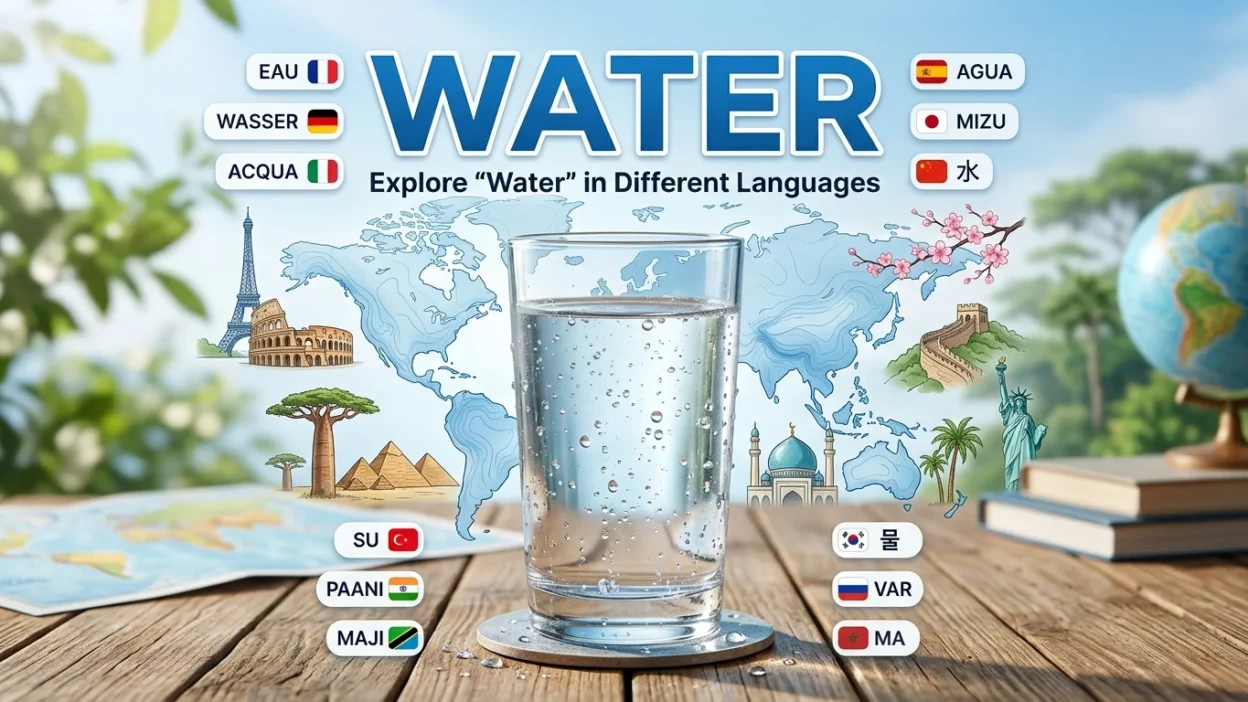
Water is one of the most universal words in human communication. Whether you are travelling, learning a new language, studying world cultures, or simply curious about languages, knowing how to say “water” in different languages is a useful place to start.
The word may look and sound completely different from one language to another, yet the meaning remains the same. From water in English to agua in Spanish and eau in French, these translations show how languages around the world express one of life’s most essential things.
Below, you will find water in all languages covered in this guide, including the native word, an easy English pronunciation, and a short everyday example sentence.
Water in Different Languages
| Language | Correct Native Phrase | Easy English Pronunciation | Example Sentence | English Meaning |
| English | water | WAW-ter | I need some water. | I need some water. |
| Spanish | agua | AH-gwa | Necesito agua. | I need water. |
| French | eau | OH | Je veux de l’eau. | I want some water. |
| German | Wasser | VAH-ser | Ich brauche Wasser. | I need water. |
| Italian | acqua | AH-kwah | Voglio dell’acqua. | I want some water. |
| Portuguese | água | AH-gwah | Eu preciso de água. | I need water. |
| Dutch | water | WAH-ter | Ik wil water. | I want water. |
| Afrikaans | water | VAH-ter | Ek wil water hê. | I want water. |
| Swedish | vatten | VAT-ten | Jag behöver vatten. | I need water. |
| Norwegian | vann | VAHN | Jeg trenger vann. | I need water. |
| Danish | vand | VAN | Jeg har brug for vand. | I need water. |
| Finnish | vesi | VEH-see | Tarvitsen vettä. | I need water. |
| Icelandic | vatn | VATN | Ég þarf vatn. | I need water. |
| Irish | uisce | ISH-kuh | Ba mhaith liom uisce. | I would like water. |
| Scottish Gaelic | uisge | OOSH-kuh | Tha mi ag iarraidh uisge. | I want water. |
| Welsh | dŵr | DOOR | Dw i eisiau dŵr. | I want water. |
| Polish | woda | VOH-dah | Potrzebuję wody. | I need water. |
| Czech | voda | VOH-dah | Potřebuji vodu. | I need water. |
| Slovak | voda | VOH-dah | Potrebujem vodu. | I need water. |
| Slovenian | voda | VOH-dah | Potrebujem vodo. | I need water. |
| Croatian | voda | VOH-dah | Trebam vodu. | I need water. |
| Serbian | вода | VOH-dah | Треба ми вода. | I need water. |
| Bosnian | voda | VOH-dah | Trebam vodu. | I need water. |
| Bulgarian | вода | VOH-dah | Искам вода. | I want water. |
| Macedonian | вода | VOH-dah | Сакам вода. | I want water. |
| Russian | вода | VOH-dah | Мне нужна вода. | I need water. |
| Ukrainian | вода | VOH-dah | Мені потрібна вода. | I need water. |
| Belarusian | вада | VAH-dah | Мне патрэбна вада. | I need water. |
| Lithuanian | vanduo | VAN-doo-oh | Man reikia vandens. | I need water. |
| Latvian | ūdens | OO-dens | Man vajag ūdeni. | I need water. |
| Estonian | vesi | VEH-see | Ma vajan vett. | I need water. |
| Hungarian | víz | VEES | Vizet kérek. | I would like water. |
| Romanian | apă | AH-puh | Am nevoie de apă. | I need water. |
| Greek | νερό | neh-ROH | Θέλω νερό. | I want water. |
| Albanian | ujë | OO-yeh | Dua ujë. | I want water. |
| Armenian | ջուր | JUR | Ես ջուր եմ ուզում։ | I want water. |
| Georgian | წყალი | TSQAH-lee | წყალი მინდა. | I want water. |
| Turkish | su | SOO | Su istiyorum. | I want water. |
| Azerbaijani | su | SOO | Mən su istəyirəm. | I want water. |
| Persian | آب | AAB | من آب میخواهم. | I want water. |
| Arabic | ماء | MAA | أريد ماء. | I want water. |
| Hebrew | מים | MAH-yim | אני רוצה מים. | I want water. |
| Hindi | पानी | PAA-nee | मुझे पानी चाहिए। | I need water. |
| Urdu | پانی | PAA-nee | مجھے پانی چاہیے۔ | I need water. |
| Bengali | পানি | PAH-nee | আমার পানি চাই। | I want water. |
| Punjabi | ਪਾਣੀ | PAA-nee | ਮੈਨੂੰ ਪਾਣੀ ਚਾਹੀਦਾ ਹੈ। | I need water. |
| Gujarati | પાણી | PAA-nee | મને પાણી જોઈએ. | I need water. |
| Marathi | पाणी | PAA-nee | मला पाणी हवे आहे. | I need water. |
| Nepali | पानी | PAA-nee | मलाई पानी चाहिन्छ। | I need water. |
| Sinhala | වතුර | VAH-toor | මට වතුර ඕනේ. | I want water. |
| Tamil | தண்ணீர் | TAN-neer | எனக்கு தண்ணீர் வேண்டும். | I need water. |
| Telugu | నీరు | NEE-roo | నాకు నీరు కావాలి. | I need water. |
| Kannada | ನೀರು | NEE-roo | ನನಗೆ ನೀರು ಬೇಕು. | I need water. |
| Malayalam | വെള്ളം | VEL-lam | എനിക്ക് വെള്ളം വേണം. | I need water. |
| Odia | ପାଣି | PAA-nee | ମୋତେ ପାଣି ଦରକାର। | I need water. |
| Assamese | পানী | PAA-nee | মোক পানী লাগে। | I need water. |
| Thai | น้ำ | NAM | ฉันต้องการน้ำ | I need water. |
| Vietnamese | nước | NUH-uhk | Tôi cần nước. | I need water. |
| Indonesian | air | AH-eer | Saya butuh air. | I need water. |
| Malay | air | AH-eer | Saya perlukan air. | I need water. |
| Filipino | tubig | TOO-big | Kailangan ko ng tubig. | I need water. |
| Chinese (Mandarin) | 水 | shuǐ | 我需要水。 | I need water. |
| Japanese | 水 | mizu | 水が必要です。 | I need water. |
| Korean | 물 | mul | 물이 필요해요. | I need water. |
| Mongolian | ус | OOS | Би ус хэрэгтэй. | I need water. |
| Swahili | maji | MAH-jee | Ninahitaji maji. | I need water. |
| Amharic | ውሃ | WU-ha | ውሃ እፈልጋለሁ። | I need water. |
| Somali | biyo | BEE-yoh | Waxaan rabaa biyo. | I want water. |
| Hausa | ruwa | ROO-wah | Ina bukatar ruwa. | I need water. |
| Yoruba | omi | OH-mee | Mo fẹ́ omi. | I want water. |
| Igbo | mmiri | MMEH-ree | Achọrọ m mmiri. | I need water. |
| Zulu | amanzi | ah-MAHN-zee | Ngidinga amanzi. | I need water. |
| Xhosa | amanzi | ah-MAHN-zee | Ndifuna amanzi. | I want water. |
| Malagasy | rano | RAH-noo | Mila rano aho. | I need water. |
How Do You Say Water in Different Languages?
The word for water varies greatly across languages. Some languages use short words, such as su in Turkish and air in Indonesian and Malay. Others have words that sound quite different, such as uisce in Irish, eau in French, and maji in Swahili.
These differences make water in different languages an interesting way to explore vocabulary and pronunciation.
Water Translations Around the World
Looking at water translations around the world reveals several interesting patterns.
Many European languages have related forms. For example, voda appears in several Slavic languages, including Croatian, Czech, Slovak and Slovenian.
South Asian languages also share similarities. Hindi, Urdu, Bengali, Nepali, Punjabi and several other languages use forms based around paani/pani.
In East Asia, the words are very different. Mandarin Chinese uses 水, Japanese uses 水, and Korean uses 물.
Water in European Languages
European languages offer a wide range of translations for water.
Spanish uses agua, French uses eau, German uses Wasser, Italian uses acqua, and Portuguese uses água. Several Slavic languages use forms of voda.
Learning these words can be especially useful for travellers because water is one of the most important words to know when ordering food, shopping, or asking for a drink.
Water in Asian Languages
Asian languages provide some fascinating examples of linguistic diversity.
In Hindi and Urdu, water is paani. Tamil uses thanneer, Telugu uses neeru, and Malayalam uses vellam.
In East Asia, Mandarin Chinese uses shuǐ, Japanese uses mizu, and Korean uses mul.
These translations demonstrate how the same everyday object can have completely different names across neighbouring cultures.
Water in African Languages
African languages also have distinctive words for water.
Swahili uses maji, Somali uses biyo, Hausa uses ruwa, Yoruba uses omi, and Zulu and Xhosa use amanzi.
Learning these terms can provide a simple introduction to the rich linguistic diversity found across Africa.
Common Uses of the Word “Water”
The word water can be used in many everyday situations. You might use it when:
- Asking for a drink
- Ordering food at a restaurant
- Talking about hydration
- Discussing rain or rivers
- Describing oceans and lakes
- Talking about swimming
- Asking where drinking water is available
- Learning basic vocabulary in another language
Because water is such a basic human need, its translation is often one of the first useful words for language learners.
Why Learn Water in Different Languages?
Learning the word for water has practical benefits. It can help travellers communicate basic needs and make simple conversations easier.
It is also a useful vocabulary-building exercise. Once you learn one everyday noun in several languages, you can begin comparing pronunciation, spelling, scripts and sentence structure.
For students and language enthusiasts, water in different languages is also a simple way to discover how closely related languages share vocabulary.
Water in Different Languages for Travellers
If you are travelling internationally, knowing the local word for water can be surprisingly helpful.
You may need to ask for bottled water, request water at a restaurant, or understand a menu. Even if you do not speak the local language fluently, knowing this one word can make basic communication easier.
For a better travel experience, learn the pronunciation as well as the written form.
Interesting Facts About Water Translations
One interesting feature of the translations above is that related languages sometimes use words that look or sound similar.
For example, voda appears in multiple Slavic languages. Likewise, several South Asian languages use versions of paani/pani.
Other languages have developed completely different terms. French eau, Japanese mizu, Korean mul, and Swahili maji show just how diverse the world’s languages can be.
How to Remember Water in Different Languages
A simple way to remember translations is to group them by region.
Start with a few common European words, then learn Asian, African and Middle Eastern forms. You can also practise each word in a short sentence instead of memorising isolated vocabulary.
For example, learning “I need water” alongside the local word gives you useful conversational context.
Conclusion
Learning water in different languages is a simple but useful way to explore global vocabulary. From agua and eau to paani, mizu, mul, maji, and su, every language has its own way of expressing this essential word.
Whether you are travelling, studying languages, or simply interested in water in different languages around the world, these 70 translations provide a useful starting point for learning and comparison.
FAQs
1. How do you say water in different languages?
“Water” has different translations depending on the language. Examples include agua in Spanish, eau in French, Wasser in German, acqua in Italian, paani in Hindi and Urdu, mizu in Japanese, and maji in Swahili.
2. What is the word for water in the most common languages?
Some common translations are water in English, agua in Spanish, eau in French, Wasser in German, acqua in Italian, água in Portuguese, su in Turkish, paani in Hindi and Urdu, and 水 (shuǐ) in Mandarin Chinese.
3. How do you say water in Spanish?
Water in Spanish is agua. A common sentence is “Necesito agua,” which means “I need water.”
4. How do you say water in Japanese?
Water in Japanese is 水, pronounced mizu. It is a common everyday word used when talking about drinking water and other forms of water.
5. Why is water called different names in different languages?
Languages develop their own vocabulary over time through historical development, cultural contact and changes in pronunciation. As a result, the same thing can have very different names in different languages.