The word “girl” is a simple everyday word, but its translation can vary greatly from one language to another. If you are learning a new language, travelling, writing multilingual content, or simply curious about world languages, knowing how to say “girl” in different languages is a useful place to start.
In this guide, you will discover girl in different languages, including the correct native word, an easy English pronunciation, and a short real-life example. These translations show how people refer to a young female person across different cultures and languages.
Below is the first half of our girl in different languages in all languages guide. The complete article covers 70 languages and is designed to make it easy to learn how to say girl in different languages.
How to Say “Girl” in Different Languages
The English word girl usually refers to a female child or young female person. However, the exact meaning and preferred word can depend on age, context, and cultural usage.
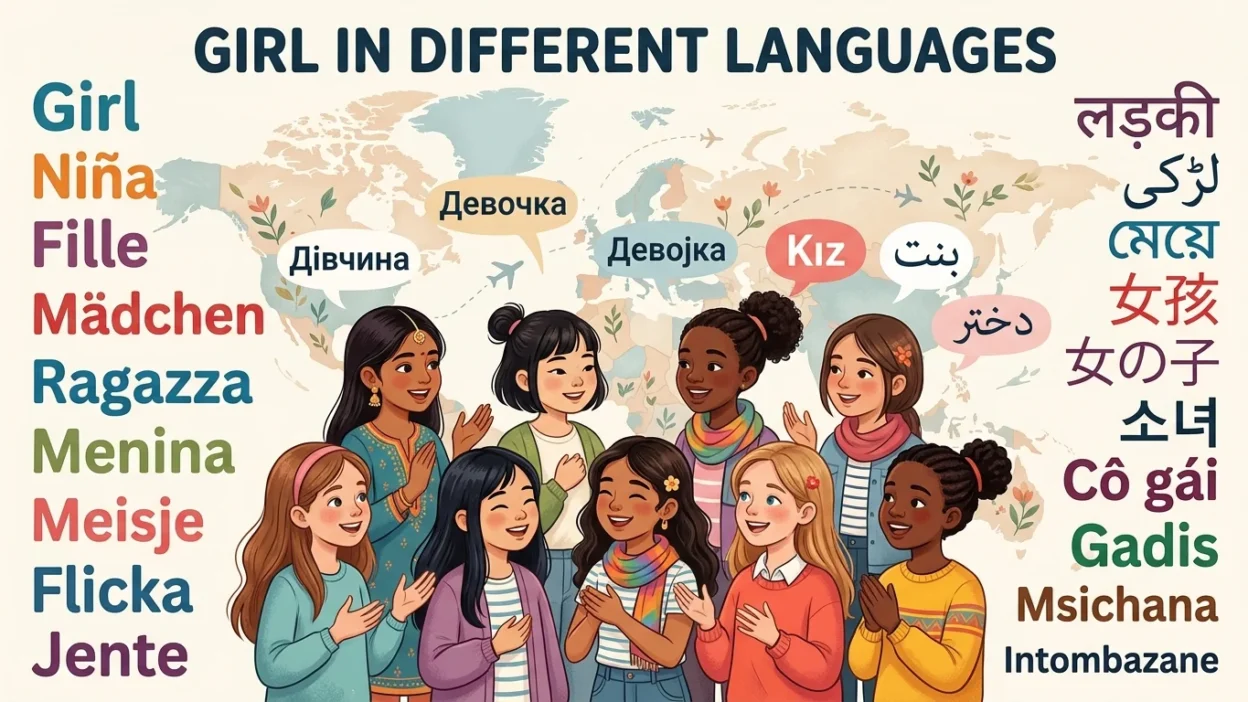
For example, Spanish commonly uses niña, French uses fille, German uses Mädchen, and Italian uses ragazza. Some languages have different words depending on whether you mean a child, teenager, or young woman.
Girl in Different Languages
| Language | Correct Native Phrase | Easy English Pronunciation | Example Sentence | English Meaning |
| Spanish | niña | nee-nya | La niña está jugando. | The girl is playing. |
| French | fille | fee-y | La fille est heureuse. | The girl is happy. |
| German | Mädchen | MET-khen | Das Mädchen liest ein Buch. | The girl is reading a book. |
| Italian | ragazza | rah-GAHT-tsah | La ragazza canta bene. | The girl sings well. |
| Portuguese | menina | meh-NEE-nah | A menina está sorrindo. | The girl is smiling. |
| Dutch | meisje | MAY-shuh | Het meisje speelt buiten. | The girl is playing outside. |
| Swedish | flicka | FLICK-ah | Flickan läser en bok. | The girl is reading a book. |
| Norwegian | jente | YEN-teh | Jenta går till skolen. | The girl is going to school. |
| Danish | pige | PEE-eh | Pigen leger i haven. | The girl is playing in the garden. |
| Finnish | tyttö | TURT-tuh | Tyttö lukee kirjaa. | The girl is reading a book. |
| Icelandic | stelpa | STEL-pah | Stelpan er að lesa. | The girl is reading. |
| Irish | cailín | ka-LEEN | Tá an cailín sásta. | The girl is happy. |
| Welsh | merch | merkh | Mae’r ferch yn canu. | The girl is singing. |
| Polish | dziewczyna | jev-CHUH-nah | Dziewczyna czyta książkę. | The girl is reading a book. |
| Czech | dívka | DEEF-kah | Dívka se směje. | The girl is laughing. |
| Slovak | dievča | DYEH-vcha | Dievča sa hrá vonku. | The girl is playing outside. |
| Slovenian | dekle | DEH-kleh | Dekle bere knjigo. | The girl is reading a book. |
| Croatian | djevojka | dyeh-VOY-kah | Djevojka pjeva. | The girl is singing. |
| Serbian | девојка | deh-VOY-kah | Девојка чита књигу. | The girl is reading a book. |
| Bulgarian | момиче | moh-MEE-cheh | Момичето игра навън. | The girl is playing outside. |
| Macedonian | девојче | deh-VOY-cheh | Девојчето чита книга. | The girl is reading a book. |
| Russian | девочка | DEH-vach-kah | Девочка играет во дворе. | The girl is playing in the yard. |
| Ukrainian | дівчина | DEEV-chy-nah | Дівчина читає книгу. | The girl is reading a book. |
| Belarusian | дзяўчынка | dzyav-CHIN-kah | Дзяўчынка гуляе ў парку. | The girl is playing in the park. |
| Lithuanian | mergaitė | mehr-guy-TEH | Mergaitė skaito knygą. | The girl is reading a book. |
| Latvian | meitene | MAY-teh-neh | Meitene spēlējas ārā. | The girl is playing outside. |
| Estonian | tüdruk | TUU-drook | Tüdruk loeb raamatut. | The girl is reading a book. |
| Hungarian | lány | LAAN-y | A lány mosolyog. | The girl is smiling. |
| Romanian | fată | FAH-tuh | Fata citește o carte. | The girl is reading a book. |
| Greek | κορίτσι | ko-REET-see | Το κορίτσι παίζει έξω. | The girl is playing outside. |
| Albanian | vajzë | VAI-zuh | Vajza po lexon. | The girl is reading. |
| Armenian | աղջիկ | agh-CHEEK | Աղջիկը գիրք է կարդում։ | The girl is reading a book. |
| Georgian | გოგო | GO-go | გოგო წიგნს კითხულობს. | The girl is reading a book. |
| Turkish | kız | kuhz | Kız kitap okuyor. | The girl is reading a book. |
Common “Girl” Translations in European Languages
European languages offer a wide range of words for girl. Several are particularly useful for beginners because they appear frequently in everyday conversations.
In Spanish, niña normally refers to a girl or female child. In French, fille can mean “girl” and, depending on context, “daughter”. German uses Mädchen, while Italian commonly uses ragazza for a girl or young woman.
Portuguese speakers use menina, and Dutch uses meisje. In Scandinavian languages, you may encounter words such as flicka in Swedish and jente in Norwegian.
Eastern European languages also have their own distinct forms. Russian uses девочка, Ukrainian uses дівчина, Polish uses dziewczyna, and Romanian uses fată.
These differences are important because a direct translation does not always carry exactly the same age or social meaning in every language.
Girl in Different Languages Around the World
The word “girl” is useful beyond basic vocabulary. It can appear in conversations about children, families, schools, friendships, stories, films, and everyday activities.
When learning girl in different languages, it is helpful to learn the word together with a natural sentence. This shows you how native speakers actually use the term instead of memorising an isolated translation.
For example:
- Spanish: La niña está jugando. — The girl is playing.
- French: La fille est heureuse. — The girl is happy.
- German: Das Mädchen liest ein Buch. — The girl is reading a book.
- Italian: La ragazza canta bene. — The girl sings well.
- Portuguese: A menina está sorrindo. — The girl is smiling.
Learning words in context can make vocabulary easier to remember and use correctly.
Why Learn How to Say “Girl” in Different Languages?
Learning the translation of a common word such as “girl” can help you build a useful foundation in another language. It can also help you recognise familiar words while reading signs, books, websites, subtitles, and conversations.
For travellers, these translations can provide useful cultural and linguistic knowledge. For language learners, they offer an opportunity to compare sentence structure, pronunciation, and vocabulary between languages.
If you are researching girl in different languages translations, remember that context matters. A word used for a young child may not always be the best choice for a teenager or young adult.
Understanding Age and Context
One important point about translating “girl” is that languages do not always divide age groups in exactly the same way as English.
For instance, some languages have a specific word for a female child, while another common word may refer to a teenage girl or young woman. In some cases, the same word can also have meanings such as “daughter” or “young woman”.
This is why simply copying a dictionary translation may not always produce the most natural sentence. Learning a word alongside an example gives you a better understanding of how it functions in everyday communication.
Quick Guide to “Girl” in Different Languages
Here are some of the most recognisable translations from the first 35 languages:
Spanish: niña
French: fille
German: Mädchen
Italian: ragazza
Portuguese: menina
Dutch: meisje
Swedish: flicka
Norwegian: jente
Polish: dziewczyna
Russian: девочка
Ukrainian: дівчина
Romanian: fată
Greek: κορίτσι
Turkish: kız
These examples give you a quick starting point if you want to know how to say girl in different languages without reading the full table.
Girl in All Languages: What to Remember
There is no single universal translation for “girl”. Each language has its own vocabulary, pronunciation, grammar, and cultural context.
The first 35 languages above demonstrate how different the word can look and sound around the world. From niña in Spanish to кыз in Turkish, each translation reflects the structure and history of its language.
In the second half of this guide, we will continue with 35 more languages to complete the full list of girl in different languages translations.
Girl in Different Languages: 35 More Translations
The first part covered 35 languages from Europe and nearby regions. The list below continues with 35 additional languages, bringing the complete guide to exactly 70 languages.
These translations include widely spoken languages from Asia, the Middle East, Africa, and other parts of the world. Each entry includes a native term, an easy pronunciation guide, and a natural example sentence.
| Language | Correct Native Phrase | Easy English Pronunciation | Example Sentence | English Meaning |
| Arabic | بنت | bint | البنت تقرأ كتابًا. | The girl is reading a book. |
| Hebrew | ילדה | yal-DAH | הילדה משחקת בחוץ. | The girl is playing outside. |
| Persian | دختر | dokh-TAR | دختر کتاب میخواند. | The girl is reading a book. |
| Hindi | लड़की | LUR-kee | लड़की स्कूल जा रही है। | The girl is going to school. |
| Urdu | لڑکی | LUR-kee | لڑکی کتاب پڑھ رہی ہے۔ | The girl is reading a book. |
| Bengali | মেয়ে | MAY-yeh | মেয়েটি বই পড়ছে। | The girl is reading a book. |
| Punjabi | ਕੁੜੀ | KUR-ree | ਕੁੜੀ ਕਿਤਾਬ ਪੜ੍ਹ ਰਹੀ ਹੈ। | The girl is reading a book. |
| Gujarati | છોકરી | chho-KREE | છોકરી પુસ્તક વાંચે છે. | The girl is reading a book. |
| Marathi | मुलगी | MOOL-gee | मुलगी पुस्तक वाचत आहे. | The girl is reading a book. |
| Nepali | केटी | KAY-tee | केटी किताब पढ्दैछ। | The girl is reading a book. |
| Sinhala | ගැහැණු ළමයා | gae-HAN-oo la-ma-YAA | ගැහැණු ළමයා පාසලට යනවා. | The girl is going to school. |
| Tamil | பெண் குழந்தை | pen KUL-an-thai | பெண் குழந்தை பள்ளிக்குச் செல்கிறாள். | The girl is going to school. |
| Telugu | అమ్మాయి | am-MAI-yee | అమ్మాయి పుస్తకం చదువుతోంది. | The girl is reading a book. |
| Kannada | ಹುಡುಗಿ | hu-DU-gee | ಹುಡುಗಿ ಪುಸ್ತಕ ಓದುತ್ತಿದ್ದಾಳೆ. | The girl is reading a book. |
| Malayalam | പെൺകുട്ടി | pen-KOOT-tee | പെൺകുട്ടി പുസ്തകം വായിക്കുന്നു. | The girl is reading a book. |
| Odia | ଝିଅ | jhee-AH | ଝିଅଟି ବହି ପଢୁଛି। | The girl is reading a book. |
| Assamese | ছোৱালী | soh-WAH-lee | ছোৱালীজনী কিতাপ পঢ়িছে। | The girl is reading a book. |
| Mandarin Chinese | 女孩 | nyoo-HIGH | 女孩正在看书。 | The girl is reading a book. |
| Cantonese | 女仔 | neui-jái | 個女仔喺度睇書。 | The girl is reading a book. |
| Japanese | 女の子 | onna no ko | 女の子が本を読んでいます。 | The girl is reading a book. |
| Korean | 소녀 | so-NYUH | 소녀가 책을 읽고 있어요. | The girl is reading a book. |
| Vietnamese | cô gái | koh GAI | Cô gái đang đọc sách. | The girl is reading a book. |
| Thai | เด็กผู้หญิง | dek poo-YING | เด็กผู้หญิงกำลังอ่านหนังสือ | The girl is reading a book. |
| Indonesian | gadis | gah-DIS | Gadis itu sedang membaca. | The girl is reading. |
| Malay | gadis | gah-dis | Gadis itu sedang membaca buku. | The girl is reading a book. |
| Filipino | batang babae | bah-TANG bah-BAH-eh | Ang batang babae ay nagbabasa. | The girl is reading. |
| Swahili | msichana | msee-CHA-na | Msichana anasoma kitabu. | The girl is reading a book. |
| Zulu | intombazane | in-tom-bah-ZAH-neh | Intombazane ifunda incwadi. | The girl is reading a book. |
| Xhosa | intombazana | in-tom-bah-ZAH-nah | Intombazana ifunda incwadi. | The girl is reading a book. |
| Afrikaans | meisie | MAY-see | Die meisie lees ‘n boek. | The girl is reading a book. |
| Amharic | ልጃገረድ | lij-ja-ge-red | ልጃገረዷ መጽሐፍ ታነባለች። | The girl is reading a book. |
| Somali | gabar | gah-BAR | Gabadhu buug bay akhrinaysaa. | The girl is reading a book. |
| Hausa | yarinya | yah-RIN-yah | Yarinyar tana karanta littafi. | The girl is reading a book. |
| Yoruba | ọmọbìnrin | aw-moh-BEEN-reen | Ọmọbìnrin náà ń ka ìwé. | The girl is reading a book. |
| Māori | kōtiro | KAW-tee-raw | Kei te pānui te kōtiro. | The girl is reading. |
Girl in Asian Languages
Asian languages demonstrate some especially interesting differences in how the concept of “girl” is expressed.
In Mandarin Chinese, 女孩 is a common term for a girl. Japanese uses 女の子, while Korean has terms such as 소녀 for a young girl. Vietnamese uses cô gái, and Thai commonly uses เด็กผู้หญิง.
South Asian languages also have their own distinct forms. Hindi and Urdu use closely related words, while Bengali, Punjabi, Gujarati, Marathi, Nepali, Tamil, Telugu, Kannada, Malayalam, Odia, and Assamese each have their own vocabulary.
These translations are useful for anyone researching girl in different languages around the world, particularly when comparing languages from the same geographical region.
Girl in Middle Eastern Languages
The word for girl also changes considerably across Middle Eastern languages.
Arabic commonly uses بنت, while Hebrew uses ילדה. Persian uses دختر, a word that is widely recognisable to Persian speakers.
Although these languages have geographical and historical connections, their everyday vocabulary can still be quite different. This makes multilingual comparison a useful way to expand your vocabulary and understand linguistic diversity.
Girl in African Languages
Africa is home to thousands of languages, so there is no single African translation for “girl”.
In this list, Swahili uses msichana, Zulu uses intombazane, and Xhosa uses intombazana. Afrikaans uses meisie, while Somali uses gabar.
These examples demonstrate why saying “girl in African languages” is too broad to describe just one translation. Each individual language has its own vocabulary and grammatical system.
Girl in Different Languages: Pronunciation Tips
Native spelling can sometimes make a translation look more complicated than it sounds.
The pronunciation column in this guide provides a simple English-friendly approximation to help beginners get started. However, these spellings are not intended to replace native pronunciation.
Some languages contain sounds that do not have exact equivalents in English. Tones are also important in languages such as Mandarin Chinese and Cantonese, so an English approximation cannot capture every detail.
For the most accurate pronunciation, it is best to listen to native speakers and practise the word in context.
How to Use the Word “Girl” Naturally
Knowing a translation is only the first step. To communicate naturally, it is important to understand how the word behaves in a sentence.
For example, English says:
The girl is reading a book.
But the word order and grammar can change considerably in another language. Some languages use articles, grammatical gender, cases, or different verb structures.
This is why the example sentences in this guide are valuable. They show girl translations in a simple real-life context instead of presenting the vocabulary as an isolated word.
Girl in Different Languages for Language Learners
If you are learning a new language, start by memorising a few common words rather than trying to learn hundreds at once.
The word “girl” can be particularly useful because it often appears in simple sentences involving family, school, friendship, stories, and everyday activities.
Try learning the translation together with a sentence. Once you recognise the word naturally, practise changing the sentence around it.
For example, you could replace:
The girl is reading a book.
with:
The girl is going to school.
or:
The girl is playing outside.
This approach helps you learn grammar and vocabulary at the same time.
Common Questions About “Girl” in Different Languages
People searching for girl in different languages may be looking for a translation, pronunciation, vocabulary comparison, or a phrase to use while travelling. The exact translation depends on the target language and the context.
It is also important to remember that “girl” does not always correspond perfectly to one word in every language. Some terms specifically refer to a female child, while others may refer to a young woman or have additional meanings.
Quick Reference: Girl Translations Around the World
Here is a quick selection of translations from the complete 70-language list:
- Spanish — niña
- French — fille
- German — Mädchen
- Italian — ragazza
- Portuguese — menina
- Russian — девочка
- Arabic — بنت
- Persian — دختر
- Hindi — लड़की
- Urdu — لڑکی
- Bengali — মেয়ে
- Mandarin Chinese — 女孩
- Japanese — 女の子
- Korean — 소녀
- Vietnamese — cô gái
- Thai — เด็กผู้หญิง
- Indonesian — gadis
- Swahili — msichana
- Zulu — intombazane
- Māori — kōtiro
This quick list is useful when you simply want to know how to say girl in different languages without going through every example.
Why “Girl” Can Have Different Meanings
Translation is not always a direct word-for-word process. The English word “girl” can describe different people depending on context.
For example, it may refer to:
- A female child
- A young female person
- A teenage girl
- A daughter in certain contexts
- A young woman in informal speech
Other languages may use separate words for some of these meanings.
Therefore, when searching for girl in different languages translations, always consider the intended age and situation. A dictionary may list several possible words, but only one may sound natural in a particular sentence.
Girl in All Languages: A Useful Vocabulary Resource
This 70-language guide provides a broad overview of the word “girl” across major world languages.
From European languages such as Spanish, French, German, Italian, and Polish to Asian languages such as Hindi, Mandarin, Japanese, Korean, and Vietnamese, the translations show how much linguistic variety exists around the world.
The examples also make the vocabulary easier to understand because each word is connected to a practical sentence.
Conclusion
Learning girl in different languages is a simple but useful way to explore vocabulary, pronunciation, grammar, and cultural differences. Across 70 languages, the word can look and sound very different, even though the basic idea remains familiar.
Whether you are learning a language, travelling, studying world cultures, or looking for girl in different languages in all languages, this guide gives you a practical starting point. Remember that context matters, especially when a language uses different words for a child, teenager, or young woman.
FAQs About Girl in Different Languages
1. How do you say “girl” in different languages?
“Girl” has different translations depending on the language. For example, it is niña in Spanish, fille in French, Mädchen in German, ragazza in Italian, 女孩 in Mandarin Chinese, 女の子 in Japanese, and लड़की in Hindi.
2. What is the word for “girl” in the most spoken languages?
Some common translations include niña in Spanish, fille in French, Mädchen in German, menina in Portuguese, بنت in Arabic, 女孩 in Mandarin Chinese, लड़की in Hindi, and ** девочка** in Russian.
3. How do you say “girl” in Asian languages?
There are many different translations across Asia. Examples include लड़की in Hindi, মেয়ে in Bengali, 女孩 in Mandarin Chinese, 女の子 in Japanese, 소녀 in Korean, cô gái in Vietnamese, and เด็กผู้หญิง in Thai.
4. Is the translation of “girl” the same as “young woman”?
Not always. Some languages use different words depending on age and context. A word for a female child may not be appropriate when referring to a teenager or young adult, so the context should always be considered.
5. Why are there different words for “girl” in different languages?
Languages develop their own vocabulary, grammar, and cultural conventions. As a result, different languages may express age, gender, and social relationships in different ways. That is why there is no single universal word for “girl”.