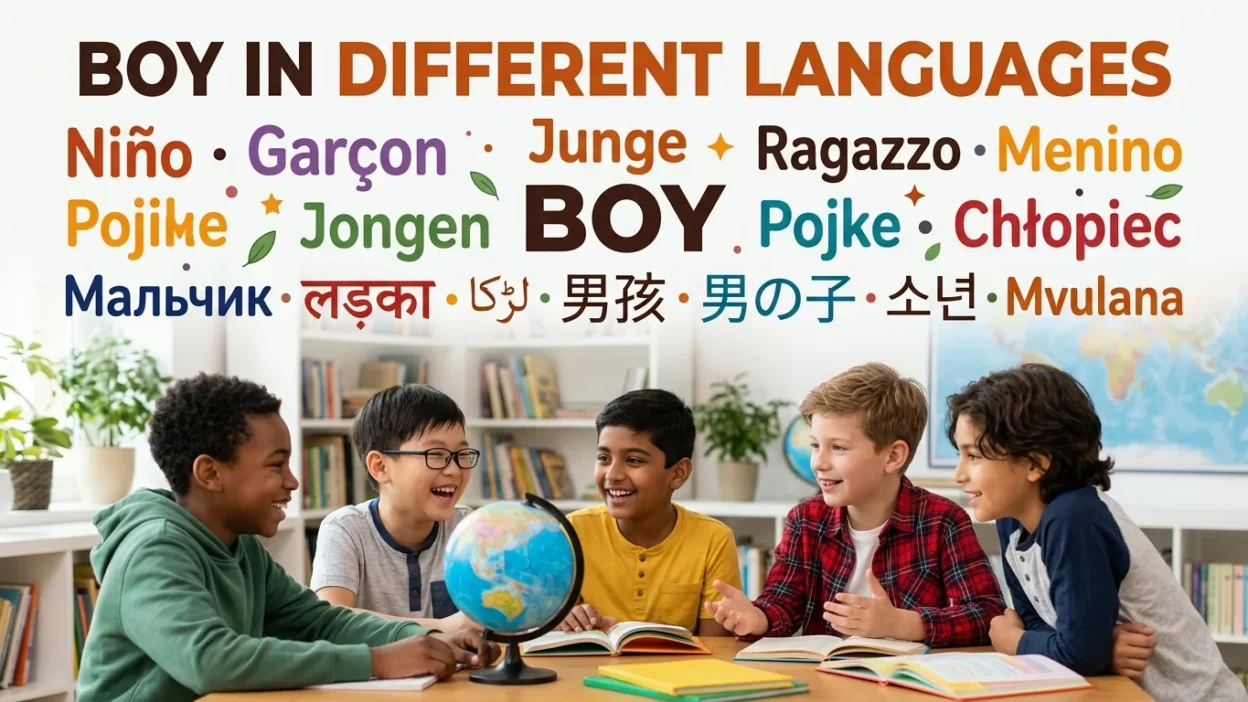
The word “boy” is a simple but useful piece of everyday vocabulary. Whether you are learning a new language, travelling, studying cultures, or creating multilingual content, knowing how to say “boy” in other languages can help you understand common conversations and expressions.
In this guide, you will discover boy in different languages with translations, easy English pronunciations, and short real-life example sentences. The table makes it easy to compare boy in all languages and understand how the word changes across different parts of the world.
Boy in Different Languages
| Language | Native Phrase | Easy English Pronunciation | Example Sentence | English Meaning |
| English | Boy | BOY | The boy is playing outside. | The boy is playing outdoors. |
| Spanish | Niño | NEE-nyoh | El niño está jugando. | The boy is playing. |
| French | Garçon | gar-SON | Le garçon joue dehors. | The boy is playing outside. |
| German | Junge | YOONG-uh | Der Junge spielt draußen. | The boy is playing outside. |
| Italian | Ragazzo | rah-GAHT-tsoh | Il ragazzo sta giocando. | The boy is playing. |
| Portuguese | Menino | meh-NEE-noh | O menino está brincando. | The boy is playing. |
| Dutch | Jongen | YONG-un | De jongen speelt buiten. | The boy is playing outside. |
| Afrikaans | Seun | SAYN | Die seun speel buite. | The boy is playing outside. |
| Swedish | Pojke | POY-keh | Pojken leker ute. | The boy is playing outside. |
| Norwegian | Gutt | GOOT | Gutten leker ute. | The boy is playing outside. |
| Danish | Dreng | DRENG | Drengen leger udenfor. | The boy is playing outside. |
| Finnish | Poika | POY-kah | Poika leikkii ulkona. | The boy is playing outside. |
| Icelandic | Strákur | STRAU-kur | Strákurinn er úti. | The boy is outside. |
| Irish | Buachaill | BOO-uh-khil | Tá an buachaill ag imirt. | The boy is playing. |
| Scottish Gaelic | Balach | BA-lakh | Tha am balach a’ cluich. | The boy is playing. |
| Welsh | Bachgen | BACH-gen | Mae’r bachgen yn chwarae. | The boy is playing. |
| Polish | Chłopiec | HWOH-pyets | Chłopiec bawi się. | The boy is playing. |
| Czech | Chlapec | KHLA-pets | Chlapec si hraje. | The boy is playing. |
| Slovak | Chlapec | KHLA-pets | Chlapec sa hrá. | The boy is playing. |
| Slovenian | Fant | FANT | Fant se igra zunaj. | The boy is playing outside. |
| Croatian | Dječak | DYEH-chak | Dječak se igra. | The boy is playing. |
| Serbian | Дечак | DEH-chak | Дечак се игра. | The boy is playing. |
| Bosnian | Dječak | DYEH-chak | Dječak se igra. | The boy is playing. |
| Macedonian | Момче | MOM-cheh | Момчето игра надвор. | The boy is playing outside. |
| Bulgarian | Момче | MOM-cheh | Момчето играе навън. | The boy is playing outside. |
| Russian | Мальчик | MAL-chik | Мальчик играет на улице. | The boy is playing outside. |
| Ukrainian | Хлопчик | KHLOP-chyk | Хлопчик грає надворі. | The boy is playing outside. |
| Belarusian | Хлопчык | KHLOP-chik | Хлопчык гуляе на вуліцы. | The boy is playing outside. |
| Lithuanian | Berniukas | ber-NYOO-kas | Berniukas žaidžia lauke. | The boy is playing outside. |
| Latvian | Zēns | ZAYNS | Zēns spēlējas ārā. | The boy is playing outside. |
| Estonian | Poiss | POYSS | Poiss mängib õues. | The boy is playing outside. |
| Hungarian | Fiú | FEE-oo | A fiú kint játszik. | The boy is playing outside. |
| Romanian | Băiat | buh-YAHT | Băiatul se joacă afară. | The boy is playing outside. |
| Greek | Αγόρι | ah-GHOH-ree | Το αγόρι παίζει έξω. | The boy is playing outside. |
| Albanian | Djalë | DYA-leh | Djali po luan. | The boy is playing. |
| Maltese | Tifel | TEE-fel | It-tifel qed jilgħab. | The boy is playing. |
| Turkish | Oğlan | OH-lahn | Oğlan dışarıda oynuyor. | The boy is playing outside. |
| Arabic | ولد | WA-lad | الولد يلعب في الخارج. | The boy is playing outside. |
| Hebrew | ילד | YEH-led | הילד משחק בחוץ. | The boy is playing outside. |
| Persian | پسر | PEH-sar | پسر بیرون بازی میکند. | The boy is playing outside. |
| Urdu | لڑکا | LAR-kah | لڑکا باہر کھیل رہا ہے۔ | The boy is playing outside. |
| Hindi | लड़का | LAR-kah | लड़का बाहर खेल रहा है। | The boy is playing outside. |
| Bengali | ছেলে | CHEH-leh | ছেলেটি বাইরে খেলছে। | The boy is playing outside. |
| Punjabi | ਮੁੰਡਾ | MOON-dah | ਮੁੰਡਾ ਬਾਹਰ ਖੇਡ ਰਿਹਾ ਹੈ। | The boy is playing outside. |
| Gujarati | છોકરો | CHHO-kroh | છોકરો બહાર રમે છે. | The boy is playing outside. |
| Marathi | मुलगा | MOOL-gah | मुलगा बाहेर खेळत आहे. | The boy is playing outside. |
| Nepali | केटा | KAY-tah | केटा बाहिर खेल्दैछ। | The boy is playing outside. |
| Sinhala | පිරිමි ළමයා | pee-ree-mee lah-MAH-yah | පිරිමි ළමයා එළියේ සෙල්ලම් කරයි. | The boy is playing outside. |
| Tamil | பையன் | PAI-yan | பையன் வெளியே விளையாடுகிறான். | The boy is playing outside. |
| Telugu | అబ్బాయి | ab-BYE | అబ్బాయి బయట ఆడుతున్నాడు. | The boy is playing outside. |
| Kannada | ಹುಡುಗ | hoo-DUG-ah | ಹುಡುಗ ಹೊರಗೆ ಆಡುತ್ತಿದ್ದಾನೆ. | The boy is playing outside. |
| Malayalam | ആൺകുട്ടി | aan-KOOT-tee | ആൺകുട്ടി പുറത്തു കളിക്കുന്നു. | The boy is playing outside. |
| Odia | ପୁଅ | POO-ah | ପୁଅ ବାହାରେ ଖେଳୁଛି। | The boy is playing outside. |
| Assamese | ল’ৰা | LOH-rah | ল’ৰাজনে বাহিৰত খেলি আছে। | The boy is playing outside. |
| Mandarin Chinese | 男孩 | nán hái | 男孩在外面玩。 | The boy is playing outside. |
| Japanese | 男の子 | otoko no ko | 男の子が外で遊んでいます。 | The boy is playing outside. |
| Korean | 소년 | so-nyeon | 소년이 밖에서 놀고 있어요. | The boy is playing outside. |
| Vietnamese | Con trai | kon chai | Cậu bé đang chơi bên ngoài. | The boy is playing outside. |
| Thai | เด็กผู้ชาย | dek poo-chaai | เด็กผู้ชายกำลังเล่นข้างนอก | The boy is playing outside. |
| Indonesian | Anak laki-laki | AH-nak lah-kee LAH-kee | Anak laki-laki itu bermain di luar. | The boy is playing outside. |
| Malay | Budak lelaki | BOO-dak leh-LAH-kee | Budak lelaki itu bermain di luar. | The boy is playing outside. |
| Filipino | Batang lalaki | BA-tang la-LA-kee | Ang batang lalaki ay naglalaro sa labas. | The boy is playing outside. |
| Javanese | Bocah lanang | BOH-chah LAH-nang | Bocah lanang kuwi dolanan ing njaba. | The boy is playing outside. |
| Swahili | Mvulana | mvoo-LAH-nah | Mvulana anacheza nje. | The boy is playing outside. |
| Amharic | ወንድ ልጅ | WEND lij | ወንድ ልጁ ውጭ እየተጫወተ ነው። | The boy is playing outside. |
| Somali | Wiil | WEEL | Wiilku bannaanka ayuu ku ciyaarayaa. | The boy is playing outside. |
| Yoruba | Ọmọkùnrin | oh-moh-KOON-reen | Ọmọkùnrin náà ń ṣeré. | The boy is playing. |
| Igbo | Nwoke nta | NWO-keh ntah | Nwoke nta ahụ na-egwu egwu. | The boy is playing. |
| Zulu | Umfana | oom-FAH-nah | Umfana udlala ngaphandle. | The boy is playing outside. |
| Xhosa | Inkwenkwe | een-KWEN-kweh | Inkwenkwe idlala ngaphandle. | The boy is playing outside. |
| Haitian Creole | Ti gason | tee gah-SON | Ti gason an ap jwe deyò. | The boy is playing outside. |
How to Say Boy in Different Languages
There are many different ways to say boy depending on the language and context.
For example, Spanish uses niño, French uses garçon, German uses Junge, and Italian uses ragazzo. In South Asian languages, Hindi and Urdu use लड़का / لڑکا, while Bengali uses ছেলে.
East Asian languages also have their own expressions. Mandarin Chinese uses 男孩, Japanese uses 男の子, and Korean uses 소년.
These translations demonstrate why learning how to say boy in different languages can be more interesting than simply memorising vocabulary. Each language has its own grammatical rules, pronunciation patterns, and cultural context.
Boy in Different Languages Around the World
The word “boy” can describe a young male child or, depending on context, a young male person. However, the exact age and social meaning can vary between languages.
Some languages have a specific word for a young boy, while others use broader expressions meaning “male child” or “young male.”
For example, niño in Spanish can mean “boy” or “child” depending on context. In Japanese, 男の子 specifically refers to a boy or male child.
Understanding these differences is important when studying boy in different languages translations, because a direct dictionary translation does not always capture every possible meaning.
Boy Translations in European Languages
European languages offer a wide range of words for “boy.”
Romance languages include forms such as:
- Spanish: niño
- French: garçon
- Italian: ragazzo
- Portuguese: menino
- Romanian: băiat
Germanic languages use different forms:
- German: Junge
- Dutch: jongen
- Swedish: pojke
- Norwegian: gutt
- Danish: dreng
Slavic languages are equally diverse, with Russian мальчик, Polish chłopiec, Czech chlapec, and Croatian dječak.
Boy in Asian Languages
Asian languages show some of the greatest variety in vocabulary and writing systems.
In Hindi and Urdu, the word is closely related in pronunciation, while Bengali, Punjabi, Marathi, Tamil, Telugu, and other languages have their own forms.
In East Asia, the written forms are particularly distinctive. Mandarin Chinese uses 男孩, while Japanese uses 男の子.
Learning these words can be especially useful for travellers, students, multilingual families, and anyone interested in Asian languages and cultures.
Boy in African Languages
African languages also offer many unique translations.
Swahili uses mvulana, Somali uses wiil, Yoruba uses ọmọkùnrin, and Zulu uses umfana.
These examples show that there is no single universal linguistic pattern for the word “boy.” Different language families have developed their own vocabulary over centuries.
Boy vs. Child: Are They the Same?
The words boy and child are related but do not always mean the same thing.
A boy specifically refers to a male child or young male person.
A child can refer to a young person of any gender.
Some languages use a word that can mean either “boy” or “child” depending on the sentence. Therefore, context is important when translating the word “boy.”
How to Use Boy in Everyday Sentences
Learning the word alone is useful, but using it in a sentence makes it easier to remember.
Here are a few common English examples:
- The boy is reading a book.
- That boy is my brother.
- I saw a boy at the park.
- The boy is wearing a blue shirt.
- A young boy helped me.
When translating these sentences, grammar may change depending on the language. Gender, articles, word order, and verb forms can all affect the final translation.
Why Learn Boy in Different Languages?
Learning boy in different languages can be useful for language students, travellers, teachers, writers, parents, and anyone interested in world languages.
It can also help you understand how different cultures describe age and gender.
Learning individual vocabulary words is one of the easiest ways to build a foundation in a new language. Once you know “boy,” you can continue with related words such as girl, child, man, father, brother, son, and friend.
Conclusion
The word boy has many different forms across the world’s languages. From niño in Spanish and garçon in French to 男孩 in Chinese and mvulana in Swahili, every language expresses this familiar concept in its own way.
These 70 translations make it easier to explore boy in different languages around the world, compare vocabulary, and build useful multilingual knowledge.
Whether you are learning a new language or simply curious about global vocabulary, knowing how to say “boy” is a small but practical step towards understanding another language and culture.
FAQs
1. How do you say boy in different languages?
“Boy” has many translations around the world. Examples include niño in Spanish, garçon in French, Junge in German, ragazzo in Italian, لڑکا in Urdu, 男孩 in Chinese, and 男の子 in Japanese.
2. How do you say boy in Spanish?
In Spanish, “boy” is commonly translated as niño. It is pronounced approximately “NEE-nyoh.”
3. What is the word for boy in Hindi?
In Hindi, “boy” is लड़का. The approximate English pronunciation is “LAR-kah.”
4. How do you say boy in Japanese?
In Japanese, “boy” is commonly written as 男の子 and pronounced approximately “otoko no ko.”
5. What is boy in Chinese?
In Mandarin Chinese, “boy” is 男孩, pronounced approximately nán hái. It refers to a male child or boy.