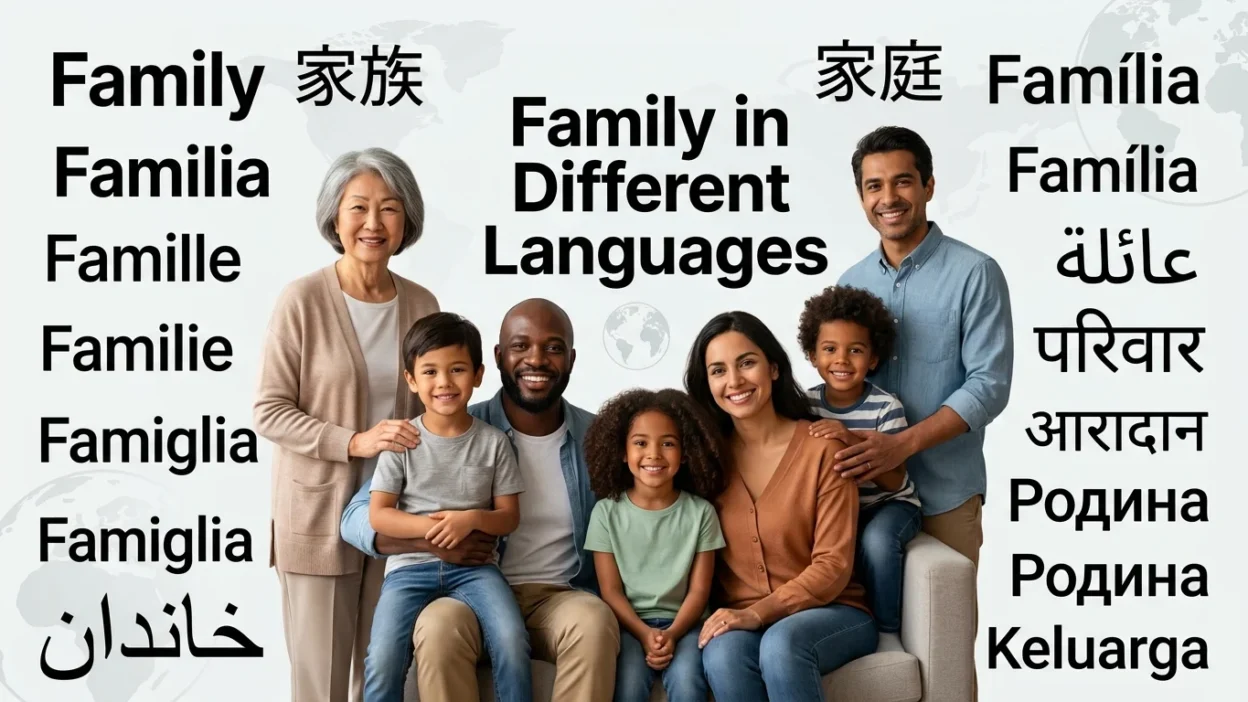
Family is one of the most universal ideas across cultures. Although every country and language has its own traditions and expressions, the word “family” carries a similar sense of belonging, connection, care, and togetherness.
If you are looking for family in different languages, this guide gives you translations in one easy-to-read table. Each entry includes the native word, an easy English pronunciation, and a short example sentence with its English meaning.
Whether you are learning languages, travelling, writing, studying cultures, or simply curious about family in different languages around the world, these translations provide a useful starting point.
Family in Different Languages
| Language | Native Phrase | Easy English Pronunciation | Example Sentence | English Meaning |
| English | Family | FAM-uh-lee | My family is very close. | My family has a strong bond. |
| Spanish | Familia | fa-MEE-lya | Mi familia vive aquí. | My family lives here. |
| French | Famille | fa-MEE-yuh | Ma famille est grande. | My family is large. |
| German | Familie | fa-MEE-lee-uh | Meine Familie ist freundlich. | My family is friendly. |
| Italian | Famiglia | fa-MEE-lyah | La mia famiglia è felice. | My family is happy. |
| Portuguese | Família | fa-MEE-lyah | Minha família está aqui. | My family is here. |
| Dutch | Familie | fa-MEE-lee | Mijn familie woont hier. | My family lives here. |
| Afrikaans | Familie | fa-MEE-lee | My familie is groot. | My family is large. |
| Swedish | Familj | fa-MEEL-y | Min familj är hemma. | My family is at home. |
| Norwegian | Familie | fa-MEE-lee-uh | Familien min er hjemme. | My family is at home. |
| Danish | Familie | fa-MEE-lee-uh | Min familie er stor. | My family is large. |
| Finnish | Perhe | PER-heh | Perheeni on suuri. | My family is large. |
| Icelandic | Fjölskylda | fyuul-SKYL-ta | Fjölskyldan mín er hér. | My family is here. |
| Irish | Teaghlach | CHYAKH | Tá mo theaghlach anseo. | My family is here. |
| Scottish Gaelic | Teaghlach | CHYAKH | Tha mo theaghlach mòr. | My family is large. |
| Welsh | Teulu | TAY-lee | Mae fy nheulu yma. | My family is here. |
| Polish | Rodzina | roh-JEE-nah | Moja rodzina jest duża. | My family is large. |
| Czech | Rodina | ROH-dee-nah | Moje rodina je doma. | My family is at home. |
| Slovak | Rodina | ROH-dee-nah | Moja rodina je veľká. | My family is large. |
| Slovenian | Družina | droo-ZHEE-nah | Moja družina je tukaj. | My family is here. |
| Croatian | Obitelj | oh-BYE-tyel | Moja obitelj je velika. | My family is large. |
| Serbian | Породица | poh-ROH-dee-tsa | Моја породица је овде. | My family is here. |
| Bosnian | Porodica | poh-ROH-dee-tsa | Moja porodica je velika. | My family is large. |
| Macedonian | Семејство | seh-MAY-stvo | Моето семејство е тука. | My family is here. |
| Bulgarian | Семейство | seh-MAY-stvo | Моето семейство е тук. | My family is here. |
| Russian | Семья | see-MYAH | Моя семья здесь. | My family is here. |
| Ukrainian | Сім’я | seem-YAH | Моя сім’я тут. | My family is here. |
| Belarusian | Сям’я | syam-YAH | Мая сям’я тут. | My family is here. |
| Lithuanian | Šeima | SHAY-mah | Mano šeima čia. | My family is here. |
| Latvian | Ģimene | GHEE-meh-neh | Mana ģimene ir šeit. | My family is here. |
| Estonian | Perekond | PEH-reh-kond | Minu perekond on siin. | My family is here. |
| Hungarian | Család | CHA-lahd | A családom nagy. | My family is large. |
| Romanian | Familie | fa-MEE-lee-eh | Familia mea este aici. | My family is here. |
| Greek | Οικογένεια | ee-kee-YEH-nee-ah | Η οικογένειά μου είναι εδώ. | My family is here. |
| Albanian | Familje | fa-MEEL-yeh | Familja ime është këtu. | My family is here. |
| Maltese | Familja | fa-MEEL-yah | Il-familja tiegħi tinsab hawn. | My family is here. |
| Turkish | Aile | eye-LEH | Ailem burada. | My family is here. |
| Arabic | عائلة | AA-eh-lah | عائلتي هنا. | My family is here. |
| Hebrew | משפחה | mish-pa-KHA | המשפחה שלי כאן. | My family is here. |
| Persian | خانواده | khah-ne-VAH-deh | خانواده من اینجاست. | My family is here. |
| Urdu | خاندان | khaan-DAAN | میرا خاندان یہاں ہے۔ | My family is here. |
| Hindi | परिवार | puh-ree-VAAR | मेरा परिवार यहाँ है। | My family is here. |
| Bengali | পরিবার | po-ree-BAAR | আমার পরিবার এখানে। | My family is here. |
| Punjabi | ਪਰਿਵਾਰ | puh-rih-VAAR | ਮੇਰਾ ਪਰਿਵਾਰ ਇੱਥੇ ਹੈ। | My family is here. |
| Gujarati | પરિવાર | puh-rih-VAAR | મારું પરિવાર અહીં છે. | My family is here. |
| Marathi | कुटुंब | koo-TOOMB | माझे कुटुंब इथे आहे. | My family is here. |
| Nepali | परिवार | puh-ree-VAAR | मेरो परिवार यहाँ छ। | My family is here. |
| Sinhala | පවුල | PAU-lah | මගේ පවුල මෙහි ඇත. | My family is here. |
| Tamil | குடும்பம் | koo-doom-bam | என் குடும்பம் இங்கே உள்ளது. | My family is here. |
| Telugu | కుటుంబం | koo-doom-bam | నా కుటుంబం ఇక్కడ ఉంది. | My family is here. |
| Kannada | ಕುಟುಂಬ | koo-doom-bah | ನನ್ನ ಕುಟುಂಬ ಇಲ್ಲಿದೆ. | My family is here. |
| Malayalam | കുടുംബം | koo-doom-bam | എന്റെ കുടുംബം ഇവിടെയുണ്ട്. | My family is here. |
| Odia | ପରିବାର | po-ree-BAAR | ମୋ ପରିବାର ଏଠାରେ ଅଛି। | My family is here. |
| Assamese | পৰিয়াল | po-ree-YAAL | মোৰ পৰিয়াল ইয়াত আছে। | My family is here. |
| Mandarin Chinese | 家庭 | jyaa-ting | 我的家庭在这里。 | My family is here. |
| Japanese | 家族 | ka-zoh-koo | 私の家族はここにいます。 | My family is here. |
| Korean | 가족 | ga-jok | 우리 가족은 여기 있어요. | My family is here. |
| Vietnamese | Gia đình | zya DINH | Gia đình tôi ở đây. | My family is here. |
| Thai | ครอบครัว | khrop-khrua | ครอบครัวของฉันอยู่ที่นี่ | My family is here. |
| Indonesian | Keluarga | kuh-loo-AR-gah | Keluarga saya di sini. | My family is here. |
| Malay | Keluarga | kuh-loo-AR-gah | Keluarga saya ada di sini. | My family is here. |
| Filipino | Pamilya | pa-MEEL-yah | Ang pamilya ko ay nandito. | My family is here. |
| Javanese | Kulawarga | koo-lah-WAR-gah | Kulawargaku ana ing kene. | My family is here. |
| Swahili | Familia | fa-MEE-lee-ah | Familia yangu iko hapa. | My family is here. |
| Amharic | ቤተሰብ | bay-teh-SEB | ቤተሰቤ እዚህ ነው። | My family is here. |
| Somali | Qoys | KOYS | Qoyskaygu waa halkan. | My family is here. |
| Yoruba | Ẹbí | eh-BEE | Ẹbí mi wà níbí. | My family is here. |
| Igbo | Ezinụlọ | eh-zee-NOO-loh | Ezinụlọ m nọ ebe a. | My family is here. |
| Zulu | Umndeni | oom-NDEH-nee | Umndeni wami ulapha. | My family is here. |
| Xhosa | Usapho | oo-SAH-poh | Usapho lwam lulapha. | My family is here. |
| Haitian Creole | Fanmi | fan-MEE | Fanmi mwen la. | My family is here. |
How to Say Family in Different Languages
The word family changes considerably from one language to another. Some languages have words that resemble one another because of shared linguistic roots, while others use completely different terms.
For example, Romance languages often have related forms such as familia in Spanish, famiglia in Italian, and família in Portuguese. German and Dutch also have closely related forms: Familie.
Other languages have distinctive words. Turkish uses aile, Japanese uses 家族, Korean uses 가족, and Hungarian uses család.
These differences make learning how to say family in different languages an interesting way to explore the world’s languages and cultures.
Family Translations Around the World
The idea of family is found in virtually every culture, but the word itself can reflect the structure and traditions of a particular language community.
In many South Asian languages, words derived from Sanskrit or related linguistic traditions are common. Hindi, Punjabi, Bengali, Nepali, and several other languages use forms related to parivaar.
In East Asia, the vocabulary is different. Mandarin Chinese uses 家庭, Japanese commonly uses 家族, and Korean uses 가족.
Across Europe, there is also significant variety. Spanish uses familia, Polish uses rodzina, Russian uses семья, Greek uses οικογένεια, and Finnish uses perhe.
Family in Different Languages in All Languages: Common Patterns
One useful way to understand these translations is to group languages according to their linguistic relationships.
Romance languages often have words derived from Latin familia. Spanish, French, Italian, Portuguese, Romanian, and others show this connection.
Germanic languages may have different forms, although some, such as English, German, Dutch, Swedish, and Norwegian, have related vocabulary or similar modern forms.
Slavic languages show another group of related words. Russian семья, Ukrainian сім’я, Polish rodzina, Czech rodina, and several other forms demonstrate the diversity within the Slavic language family.
Asian and African languages provide even more variety, showing how the same universal concept can be expressed through completely different sounds and writing systems.
Why Learn the Word Family in Other Languages?
Learning a simple word such as family can be useful for several reasons.
It can help travellers communicate with local people, give language learners useful everyday vocabulary, and make cultural studies more meaningful.
It can also be useful when creating multilingual content, studying translation, learning greetings and basic conversation, or exploring how different languages describe relationships.
Because family is such an important part of everyday life, it is a practical vocabulary word for beginners.
Family Vocabulary for Language Learners
Once you know the word for family, you can expand your vocabulary with related terms.
Common words to learn include:
- Mother
- Father
- Parents
- Brother
- Sister
- Son
- Daughter
- Child
- Husband
- Wife
- Grandmother
- Grandfather
- Uncle
- Aunt
- Cousin
Learning these words together makes it easier to talk about relatives, introduce your family, and understand everyday conversations.
Difference Between Family and Household
Although family and household can sometimes overlap, they do not always mean exactly the same thing.
Family generally refers to people connected through relationships, such as parents, children, siblings, or extended relatives.
Household usually refers to the people who live together in the same home. A household can include family members, but it can also include unrelated people.
The appropriate translation therefore depends on the context and the language being used.
How Family Is Used in Everyday Sentences
The word family commonly appears in simple sentences.
For example:
- My family is very important to me.
- I am visiting my family this weekend.
- Her family lives nearby.
- We had dinner with our family.
- His family moved to another city.
When translating these sentences, it is important to consider grammar, possessive forms, plural forms, and cultural context rather than translating each word mechanically.
Conclusion
The word family may sound very different from one language to another, but its meaning remains deeply connected with relationships, belonging, care, and togetherness.
From familia in Spanish and famiglia in Italian to 家族 in Japanese and 가족 in Korean, these 70 translations show how languages around the world express one of life’s most familiar concepts.
Learning family in different languages is a simple and useful way to build vocabulary while discovering the linguistic diversity found around the world.
FAQs
1. How do you say family in different languages?
The word for family varies by language. Some examples include familia in Spanish, famille in French, Familie in German, famiglia in Italian, aile in Turkish, rodzina in Polish, 家族 in Japanese, and 가족 in Korean.
2. What is the most common translation of family?
There is no single translation used by every language. Familia, famille, famiglia, and similar forms are common across several European languages, while other languages use completely different words.
3. How do you say family in Spanish?
In Spanish, family is familia. It is pronounced approximately fa-MEE-lya.
4. How do you say family in Japanese?
In Japanese, family can be written as 家族 and is commonly pronounced approximately ka-zoh-koo.
5. Why is learning family in different languages useful?
Learning the word for family can help with everyday conversations, travel, language study, cultural learning, translation, and building basic vocabulary in a new language.