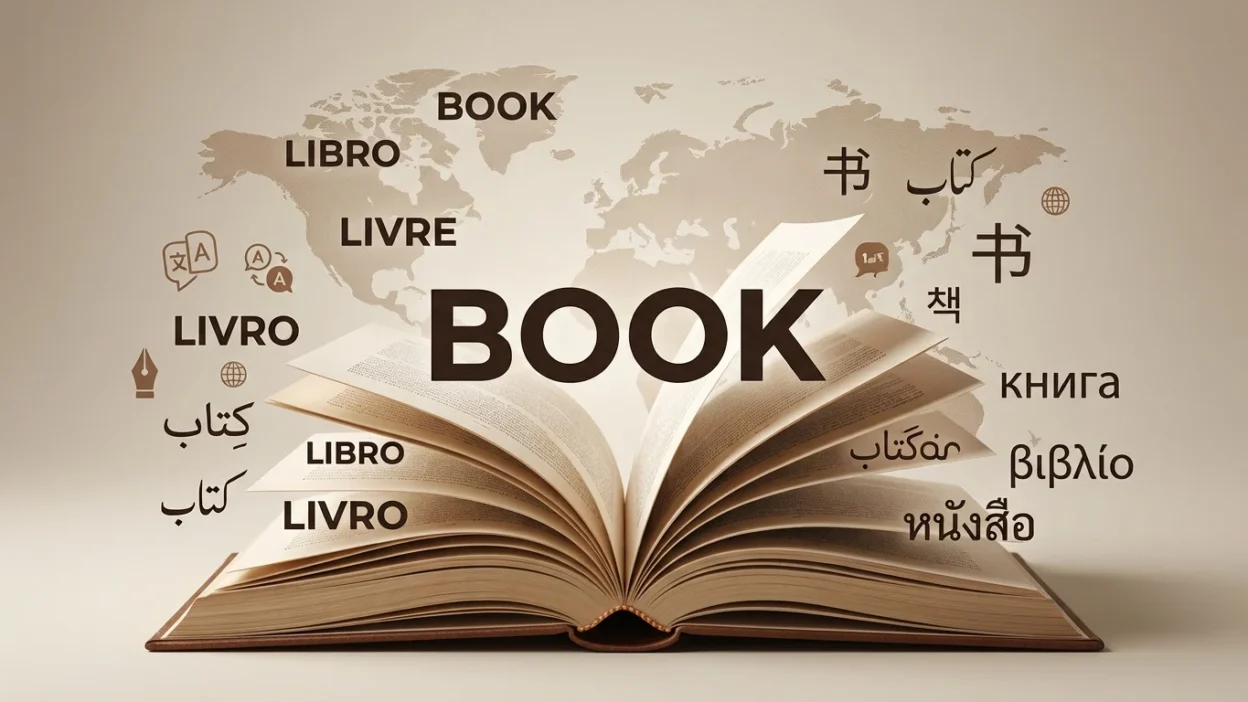
A book is one of the most universal ways people share stories, knowledge, history, ideas, and imagination. Although the object is familiar around the world, the word used for “book” sounds very different from one language to another.
If you are learning languages, travelling, studying translation, or simply curious about vocabulary, learning book in different languages is a useful place to start. This guide provides translations, their easy English pronunciations, and short real-life examples.
Below, you can discover book in different languages in all languages and see how this everyday word is written and used around the world.
Book in Different Languages
| Language | Correct native phrase | Easy English pronunciation | Example sentence | English meaning |
| English | book | BOOK | I bought a new book. | I purchased a new book. |
| Spanish | libro | LEE-broh | Compré un libro nuevo. | I bought a new book. |
| French | livre | LEE-vruh | J’ai acheté un nouveau livre. | I bought a new book. |
| German | Buch | BOOKH | Ich lese ein Buch. | I am reading a book. |
| Italian | libro | LEE-broh | Sto leggendo un libro. | I am reading a book. |
| Portuguese | livro | LEE-vroh | Estou lendo um livro. | I am reading a book. |
| Dutch | boek | BOOK | Ik lees een boek. | I am reading a book. |
| Afrikaans | boek | BOOK | Ek lees ‘n boek. | I am reading a book. |
| Swedish | bok | BOOK | Jag läser en bok. | I am reading a book. |
| Danish | bog | BOH | Jeg læser en bog. | I am reading a book. |
| Norwegian | bok | BOOK | Jeg leser en bok. | I am reading a book. |
| Finnish | kirja | KEER-yah | Luen kirjaa. | I am reading a book. |
| Icelandic | bók | BOHK | Ég les bók. | I am reading a book. |
| Irish | leabhar | LYOW-er | Tá leabhar agam. | I have a book. |
| Welsh | llyfr | HLUHV-r | Mae gen i lyfr. | I have a book. |
| Scottish Gaelic | leabhar | LYOW-er | Tha leabhar agam. | I have a book. |
| Polish | książka | KSHONZH-kah | Czytam książkę. | I am reading a book. |
| Czech | kniha | KNEE-hah | Čtu knihu. | I am reading a book. |
| Slovak | kniha | KNEE-hah | Čítam knihu. | I am reading a book. |
| Slovenian | knjiga | KNEE-gah | Berem knjigo. | I am reading a book. |
| Croatian | knjiga | KNEE-gah | Čitam knjigu. | I am reading a book. |
| Serbian | књига | KNEE-gah | Читам књигу. | I am reading a book. |
| Bosnian | knjiga | KNEE-gah | Čitam knjigu. | I am reading a book. |
| Bulgarian | книга | KNEE-gah | Чета книга. | I am reading a book. |
| Macedonian | книга | KNEE-gah | Читам книга. | I am reading a book. |
| Russian | книга | KNEE-gah | Я читаю книгу. | I am reading a book. |
| Ukrainian | книга | KNEE-hah | Я читаю книгу. | I am reading a book. |
| Belarusian | кніга | KNEE-gah | Я чытаю кнігу. | I am reading a book. |
| Lithuanian | knyga | KNEE-gah | Aš skaitau knygą. | I am reading a book. |
| Latvian | grāmata | GRAH-mah-tah | Es lasu grāmatu. | I am reading a book. |
| Estonian | raamat | RAH-maht | Ma loen raamatut. | I am reading a book. |
| Hungarian | könyv | KURNYV | Könyvet olvasok. | I am reading a book. |
| Romanian | carte | KAR-teh | Citesc o carte. | I am reading a book. |
| Albanian | libër | LEE-bur | Po lexoj një libër. | I am reading a book. |
| Greek | βιβλίο | vee-VLEE-oh | Διαβάζω ένα βιβλίο. | I am reading a book. |
| Turkish | kitap | kee-TAHP | Bir kitap okuyorum. | I am reading a book. |
| Armenian | գիրք | GHEERK | Ես գիրք եմ կարդում։ | I am reading a book. |
| Georgian | წიგნი | TSIG-nee | მე წიგნს ვკითხულობ. | I am reading a book. |
| Persian | کتاب | ke-TAAB | من یک کتاب میخوانم. | I am reading a book. |
| Arabic | كتاب | kee-TAAB | أقرأ كتابًا. | I am reading a book. |
| Hebrew | ספר | SEH-fer | אני קורא ספר. | I am reading a book. |
| Hindi | किताब | ki-TAAB | मैं किताब पढ़ रहा हूँ। | I am reading a book. |
| Urdu | کتاب | ki-TAAB | میں کتاب پڑھ رہا ہوں۔ | I am reading a book. |
| Bengali | বই | BOI | আমি একটি বই পড়ছি। | I am reading a book. |
| Punjabi | ਕਿਤਾਬ | ki-TAAB | ਮੈਂ ਕਿਤਾਬ ਪੜ੍ਹ ਰਿਹਾ ਹਾਂ। | I am reading a book. |
| Gujarati | પુસ્તક | poos-TAK | હું પુસ્તક વાંચું છું. | I am reading a book. |
| Marathi | पुस्तक | poos-TAK | मी पुस्तक वाचत आहे. | I am reading a book. |
| Nepali | किताब | ki-TAAB | म किताब पढ्दैछु। | I am reading a book. |
| Sinhala | පොත | POH-tah | මම පොතක් කියවනවා. | I am reading a book. |
| Tamil | புத்தகம் | POOT-tha-gam | நான் ஒரு புத்தகம் படிக்கிறேன். | I am reading a book. |
| Telugu | పుస్తకం | POOS-ta-kam | నేను పుస్తకం చదువుతున్నాను. | I am reading a book. |
| Kannada | ಪುಸ್ತಕ | POOS-ta-ka | ನಾನು ಪುಸ್ತಕ ಓದುತ್ತಿದ್ದೇನೆ. | I am reading a book. |
| Malayalam | പുസ്തകം | POOS-ta-kam | ഞാൻ ഒരു പുസ്തകം വായിക്കുന്നു. | I am reading a book. |
| Thai | หนังสือ | nang-SUE | ฉันกำลังอ่านหนังสือ | I am reading a book. |
| Vietnamese | sách | sahk | Tôi đang đọc sách. | I am reading a book. |
| Indonesian | buku | BOO-koo | Saya sedang membaca buku. | I am reading a book. |
| Malay | buku | BOO-koo | Saya sedang membaca buku. | I am reading a book. |
| Filipino | aklat | AK-lat | Nagbabasa ako ng aklat. | I am reading a book. |
| Chinese (Mandarin) | 书 | shū | 我正在看书。 | I am reading a book. |
| Japanese | 本 | hon | 本を読んでいます。 | I am reading a book. |
| Korean | 책 | chaek | 저는 책을 읽고 있어요. | I am reading a book. |
| Mongolian | ном | NOHM | Би ном уншиж байна. | I am reading a book. |
| Kazakh | кітап | kee-TAHP | Мен кітап оқып отырмын. | I am reading a book. |
| Uzbek | kitob | kee-TOHB | Men kitob o‘qiyapman. | I am reading a book. |
| Azerbaijani | kitab | kee-TAHB | Mən kitab oxuyuram. | I am reading a book. |
| Swahili | kitabu | kee-TAH-boo | Ninasoma kitabu. | I am reading a book. |
| Amharic | መጽሐፍ | mets-HAHF | መጽሐፍ እያነበብኩ ነው። | I am reading a book. |
| Zulu | incwadi | in-KWAH-dee | Ngifunda incwadi. | I am reading a book. |
| Xhosa | incwadi | in-KWAH-dee | Ndifunda incwadi. | I am reading a book. |
| Haitian Creole | liv | LEEV | M ap li yon liv. | I am reading a book. |
| Latin | liber | LEE-ber | Librum lego. | I am reading a book. |
| Esperanto | libro | LEE-broh | Mi legas libron. | I am reading a book. |
What Does “Book” Mean?
The word book usually refers to a written, printed, or digital work containing pages of text, illustrations, information, or a story. A book can be fiction, non-fiction, educational, historical, religious, or created for entertainment.
The English word can also be used as a verb. For example, “I want to book a hotel” means to reserve a room. However, in this guide, book in different languages refers primarily to the noun: a book that people read.
How to Say “Book” in Different Languages
If you are wondering how to say book in different languages, the translations vary considerably.
Some languages have words that sound relatively similar. For example, Spanish libro, Italian libro, Portuguese livro, and Romanian carte all have their own forms.
In several Slavic languages, the word is related to forms such as Russian книга, Polish książka, Czech kniha, and Croatian knjiga.
In Asian languages, the differences are even more noticeable. Mandarin uses 书, Japanese uses 本, Korean uses 책, Hindi uses किताब, and Arabic uses كتاب.
Book in Different Languages Around the World
Books are found in almost every culture, but languages have developed their own words for them.
In Europe, common examples include French livre, German Buch, Spanish libro, Dutch boek, and Greek βιβλίο.
Across South Asia, you can find Hindi किताब, Urdu کتاب, Bengali বই, Punjabi ਕਿਤਾਬ, Tamil புத்தகம், and Malayalam പുസ്തകം.
In East and Southeast Asia, Mandarin 书, Japanese 本, Korean 책, Vietnamese sách, Thai หนังสือ, Indonesian buku, and Filipino aklat are common terms.
African languages also have distinctive words. Swahili uses kitabu, Zulu uses incwadi, Xhosa uses incwadi, and Amharic uses መጽሐፍ.
Book in Different Languages Translations and Pronunciation
Knowing the written translation is useful, but pronunciation helps you use the word in conversation.
Some languages use familiar Latin letters, while others use completely different writing systems. Arabic, Hebrew, Hindi, Bengali, Chinese, Japanese, Korean, Thai, and Georgian are examples of languages where the native spelling may look very different from English.
The pronunciation column provides an easy English approximation to help beginners recognise the word. These approximations are designed for learning rather than replacing the natural pronunciation of a native speaker.
Why Is the Word “Book” Important to Learn?
“Book” is a practical vocabulary word because books are part of education, work, travel, culture, and everyday life.
Learning this word can help you:
- talk about reading
- ask for a book in a shop
- discuss your favourite books
- understand library vocabulary
- improve your basic vocabulary
- recognise book-related words while travelling
- communicate with language learners and native speakers
It is also a useful word for beginners because it can easily be combined with other vocabulary, such as “new book”, “old book”, “history book”, “school book”, and “favourite book”.
Interesting Differences Between Book Translations
One interesting feature of book in different languages is that several languages have historically related forms.
For example, Spanish libro, Italian libro, Portuguese livro, and Esperanto libro are visibly similar.
Another group can be seen in Central and Eastern Europe, where forms such as Russian книга, Bulgarian книга, Serbian књига, and Slovenian knjiga share noticeable similarities.
South Asian languages also show interesting variation. Hindi, Urdu, and Nepali use forms based on किताब, while Gujarati and Marathi use પુસ્તક and पुस्तक respectively.
Book as a Verb in English
It is important to remember that English has another common meaning of “book”.
As a verb, to book means to arrange or reserve something in advance.
For example:
I need to book a hotel room.
Here, “book” does not mean a written publication. It means to make a reservation.
This distinction matters when searching for book in different languages translations, because other languages may use completely different words for the noun and the verb.
Common Types of Books
The word “book” can describe many types of publications, including:
- novels
- textbooks
- dictionaries
- biographies
- cookbooks
- poetry books
- history books
- children’s books
- reference books
- travel books
Learning the basic word first makes it easier to build a larger vocabulary around reading and publishing.
How to Remember “Book” in Different Languages
A useful way to remember new translations is to group languages together.
Start with similar forms such as libro, livro, and libro. Then practise words that look completely different, such as Mandarin 书, Japanese 本, Korean 책, and Arabic كتاب.
Writing each word several times, saying it aloud, and using it in a short sentence can make vocabulary easier to remember.
Conclusion
Learning book in different languages is a simple but useful way to expand your multilingual vocabulary. The translations above show how one familiar object can have completely different names across languages and cultures.
From Spanish libro and French livre to Mandarin 书, Japanese 本, Arabic كتاب, and Swahili kitabu, each translation provides a small insight into another language.
Whether you are studying languages, travelling, reading foreign literature, or simply curious about book in different languages around the world, these translations offer a practical starting point.
FAQs
1. How do you say “book” in different languages?
“Book” has many different translations. Examples include libro in Spanish, livre in French, Buch in German, книга in Russian, کتاب in Urdu, 书 in Chinese, 本 in Japanese, and 책 in Korean.
2. What is “book” in Spanish?
The Spanish word for “book” is libro. For example, “I am reading a book” can be expressed as Estoy leyendo un libro.
3. What is “book” in French?
The French word for “book” is livre. It is commonly used when referring to a written or published book.
4. What is “book” in Japanese?
The Japanese word 本 (hon) is commonly used for “book”. A natural sentence is 本を読んでいます, meaning “I am reading a book.”
5. Is “book” both a noun and a verb in English?
Yes. As a noun, “book” means a written or published work. As a verb, “to book” means to reserve or arrange something in advance, such as a hotel room, flight, or appointment.