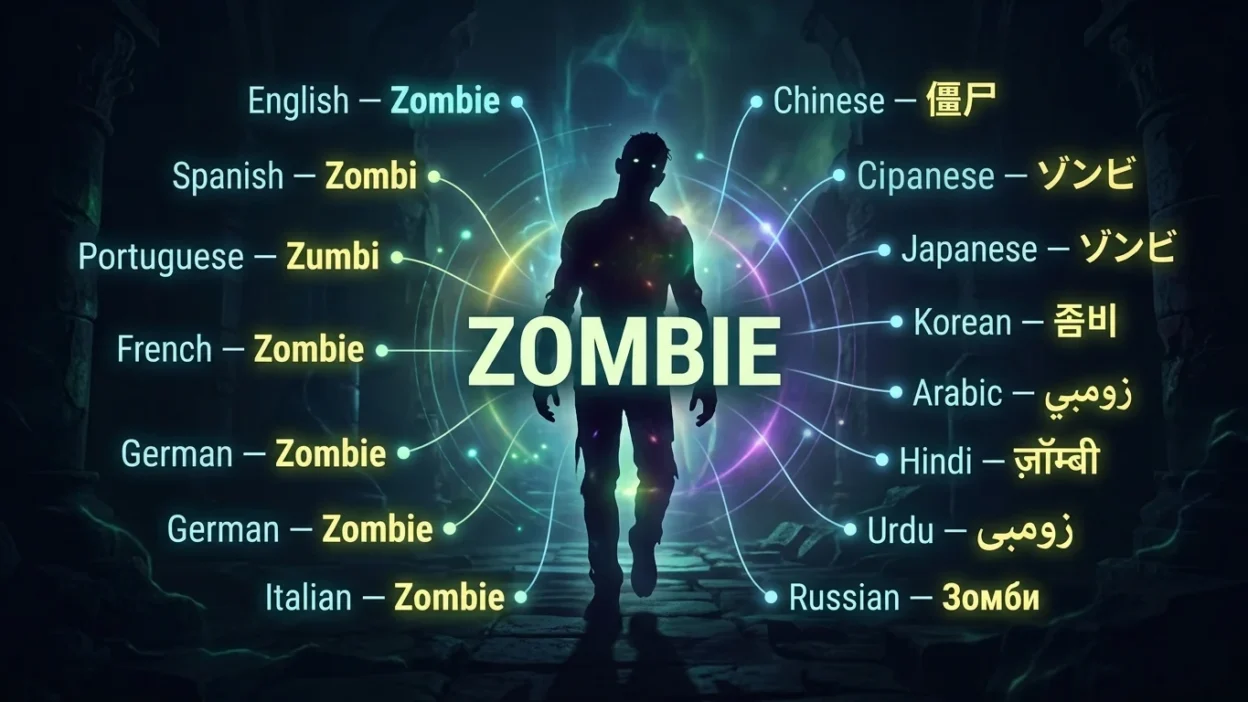
The word zombie is recognised in many parts of the world, especially through films, television, games, books, and popular culture. However, different languages may use a local spelling, pronunciation, or an entirely different expression for the same idea.
If you are wondering how to say zombie in different languages, this guide provides translations in one easy reference table. Each entry includes the native word, a simple English pronunciation, a short example sentence, and the English meaning.
Whether you are learning vocabulary, writing a story, studying world languages, or simply curious about zombie in different languages in all languages, this collection gives you a useful look at how the concept is expressed around the world.
Zombie in Different Languages
| Language | Correct Native Phrase | Easy English Pronunciation | Example Sentence | English Meaning of Example |
| Afrikaans | zombie | ZOM-bee | Die zombie loop stadig. | The zombie walks slowly. |
| Albanian | zomb | ZOMB | Zombi po ecën ngadalë. | The zombie is walking slowly. |
| Arabic | زومبي | ZOOM-bee | الزومبي يتحرك ببطء. | The zombie moves slowly. |
| Armenian | զոմբի | ZOM-bee | Զոմբին դանդաղ է քայլում։ | The zombie is walking slowly. |
| Azerbaijani | zombi | ZOM-bee | Zombi yavaş yeriyir. | The zombie walks slowly. |
| Basque | zonbi | ZON-bee | Zonbia poliki doa. | The zombie is going slowly. |
| Belarusian | зомбі | ZOM-bee | Зомбі павольна ідзе. | The zombie walks slowly. |
| Bengali | জম্বি | JOM-bee | জম্বিটি ধীরে হাঁটে। | The zombie walks slowly. |
| Bosnian | zombi | ZOM-bee | Zombi polako hoda. | The zombie walks slowly. |
| Bulgarian | зомби | ZOM-bee | Зомбито върви бавно. | The zombie walks slowly. |
| Catalan | zombi | ZOM-bee | El zombi camina lentament. | The zombie walks slowly. |
| Chinese (Mandarin) | 僵尸 | jyahng-shr | 僵尸走得很慢。 | The zombie walks very slowly. |
| Croatian | zombi | ZOM-bee | Zombi polako hoda. | The zombie walks slowly. |
| Czech | zombie | ZOM-bee | Zombie jde pomalu. | The zombie walks slowly. |
| Danish | zombie | ZOM-bee | Zombien går langsomt. | The zombie walks slowly. |
| Dutch | zombie | ZOM-bee | De zombie loopt langzaam. | The zombie walks slowly. |
| Estonian | zombi | ZOM-bee | Zombi kõnnib aeglaselt. | The zombie walks slowly. |
| Filipino | zombie | ZOM-bee | Mabagal maglakad ang zombie. | The zombie walks slowly. |
| Finnish | zombi | ZOM-bee | Zombi kävelee hitaasti. | The zombie walks slowly. |
| French | zombie | ZOM-bee | Le zombie marche lentement. | The zombie walks slowly. |
| Georgian | ზომბი | ZOM-bee | ზომბი ნელა დადის. | The zombie walks slowly. |
| German | Zombie | ZOM-bee | Der Zombie läuft langsam. | The zombie walks slowly. |
| Greek | ζόμπι | ZOM-bee | Το ζόμπι περπατά αργά. | The zombie walks slowly. |
| Gujarati | ઝોમ્બી | ZOM-bee | ઝોમ્બી ધીમે ચાલે છે. | The zombie walks slowly. |
| Haitian Creole | zonbi | ZON-bee | Zonbi a ap mache dousman. | The zombie is walking slowly. |
| Hausa | aljanu | al-JAH-noo | Aljanun yana tafiya a hankali. | The zombie walks slowly. |
| Hebrew | זומבי | ZOM-bee | הזומבי הולך לאט. | The zombie walks slowly. |
| Hindi | ज़ॉम्बी | ZOM-bee | ज़ॉम्बी धीरे चलता है। | The zombie walks slowly. |
| Hungarian | zombi | ZOM-bee | A zombi lassan sétál. | The zombie walks slowly. |
| Icelandic | uppvakningur | OOP-vak-ning-ur | Uppvakningurinn gengur hægt. | The zombie walks slowly. |
| Indonesian | zombi | ZOM-bee | Zombi itu berjalan pelan. | The zombie walks slowly. |
| Irish | zombaí | ZOM-bee | Tá an zombaí ag siúl go mall. | The zombie is walking slowly. |
| Italian | zombie | ZOM-bee | Lo zombie cammina lentamente. | The zombie walks slowly. |
| Japanese | ゾンビ | ZOM-bee | ゾンビがゆっくり歩いている。 | The zombie is walking slowly. |
| Kannada | ಜಾಂಬಿ | JAAM-bee | ಜಾಂಬಿ ನಿಧಾನವಾಗಿ ನಡೆಯುತ್ತದೆ. | The zombie walks slowly. |
| Kazakh | зомби | ZOM-bee | Зомби баяу жүріп келеді. | The zombie is walking slowly. |
| Khmer | ខ្មោចឆៅ | khmaoch-chaov | ខ្មោចឆៅដើរយឺតៗ។ | The zombie walks slowly. |
| Korean | 좀비 | JOM-bee | 좀비가 천천히 걸어온다. | The zombie walks slowly. |
| Lao | ຊອມບີ | SOM-bee | ຊອມບີຍ່າງຊ້າໆ. | The zombie walks slowly. |
| Latin | cadaver ambulans | KA-da-ver am-boo-lans | Cadaver ambulans lente ambulat. | The walking corpse walks slowly. |
| Latvian | zombijs | ZOM-biyss | Zombijs lēni iet. | The zombie walks slowly. |
| Lithuanian | zombis | ZOM-bis | Zombis eina lėtai. | The zombie walks slowly. |
| Macedonian | зомби | ZOM-bee | Зомбито оди бавно. | The zombie walks slowly. |
| Malay | zombi | ZOM-bee | Zombi itu berjalan perlahan. | The zombie walks slowly. |
| Malayalam | സോമ്പി | SOM-bee | സോമ്പി പതുക്കെ നടക്കുന്നു. | The zombie walks slowly. |
| Maltese | zombie | ZOM-bee | Iż-zombie jimxi bil-mod. | The zombie walks slowly. |
| Marathi | झॉम्बी | ZOM-bee | झॉम्बी हळू चालतो. | The zombie walks slowly. |
| Mongolian | зомби | ZOM-bee | Зомби удаан алхаж байна. | The zombie is walking slowly. |
| Nepali | जोम्बी | JOM-bee | जोम्बी बिस्तारै हिँड्छ। | The zombie walks slowly. |
| Norwegian | zombie | ZOM-bee | Zombien går sakte. | The zombie walks slowly. |
| Pashto | زومبي | ZOOM-bee | زومبي ورو روان دی. | The zombie is moving slowly. |
| Persian | زامبی | ZOM-bee | زامبی آرام راه میرود. | The zombie walks slowly. |
| Polish | zombie | ZOM-bee | Zombie idzie powoli. | The zombie walks slowly. |
| Portuguese | zumbi | ZOOM-bee | O zumbi anda devagar. | The zombie walks slowly. |
| Punjabi | ਜ਼ੌਂਬੀ | ZON-bee | ਜ਼ੌਂਬੀ ਹੌਲੀ ਤੁਰਦਾ ਹੈ। | The zombie walks slowly. |
| Romanian | zombi | ZOM-bee | Zombiul merge încet. | The zombie walks slowly. |
| Russian | зомби | ZOM-bee | Зомби медленно идёт. | The zombie walks slowly. |
| Serbian | зомби | ZOM-bee | Зомби полако хода. | The zombie walks slowly. |
| Slovak | zombie | ZOM-bee | Zombie ide pomaly. | The zombie walks slowly. |
| Slovenian | zombi | ZOM-bee | Zombi hodi počasi. | The zombie walks slowly. |
| Somali | zombi | ZOM-bee | Zombigu si tartiib ah ayuu u socdaa. | The zombie walks slowly. |
| Spanish | zombi | ZOM-bee | El zombi camina lentamente. | The zombie walks slowly. |
| Swahili | zombie | ZOM-bee | Zombie anatembea polepole. | The zombie walks slowly. |
| Swedish | zombie | ZOM-bee | Zombien går långsamt. | The zombie walks slowly. |
| Tamil | ஜாம்பி | JAAM-bee | ஜாம்பி மெதுவாக நடக்கிறது. | The zombie walks slowly. |
| Telugu | జాంబీ | JAAM-bee | జాంబీ నెమ్మదిగా నడుస్తోంది. | The zombie is walking slowly. |
| Thai | ซอมบี้ | som-BEE | ซอมบี้เดินช้า | The zombie walks slowly. |
| Turkish | zombi | ZOM-bee | Zombi yavaş yürüyor. | The zombie is walking slowly. |
| Ukrainian | зомбі | ZOM-bee | Зомбі повільно йде. | The zombie walks slowly. |
| Urdu | زومبی | ZOOM-bee | زومبی آہستہ چل رہا ہے۔ | The zombie is walking slowly. |
| Uzbek | zombi | ZOM-bee | Zombi sekin yuradi. | The zombie walks slowly. |
| Vietnamese | thây ma | tay-ma | Thây ma đi rất chậm. | The zombie walks very slowly. |
| Welsh | zombie | ZOM-bee | Mae’r zombie yn cerdded yn araf. | The zombie walks slowly. |
| Yiddish | זאָמביע | ZOM-bee | דער זאָמביע גייט פּאַמעלעך. | The zombie walks slowly. |
| Zulu | uzombi | oo-ZOM-bee | Uzombi uhamba kancane. | The zombie walks slowly. |
How to Say Zombie in Different Languages
The word zombie is unusual because it has become a widely recognised international term. Many languages use a direct adaptation of the English or international form, often changing the spelling or pronunciation slightly.
For example, Spanish commonly uses zombi, Portuguese uses zumbi, and Italian uses zombie. Korean uses 좀비, Japanese uses ゾンビ, and Chinese uses the distinct expression 僵尸.
This means that how to say zombie in different languages does not always involve a completely unrelated word. In many cases, the same international term has simply been adapted to the writing system and pronunciation rules of the local language.
Zombie in Different Languages Around the World
The concept of a zombie appears in entertainment and popular culture across many countries. Horror films, television series, video games, novels, comics, and online media have helped make the word familiar internationally.
In European languages, forms such as zombie, zombi, and zombis are common. In many Asian languages, the word is adapted into the local writing system.
For example, Japanese writes zombie as ゾンビ, Korean as 좀비, and Georgian as ზომბი.
Some languages use a more descriptive expression instead. Mandarin Chinese uses 僵尸, while Vietnamese uses thây ma. Icelandic has uppvakningur, a native descriptive term associated with a reanimated person.
This variety makes zombie in different languages around the world an interesting example of how global popular culture interacts with local vocabulary.
Zombie Translations in European Languages
European languages demonstrate both borrowing and adaptation.
Spanish uses zombi, while Portuguese uses zumbi. French, German, Italian, Dutch, Danish, Norwegian, and Swedish commonly use forms based on zombie.
Slavic languages also use closely related forms. Russian uses зомби, Ukrainian uses зомбі, Bulgarian uses зомби, Serbian uses зомби, and Macedonian uses зомби.
There are also languages with more descriptive vocabulary. Icelandic uses uppvakningur, which is associated with the idea of someone who has been brought back from death.
Zombie in Asian Languages
Asian languages provide some of the most interesting examples of zombie translations because several languages adapt the international word to completely different writing systems.
Japanese uses ゾンビ, while Korean uses 좀비. Hindi uses ज़ॉम्बी, Bengali uses জম্বি, and Nepali uses जोम्बी.
Mandarin Chinese is different, using 僵尸, a traditional term for an animated corpse or undead being.
Vietnamese commonly uses thây ma, while Khmer has ខ្មោចឆៅ, a descriptive expression connected with the idea of an undead or reanimated dead being.
Zombie in Popular Culture
The word zombie is strongly associated with modern horror and fantasy entertainment.
Zombies commonly appear as fictional undead characters that return after death and behave as dangerous or mindless beings. Different films and stories give them different characteristics, including slow movement, infection, supernatural resurrection, or aggressive behaviour.
Because zombie stories are popular internationally, the vocabulary has travelled across borders. This is one reason many languages use a form of the international word rather than creating a completely new term.
Zombie vs. Undead
Although the words are sometimes used interchangeably, zombie and undead are not always identical.
A zombie is generally a particular type of reanimated or undead character. The broader term undead can include zombies, vampires, skeletons, ghosts, and other fictional beings depending on the story.
Therefore, when translating the word zombie, context matters. A translator may choose a direct loanword or a descriptive term depending on the language and the type of story being discussed.
Why Learn Zombie in Different Languages?
Learning unusual vocabulary can make language study more memorable.
The word “zombie” is especially useful for learners interested in films, gaming, fantasy fiction, horror stories, Halloween vocabulary, or international popular culture.
It can also help learners understand how languages borrow words from one another. Some languages preserve the familiar spelling, while others change the word to fit their alphabet or pronunciation system.
A list of zombie in all languages therefore provides more than simple translations. It also shows how languages adapt international vocabulary.
Common Ways to Use the Word Zombie
The word zombie is usually used as a noun.
Here are a few simple examples in English:
“The zombie is coming.”
“The film has hundreds of zombies.”
“She dressed as a zombie for the party.”
“The game features a zombie attack.”
The translated examples in the table above follow the same basic idea while adapting the sentence structure to each language.
How to Remember Zombie Translations
Because many languages use a form of the international word, some translations are relatively easy to remember.
You can group similar forms together. Spanish zombi, Portuguese zumbi, and Romanian zombi have obvious similarities.
You can also learn the words by writing system. For example:
- Japanese: ゾンビ
- Korean: 좀비
- Chinese: 僵尸
- Arabic: زومبي
- Hebrew: זומבי
- Greek: ζόμπι
- Hindi: ज़ॉम्बी
- Thai: ซอมบี้
Learning both the native spelling and the pronunciation can make the vocabulary much easier to recognise.
FAQs
1. How do you say zombie in different languages?
In many languages, the word is a variation of “zombie”. For example, Spanish uses zombi, Portuguese uses zumbi, Japanese uses ゾンビ, Korean uses 좀비, and Arabic uses زومبي.
2. What is zombie in Spanish?
Zombie is commonly written as zombi in Spanish. For example, El zombi camina lentamente means “The zombie walks slowly.”
3. What is zombie called in Japanese?
Zombie is written ゾンビ in Japanese. The word is pronounced approximately “ZOM-bee” and is widely understood in modern Japanese popular culture.
4. What is zombie in Chinese?
In Mandarin Chinese, zombie is commonly written 僵尸. It refers to an undead or reanimated corpse and is particularly associated with traditional Chinese supernatural folklore as well as modern zombie fiction.
5. Is the word zombie the same in every language?
No. Many languages use a borrowed or adapted form of “zombie”, but some languages have their own spelling or descriptive expression. For example, Portuguese uses zumbi, Spanish uses zombi, Vietnamese uses thây ma, and Mandarin Chinese uses 僵尸.
Conclusion
The word zombie has become a truly international piece of vocabulary. Although many languages use a form of the familiar word, others have adapted it to their own writing systems or use descriptive expressions with local cultural meaning.
From zombi in Spanish and zumbi in Portuguese to ゾンビ in Japanese and 僵尸 in Mandarin Chinese, these translations show how one popular concept can appear in many different linguistic forms.
Whether you are learning a new language, exploring international vocabulary, or looking for zombie translations around the world, this list provides a simple and useful reference.