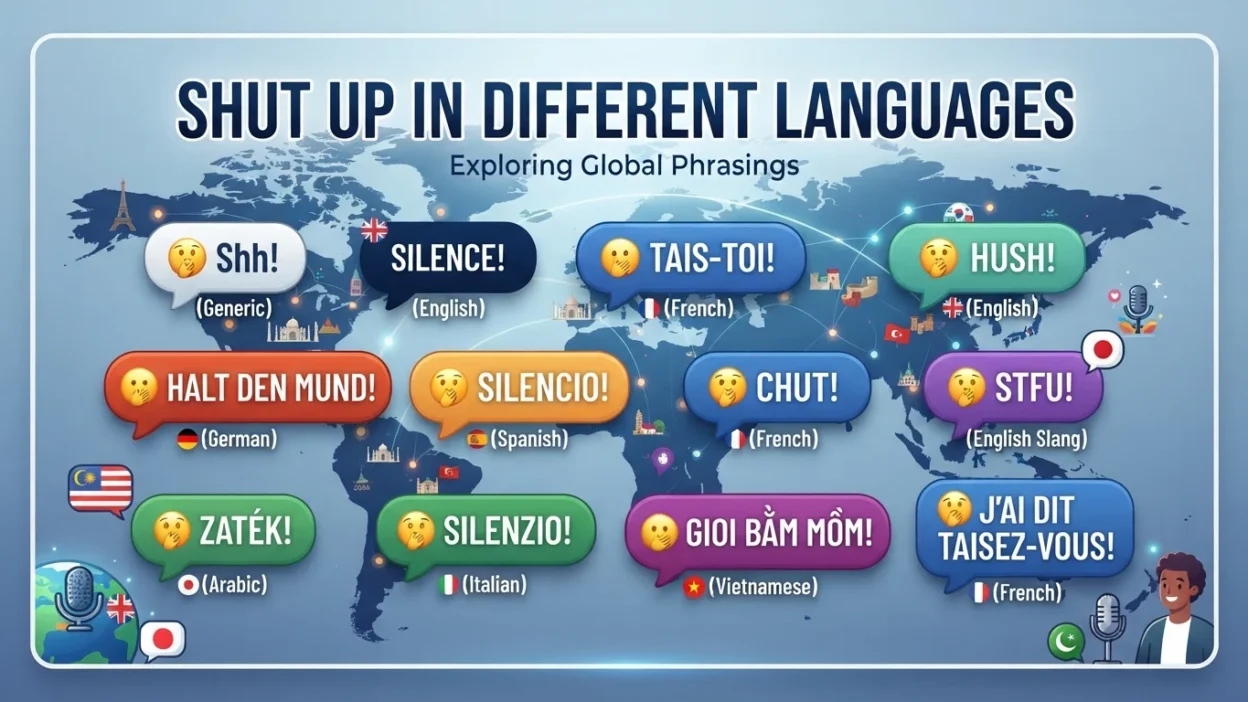
Have you ever wondered how to say shut up in different languages? Whether you’re learning a new language, traveling abroad, watching international movies, or simply curious about global expressions, understanding this phrase can be both interesting and educational.
The phrase “shut up” is commonly used in many languages, but its tone can vary significantly. In some cultures, it may sound rude or offensive, while in others it can be used jokingly among friends. This guide explores shut up in different languages in all languages, including pronunciation, example sentences, and meanings to help you understand how this expression is used around the world.
Shut Up in Different Languages
| Language | Native Phrase | Pronunciation | Example Sentence | English Meaning |
| English | Shut up | Shut up | Shut up and listen. | Be quiet and listen. |
| Spanish | Cállate | Kai-ya-te | Cállate por favor. | Please be quiet. |
| French | Tais-toi | Tay-twa | Tais-toi un moment. | Be quiet for a moment. |
| German | Halt den Mund | Halt den Moont | Halt den Mund jetzt. | Be quiet now. |
| Italian | Stai zitto | Sty zeet-to | Stai zitto per favore. | Please be quiet. |
| Portuguese | Cala a boca | Ka-la a bo-ka | Cala a boca agora. | Be quiet now. |
| Dutch | Hou je mond | How yuh mond | Hou je mond even. | Be quiet for a moment. |
| Russian | Замолчи | Za-mol-chee | Замолчи сейчас. | Be quiet now. |
| Ukrainian | Замовкни | Za-mov-knee | Замовкни на хвилину. | Be quiet for a minute. |
| Polish | Zamknij się | Zam-kneej shye | Zamknij się proszę. | Please be quiet. |
| Czech | Mlč | Mulch | Mlč chvíli. | Be quiet for a while. |
| Slovak | Mlč | Mulch | Mlč prosím. | Please be quiet. |
| Hungarian | Fogd be a szád | Fogd beh a saad | Fogd be a szád. | Shut your mouth. |
| Romanian | Taci | Ta-chee | Taci puțin. | Be quiet a little. |
| Bulgarian | Млъкни | Mluk-nee | Млъкни за малко. | Be quiet for a while. |
| Serbian | Ćuti | Choo-tee | Ćuti malo. | Be quiet a little. |
| Croatian | Šuti | Shoo-tee | Šuti molim te. | Please be quiet. |
| Bosnian | Šuti | Shoo-tee | Šuti sada. | Be quiet now. |
| Slovenian | Utihni | Oo-teeh-nee | Utihni prosim. | Please be quiet. |
| Albanian | Hesht | Hesht | Hesht pak. | Be quiet a bit. |
| Greek | Σκάσε | Ska-se | Σκάσε λίγο. | Be quiet for a bit. |
| Turkish | Sus | Soos | Sus lütfen. | Please be quiet. |
| Arabic | اصمت | Us-mut | اصمت قليلاً | Be quiet for a moment. |
| Hebrew | שתוק | She-tok | שתוק בבקשה | Please be quiet. |
| Persian | ساکت شو | Sa-ket sho | ساکت شو لطفا | Please be quiet. |
| Urdu | خاموش ہو جاؤ | Khamosh ho jao | خاموش ہو جاؤ ذرا | Be quiet for a moment. |
| Hindi | चुप रहो | Chup raho | चुप रहो और सुनो। | Be quiet and listen. |
| Punjabi | ਚੁੱਪ ਰਹੋ | Chup raho | ਚੁੱਪ ਰਹੋ ਜੀ। | Please be quiet. |
| Bengali | চুপ করো | Chup koro | চুপ করো একটু। | Be quiet a little. |
| Gujarati | ચૂપ રહો | Chup raho | ચૂપ રહો કૃપા કરીને. | Please be quiet. |
| Marathi | गप्प बसा | Gapp basa | गप्प बसा थोडा वेळ. | Be quiet for a while. |
| Tamil | அமைதியாக இரு | Amaithiyaga iru | அமைதியாக இரு. | Stay quiet. |
| Telugu | నోరు మూసుకో | Noru moosuko | నోరు మూసుకో కాసేపు. | Be quiet for a while. |
| Kannada | ಸುಮ್ಮನಿರು | Summaniru | ಸುಮ್ಮನಿರು ಸ್ವಲ್ಪ. | Be quiet a little. |
| Malayalam | മിണ്ടാതിരിക്കുക | Mindathirikuka | മിണ്ടാതിരിക്കുക കുറച്ച് നേരം. | Stay quiet for a while. |
| Sinhala | කට වහගන්න | Kata wahaganna | කට වහගන්න ටිකක්. | Be quiet a little. |
| Nepali | चुप लाग | Chup laga | चुप लाग केही बेर। | Be quiet for a while. |
| Chinese (Mandarin) | 闭嘴 | Bee zway | 闭嘴一下。 | Be quiet for a moment. |
| Cantonese | 收聲 | Sau seng | 收聲啦。 | Be quiet. |
| Japanese | 黙れ | Da-ma-re | 黙れ少し。 | Be quiet for a bit. |
| Korean | 조용히 해 | Jo-yong-hi hae | 조용히 해 주세요. | Please be quiet. |
| Vietnamese | Im đi | Eem dee | Im đi một chút. | Be quiet for a bit. |
| Thai | หุบปาก | Hoop pak | หุบปากหน่อย | Be quiet please. |
| Indonesian | Diam | Dee-am | Diam sebentar. | Be quiet for a moment. |
| Malay | Diam | Dee-am | Diam sekejap. | Be quiet for a moment. |
| Filipino | Tumahimik ka | Too-ma-hi-mik ka | Tumahimik ka muna. | Be quiet for now. |
| Burmese | တိတ်တိတ်နေ | Tate-tate nay | တိတ်တိတ်နေပါ | Please stay quiet. |
| Khmer | ស្ងៀម | Sngiem | ស្ងៀមសិន | Be quiet first. |
| Lao | ມິດໄວ້ | Mit wai | ມິດໄວ້ແນ່ | Please be quiet. |
| Mongolian | Чимээгүй бай | Chi-me-gui bai | Чимээгүй бай. | Stay quiet. |
| Kazakh | Үндеме | Oon-de-me | Үндеме біраз. | Be quiet for a bit. |
| Uzbek | Jim bo‘l | Jeem bol | Jim bo‘l iltimos. | Please be quiet. |
| Azerbaijani | Sus | Soos | Sus bir az. | Be quiet a little. |
| Georgian | გაჩუმდი | Ga-choom-dee | გაჩუმდი ცოტა ხნით. | Be quiet for a while. |
| Armenian | Լռիր | Luh-reer | Լռիր մի պահ։ | Be quiet for a moment. |
| Swahili | Nyamaza | Nya-ma-za | Nyamaza tafadhali. | Please be quiet. |
| Zulu | Thula | Too-la | Thula kancane. | Be quiet a little. |
| Xhosa | Thula | Too-la | Thula ngoku. | Be quiet now. |
| Afrikaans | Bly stil | Blay stil | Bly stil asseblief. | Please be quiet. |
| Yoruba | Dakẹ́ | Da-keh | Dakẹ́ jọ̀wọ́. | Please be quiet. |
| Igbo | Gbachi nkịtị | Gba-chee nkee-tee | Gbachi nkịtị biko. | Please be quiet. |
| Hausa | Yi shiru | Yee shee-roo | Yi shiru don Allah. | Please be quiet. |
| Amharic | ዝም በል | Zim bel | ዝም በል እባክህ | Please be quiet. |
| Somali | Aamus | Aa-moos | Aamus fadlan. | Please be quiet. |
| Finnish | Ole hiljaa | O-le heel-ya | Ole hiljaa hetki. | Be quiet for a moment. |
| Swedish | Håll tyst | Hol toost | Håll tyst lite. | Be quiet a little. |
| Norwegian | Hold kjeft | Hol yeft | Hold kjeft nå. | Be quiet now. |
| Danish | Hold kæft | Hol keft | Hold kæft lidt. | Be quiet a little. |
| Icelandic | Þegiðu | The-yi-thu | Þegiðu aðeins. | Be quiet for a bit. |
| Estonian | Ole vait | O-le vait | Ole vait korraks. | Be quiet for a moment. |
| Latvian | Klusē | Kloo-seh | Klusē mazliet. | Be quiet a little. |
| Lithuanian | Tylėk | Tee-lek | Tylėk prašau. | Please be quiet. |
| Irish | Bí ciúin | Bee kyoo-in | Bí ciúin le do thoil. | Please be quiet. |
| Welsh | Taw | Tau | Taw am eiliad. | Be quiet for a moment. |
How to Say Shut Up in Different Languages
People search for how to say shut up in different languages for language learning, travel, entertainment, and cultural understanding. While the phrase exists in nearly every language, its level of politeness differs significantly from one culture to another.
Is “Shut Up” Considered Rude?
In many countries, direct translations of “shut up” are considered impolite and should be used carefully. A softer phrase such as “please be quiet” is often preferred in formal conversations.
Understanding cultural context helps avoid misunderstandings and ensures respectful communication.
Why Learn Shut Up in Different Languages Around the World?
Learning these translations can help you:
- Understand foreign movies and TV shows.
- Improve language-learning skills.
- Recognize common expressions while traveling.
- Build cultural awareness.
- Expand multilingual vocabulary.
Common Situations Where the Phrase Is Used
The phrase may appear in:
- Casual conversations among friends.
- Movies and television shows.
- Arguments or heated discussions.
- Joking situations.
- Informal speech.
Always consider the tone and cultural setting before using it.
Conclusion
Learning shut up in different languages offers an interesting look into how cultures express silence and attention. While the phrase exists worldwide, its meaning and politeness level can vary greatly. Understanding these translations can help language learners communicate more effectively and appreciate cultural differences.
FAQs
1. How do you say shut up in different languages?
Different languages have unique translations such as “Cállate” in Spanish, “Tais-toi” in French, “Sus” in Turkish, and “闭嘴” in Chinese.
2. Is shut up rude in every language?
No. Some translations are considered very rude, while others may be acceptable among friends or in casual situations.
3. What is the most common translation of shut up around the world?
Many languages use direct commands meaning “be quiet” or “close your mouth,” depending on cultural norms.
4. Why do people search for shut up in different languages translations?
People often search for these translations for language learning, travel, entertainment, and cultural knowledge.
5. Should I use shut up when speaking another language?
It is usually safer to use a more polite phrase like “please be quiet” unless you understand the cultural context.