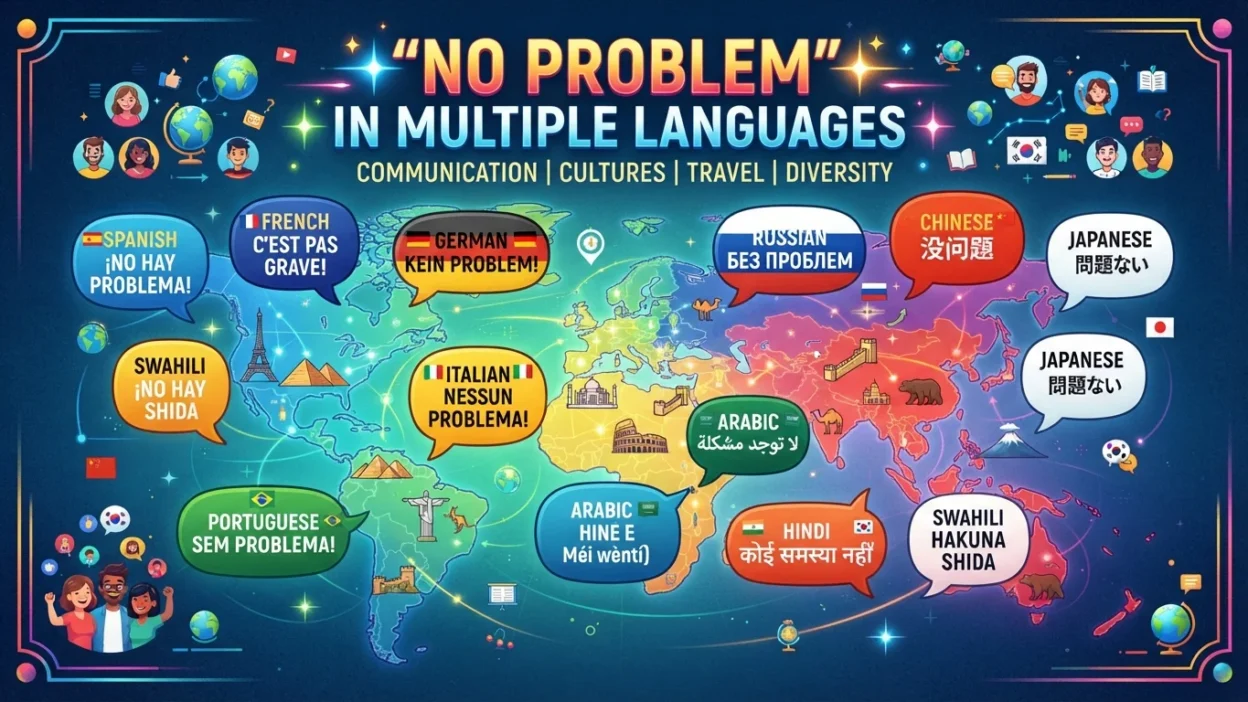
Have you ever wanted to respond politely to a thank you while speaking another language? Learning how to say no problem in different languages is a simple and useful way to communicate with people from different cultures. Whether you’re traveling, studying a foreign language, making international friends, or creating multilingual content, knowing these expressions can help you sound more natural and friendly.
In this guide, you’ll discover no problem in different languages in all languages, including pronunciation, example sentences, and meanings. This comprehensive collection will help you understand how to say no problem in different languages, explore common no problem in different languages translations, and learn how people express this phrase around the world.
No Problem in Different Languages
| Language | Native Phrase | Pronunciation | Example Sentence | English Meaning |
| English | No problem | No prob-lum | No problem, I’m happy to help. | I am happy to help. |
| Spanish | No hay problema | No eye pro-ble-ma | No hay problema, amigo. | No problem, friend. |
| French | Pas de problème | Pa duh pro-blem | Pas de problème, je peux aider. | No problem, I can help. |
| German | Kein Problem | Kine pro-blem | Kein Problem, gern geschehen. | No problem, you’re welcome. |
| Italian | Nessun problema | Ness-oon pro-ble-ma | Nessun problema, posso farlo. | No problem, I can do it. |
| Portuguese | Sem problema | Seng pro-ble-ma | Sem problema, eu ajudo. | No problem, I’ll help. |
| Dutch | Geen probleem | Khane pro-blame | Geen probleem, hoor. | No problem at all. |
| Russian | Нет проблем | Nyet pro-blem | Нет проблем, помогу. | No problem, I’ll help. |
| Ukrainian | Немає проблем | Ne-ma-ye pro-blem | Немає проблем, друже. | No problem, friend. |
| Polish | Nie ma problemu | Nye ma pro-ble-moo | Nie ma problemu, pomogę. | No problem, I’ll help. |
| Czech | Žádný problém | Zhad-nee pro-blem | Žádný problém. | No problem. |
| Slovak | Žiadny problém | Zhee-ad-nee pro-blem | Žiadny problém, pomôžem. | No problem, I’ll help. |
| Hungarian | Semmi probléma | Shem-mee pro-ble-ma | Semmi probléma. | No problem. |
| Romanian | Nicio problemă | Nee-cho pro-ble-ma | Nicio problemă, te ajut. | No problem, I’ll help you. |
| Bulgarian | Няма проблем | Nya-ma pro-blem | Няма проблем. | No problem. |
| Serbian | Nema problema | Ne-ma pro-ble-ma | Nema problema, prijatelju. | No problem, friend. |
| Croatian | Nema problema | Ne-ma pro-ble-ma | Nema problema. | No problem. |
| Bosnian | Nema problema | Ne-ma pro-ble-ma | Nema problema, pomoći ću. | No problem, I’ll help. |
| Slovenian | Ni problema | Nee pro-ble-ma | Ni problema. | No problem. |
| Albanian | S’ka problem | Ska pro-blem | S’ka problem, mund ta bëj. | No problem, I can do it. |
| Greek | Κανένα πρόβλημα | Ka-ne-na pro-vli-ma | Κανένα πρόβλημα. | No problem. |
| Turkish | Sorun değil | So-roon de-yil | Sorun değil, yardımcı olurum. | No problem, I’ll help. |
| Arabic | لا مشكلة | La mush-ki-la | لا مشكلة، سأساعدك. | No problem, I’ll help you. |
| Hebrew | אין בעיה | Ayn be-a-ya | אין בעיה, בשמחה. | No problem, gladly. |
| Persian | مشکلی نیست | Mosh-ke-lee neest | مشکلی نیست، کمک میکنم. | No problem, I’ll help. |
| Urdu | کوئی مسئلہ نہیں | Koi masla nahi | کوئی مسئلہ نہیں، میں مدد کروں گا۔ | No problem, I’ll help. |
| Hindi | कोई समस्या नहीं | Koi samasya nahi | कोई समस्या नहीं, मैं मदद करूँगा। | No problem, I’ll help. |
| Punjabi | ਕੋਈ ਗੱਲ ਨਹੀਂ | Koi gal nahi | ਕੋਈ ਗੱਲ ਨਹੀਂ, ਮੈਂ ਮਦਦ ਕਰਾਂਗਾ। | No problem, I’ll help. |
| Bengali | কোনো সমস্যা নেই | Kono shomossha nei | কোনো সমস্যা নেই। | No problem. |
| Gujarati | કોઈ સમસ્યા નથી | Koi samasya nathi | કોઈ સમસ્યા નથી. | No problem. |
| Marathi | काही हरकत नाही | Kahi harakat nahi | काही हरकत नाही. | No problem. |
| Tamil | பிரச்சனை இல்லை | Pirachanai illai | பிரச்சனை இல்லை. | No problem. |
| Telugu | సమస్య లేదు | Samasya ledu | సమస్య లేదు. | No problem. |
| Kannada | ಸಮಸ್ಯೆ ಇಲ್ಲ | Samasye illa | ಸಮಸ್ಯೆ ಇಲ್ಲ. | No problem. |
| Malayalam | പ്രശ്നമില്ല | Prashna-milla | പ്രശ്നമില്ല. | No problem. |
| Sinhala | ප්රශ්නයක් නැහැ | Prash-na-yak nae-ha | ප්රශ්නයක් නැහැ. | No problem. |
| Nepali | समस्या छैन | Samasya chaina | समस्या छैन। | No problem. |
| Chinese (Mandarin) | 没问题 | Mei wen ti | 没问题,我可以帮忙。 | No problem, I can help. |
| Cantonese | 冇問題 | Mou man tai | 冇問題。 | No problem. |
| Japanese | 問題ない | Mon-dai nai | 問題ないですよ。 | No problem. |
| Korean | 문제없어요 | Mun-je op-so-yo | 문제없어요. | No problem. |
| Vietnamese | Không vấn đề gì | Khong vun de zi | Không vấn đề gì. | No problem. |
| Thai | ไม่มีปัญหา | Mai mee pan-ha | ไม่มีปัญหา. | No problem. |
| Indonesian | Tidak masalah | Tee-dak ma-sa-lah | Tidak masalah. | No problem. |
| Malay | Tiada masalah | Tee-a-da ma-sa-lah | Tiada masalah. | No problem. |
| Filipino | Walang problema | Wa-lang pro-ble-ma | Walang problema. | No problem. |
| Burmese | ပြဿနာမရှိပါ | Pya-tha-na ma-shi-ba | ပြဿနာမရှိပါ။ | No problem. |
| Khmer | គ្មានបញ្ហា | Kmean ban-ha | គ្មានបញ្ហា។ | No problem. |
| Lao | ບໍ່ມີບັນຫາ | Bor mee ban-ha | ບໍ່ມີບັນຫາ. | No problem. |
| Mongolian | Асуудалгүй | A-soo-dal-gui | Асуудалгүй. | No problem. |
| Kazakh | Ешқандай проблема жоқ | Yesh-kan-dai pro-ble-ma jok | Ешқандай проблема жоқ. | No problem. |
| Uzbek | Muammo yo‘q | Moo-am-mo yok | Muammo yo‘q. | No problem. |
| Azerbaijani | Problem yoxdur | Pro-blem yokh-dur | Problem yoxdur. | No problem. |
| Georgian | პრობლემა არ არის | Pro-ble-ma ar aris | პრობლემა არ არის. | No problem. |
| Armenian | Խնդիր չկա | Khndir chka | Խնդիր չկա. | No problem. |
| Swahili | Hakuna shida | Ha-koo-na shee-da | Hakuna shida. | No problem. |
| Zulu | Ayikho inkinga | Ayee-kho in-kin-ga | Ayikho inkinga. | No problem. |
| Xhosa | Akukho ngxaki | A-koo-kho nga-ki | Akukho ngxaki. | No problem. |
| Afrikaans | Geen probleem | Khane pro-bleem | Geen probleem. | No problem. |
| Yoruba | Kò sí ìṣòro | Ko see i-sho-ro | Kò sí ìṣòro. | No problem. |
| Igbo | Enweghị nsogbu | En-we-re nsoo-go | Enweghị nsogbu. | No problem. |
| Hausa | Babu matsala | Ba-boo mat-sa-la | Babu matsala. | No problem. |
| Amharic | ችግር የለም | Chigir yelem | ችግር የለም. | No problem. |
| Somali | Dhibaato ma jirto | Dhi-baa-to ma jir-to | Dhibaato ma jirto. | No problem. |
| Finnish | Ei ongelmaa | Ay on-gel-maa | Ei ongelmaa. | No problem. |
| Swedish | Inga problem | Ing-a pro-blem | Inga problem. | No problem. |
| Norwegian | Ikke noe problem | Ik-ke noo pro-blem | Ikke noe problem. | No problem. |
| Danish | Intet problem | In-ted pro-blem | Intet problem. | No problem. |
| Icelandic | Ekkert mál | Ek-kert maul | Ekkert mál. | No problem. |
| Estonian | Pole probleemi | Po-le pro-ble-mi | Pole probleemi. | No problem. |
| Latvian | Nav problēmu | Nav pro-ble-mu | Nav problēmu. | No problem. |
| Lithuanian | Jokių problemų | Yo-kyoo pro-ble-moo | Jokių problemų. | No problem. |
| Irish | Gan fadhb | Gan fybe | Gan fadhb. | No problem. |
| Welsh | Dim problem | Deem pro-blem | Dim problem. | No problem. |
How to Say No Problem in Different Languages
The phrase “no problem” is commonly used to respond to thanks, reassure someone, or show willingness to help. While the exact wording varies by country and culture, the meaning remains similar. Learning these expressions can improve communication during travel, business meetings, language learning, and international friendships.
Why Learn No Problem in Different Languages Around the World?
There are many benefits to learning multilingual expressions:
- Build stronger connections with people from different cultures.
- Improve travel experiences.
- Enhance language-learning skills.
- Communicate more naturally in conversations.
- Show cultural awareness and respect.
Because “no problem” is used frequently in daily conversations, it is one of the most practical phrases to learn in any language.
Common Situations to Use “No Problem”
You can use these translations when:
- Responding to a thank you.
- Helping someone with a task.
- Offering assistance.
- Reassuring a friend.
- Providing customer service.
Using the local phrase often makes interactions more friendly and memorable.
No Problem Translations and Cultural Differences
Although many languages have a direct translation of “no problem,” some cultures prefer expressions that mean “you’re welcome,” “it’s nothing,” or “don’t worry about it.” Understanding these subtle differences helps you communicate more naturally and respectfully.
Conclusion
Learning no problem in different languages is a simple way to improve communication across cultures. Whether you’re traveling, studying languages, or meeting people from around the world, these translations can help you respond politely and confidently in many situations.
FAQs
1. How do you say no problem in different languages?
Different languages use different phrases such as “No hay problema” in Spanish, “Pas de problème” in French, “Kein Problem” in German, and “没问题” in Chinese.
2. What is the most common translation of no problem worldwide?
Many languages use a phrase that directly translates to “no problem” or “there is no problem,” making it easy to understand across cultures.
3. Why should I learn no problem in different languages?
It helps improve communication, shows respect for other cultures, and makes travel and international conversations easier.
4. Is no problem the same as you’re welcome?
Not always. In some languages, people use phrases closer to “you’re welcome,” while others use direct equivalents of “no problem.”
5. Which languages have similar no problem translations?
Spanish, Italian, Portuguese, Romanian, Serbian, Croatian, and several other languages use very similar expressions based on the word “problem.”