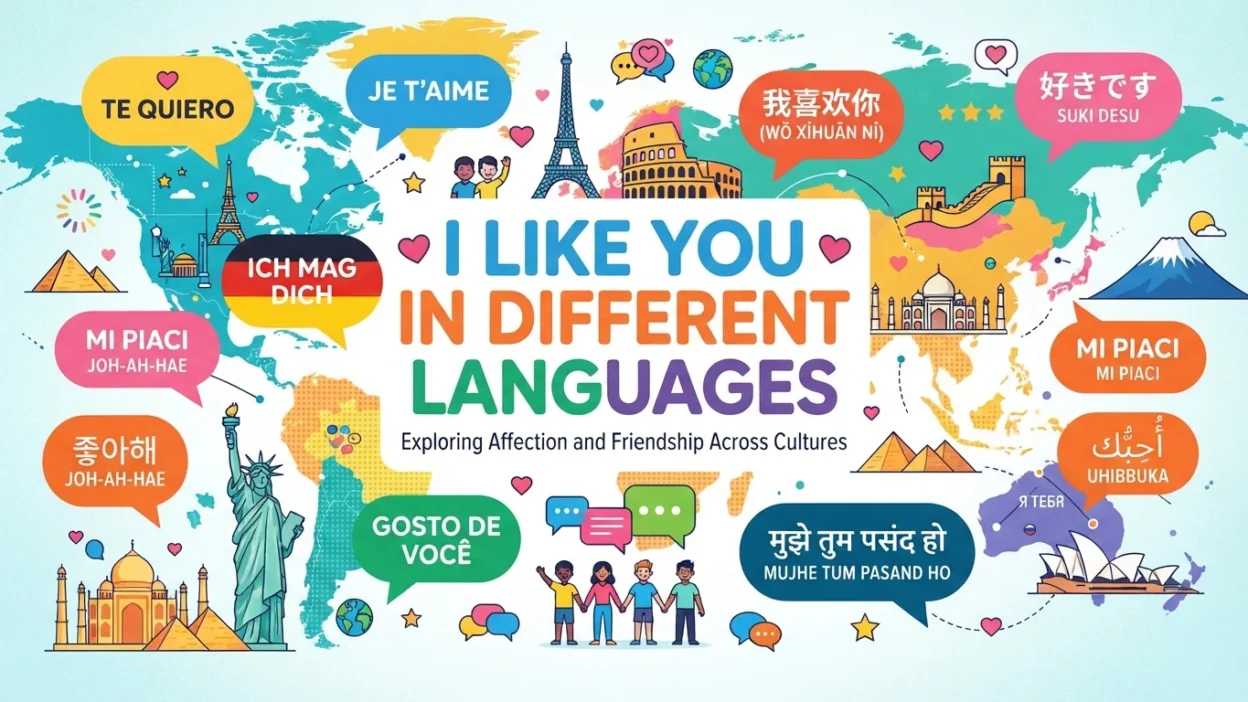
Expressing affection is one of the most meaningful ways to connect with people. Whether you’re learning a new language, traveling abroad, talking to an international friend, or simply exploring world cultures, knowing how to say I like you in different languages can help you communicate your feelings in a thoughtful and memorable way.
The phrase “I like you” is often used to show admiration, friendship, appreciation, or romantic interest. While the wording differs across cultures, the sentiment remains universal. In this guide, you’ll discover I like you in different languages in all languages, learn how to say I like you in different languages, explore popular I like you in different languages translations, and see how this heartfelt phrase is expressed around the world.
Saying “I like you” in someone’s native language can make conversations more personal and meaningful. It also helps language learners understand sentence structure, pronunciation, and cultural communication styles. Whether you’re preparing a message for someone special or expanding your multilingual vocabulary, this article provides a useful and engaging resource.
Across different countries, there are many ways to express liking someone. Some languages use a direct translation, while others have unique expressions that convey the same feeling. Understanding these differences can help you communicate more naturally and respectfully.
In the sections below, you’ll find a comprehensive collection of translations, pronunciations, example sentences, and meanings designed to make learning easy. This guide is ideal for travelers, students, language enthusiasts, content creators, and anyone interested in global communication.
I Like You in Different Languages
| Language | Native Phrase | Pronunciation | Example Sentence | English Meaning |
| English | I like you | I like you | I like you very much. | I enjoy being with you. |
| Spanish | Me gustas | Meh goo-stas | Me gustas mucho. | I like you a lot. |
| French | Je t’aime bien | Zhuh tem bee-en | Je t’aime bien depuis longtemps. | I have liked you for a long time. |
| German | Ich mag dich | Ikh mahg deekh | Ich mag dich sehr. | I like you very much. |
| Italian | Mi piaci | Mee pya-chee | Mi piaci tanto. | I like you a lot. |
| Portuguese | Eu gosto de você | Eh-oo gos-to de vo-se | Eu gosto de você muito. | I like you very much. |
| Dutch | Ik vind je leuk | Ik vind yuh loke | Ik vind je heel leuk. | I really like you. |
| Russian | Ты мне нравишься | Ti mnye nra-veesh-sya | Ты мне очень нравишься. | I like you a lot. |
| Ukrainian | Ти мені подобаєшся | Ti me-nee po-do-ba-yesh-sya | Ти мені дуже подобаєшся. | I like you very much. |
| Polish | Lubię cię | Loo-bye chen | Lubię cię bardzo. | I like you a lot. |
| Czech | Mám tě rád | Maam tye raad | Mám tě rád moc. | I like you very much. |
| Slovak | Mám ťa rád | Maam tya raad | Mám ťa rád veľmi. | I like you a lot. |
| Hungarian | Kedvellek | Ked-vel-lek | Nagyon kedvellek. | I like you very much. |
| Romanian | Te plac | Teh plak | Te plac foarte mult. | I like you very much. |
| Bulgarian | Харесвам те | Ha-res-vam te | Харесвам те много. | I like you a lot. |
| Serbian | Sviđaš mi se | Svee-jash mee seh | Sviđaš mi se puno. | I like you a lot. |
| Croatian | Sviđaš mi se | Svee-jash mee seh | Sviđaš mi se jako. | I like you very much. |
| Bosnian | Sviđaš mi se | Svee-jash mee seh | Sviđaš mi se mnogo. | I like you a lot. |
| Slovenian | Všeč si mi | Vshech see mee | Zelo všeč si mi. | I like you very much. |
| Albanian | Më pëlqen | Muh pel-chen | Më pëlqen shumë. | I like you a lot. |
| Greek | Μου αρέσεις | Moo a-re-sis | Μου αρέσεις πολύ. | I like you very much. |
| Turkish | Senden hoşlanıyorum | Sen-den hosh-la-ni-yo-rum | Senden çok hoşlanıyorum. | I like you a lot. |
| Arabic | أنا معجب بك | Ana mu’jab bik | أنا معجب بك كثيرًا. | I like you very much. |
| Hebrew | אני מחבב אותך | Ani meh-ha-vev ot-kha | אני מחבב אותך מאוד. | I like you a lot. |
| Persian | من از تو خوشم میآید | Man az to khosham mi-ayad | من خیلی از تو خوشم میآید. | I like you very much. |
| Urdu | مجھے تم پسند ہو | Mujhe tum pasand ho | مجھے تم بہت پسند ہو۔ | I like you very much. |
| Hindi | मैं तुम्हें पसंद करता हूँ | Main tumhe pasand karta hoon | मैं तुम्हें बहुत पसंद करता हूँ। | I like you a lot. |
| Punjabi | ਮੈਨੂੰ ਤੂੰ ਪਸੰਦ ਹੈ | Mainu tu pasand hai | ਮੈਨੂੰ ਤੂੰ ਬਹੁਤ ਪਸੰਦ ਹੈ। | I like you very much. |
| Bengali | আমি তোমাকে পছন্দ করি | Ami tomake pochondo kori | আমি তোমাকে খুব পছন্দ করি। | I like you a lot. |
| Gujarati | મને તમે ગમો છો | Mane tame gamo cho | મને તમે બહુ ગમો છો. | I like you very much. |
| Marathi | मला तू आवडतोस | Mala tu avadtos | मला तू खूप आवडतोस. | I like you a lot. |
| Tamil | நான் உன்னை விரும்புகிறேன் | Naan unnai virumbugiren | நான் உன்னை மிகவும் விரும்புகிறேன். | I like you very much. |
| Telugu | నాకు నువ్వు నచ్చావు | Naaku nuvvu nachchavu | నాకు నువ్వు చాలా నచ్చావు. | I like you a lot. |
| Kannada | ನಾನು ನಿನ್ನನ್ನು ಇಷ್ಟಪಡುತ್ತೇನೆ | Naanu ninnannu ishtapaduttene | ನಾನು ನಿನ್ನನ್ನು ತುಂಬಾ ಇಷ್ಟಪಡುತ್ತೇನೆ. | I like you very much. |
| Malayalam | എനിക്ക് നിന്നെ ഇഷ്ടമാണ് | Enikku ninne ishtamaan | എനിക്ക് നിന്നെ വളരെ ഇഷ്ടമാണ്. | I like you a lot. |
| Sinhala | මම ඔයාට කැමතියි | Mama oyata kemathiyi | මම ඔයාට ගොඩක් කැමතියි. | I like you very much. |
| Nepali | मलाई तिमी मन पर्छ | Malai timi man parchha | मलाई तिमी धेरै मन पर्छ। | I like you a lot. |
| Chinese (Mandarin) | 我喜欢你 | Wo shi-hwan nee | 我很喜欢你。 | I like you very much. |
| Cantonese | 我鍾意你 | Ngo zung yi nei | 我好鍾意你。 | I like you a lot. |
| Japanese | あなたが好きです | A-na-ta ga su-ki des | あなたが好きです。 | I like you. |
| Korean | 나는 너를 좋아해 | Na-neun no-reul jo-a-hae | 나는 너를 정말 좋아해. | I really like you. |
| Vietnamese | Tôi thích bạn | Toy thik ban | Tôi rất thích bạn. | I like you very much. |
| Thai | ฉันชอบคุณ | Chan chop khun | ฉันชอบคุณมาก. | I like you a lot. |
| Indonesian | Aku suka kamu | A-koo soo-ka ka-moo | Aku sangat suka kamu. | I like you very much. |
| Malay | Saya suka awak | Sa-ya soo-ka a-wak | Saya sangat suka awak. | I like you a lot. |
| Filipino | Gusto kita | Goos-to ki-ta | Gusto kita talaga. | I really like you. |
| Burmese | မင်းကို သဘောကျတယ် | Min ko tha-baw kyae de | မင်းကို အရမ်းသဘောကျတယ်။ | I like you very much. |
| Khmer | ខ្ញុំចូលចិត្តអ្នក | Khnyom jol-chet neak | ខ្ញុំចូលចិត្តអ្នកណាស់។ | I like you a lot. |
| Lao | ຂ້ອຍມັກເຈົ້າ | Khoy mak jao | ຂ້ອຍມັກເຈົ້າຫຼາຍ. | I like you very much. |
| Mongolian | Чи надад таалагддаг | Chi na-dad taa-lag-dag | Чи надад их таалагддаг. | I like you a lot. |
| Kazakh | Сен маған ұнайсың | Sen ma-gan oo-nai-sing | Сен маған қатты ұнайсың. | I like you very much. |
| Uzbek | Men seni yoqtiraman | Men se-ni yok-ti-ra-man | Men seni juda yoqtiraman. | I like you a lot. |
| Azerbaijani | Mən səni bəyənirəm | Men se-ni be-ye-ni-rem | Mən səni çox bəyənirəm. | I like you very much. |
| Georgian | მე შენ მომწონხარ | Me shen momtsonkhar | მე შენ ძალიან მომწონხარ. | I like you a lot. |
| Armenian | Ես քեզ հավանում եմ | Yes kez hava-num em | Ես քեզ շատ հավանում եմ։ | I like you very much. |
| Swahili | Nakupenda | Na-koo-pen-da | Nakupenda sana. | I like you very much. |
| Zulu | Ngiyakuthanda | Ngi-ya-ku-than-da | Ngiyakuthanda kakhulu. | I like you a lot. |
| Xhosa | Ndiyakuthanda | Ndi-ya-ku-than-da | Ndiyakuthanda kakhulu. | I like you very much. |
| Afrikaans | Ek hou van jou | Ek how van yo | Ek hou baie van jou. | I like you a lot. |
| Yoruba | Mo fẹ́ràn rẹ | Mo fe-ran re | Mo fẹ́ràn rẹ gan-an. | I like you very much. |
| Igbo | A na m amasị gị | A na m a-ma-si gi | A na m amasị gị nke ukwuu. | I like you a lot. |
| Hausa | Ina son ka | Ee-na son ka | Ina son ka sosai. | I like you very much. |
| Amharic | እወድሃለሁ | E-wed-ha-le-hu | እወድሃለሁ በጣም። | I like you very much. |
| Somali | Waan ku jeclahay | Waan ku je-cla-hay | Waan ku jeclahay aad. | I like you a lot. |
| Finnish | Minä pidän sinusta | Mi-na pee-dan si-noos-ta | Minä pidän sinusta paljon. | I like you very much. |
| Swedish | Jag gillar dig | Yag gil-lar day | Jag gillar dig mycket. | I like you a lot. |
| Norwegian | Jeg liker deg | Yai lee-ker dai | Jeg liker deg veldig godt. | I like you very much. |
| Danish | Jeg kan lide dig | Yai kan lee-the dai | Jeg kan lide dig meget. | I like you a lot. |
| Icelandic | Mér líkar við þig | Myeer lee-kar vith thig | Mér líkar mjög vel við þig. | I like you very much. |
| Estonian | Sa meeldid mulle | Sa meel-did mul-le | Sa meeldid mulle väga. | I like you a lot. |
| Latvian | Tu man patīc | Too man pa-teets | Tu man ļoti patīc. | I like you very much. |
| Lithuanian | Tu man patinki | Too man pa-tin-ki | Tu man labai patinki. | I like you a lot. |
| Irish | Is maith liom thú | Iss mah lyum hoo | Is maith liom thú go mór. | I like you very much. |
| Welsh | Rwy’n dy hoffi di | Roo-in duh hof-ee dee | Rwy’n dy hoffi di’n fawr. | I like you a lot. |
How to Say I Like You in Different Languages
Learning how to say I like you in different languages is useful for language learners, travelers, and anyone interested in international communication. While the exact words vary from one language to another, the message remains the same: expressing admiration, affection, or appreciation for another person.
In some cultures, saying “I like you” can indicate friendship, while in others it may suggest romantic interest. Understanding the context helps you use the phrase naturally and respectfully.
Why Learn I Like You in Different Languages Around the World?
There are many reasons people search for I like you in different languages around the world:
- Build stronger connections with people from different cultures.
- Express feelings in a unique and memorable way.
- Improve foreign language skills.
- Understand international movies, music, and books.
- Enhance travel experiences and social interactions.
A simple phrase spoken in someone’s native language can often create a positive and lasting impression.
Cultural Differences in Expressing Affection
Not every culture expresses affection in the same way. Some languages use direct phrases that translate exactly to “I like you,” while others use expressions that imply admiration or attraction.
For example:
- Some cultures are very open about expressing emotions.
- Others prefer indirect or subtle expressions.
- Certain phrases may be used only among close friends or romantic partners.
Learning these differences helps avoid misunderstandings and improves communication.
When to Use “I Like You”
The phrase can be used in many situations, including:
- Telling someone you enjoy their company.
- Expressing romantic interest.
- Showing appreciation for a friend.
- Complimenting someone’s personality.
- Building stronger personal relationships.
Always consider the cultural context and your relationship with the person before using the phrase.
Benefits of Learning Romantic and Friendly Phrases
Learning common expressions such as “I like you” can improve your overall language skills. It helps you:
- Learn sentence structure naturally.
- Improve pronunciation.
- Expand everyday vocabulary.
- Gain confidence in conversations.
- Understand cultural communication styles.
These practical phrases are often among the first expressions language learners remember and use.
Conclusion
Learning I like you in different languages is a fun and meaningful way to explore world cultures and improve communication skills. Whether you’re making new friends, traveling abroad, studying a foreign language, or expressing your feelings to someone special, these translations can help you connect with people from different backgrounds. A simple phrase spoken in another language can make interactions more personal, memorable, and heartfelt.
FAQs
1. How do you say I like you in different languages?
The phrase varies by language, such as “Me gustas” in Spanish, “Je t’aime bien” in French, “Ich mag dich” in German, and “我喜欢你” in Chinese.
2. What is the difference between I like you and I love you in other languages?
In most languages, “I like you” expresses affection, admiration, or interest, while “I love you” usually conveys a deeper emotional or romantic connection.
3. Why do people learn I like you in different languages?
People learn these translations for language study, travel, cultural understanding, friendships, and romantic communication.
4. Is I like you considered romantic in every language?
Not always. In some cultures, it can simply mean friendship or appreciation, while in others it may suggest romantic interest.
5. What is the most popular translation of I like you around the world?
Some of the most searched translations include Spanish “Me gustas,” French “Je t’aime bien,” German “Ich mag dich,” and Japanese “あなたが好きです.”