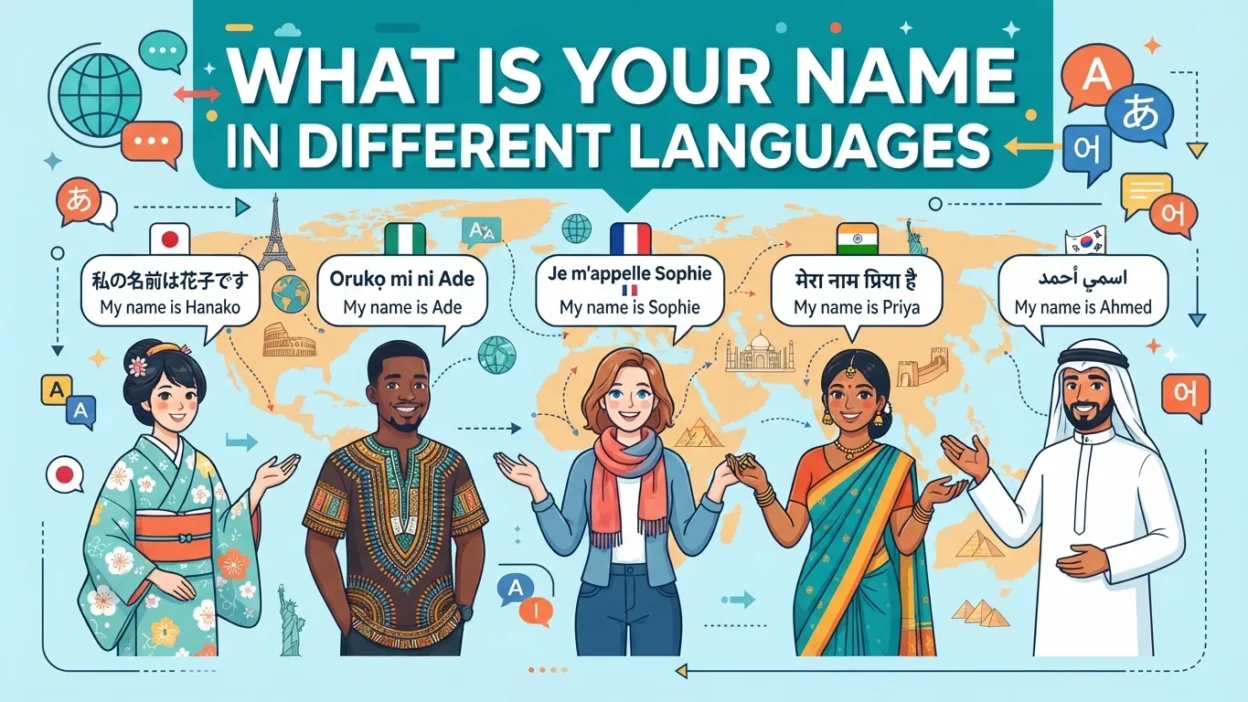
One of the first questions people learn in any language is “What is your name?”. Whether you’re traveling, meeting new people, studying a foreign language, or exploring different cultures, knowing how to ask someone’s name is an important communication skill.
Learning what is your name in different languages helps you start conversations, make friends, and understand cultural differences in greetings and introductions. It’s one of the most useful phrases for beginners because it is commonly used in everyday interactions around the world.
In this comprehensive guide, you’ll discover what is your name in different languages in all languages, learn how to say what is your name in different languages, explore common what is your name in different languages translations, and understand how people introduce themselves around the world.
Each translation includes the native phrase, pronunciation, an example sentence, and its English meaning to make learning easy and practical. Whether you’re a language learner, traveler, student, or content creator, this guide will help you communicate more confidently across cultures.
What Is Your Name in Different
| Language | Native Phrase | Pronunciation | Example Sentence | English Meaning |
| English | What is your name? | What is your name | What is your name, please? | May I know your name? |
| Spanish | ¿Cómo te llamas? | Ko-mo te ya-mas | ¿Cómo te llamas, amigo? | What is your name, friend? |
| French | Comment tu t’appelles ? | Ko-mon tu ta-pel | Comment tu t’appelles ? | What is your name? |
| German | Wie heißt du? | Vee hysst doo | Wie heißt du? | What is your name? |
| Italian | Come ti chiami? | Ko-me tee kya-mee | Come ti chiami? | What is your name? |
| Portuguese | Como você se chama? | Ko-mo vo-se se sha-ma | Como você se chama? | What is your name? |
| Dutch | Hoe heet je? | Hoo hayt yuh | Hoe heet je? | What is your name? |
| Russian | Как тебя зовут? | Kak te-bya za-voot | Как тебя зовут? | What is your name? |
| Ukrainian | Як тебе звати? | Yak te-be zva-ty | Як тебе звати? | What is your name? |
| Polish | Jak masz na imię? | Yak mash na ee-mye | Jak masz na imię? | What is your name? |
| Czech | Jak se jmenuješ? | Yak se ye-men-oo-yesh | Jak se jmenuješ? | What is your name? |
| Slovak | Ako sa voláš? | A-ko sa vo-lash | Ako sa voláš? | What is your name? |
| Hungarian | Hogy hívnak? | Hodj heev-nok | Hogy hívnak? | What is your name? |
| Romanian | Cum te cheamă? | Koom te kya-ma | Cum te cheamă? | What is your name? |
| Bulgarian | Как се казваш? | Kak se kaz-vash | Как се казваш? | What is your name? |
| Serbian | Kako se zoveš? | Ka-ko se zo-vesh | Kako se zoveš? | What is your name? |
| Croatian | Kako se zoveš? | Ka-ko se zo-vesh | Kako se zoveš? | What is your name? |
| Bosnian | Kako se zoveš? | Ka-ko se zo-vesh | Kako se zoveš? | What is your name? |
| Slovenian | Kako ti je ime? | Ka-ko ti ye ee-me | Kako ti je ime? | What is your name? |
| Albanian | Si quhesh? | See koo-hesh | Si quhesh? | What is your name? |
| Greek | Πώς σε λένε; | Pos se le-ne | Πώς σε λένε; | What is your name? |
| Turkish | Adın ne? | A-dun ne | Adın ne? | What is your name? |
| Arabic | ما اسمك؟ | Ma is-muk | ما اسمك؟ | What is your name? |
| Hebrew | מה שמך? | Ma shim-kha | מה שמך? | What is your name? |
| Persian | اسم شما چیست؟ | Esm-e sho-ma chist | اسم شما چیست؟ | What is your name? |
| Urdu | آپ کا نام کیا ہے؟ | Aap ka naam kya hai | آپ کا نام کیا ہے؟ | What is your name? |
| Hindi | आपका नाम क्या है? | Aap-ka naam kya hai | आपका नाम क्या है? | What is your name? |
| Punjabi | ਤੁਹਾਡਾ ਨਾਮ ਕੀ ਹੈ? | Tu-ha-da naam ki hai | ਤੁਹਾਡਾ ਨਾਮ ਕੀ ਹੈ? | What is your name? |
| Bengali | আপনার নাম কি? | Ap-naar naam ki | আপনার নাম কি? | What is your name? |
| Gujarati | તમારું નામ શું છે? | Ta-ma-ru naam shu che | તમારું નામ શું છે? | What is your name? |
| Marathi | तुमचे नाव काय आहे? | Tum-che naav kay aa-he | तुमचे नाव काय आहे? | What is your name? |
| Tamil | உங்கள் பெயர் என்ன? | Ung-gal pey-ar en-na | உங்கள் பெயர் என்ன? | What is your name? |
| Telugu | మీ పేరు ఏమిటి? | Mee pe-roo e-mi-ti | మీ పేరు ఏమిటి? | What is your name? |
| Kannada | ನಿಮ್ಮ ಹೆಸರು ಏನು? | Nim-ma he-sa-roo e-nu | ನಿಮ್ಮ ಹೆಸರು ಏನು? | What is your name? |
| Malayalam | നിങ്ങളുടെ പേര് എന്താണ്? | Ning-a-lu-de pe-r en-thaan | നിങ്ങളുടെ പേര് എന്താണ്? | What is your name? |
| Sinhala | ඔබගේ නම කුමක්ද? | Oba-ge nama ku-mak-da | ඔබගේ නම කුමක්ද? | What is your name? |
| Nepali | तपाईंको नाम के हो? | Ta-pai-ko naam ke ho | तपाईंको नाम के हो? | What is your name? |
| Chinese (Mandarin) | 你叫什么名字? | Nee jiao shen me ming zi | 你叫什么名字? | What is your name? |
| Cantonese | 你叫咩名? | Nei giu meh meng | 你叫咩名? | What is your name? |
| Japanese | お名前は何ですか? | O-na-mae wa nan des ka | お名前は何ですか? | What is your name? |
| Korean | 이름이 뭐예요? | Ee-reum-ee mwo-ye-yo | 이름이 뭐예요? | What is your name? |
| Vietnamese | Bạn tên là gì? | Ban ten la zi | Bạn tên là gì? | What is your name? |
| Thai | คุณชื่ออะไร | Khun cheu a-rai | คุณชื่ออะไร | What is your name? |
| Indonesian | Siapa nama kamu? | See-a-pa na-ma ka-mu | Siapa nama kamu? | What is your name? |
| Malay | Siapa nama awak? | See-a-pa na-ma a-wak | Siapa nama awak? | What is your name? |
| Filipino | Ano ang pangalan mo? | A-no ang pa-ngal-an mo | Ano ang pangalan mo? | What is your name? |
| Burmese | မင်းနာမည်ဘာလဲ | Min na-me ba-le | မင်းနာမည်ဘာလဲ | What is your name? |
| Khmer | អ្នកឈ្មោះអ្វី? | Neak chhmoh avei | អ្នកឈ្មោះអ្វី? | What is your name? |
| Lao | ເຈົ້າຊື່ຫຍັງ? | Jao seu nyang | ເຈົ້າຊື່ຫຍັງ? | What is your name? |
| Mongolian | Таны нэр хэн бэ? | Ta-ni ner hen be | Таны нэр хэн бэ? | What is your name? |
| Kazakh | Сіздің атыңыз кім? | See-zdin a-ty-ngyz kim | Сіздің атыңыз кім? | What is your name? |
| Uzbek | Ismingiz nima? | Is-ming-iz ni-ma | Ismingiz nima? | What is your name? |
| Azerbaijani | Adınız nədir? | A-du-nuz ne-dir | Adınız nədir? | What is your name? |
| Georgian | რა გქვია? | Ra gkvia | რა გქვია? | What is your name? |
| Armenian | Ինչ է քո անունը? | Inch e ko a-nu-nuh | Ինչ է քո անունը? | What is your name? |
| Swahili | Jina lako nani? | Jee-na la-ko na-ni | Jina lako nani? | What is your name? |
| Zulu | Ubani igama lakho? | U-ba-ni i-ga-ma la-kho | Ubani igama lakho? | What is your name? |
| Xhosa | Ngubani igama lakho? | Ngu-ba-ni i-ga-ma la-kho | Ngubani igama lakho? | What is your name? |
| Afrikaans | Wat is jou naam? | Vat is yo naam | Wat is jou naam? | What is your name? |
| Yoruba | Kí ni orúkọ rẹ? | Kee ni o-roo-ko re | Kí ni orúkọ rẹ? | What is your name? |
| Igbo | Kedu aha gị? | Ke-du a-ha gi | Kedu aha gị? | What is your name? |
| Hausa | Menene sunanka? | Me-ne-ne soo-nan-ka | Menene sunanka? | What is your name? |
| Amharic | ስምህ ማን ነው? | Simih man new | ስምህ ማን ነው? | What is your name? |
| Somali | Magacaa? | Ma-ga-caa | Magacaa? | What is your name? |
| Finnish | Mikä sinun nimesi on? | Mi-ka see-nun ni-me-si on | Mikä sinun nimesi on? | What is your name? |
| Swedish | Vad heter du? | Vad he-ter du | Vad heter du? | What is your name? |
| Norwegian | Hva heter du? | Hva he-ter du | Hva heter du? | What is your name? |
| Danish | Hvad hedder du? | Vel he-ther du | Hvad hedder du? | What is your name? |
| Icelandic | Hvað heitir þú? | Kva heyt-ir thu | Hvað heitir þú? | What is your name? |
| Estonian | Mis su nimi on? | Mis su ni-mi on | Mis su nimi on? | What is your name? |
| Latvian | Kā tevi sauc? | Kaa te-vi sowts | Kā tevi sauc? | What is your name? |
| Lithuanian | Koks tavo vardas? | Koks ta-vo var-das | Koks tavo vardas? | What is your name? |
| Irish | Cad is ainm duit? | Kad ish an-im ditch | Cad is ainm duit? | What is your name? |
| Welsh | Beth yw dy enw di? | Beth oo dee en-oo dee | Beth yw dy enw di? | What is your name? |
How to Say What Is Your Name in Different Languages
Learning what is your name in different languages is one of the easiest and most useful ways to begin communicating with people from different cultures. This simple question helps start conversations, build friendships, and create positive first impressions.
Whether you’re traveling internationally, studying a foreign language, or meeting people online, knowing how to ask someone’s name in their native language can make interactions more natural and respectful.
Because introductions are an essential part of everyday communication, this phrase is often one of the first expressions language learners memorize.
Why Learn What Is Your Name in Different Languages Around the World?
There are many reasons why people search for what is your name in different languages around the world:
- Start conversations confidently.
- Make friends while traveling.
- Improve language-learning skills.
- Understand cultural communication styles.
- Practice common everyday phrases.
- Build stronger international connections.
A simple introduction can open the door to meaningful conversations and cultural exchange.
The Importance of Names in Different Cultures
Names hold special significance in cultures worldwide. While the phrase “What is your name?” is universal, the way people introduce themselves can vary greatly.
Some cultures:
- Use formal introductions when meeting someone for the first time.
- Include family names before given names.
- Place strong importance on titles and honorifics.
- Prefer informal introductions among friends.
Understanding these customs can help you communicate more effectively and respectfully.
Common Situations to Use This Phrase
You can use “What is your name?” in many everyday situations, including:
Meeting Someone New
Whether at school, work, or social events, asking someone’s name is usually the first step in getting acquainted.
Traveling Abroad
Learning local introductions helps travelers communicate more comfortably with residents.
Language Learning Practice
This phrase is commonly used in beginner language lessons because it is practical and easy to remember.
International Business
Professional introductions often begin by exchanging names and basic information.
Tips for Pronouncing Foreign Names Correctly
After asking someone’s name, try to pronounce it carefully and respectfully.
Helpful tips include:
- Listen closely to native pronunciation.
- Repeat the name politely if needed.
- Ask for clarification when unsure.
- Avoid shortening names without permission.
- Show interest in learning the correct pronunciation.
People generally appreciate the effort to say their name correctly.
What Is Your Name in Different Languages Translations and Their Uses
Many learners search for what is your name in different languages translations because the phrase is useful in nearly every conversation. It serves as a foundation for language learning and helps build confidence when speaking with native speakers.
Since introductions are universal, mastering this phrase is one of the most practical steps toward learning any new language.
Conclusion
Learning what is your name in different languages is an excellent way to improve communication skills and connect with people from different backgrounds. This simple phrase is often the starting point of friendships, travel experiences, language learning journeys, and professional relationships. By understanding how to ask someone’s name in multiple languages, you can communicate more confidently and show respect for different cultures around the world.
FAQs
1. How do you say what is your name in different languages?
Different languages have unique translations, such as “¿Cómo te llamas?” in Spanish, “Comment tu t’appelles ?” in French, “Wie heißt du?” in German, and “你叫什么名字?” in Chinese.
2. Why is what is your name an important phrase to learn?
It is one of the most commonly used conversation starters and helps people introduce themselves when meeting for the first time.
3. Is asking someone’s name considered polite in every culture?
Yes, although the level of formality may vary depending on cultural traditions and social situations.
4. What language learners should learn first after greetings?
After learning greetings like hello and good morning, asking “What is your name?” is usually the next most useful phrase.
5. Can I use these translations while traveling?
Yes. Learning local introductions can help travelers communicate more effectively and create positive interactions with native speakers.