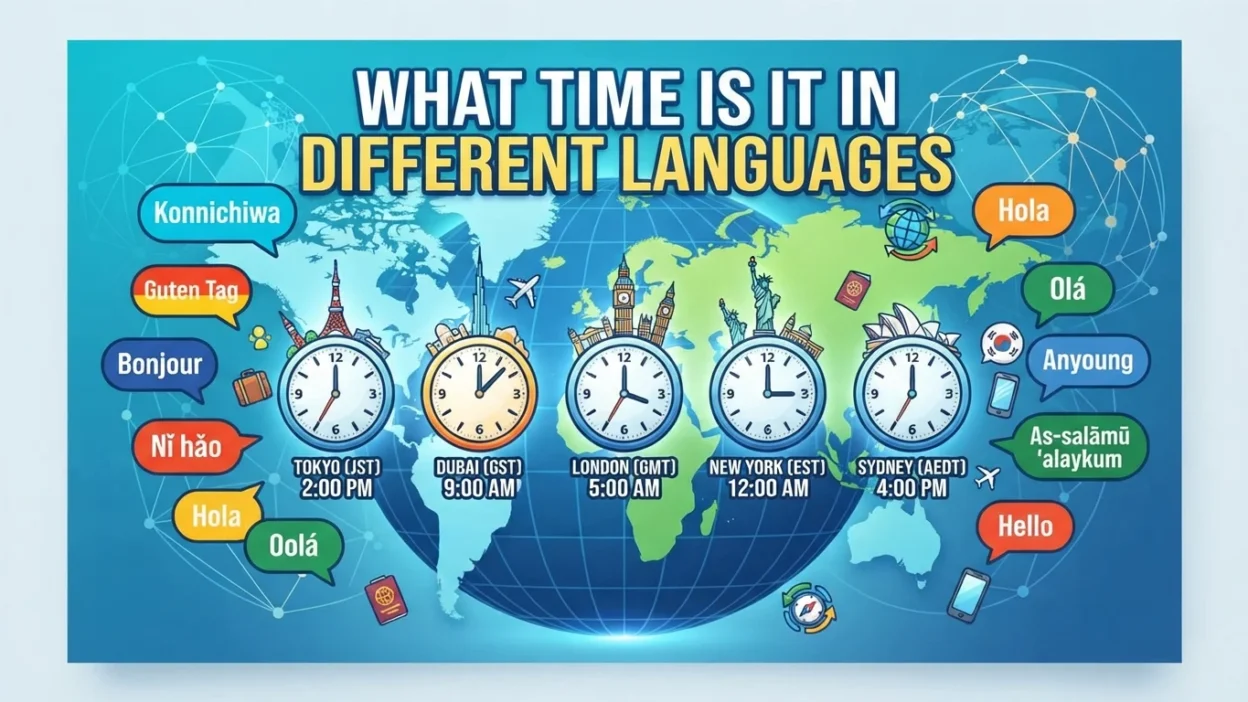
Knowing how to ask “What time is it?” in different languages is one of the most practical skills for travelers, language learners, and anyone communicating with people from different countries. Whether you’re catching a train, attending a meeting, exploring a new city, or simply practicing a language, this phrase is incredibly useful in everyday life.
Learning what time is it in different languages helps you navigate unfamiliar places, improve communication skills, and gain confidence when speaking with native speakers. Because asking for the time is a common conversation starter, it is often one of the first phrases taught in language courses.
In this guide, you’ll discover what time is it in different languages in all languages, learn how to say what time is it in different languages, explore useful what time is it in different languages translations, and understand how people ask about time around the world.
What Time Is It in Different Languages
| Language | Native Phrase | Pronunciation | Example Sentence | English Meaning |
| English | What time is it? | What time is it | What time is it now? | Can you tell me the time? |
| Spanish | ¿Qué hora es? | Kay o-ra es | ¿Qué hora es ahora? | What time is it now? |
| French | Quelle heure est-il ? | Kel ur eh-teel | Quelle heure est-il ? | What time is it? |
| German | Wie spät ist es? | Vee shpate ist es | Wie spät ist es jetzt? | What time is it now? |
| Italian | Che ora è? | Kay o-ra eh | Che ora è adesso? | What time is it now? |
| Portuguese | Que horas são? | Kay o-ras sow | Que horas são agora? | What time is it now? |
| Dutch | Hoe laat is het? | Hoo laat is het | Hoe laat is het nu? | What time is it now? |
| Russian | Который час? | Ka-to-riy chas | Который сейчас час? | What time is it now? |
| Ukrainian | Котра година? | Ko-tra ho-di-na | Котра година зараз? | What time is it now? |
| Polish | Która godzina? | Ktoo-ra go-jee-na | Która godzina jest teraz? | What time is it now? |
| Czech | Kolik je hodin? | Ko-lik ye ho-din | Kolik je hodin? | What time is it? |
| Slovak | Koľko je hodín? | Kol-ko ye ho-deen | Koľko je hodín? | What time is it? |
| Hungarian | Mennyi az idő? | Men-nyi az ee-do | Mennyi az idő most? | What time is it now? |
| Romanian | Cât este ceasul? | Kut es-te chea-sul | Cât este ceasul? | What time is it? |
| Bulgarian | Колко е часът? | Kol-ko e cha-sut | Колко е часът? | What time is it? |
| Serbian | Koliko je sati? | Ko-li-ko ye sa-ti | Koliko je sati? | What time is it? |
| Croatian | Koliko je sati? | Ko-li-ko ye sa-ti | Koliko je sati? | What time is it? |
| Bosnian | Koliko je sati? | Ko-li-ko ye sa-ti | Koliko je sati? | What time is it? |
| Slovenian | Koliko je ura? | Ko-li-ko ye oo-ra | Koliko je ura? | What time is it? |
| Albanian | Sa është ora? | Sa osh-t o-ra | Sa është ora? | What time is it? |
| Greek | Τι ώρα είναι; | Tee o-ra ee-ne | Τι ώρα είναι τώρα; | What time is it now? |
| Turkish | Saat kaç? | Sa-at kach | Saat kaç şimdi? | What time is it now? |
| Arabic | كم الساعة؟ | Kam as-sa-ah | كم الساعة الآن؟ | What time is it now? |
| Hebrew | מה השעה? | Ma ha-sha-ah | מה השעה עכשיו? | What time is it now? |
| Persian | ساعت چند است؟ | Sa-at chand ast | ساعت چند است؟ | What time is it? |
| Urdu | کیا وقت ہوا ہے؟ | Kya waqt hua hai | ابھی کیا وقت ہوا ہے؟ | What time is it now? |
| Hindi | क्या समय हुआ है? | Kya samay hua hai | अभी क्या समय हुआ है? | What time is it now? |
| Punjabi | ਕੀ ਸਮਾਂ ਹੋਇਆ ਹੈ? | Ki sa-maa ho-ya hai | ਕੀ ਸਮਾਂ ਹੋਇਆ ਹੈ? | What time is it? |
| Bengali | এখন কয়টা বাজে? | Ek-hon koi-ta ba-je | এখন কয়টা বাজে? | What time is it now? |
| Gujarati | કેટલા વાગ્યા છે? | Ket-la vaag-ya che | કેટલા વાગ્યા છે? | What time is it? |
| Marathi | किती वाजले आहेत? | Ki-ti vaj-le aa-het | किती वाजले आहेत? | What time is it? |
| Tamil | மணி என்ன? | Ma-ni en-na | மணி என்ன இப்போது? | What time is it now? |
| Telugu | సమయం ఎంత? | Sa-ma-yam en-tha | సమయం ఎంత? | What time is it? |
| Kannada | ಸಮಯ ಎಷ್ಟು? | Sa-ma-ya esh-tu | ಸಮಯ ಎಷ್ಟು? | What time is it? |
| Malayalam | സമയം എത്രയായി? | Sa-ma-yam eth-ra-ya-yi | സമയം എത്രയായി? | What time is it? |
| Sinhala | දැන් වෙලාව කීයද? | Dan ve-la-va kee-ya-da | දැන් වෙලාව කීයද? | What time is it now? |
| Nepali | अहिले कति बज्यो? | A-hi-le ka-ti ba-jyo | अहिले कति बज्यो? | What time is it now? |
| Chinese (Mandarin) | 现在几点? | Shyen-zai jee-dyen | 现在几点? | What time is it now? |
| Cantonese | 而家幾點呀? | Yee-ga gay dim a | 而家幾點呀? | What time is it now? |
| Japanese | 今何時ですか? | Ee-ma nan-ji des-ka | 今何時ですか? | What time is it now? |
| Korean | 지금 몇 시예요? | Jee-geum myeot shi ye-yo | 지금 몇 시예요? | What time is it now? |
| Vietnamese | Mấy giờ rồi? | May zo zoi | Mấy giờ rồi? | What time is it? |
| Thai | กี่โมงแล้ว | Gee mong laeo | กี่โมงแล้ว | What time is it? |
| Indonesian | Jam berapa? | Jam be-ra-pa | Jam berapa sekarang? | What time is it now? |
| Malay | Pukul berapa? | Poo-kool be-ra-pa | Pukul berapa sekarang? | What time is it now? |
| Filipino | Anong oras na? | A-nong o-ras na | Anong oras na? | What time is it now? |
| Burmese | ဘယ်နှနာရီရှိပြီလဲ | Be na-ri shi pyi le | ဘယ်နှနာရီရှိပြီလဲ | What time is it? |
| Khmer | ម៉ោងប៉ុន្មានហើយ? | Maong pon-man hoi | ម៉ោងប៉ុន្មានហើយ? | What time is it? |
| Lao | ຈັກໂມງແລ້ວ? | Jak mong laeo | ຈັກໂມງແລ້ວ? | What time is it? |
| Mongolian | Хэдэн цаг болж байна? | He-den tsag bolj bai-na | Хэдэн цаг болж байна? | What time is it? |
| Kazakh | Сағат қанша? | Sa-ghat qan-sha | Сағат қанша? | What time is it? |
| Uzbek | Soat necha? | So-at ne-cha | Soat necha? | What time is it? |
| Azerbaijani | Saat neçədir? | Sa-at ne-che-dir | Saat neçədir? | What time is it? |
| Georgian | რომელი საათია? | Ro-me-li sa-a-ti-a | რომელი საათია? | What time is it? |
| Armenian | Ժամը քանիսն է? | Zha-muh ka-nisn e | Ժամը քանիսն է? | What time is it? |
| Swahili | Saa ngapi? | Saa nga-pi | Saa ngapi sasa? | What time is it now? |
| Zulu | Isikhathi sini? | Ee-si-kha-thi si-ni | Isikhathi sini? | What time is it? |
| Xhosa | Lixesha lini? | Lee-khe-sha lee-ni | Lixesha lini? | What time is it? |
| Afrikaans | Hoe laat is dit? | Hoo laat is dit | Hoe laat is dit nou? | What time is it now? |
| Yoruba | Ago melo ni? | A-go me-lo ni | Ago melo ni bayi? | What time is it now? |
| Igbo | Kedu oge ọ bụ? | Ke-du o-ge o bu | Kedu oge ọ bụ? | What time is it? |
| Hausa | Karfe nawa ne? | Kar-fe na-wa ne | Karfe nawa ne? | What time is it? |
| Amharic | ስንት ሰዓት ነው? | Sint se-at new | ስንት ሰዓት ነው? | What time is it? |
| Somali | Saacaddu waa imisa? | Saa-cad-du waa ee-mi-sa | Saacaddu waa imisa? | What time is it? |
| Finnish | Paljonko kello on? | Pal-yon-ko kel-lo on | Paljonko kello on? | What time is it? |
| Swedish | Vad är klockan? | Vad er klok-kan | Vad är klockan nu? | What time is it now? |
| Norwegian | Hva er klokken? | Hva er klok-ken | Hva er klokken nå? | What time is it now? |
| Danish | Hvad er klokken? | Vel er klok-ken | Hvad er klokken? | What time is it? |
| Icelandic | Hvað er klukkan? | Kva er kluk-kan | Hvað er klukkan? | What time is it? |
| Estonian | Mis kell on? | Mis kel on | Mis kell on? | What time is it? |
| Latvian | Cik ir pulkstenis? | Tsik ir poolk-ste-nis | Cik ir pulkstenis? | What time is it? |
| Lithuanian | Kiek valandų? | Kyek va-lan-doo | Kiek valandų? | What time is it? |
| Irish | Cén t-am é? | Kane tam ay | Cén t-am é? | What time is it? |
| Welsh | Faint o’r gloch ydy hi? | Vaint or gloch uh-dee hee | Faint o’r gloch ydy hi? | What time is it? |
How to Say What Time Is It in Different Languages
Learning what time is it in different languages is one of the most useful language skills for travelers, students, and anyone communicating internationally. Asking for the time is a common part of everyday life, whether you’re catching a bus, attending a meeting, or exploring a new city.
Understanding how to say what time is it in different languages can help you communicate more confidently and navigate unfamiliar places with ease. Since time plays an important role in daily schedules worldwide, this phrase is considered essential in almost every language.
Why Learn What Time Is It in Different Languages Around the World?
People often search for what time is it in different languages around the world because it is a practical phrase used in countless situations.
Benefits of learning this phrase include:
- Communicating while traveling abroad.
- Asking for schedules and appointments.
- Improving conversational language skills.
- Understanding local time-related discussions.
- Building confidence when speaking with native speakers.
Even if you know only a few words in another language, being able to ask for the time can be extremely helpful.
Common Situations to Use This Phrase
While Traveling
Travelers frequently ask for the time when checking transportation schedules, tours, or event timings.
During Language Learning
Beginners often learn time-related questions early because they are useful in everyday conversations.
At School or Work
Students and professionals may need to ask for the time during meetings, classes, or events.
In Social Conversations
Asking the time is also a simple way to begin conversations with native speakers.
Time Expressions Around the World
Different languages use unique ways to talk about time.
Some cultures commonly use:
- 12-hour clocks
- 24-hour clocks
- Formal time expressions
- Informal conversational time phrases
Understanding these differences can improve both language comprehension and cultural awareness.
Related Time Phrases to Learn
After learning what time is it in different languages translations, you may also find these phrases useful:
- What Day Is It?
- What Is Today’s Date?
- When Does It Start?
- How Long Does It Take?
- See You Tomorrow
- Good Morning
- Good Night
- See You Later
Together, these expressions help create a strong foundation for daily communication.
Tips for Learning Time Phrases Faster
To remember time-related vocabulary more effectively:
- Practice asking the question daily.
- Listen to native speakers.
- Use flashcards for repetition.
- Watch videos in your target language.
- Practice with friends or language partners.
Regular use helps make these phrases part of your active vocabulary.
What Time Is It in Different Languages Translations and Global Communication
The phrase what time is it in different languages is among the most searched travel and language-learning expressions because it has universal usefulness. Regardless of where you travel, knowing how to ask for the time can help you stay organized, avoid misunderstandings, and communicate more effectively.
These translations also offer insight into how different cultures discuss schedules, punctuality, and daily routines.
Conclusion
Learning what time is it in different languages is a practical skill that benefits travelers, students, professionals, and language enthusiasts alike. This simple phrase can help you navigate new environments, communicate more effectively, and gain confidence when interacting with people from different cultures. By mastering these translations, you’ll be better prepared for everyday conversations around the world.
FAQs
1. How do you say what time is it in different languages?
The phrase varies by language, such as “¿Qué hora es?” in Spanish, “Quelle heure est-il ?” in French, “Wie spät ist es?” in German, and “现在几点?” in Chinese.
2. Why is what time is it an important phrase to learn?
It is useful for travel, daily communication, scheduling activities, and understanding local time-related conversations.
3. Is asking for the time common in every country?
Yes. Asking for the time is a universal communication need and is commonly understood worldwide.
4. Do all countries use the same time format?
No. Some countries primarily use the 12-hour clock, while others commonly use the 24-hour format.
5. What travel phrases should I learn alongside this one?
Helpful phrases include hello, thank you, where is the bathroom, what is your name, where are you from, and do you speak English.