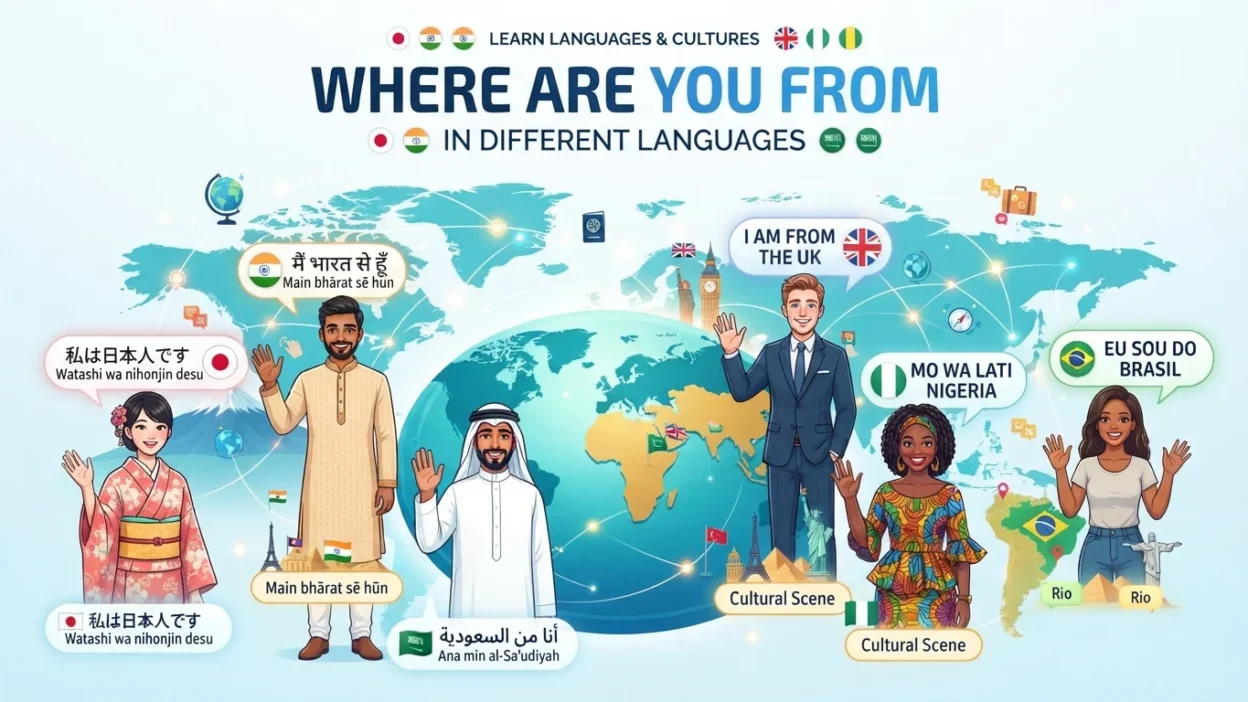
One of the most common questions people ask when meeting someone new is, “Where are you from?”. Whether you’re traveling, learning a foreign language, making international friends, or exploring different cultures, knowing how to ask this question can help start meaningful conversations.
Learning where are you from in different languages is useful because it allows you to connect with people from diverse backgrounds and learn more about their culture, country, and experiences. This phrase is commonly used in everyday conversations and is often among the first questions asked during introductions.
In this guide, you’ll discover where are you from in different languages in all languages, learn how to say where are you from in different languages, explore common where are you from in different languages translations, and understand how people ask this question around the world.
Each translation includes the native phrase, pronunciation, an example sentence, and its English meaning. This makes the guide practical for travelers, students, language learners, and anyone interested in multilingual communication.
Where Are You From in Different
| Language | Native Phrase | Pronunciation | Example Sentence | English Meaning |
| English | Where are you from? | Wair are you from | Where are you from originally? | Which place do you come from? |
| Spanish | ¿De dónde eres? | De don-de eh-res | ¿De dónde eres? | Where are you from? |
| French | D’où viens-tu ? | Doo vee-an too | D’où viens-tu ? | Where are you from? |
| German | Woher kommst du? | Vo-hair komst doo | Woher kommst du? | Where are you from? |
| Italian | Di dove sei? | Dee do-veh say | Di dove sei? | Where are you from? |
| Portuguese | De onde você é? | De on-je vo-se eh | De onde você é? | Where are you from? |
| Dutch | Waar kom je vandaan? | Vaar kom yuh van-daan | Waar kom je vandaan? | Where are you from? |
| Russian | Откуда ты? | At-koo-da ti | Откуда ты? | Where are you from? |
| Ukrainian | Звідки ти? | Zvid-ki ty | Звідки ти? | Where are you from? |
| Polish | Skąd jesteś? | Skond yes-tesh | Skąd jesteś? | Where are you from? |
| Czech | Odkud jsi? | Od-kood ysi | Odkud jsi? | Where are you from? |
| Slovak | Odkiaľ si? | Od-ki-al see | Odkiaľ si? | Where are you from? |
| Hungarian | Honnan jöttél? | Hon-nan yot-tail | Honnan jöttél? | Where are you from? |
| Romanian | De unde ești? | De oon-de yesht | De unde ești? | Where are you from? |
| Bulgarian | Откъде си? | Ot-ku-de si | Откъде си? | Where are you from? |
| Serbian | Odakle si? | O-dak-le see | Odakle si? | Where are you from? |
| Croatian | Odakle si? | O-dak-le see | Odakle si? | Where are you from? |
| Bosnian | Odakle si? | O-dak-le see | Odakle si? | Where are you from? |
| Slovenian | Od kod si? | Od kod see | Od kod si? | Where are you from? |
| Albanian | Nga je? | Nga yeh | Nga je? | Where are you from? |
| Greek | Από πού είσαι; | A-po poo ee-se | Από πού είσαι; | Where are you from? |
| Turkish | Nerelisin? | Ne-re-li-sin | Nerelisin? | Where are you from? |
| Arabic | من أين أنت؟ | Min ay-na ant | من أين أنت؟ | Where are you from? |
| Hebrew | מאיפה אתה? | Me-ay-fo a-ta | מאיפה אתה? | Where are you from? |
| Persian | اهل کجا هستی؟ | Ahl-e ko-ja has-ti | اهل کجا هستی؟ | Where are you from? |
| Urdu | آپ کہاں سے ہیں؟ | Aap kahan se hain | آپ کہاں سے ہیں؟ | Where are you from? |
| Hindi | आप कहाँ से हैं? | Aap ka-han se hain | आप कहाँ से हैं? | Where are you from? |
| Punjabi | ਤੁਸੀਂ ਕਿੱਥੋਂ ਹੋ? | Tu-see kit-thon ho | ਤੁਸੀਂ ਕਿੱਥੋਂ ਹੋ? | Where are you from? |
| Bengali | আপনি কোথা থেকে এসেছেন? | A-pni ko-tha the-ke es-he-chen | আপনি কোথা থেকে এসেছেন? | Where are you from? |
| Gujarati | તમે ક્યાંના છો? | Ta-me kya-na cho | તમે ક્યાંના છો? | Where are you from? |
| Marathi | तुम्ही कुठून आला आहात? | Tum-hi ku-thoon aa-la aa-hat | तुम्ही कुठून आला आहात? | Where are you from? |
| Tamil | நீங்கள் எங்கிருந்து வருகிறீர்கள்? | Neen-gal en-gi-run-thu va-ru-gee-reer-gal | நீங்கள் எங்கிருந்து வருகிறீர்கள்? | Where are you from? |
| Telugu | మీరు ఎక్కడి నుండి వచ్చారు? | Mee-ru ek-ka-di nun-di vach-cha-ru | మీరు ఎక్కడి నుండి వచ్చారు? | Where are you from? |
| Kannada | ನೀವು ಎಲ್ಲಿಂದ ಬಂದಿದ್ದೀರಿ? | Nee-vu el-lin-da ban-did-dee-ri | ನೀವು ಎಲ್ಲಿಂದ ಬಂದಿದ್ದೀರಿ? | Where are you from? |
| Malayalam | നിങ്ങൾ എവിടെ നിന്നാണ്? | Ning-gal e-vi-de nin-naan | നിങ്ങൾ എവിടെ നിന്നാണ്? | Where are you from? |
| Sinhala | ඔබ කොහෙන්ද? | O-ba ko-hen-da | ඔබ කොහෙන්ද? | Where are you from? |
| Nepali | तपाईं कहाँबाट हुनुहुन्छ? | Ta-pai ka-haan-bat hu-nu-hunch-ha | तपाईं कहाँबाट हुनुहुन्छ? | Where are you from? |
| Chinese (Mandarin) | 你来自哪里? | Nee lai-zuh na-li | 你来自哪里? | Where are you from? |
| Cantonese | 你喺邊度嚟㗎? | Nei hai bin dou lai ga | 你喺邊度嚟㗎? | Where are you from? |
| Japanese | どこから来ましたか? | Do-ko ka-ra ki-ma-shi-ta ka | どこから来ましたか? | Where are you from? |
| Korean | 어디에서 왔어요? | Eo-di-e-so wat-so-yo | 어디에서 왔어요? | Where are you from? |
| Vietnamese | Bạn đến từ đâu? | Ban den tu dow | Bạn đến từ đâu? | Where are you from? |
| Thai | คุณมาจากไหน | Khun ma jak nai | คุณมาจากไหน | Where are you from? |
| Indonesian | Kamu berasal dari mana? | Ka-mu ber-a-sal da-ri ma-na | Kamu berasal dari mana? | Where are you from? |
| Malay | Awak dari mana? | A-wak da-ri ma-na | Awak dari mana? | Where are you from? |
| Filipino | Taga saan ka? | Ta-ga sa-an ka | Taga saan ka? | Where are you from? |
| Burmese | မင်းဘယ်ကလာတာလဲ | Min be ka la ta le | မင်းဘယ်ကလာတာလဲ | Where are you from? |
| Khmer | អ្នកមកពីណា? | Neak mok pi na | អ្នកមកពីណា? | Where are you from? |
| Lao | ເຈົ້າມາຈາກໃສ? | Jao ma jak sai | ເຈົ້າມາຈາກໃສ? | Where are you from? |
| Mongolian | Та хаанаас ирсэн бэ? | Ta haa-naas ir-sen be | Та хаанаас ирсэн бэ? | Where are you from? |
| Kazakh | Сіз қайдансыз? | Siz kai-dan-siz | Сіз қайдансыз? | Where are you from? |
| Uzbek | Siz qayerdansiz? | Siz qa-yer-dan-siz | Siz qayerdansiz? | Where are you from? |
| Azerbaijani | Haralısınız? | Ha-ra-li-si-niz | Haralısınız? | Where are you from? |
| Georgian | საიდან ხარ? | Sai-dan khar | საიდან ხარ? | Where are you from? |
| Armenian | Որտեղից ես? | Vor-te-ghits yes | Որտեղից ես? | Where are you from? |
| Swahili | Unatoka wapi? | Oo-na-to-ka wa-pi | Unatoka wapi? | Where are you from? |
| Zulu | Uvelaphi? | Oo-ve-la-phee | Uvelaphi? | Where are you from? |
| Xhosa | Uvela phi? | Oo-ve-la phee | Uvela phi? | Where are you from? |
| Afrikaans | Waar kom jy vandaan? | Vaar kom yai van-daan | Waar kom jy vandaan? | Where are you from? |
| Yoruba | Nibo ni o ti wa? | Nee-bo nee o tee wa | Nibo ni o ti wa? | Where are you from? |
| Igbo | Ebee ka i si? | E-be ka ee si | Ebee ka i si? | Where are you from? |
| Hausa | Daga ina kake? | Da-ga ee-na ka-ke | Daga ina kake? | Where are you from? |
| Amharic | ከየት ነህ? | Ke-yet neh | ከየት ነህ? | Where are you from? |
| Somali | Xaggee baad ka timid? | Hag-gee baad ka ti-mid | Xaggee baad ka timid? | Where are you from? |
| Finnish | Mistä olet kotoisin? | Mis-ta o-let ko-toi-sin | Mistä olet kotoisin? | Where are you from? |
| Swedish | Var kommer du ifrån? | Var kom-mer du ee-fron | Var kommer du ifrån? | Where are you from? |
| Norwegian | Hvor kommer du fra? | Vor kom-mer du fra | Hvor kommer du fra? | Where are you from? |
| Danish | Hvor kommer du fra? | Vor kom-mer du fra | Hvor kommer du fra? | Where are you from? |
| Icelandic | Hvaðan ert þú? | Kva-than ert thu | Hvaðan ert þú? | Where are you from? |
| Estonian | Kust sa pärit oled? | Koost sa pae-rit o-led | Kust sa pärit oled? | Where are you from? |
| Latvian | No kurienes tu esi? | No ku-ri-en-es tu e-si | No kurienes tu esi? | Where are you from? |
| Lithuanian | Iš kur esi? | Ish kur e-si | Iš kur esi? | Where are you from? |
| Irish | Cad as duit? | Kad as ditch | Cad as duit? | Where are you from? |
| Welsh | O ble wyt ti? | O ble wit tee | O ble wyt ti? | Where are you from? |
How to Say Where Are You From in Different Languages
Learning where are you from in different languages is one of the best ways to start meaningful conversations with people from around the world. This simple question helps break the ice, encourages cultural exchange, and allows you to learn more about someone’s background.
Whether you’re traveling, studying abroad, attending international events, or making friends online, knowing how to ask this question in different languages can make communication easier and more engaging.
Because it is commonly used during introductions, it is often one of the first phrases language learners study.
Why Learn Where Are You From in Different Languages Around the World?
People frequently search for where are you from in different languages around the world because it is a useful phrase in many situations.
Benefits of learning this expression include:
- Starting conversations naturally.
- Building friendships with international people.
- Learning about different cultures.
- Improving language-learning skills.
- Enhancing travel experiences.
- Communicating more confidently abroad.
A simple question about someone’s origin can lead to fascinating discussions about culture, traditions, and personal experiences.
Cultural Differences When Asking Where Someone Is From
Although the phrase exists in nearly every language, cultural expectations may differ.
Formal and Informal Speech
Some languages have both formal and informal versions of the question. Using the appropriate form shows politeness and respect.
Nationality vs. Hometown
In some cultures, people may answer with their country, while others may mention their city, region, or hometown.
Social Context
The question is generally considered friendly and appropriate when meeting new people, especially in social, educational, and travel settings.
Understanding these differences helps create positive and respectful interactions.
Common Situations to Use This Phrase
Traveling Abroad
Travelers often use this phrase to connect with locals and fellow tourists.
Language Exchange Programs
Students and language learners frequently ask this question when practicing conversations.
International Business Events
Networking events often begin with introductions and discussions about where participants come from.
Online Communities
Global social platforms allow people from different countries to connect, making this phrase especially useful.
Useful Responses to Where Are You From
After asking the question, you may hear responses such as:
- I am from Pakistan.
- I am from Canada.
- I am from Japan.
- I am from Brazil.
- I am from Germany.
Learning both the question and possible responses can improve your conversational skills significantly.
Related Phrases to Learn
Once you know how to ask where someone is from, consider learning these useful expressions:
- What Is Your Name?
- Nice to Meet You
- How Are You?
- Where Do You Live?
- Do You Speak English?
- Thank You
- Goodbye
Together, these phrases provide a strong foundation for everyday conversations in many languages.
Conclusion
Learning where are you from in different languages is a valuable skill for travelers, students, language learners, and anyone interested in global communication. This simple question helps people connect, share cultural experiences, and build friendships across borders. By understanding how this phrase is used around the world, you can communicate more confidently and respectfully with people from diverse backgrounds.
FAQs
1. How do you say where are you from in different languages?
The phrase varies by language, such as “¿De dónde eres?” in Spanish, “D’où viens-tu ?” in French, “Woher kommst du?” in German, and “你来自哪里?” in Chinese.
2. Why is where are you from an important phrase to learn?
It is a common conversation starter that helps people learn about each other’s background, culture, and nationality.
3. Is it polite to ask where someone is from?
Yes, in most situations it is considered a friendly and respectful question, especially during introductions.
4. Can this phrase help when traveling?
Absolutely. It helps travelers connect with locals, other visitors, and people from different countries.
5. What phrases should I learn after where are you from?
Useful follow-up phrases include “What is your name?”, “Nice to meet you”, “How are you?”, and “Do you speak English?”