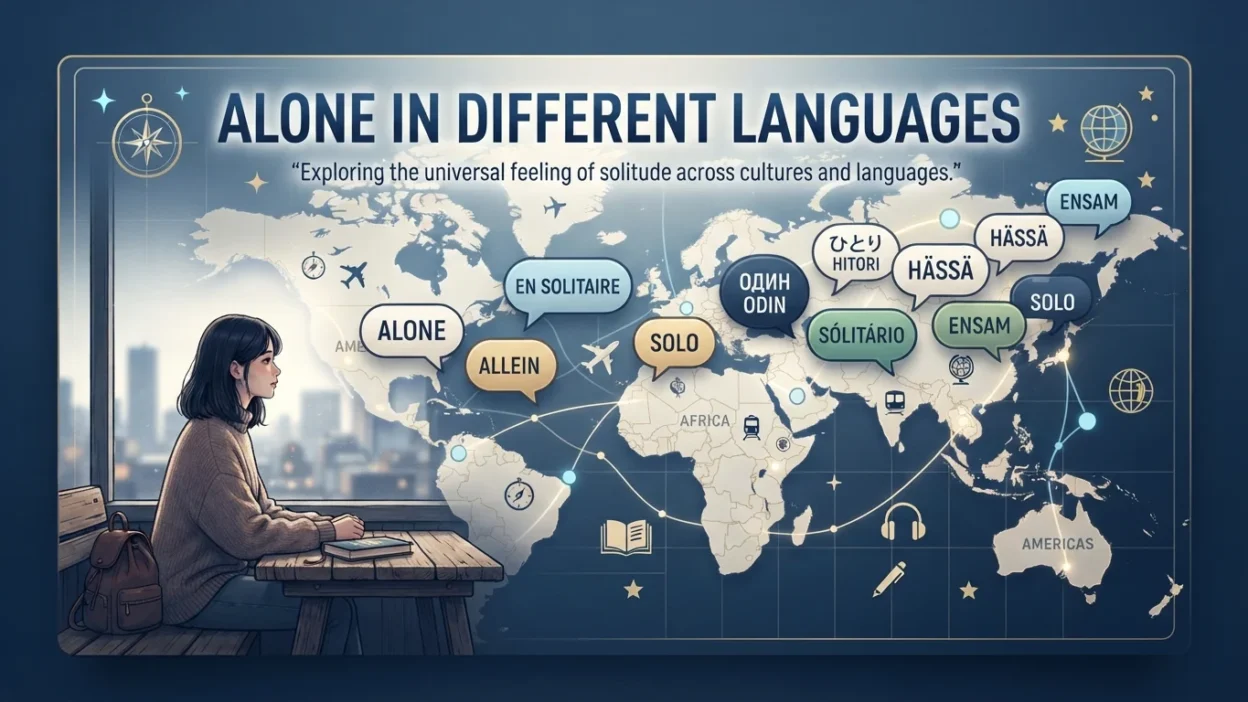
The word “alone” can describe being by yourself, without company, or sometimes feeling emotionally isolated. Learning how to say alone in different languages is useful for language learners, travelers, writers, students, and anyone interested in how different cultures express feelings and situations.
Although the basic idea of being alone is universal, the exact expression can change depending on the language and context. Some languages use a single adjective, while others use phrases that mean “by myself,” “on my own,” or “without anyone else.”
In this guide, you’ll discover alone in different languages in all languages, learn how to say alone in different languages, and explore useful alone in different languages translations from around the world.
The table below includes 70 languages, simple English pronunciations, practical example sentences, and their English meanings. This makes it easier to understand not only the translation but also how the word or phrase can be used naturally.
Alone in Different Languages Around the World
| Language | Native Phrase | Easy English Pronunciation | Example Sentence | English Meaning |
| English | Alone | Uh-lohn | I am alone at home. | I am by myself at home. |
| Spanish | Solo / Sola | So-lo / So-la | Estoy solo en casa. | I am alone at home. |
| French | Seul / Seule | Suhl / Suhl | Je suis seul à la maison. | I am alone at home. |
| German | Allein | Ah-line | Ich bin allein zu Hause. | I am alone at home. |
| Italian | Solo / Sola | So-lo / So-la | Sono solo a casa. | I am alone at home. |
| Portuguese | Sozinho / Sozinha | So-zeen-yo / So-zeen-ya | Estou sozinho em casa. | I am alone at home. |
| Dutch | Alleen | Ah-lane | Ik ben alleen thuis. | I am alone at home. |
| Russian | Один / Одна | Ah-deen / Ahd-na | Я один дома. | I am alone at home. |
| Ukrainian | Сам / Сама | Sam / Sa-ma | Я сам удома. | I am alone at home. |
| Polish | Sam / Sama | Sam / Sa-ma | Jestem sam w domu. | I am alone at home. |
| Czech | Sám / Sama | Saam / Sa-ma | Jsem sám doma. | I am alone at home. |
| Slovak | Sám / Sama | Saam / Sa-ma | Som sám doma. | I am alone at home. |
| Hungarian | Egyedül | Ed-ye-dool | Egyedül vagyok otthon. | I am alone at home. |
| Romanian | Singur / Singură | Seen-goor / Seen-goo-ra | Sunt singur acasă. | I am alone at home. |
| Bulgarian | Сам / Сама | Sam / Sa-ma | Аз съм сам вкъщи. | I am alone at home. |
| Serbian | Sam / Sama | Sam / Sa-ma | Sam sam kod kuće. | I am alone at home. |
| Croatian | Sam / Sama | Sam / Sa-ma | Sam sam kod kuće. | I am alone at home. |
| Bosnian | Sam / Sama | Sam / Sa-ma | Sam sam kod kuće. | I am alone at home. |
| Slovenian | Sam / Sama | Sam / Sa-ma | Sam sem doma. | I am alone at home. |
| Albanian | Vetëm | Veh-tum | Jam vetëm në shtëpi. | I am alone at home. |
| Greek | Μόνος / Μόνη | Mo-nos / Mo-nee | Είμαι μόνος στο σπίτι. | I am alone at home. |
| Turkish | Yalnız | Yal-nuz | Evde yalnızım. | I am alone at home. |
| Arabic | وحيد / وحيدة | Wa-heed / Wa-hee-da | أنا وحيد في المنزل. | I am alone at home. |
| Hebrew | לבד | Le-vad | אני לבד בבית. | I am alone at home. |
| Persian | تنها | Tan-ha | من در خانه تنها هستم. | I am alone at home. |
| Urdu | اکیلا / اکیلی | A-kee-la / A-kee-lee | میں گھر میں اکیلا ہوں۔ | I am alone at home. |
| Hindi | अकेला / अकेली | A-ke-la / A-ke-lee | मैं घर पर अकेला हूँ। | I am alone at home. |
| Punjabi | ਇਕੱਲਾ / ਇਕੱਲੀ | Ik-lla / Ik-llee | ਮੈਂ ਘਰ ਵਿੱਚ ਇਕੱਲਾ ਹਾਂ। | I am alone at home. |
| Bengali | একা | E-ka | আমি বাড়িতে একা আছি। | I am alone at home. |
| Gujarati | એકલો / એકલી | Ek-lo / Ek-lee | હું ઘરે એકલો છું. | I am alone at home. |
| Marathi | एकटा / एकटी | Ek-ta / Ek-tee | मी घरी एकटा आहे. | I am alone at home. |
| Tamil | தனியாக | Tha-ni-yaa-ga | நான் வீட்டில் தனியாக இருக்கிறேன். | I am alone at home. |
| Telugu | ఒంటరిగా | On-ta-ri-ga | నేను ఇంట్లో ఒంటరిగా ఉన్నాను. | I am alone at home. |
| Kannada | ಒಂಟಿಯಾಗಿ | On-ti-yaa-gi | ನಾನು ಮನೆಯಲ್ಲಿ ಒಂಟಿಯಾಗಿದ್ದೇನೆ. | I am alone at home. |
| Malayalam | ഒറ്റയ്ക്ക് | Ot-tayk-ku | ഞാൻ വീട്ടിൽ ഒറ്റയ്ക്കാണ്. | I am alone at home. |
| Sinhala | තනියම | Tha-ni-ya-ma | මම ගෙදර තනියම ඉන්නවා. | I am alone at home. |
| Nepali | एक्लै | Ek-lai | म घरमा एक्लै छु। | I am alone at home. |
| Chinese (Mandarin) | 独自 | Doo-zee | 我独自在家。 | I am alone at home. |
| Cantonese | 一個人 | Yat-go-yan | 我一個人在屋企。 | I am alone at home. |
| Japanese | 一人で | Hee-to-ree-de | 一人で家にいます。 | I am alone at home. |
| Korean | 혼자 | Hon-ja | 저는 집에 혼자 있어요. | I am alone at home. |
| Vietnamese | Một mình | Mot minh | Tôi ở nhà một mình. | I am alone at home. |
| Thai | คนเดียว | Khon diao | ฉันอยู่บ้านคนเดียว | I am alone at home. |
| Indonesian | Sendirian | Sen-dee-ree-an | Saya sendirian di rumah. | I am alone at home. |
| Malay | Bersendirian | Ber-sen-dee-ree-an | Saya bersendirian di rumah. | I am alone at home. |
| Filipino | Mag-isa | Mag-ee-sa | Mag-isa ako sa bahay. | I am alone at home. |
| Burmese | တစ်ယောက်တည်း | Tit-yout-te | ကျွန်တော် တစ်ယောက်တည်း အိမ်မှာရှိတယ်။ | I am alone at home. |
| Khmer | ម្នាក់ឯង | Mneak aeng | ខ្ញុំនៅផ្ទះម្នាក់ឯង។ | I am alone at home. |
| Lao | ຄົນດຽວ | Khon diao | ຂ້ອຍຢູ່ເຮືອນຄົນດຽວ. | I am alone at home. |
| Mongolian | Ганцаараа | Gants-aa-raa | Би гэртээ ганцаараа байна. | I am alone at home. |
| Kazakh | Жалғыз | Zhal-ghyz | Мен үйде жалғызбын. | I am alone at home. |
| Uzbek | Yolg’iz | Yol-ghiz | Men uyda yolg’izman. | I am alone at home. |
| Azerbaijani | Tək | Tek | Mən evdə təkəm. | I am alone at home. |
| Georgian | მარტო | Mar-to | სახლში მარტო ვარ. | I am alone at home. |
| Armenian | Մենակ | Me-nak | Ես տանը մենակ եմ։ | I am alone at home. |
| Swahili | Peke yangu | Pe-ke yan-gu | Niko nyumbani peke yangu. | I am alone at home. |
| Zulu | Ngedwa | Nge-dwa | Ngisekhaya ngedwa. | I am alone at home. |
| Xhosa | Ndindedwa | Ndin-de-dwa | Ndisekhaya ndindedwa. | I am alone at home. |
| Afrikaans | Alleen | Ah-lane | Ek is alleen by die huis. | I am alone at home. |
| Yoruba | Nikan | Nee-kan | Mo wa nikan ni ile. | I am alone at home. |
| Igbo | Naanị m | Na-a-nee m | Anọ m naanị m n’ụlọ. | I am alone at home. |
| Hausa | Ni kaɗai | Nee ka-dai | Ina gida ni kaɗai. | I am alone at home. |
| Amharic | ብቻ | Bit-cha | እኔ ቤት ብቻዬን ነኝ። | I am alone at home. |
| Somali | Kaligay | Ka-li-gay | Guriga kaligay ayaan joogaa. | I am alone at home. |
| Finnish | Yksin | Yook-sin | Olen yksin kotona. | I am alone at home. |
| Swedish | Ensam | En-sam | Jag är ensam hemma. | I am alone at home. |
| Norwegian | Alene | Ah-leh-neh | Jeg er alene hjemme. | I am alone at home. |
| Danish | Alene | Ah-leh-neh | Jeg er alene hjemme. | I am alone at home. |
| Icelandic | Einn / Ein | Ayn / Ayn | Ég er einn heima. | I am alone at home. |
| Estonian | Üksi | Ook-see | Ma olen üksi kodus. | I am alone at home. |
| Latvian | Viens / Viena | Vyens / Vye-na | Es esmu viens mājās. | I am alone at home. |
| Lithuanian | Vienas / Viena | Vye-nas / Vye-na | Aš esu vienas namuose. | I am alone at home. |
| Irish | Aonair | Ee-nir | Tá mé i m’aonar sa bhaile. | I am alone at home. |
| Welsh | Ar fy mhen fy hun | Ar vee men vee heen | Rwy’n ar fy mhen fy hun. | I am by myself. |
How to Say Alone in Different Languages
The translations above show that alone does not always have a single direct equivalent. Depending on the language, the natural expression may mean “by myself,” “on my own,” “without company,” or simply “alone.”
For example, Spanish uses solo or sola, while Japanese commonly uses 一人で (hitori de) to express doing something alone. In Korean, 혼자 (honja) is widely used for the idea of being alone or doing something alone.
This is why understanding the context is important when learning alone in different languages translations.
Alone vs. Lonely: What’s the Difference?
The words alone and lonely are related but do not have exactly the same meaning.
Alone usually describes a physical situation where someone is by themselves. A person can be alone and still feel perfectly happy.
Lonely, on the other hand, generally describes an emotional feeling of missing companionship or connection.
For example:
- “I am alone at home” describes a situation.
- “I feel lonely” describes an emotion.
Understanding this distinction can help language learners choose the right expression.
Cultural Meaning of Being Alone
The concept of being alone can have different cultural associations. In some cultures, spending time alone may be viewed as an opportunity for relaxation, independence, or personal reflection. In others, strong social connections and group activities may be emphasized more heavily.
Because of these differences, learning alone in different languages around the world is not only about vocabulary. It can also introduce learners to different ways cultures describe independence, privacy, solitude, and companionship.
Common Situations to Use the Word Alone
Traveling
You may need to explain that you are traveling alone, staying somewhere alone, or looking for something by yourself.
Everyday Conversation
The word can describe simple situations, such as being home alone or going somewhere alone.
Language Learning
“Alone” is useful vocabulary for practicing sentences about daily routines, plans, and personal experiences.
Writing and Creative Expression
Writers often use the concept of being alone when describing independence, quiet moments, reflection, or solitude.
Useful Related Phrases
Once you learn how to say alone in different languages, you can expand your vocabulary with related expressions such as:
- By myself
- On my own
- I am alone
- I live alone
- I am traveling alone
- I went there alone
- Leave me alone
- Alone at home
- Spending time alone
- I don’t want to be alone
Learning these expressions helps you use the concept naturally rather than memorizing a single word.
Tips for Learning Alone in Different Languages
To remember these translations more easily, practice each word in a complete sentence instead of studying vocabulary in isolation.
You can also:
- Read the phrase aloud.
- Compare similar languages.
- Practice with native speakers.
- Write short daily sentences.
- Review pronunciation regularly.
- Learn both formal and informal variations when available.
Context-based practice makes it easier to remember how each expression is naturally used.
Conclusion
Learning alone in different languages is a useful way to expand your vocabulary and understand how different languages describe independence, solitude, and being by yourself. Although the basic meaning is universal, each language may use a slightly different word or expression depending on context.
With these translations, pronunciations, and practical examples, you can confidently understand and use expressions for alone in different languages in all languages and explore how this everyday concept is expressed around the world.
FAQs
1. How do you say alone in different languages?
The translation varies by language. For example, “alone” is solo in Spanish, allein in German, seul in French, yalnız in Turkish, and 혼자 in Korean.
2. What is the difference between alone and lonely?
“Alone” usually describes being physically by yourself, while “lonely” generally describes an emotional feeling of lacking companionship.
3. What is alone in Spanish?
“Alone” can be solo for masculine contexts and sola for feminine contexts. The appropriate form depends on the person or grammatical context.
4. How do you say alone in Japanese?
A common expression is 一人で (hitori de), which can mean “alone” or “by oneself,” especially when describing an action done without other people.
5. Why should I learn alone in different languages?
Learning this word in multiple languages can improve everyday vocabulary, help with travel and conversations, and provide insight into how different cultures express solitude and independence.