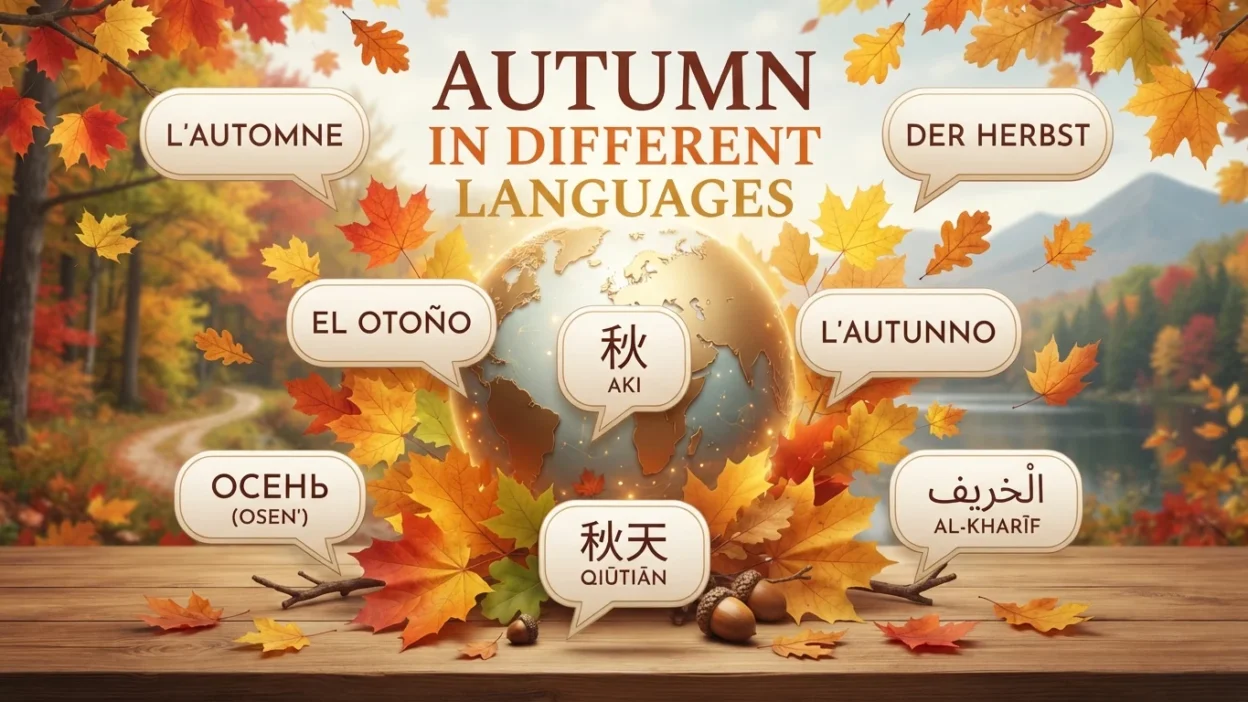
Autumn is one of the most beautiful seasons of the year, known for colorful leaves, cooler weather, shorter days, and cozy seasonal traditions. Learning autumn in different languages is a great way to expand your vocabulary while discovering how people around the world describe this special time of year.
The word “autumn” can have different forms and pronunciations depending on the language. In some countries, people use a word equivalent to “fall,” while others have a traditional seasonal name with its own cultural meaning.
Whether you are learning a new language, preparing for travel, writing about the seasons, or simply interested in multilingual vocabulary, knowing how to say autumn in different languages can be both useful and fascinating.
In this guide, you will discover autumn in different languages in all languages, explore autumn in different languages translations, and learn how this seasonal word is expressed around the world.
Autumn in Different Languages Around the World
Autumn is commonly associated with falling leaves, harvests, changing weather, and the transition from summer to winter. However, different cultures may describe and experience the season in unique ways.
The word itself is also interesting because English has two widely recognized terms: autumn and fall. “Autumn” is especially common in British English, while “fall” is widely used in American English.
Learning seasonal vocabulary across languages can make it easier to talk about weather, nature, travel, holidays, and everyday life.
Why Learn Autumn in Different Languages?
Knowing autumn in different languages can be useful for several reasons:
- It expands your everyday vocabulary.
- It helps language learners discuss seasons naturally.
- It makes travel conversations easier.
- It improves understanding of foreign-language content.
- It introduces interesting cultural differences.
- It helps writers describe seasonal settings accurately.
Seasonal vocabulary is also easy to practice because autumn appears frequently in conversations, books, songs, travel content, and weather discussions.
Autumn and Fall: Are They the Same?
Yes. Autumn and fall generally refer to the same season.
“Autumn” is more commonly used in British English and many other varieties of English. “Fall” is particularly common in American English.
For example:
- British English: “Autumn begins in September.”
- American English: “Fall begins in September.”
Both words describe the season between summer and winter.
What Makes Autumn Special?
Autumn is often recognized by noticeable changes in nature and daily life.
Leaves may change from green to yellow, orange, red, or brown before falling from trees. Temperatures generally become cooler, and many regions experience shorter daylight hours.
Autumn is also connected with harvest traditions, seasonal foods, festivals, school terms, and outdoor activities.
These associations make autumn an especially useful word to learn when studying languages and cultures.
Common Autumn Vocabulary
Once you learn how to say autumn in different languages, you can expand your seasonal vocabulary with related words such as:
- Leaves
- Fall
- Harvest
- Weather
- Cool
- Wind
- Rain
- Season
- Trees
- October
- November
- Winter
Learning related vocabulary makes it easier to create complete sentences rather than memorizing one word alone.
Autumn in Different Languages: What to Expect
The translations in the table below show how languages around the world express the idea of autumn.
Some languages have a single word for the season, while others may use forms that change according to grammar. Pronunciation is also different from language to language, so the easy pronunciation column is designed to give English speakers a simple starting point.
For accurate communication, learners should also pay attention to regional usage and grammatical forms.
How to Learn Seasonal Words Faster
A simple way to remember autumn in different languages translations is to connect the word with a visual image.
For example, imagine colorful autumn leaves whenever you practice the word. Then create a short sentence using the translation.
You can also compare several languages at once and practice their pronunciation aloud. Repetition and real-life examples make seasonal vocabulary much easier to remember.
Autumn Around the World
The experience of autumn varies significantly depending on geography.
In some northern regions, autumn brings dramatic changes in foliage and noticeably colder temperatures. In warmer climates, seasonal changes may be less visually obvious.
This means that the word for autumn may be universal in meaning, while people’s experiences of the season can be very different.
Understanding these differences adds cultural depth to learning autumn in different languages around the world.
What You’ll Find in the Translation Table
The complete table includes exactly 70 languages. For each language, you will find:
- Language name
- Native word or phrase for autumn
- Easy English pronunciation
- A short real-life example
- English meaning of the example
This format makes the information easy to scan, compare, and use for language learning.
Autumn in Different Languages
| Language | Native Phrase | Easy English Pronunciation | Example Sentence | English Meaning |
| English | Autumn | Aw-tum | Autumn is my favorite season. | Autumn is my favorite season. |
| Spanish | Otoño | Oh-toh-nyoh | El otoño es mi estación favorita. | Autumn is my favorite season. |
| French | Automne | Oh-tomn | J’aime l’automne. | I like autumn. |
| German | Herbst | Hairpst | Der Herbst ist meine Lieblingsjahreszeit. | Autumn is my favorite season. |
| Italian | Autunno | Ow-toon-no | Amo l’autunno. | I love autumn. |
| Portuguese | Outono | Oh-too-no | Eu gosto do outono. | I like autumn. |
| Dutch | Herfst | Hairfst | Ik hou van de herfst. | I love autumn. |
| Russian | Осень | Oh-sen | Я люблю осень. | I love autumn. |
| Ukrainian | Осінь | Oh-sin | Я люблю осінь. | I love autumn. |
| Polish | Jesień | Yeh-shen | Lubię jesień. | I like autumn. |
| Czech | Podzim | Pohd-zeem | Mám rád podzim. | I like autumn. |
| Slovak | Jeseň | Yeh-sen | Mám rád jeseň. | I like autumn. |
| Hungarian | Ősz | Oosh | Szeretem az őszt. | I love autumn. |
| Romanian | Toamnă | Toam-nuh | Îmi place toamna. | I like autumn. |
| Bulgarian | Есен | Eh-sen | Обичам есента. | I love autumn. |
| Serbian | Јесен | Yeh-sen | Волим јесен. | I love autumn. |
| Croatian | Jesen | Yeh-sen | Volim jesen. | I love autumn. |
| Bosnian | Jesen | Yeh-sen | Volim jesen. | I love autumn. |
| Slovenian | Jesen | Yeh-sen | Rad imam jesen. | I like autumn. |
| Albanian | Vjeshtë | Vyesht | Më pëlqen vjeshta. | I like autumn. |
| Greek | Φθινόπωρο | Fthi-no-po-ro | Μου αρέσει το φθινόπωρο. | I like autumn. |
| Turkish | Sonbahar | Son-ba-har | Sonbaharı seviyorum. | I love autumn. |
| Arabic | الخريف | Al-kha-reef | أحب الخريف. | I love autumn. |
| Hebrew | סתיו | Stav | אני אוהב סתיו. | I love autumn. |
| Persian | پاییز | Paa-yeez | من پاییز را دوست دارم. | I love autumn. |
| Urdu | خزاں | Khiz-aan | مجھے خزاں پسند ہے۔ | I like autumn. |
| Hindi | पतझड़ | Pat-jhar | मुझे पतझड़ पसंद है। | I like autumn. |
| Punjabi | ਪਤਝੜ | Pat-jhar | ਮੈਨੂੰ ਪਤਝੜ ਪਸੰਦ ਹੈ। | I like autumn. |
| Bengali | শরৎ | Sho-rot | আমার শরৎকাল ভালো লাগে। | I like autumn. |
| Gujarati | પાનખર | Paan-khar | મને પાનખર ગમે છે. | I like autumn. |
| Marathi | शरद ऋतू | Sha-rad ri-too | मला शरद ऋतू आवडतो. | I like autumn. |
| Tamil | இலையுதிர் காலம் | Ilai-yu-thir kaa-lam | எனக்கு இலையுதிர் காலம் பிடிக்கும். | I like autumn. |
| Telugu | శరదృతువు | Sha-ra-dri-too-voo | నాకు శరదృతువు ఇష్టం. | I like autumn. |
| Kannada | ಶರತ್ಕಾಲ | Sha-rat-ka-la | ನನಗೆ ಶರತ್ಕಾಲ ಇಷ್ಟ. | I like autumn. |
| Malayalam | ശരത്കാലം | Sha-rath-kaa-lam | എനിക്ക് ശരത്കാലം ഇഷ്ടമാണ്. | I like autumn. |
| Sinhala | සරත් සමය | Sa-rath sa-ma-ya | මම සරත් සමයට කැමතියි. | I like autumn. |
| Nepali | शरद ऋतु | Sha-rad ri-too | मलाई शरद ऋतु मन पर्छ। | I like autumn. |
| Chinese (Mandarin) | 秋天 | Chyo-tyen | 我喜欢秋天。 | I like autumn. |
| Cantonese | 秋天 | Chow-teen | 我鍾意秋天。 | I like autumn. |
| Japanese | 秋 | A-ki | 私は秋が好きです。 | I like autumn. |
| Korean | 가을 | Ga-eul | 저는 가을을 좋아해요. | I like autumn. |
| Vietnamese | Mùa thu | Moo-ah too | Tôi thích mùa thu. | I like autumn. |
| Thai | ฤดูใบไม้ร่วง | Rue-doo bai-mai ruang | ฉันชอบฤดูใบไม้ร่วง | I like autumn. |
| Indonesian | Musim gugur | Moo-sim goo-goor | Saya suka musim gugur. | I like autumn. |
| Malay | Musim luruh | Moo-sim loo-rooh | Saya suka musim luruh. | I like autumn. |
| Filipino | Taglagas | Tag-la-gas | Gusto ko ang taglagas. | I like autumn. |
| Burmese | ဆောင်းဦး | Saung oo | ဆောင်းဦးကို ကြိုက်တယ်။ | I like autumn. |
| Khmer | រដូវស្លឹកឈើជ្រុះ | Ro-dov sleuk-chheu jroo | ខ្ញុំចូលចិត្តរដូវស្លឹកឈើជ្រុះ។ | I like autumn. |
| Lao | ລະດູໃບໄມ້ຫຼົ່ນ | La-doo bai-mai lon | ຂ້ອຍມັກລະດູໃບໄມ້ຫຼົ່ນ. | I like autumn. |
| Mongolian | Намар | Na-mar | Би намарт дуртай. | I like autumn. |
| Kazakh | Күз | Koos | Мен күзді жақсы көремін. | I love autumn. |
| Uzbek | Kuz | Kooz | Men kuzni yaxshi ko’raman. | I love autumn. |
| Azerbaijani | Payız | Pa-yiz | Mən payızı sevirəm. | I love autumn. |
| Georgian | შემოდგომა | She-mod-go-ma | მე მიყვარს შემოდგომა. | I love autumn. |
| Armenian | Աշուն | A-shoon | Ես սիրում եմ աշունը։ | I love autumn. |
| Swahili | Vuli | Voo-lee | Ninapenda vuli. | I like autumn. |
| Zulu | Ikwindla | Ee-kwind-la | Ngiyalithanda ikwindla. | I love autumn. |
| Xhosa | Ekwindla | E-kwind-la | Ndiyalithanda ikwindla. | I love autumn. |
| Afrikaans | Herfs | Hairfs | Ek hou van die herfs. | I love autumn. |
| Yoruba | Igba Irẹdanu Ewe | Ig-ba ee-re-da-noo e-we | Mo fẹ́ràn ìgbà ìrẹ̀dànú ewé. | I love autumn. |
| Igbo | Oge mgbụsị akwụkwọ | Oh-geh mboo-see a-kwoo | Ahụrụ m oge mgbụsị akwụkwọ n’anya. | I love autumn. |
| Hausa | Kaka | Ka-ka | Ina son kaka. | I like autumn. |
| Amharic | መኸር | Me-her | መኸርን እወዳለሁ። | I like autumn. |
| Somali | Dayr | Dair | Dayr waan jeclahay. | I love autumn. |
| Finnish | Syksy | Sook-see | Pidän syksystä. | I like autumn. |
| Swedish | Höst | Hurst | Jag gillar hösten. | I like autumn. |
| Norwegian | Høst | Hurst | Jeg liker høsten. | I like autumn. |
| Danish | Efterår | Ef-ter-or | Jeg kan godt lide efteråret. | I like autumn. |
| Icelandic | Haust | Hoyst | Mér líkar haustið. | I like autumn. |
| Estonian | Sügis | Soo-gis | Mulle meeldib sügis. | I like autumn. |
| Latvian | Rudens | Roo-dens | Man patīk rudens. | I like autumn. |
| Lithuanian | Ruduo | Roo-doo-oh | Man patinka ruduo. | I like autumn. |
| Irish | Fómhar | Foh-war | Is maith liom an fómhar. | I like autumn. |
| Welsh | Hydref | Hud-rev | Dw i’n hoffi’r hydref. | I like autumn. |
How to Say Autumn in Different Languages
If you are wondering how to say autumn in different languages, the table above gives you 70 useful translations with pronunciation and examples. Many European languages have words that sound somewhat similar because of shared linguistic roots, while languages from Asia and Africa often use completely different terms.
For example, Spanish uses otoño, French uses automne, German uses Herbst, Japanese uses 秋 (aki), and Korean uses 가을 (gaeul). Learning these differences can make your vocabulary more interesting and help you recognize seasonal words when reading or traveling.
Autumn in Different Languages and Seasonal Vocabulary
Learning autumn in different languages becomes even more useful when you learn related seasonal words. These words can help you describe weather, nature, and daily activities.
Some useful autumn-related vocabulary includes:
- Autumn leaves
- Falling leaves
- Cool weather
- Rainy days
- Harvest season
- Changing colors
- Shorter days
- Cold weather
- Pumpkin season
- Autumn morning
For example, instead of learning only the word “autumn,” you can practice a sentence such as, “I love walking through the park in autumn.” This gives you a practical way to remember the vocabulary.
Autumn in Different Languages Translations for Travelers
Knowing autumn in different languages translations can be helpful when traveling during the fall season. You may need to discuss weather, seasonal activities, clothing, festivals, or travel plans.
You can also use the word when asking local people about the best places to see autumn colors. In countries famous for colorful foliage, autumn can be an especially popular travel season.
Autumn Around the World
The arrival of autumn is not experienced in exactly the same way everywhere.
In countries with four distinct seasons, autumn can bring dramatic changes in temperature and colorful foliage. In tropical regions, however, the traditional four-season pattern may not apply in the same way.
This makes autumn in different languages around the world an interesting topic because the word can be shared across languages even though the actual seasonal experience differs from place to place.
Why Is Autumn Called Fall?
The English word fall comes from the idea of leaves “falling” from trees. It became a common name for the season in English.
The word autumn has a much older history and is especially common in British English and many international forms of English.
Today, both words are correct:
- Autumn is especially common in British English.
- Fall is especially common in American English.
Autumn and Nature
Autumn is strongly connected with nature. Trees change color, leaves fall, and many landscapes take on shades of yellow, orange, red, and brown.
This makes autumn vocabulary particularly useful for describing:
- Forests
- Parks
- Mountains
- Gardens
- Weather
- Landscapes
- Seasonal photography
If you are learning a language for travel or creative writing, autumn-related vocabulary can help you describe these scenes naturally.
Autumn Traditions Around the World
Different countries celebrate autumn through local traditions, harvest festivals, seasonal foods, and cultural events.
Some communities celebrate the harvest, while others enjoy seasonal outdoor activities or festivals. In many places, autumn is also associated with returning to school and preparing for winter.
These traditions show that learning autumn in different languages can provide more than a simple translation. It can also introduce you to the culture connected with the season.
Easy Ways to Remember Autumn Translations
Memorizing translations may seem difficult, but a few simple techniques can make it easier.
Connect Words With Images
Imagine colorful autumn leaves whenever you learn a new translation.
Practice Short Sentences
Use the word in a sentence instead of memorizing it alone.
Group Similar Languages
European languages can sometimes have related vocabulary, making comparisons easier.
Practice Pronunciation
Say each word aloud several times to become familiar with its sound.
Review Regularly
Short, repeated practice sessions are usually more effective than trying to memorize everything at once.
Autumn Vocabulary for Language Learners
Once you know how to say autumn in different languages, you can continue learning other seasonal expressions.
Useful phrases include:
- I love autumn.
- Autumn is beautiful.
- The leaves are changing.
- The weather is getting colder.
- It is raining today.
- The leaves are falling.
- Autumn is my favorite season.
- I enjoy autumn weather.
- The trees look beautiful.
- Winter is coming.
These phrases can help turn one vocabulary word into a complete set of useful language skills.
Conclusion
Learning autumn in different languages is a simple and interesting way to expand your vocabulary while discovering how different cultures describe the seasons. From otoño in Spanish and Herbst in German to 秋 (aki) in Japanese and 가을 (gaeul) in Korean, every language offers its own unique expression.
The translations in this guide make it easy to compare autumn in different languages in all languages, understand pronunciation, and see each word used in a real-life sentence.
Whether you are a student, traveler, writer, or language enthusiast, learning seasonal vocabulary can make conversations more natural and help you better understand cultures around the world.
FAQs
1. How do you say autumn in different languages?
The word varies across languages. For example, Spanish uses otoño, French uses automne, German uses Herbst, Italian uses autunno, Japanese uses 秋 (aki), and Korean uses 가을 (gaeul).
2. What is autumn called in American English?
In American English, fall is the most common word for the season. Autumn is also understood and is widely used in British English and other varieties of English.
3. What is autumn in Spanish?
Autumn is otoño in Spanish. It is pronounced approximately oh-toh-nyoh.
4. What is autumn in Japanese?
Autumn is 秋, pronounced aki, in Japanese. The word refers to the autumn season and is commonly used in everyday conversation.
5. Why are autumn translations different around the world?
Languages developed independently across different regions and cultures, so each language has its own vocabulary for the seasons. Some words also have historical or cultural origins that make them different from their equivalents in other languages.