The word “art” represents creativity, imagination, expression, and culture. From paintings and sculptures to music, design, photography, and traditional crafts, art has an important place in societies around the world.
Learning art in different languages is a useful way to expand your vocabulary while discovering how different cultures describe creativity and artistic expression. Whether you are a student, artist, traveler, writer, or language enthusiast, knowing how to say “art” in another language can make communication more interesting and meaningful.
In this guide, you will discover art in different languages in all languages, including the native translation, easy English pronunciation, a short real-life example, and the English meaning of each example.
How to Say Art in Different Languages
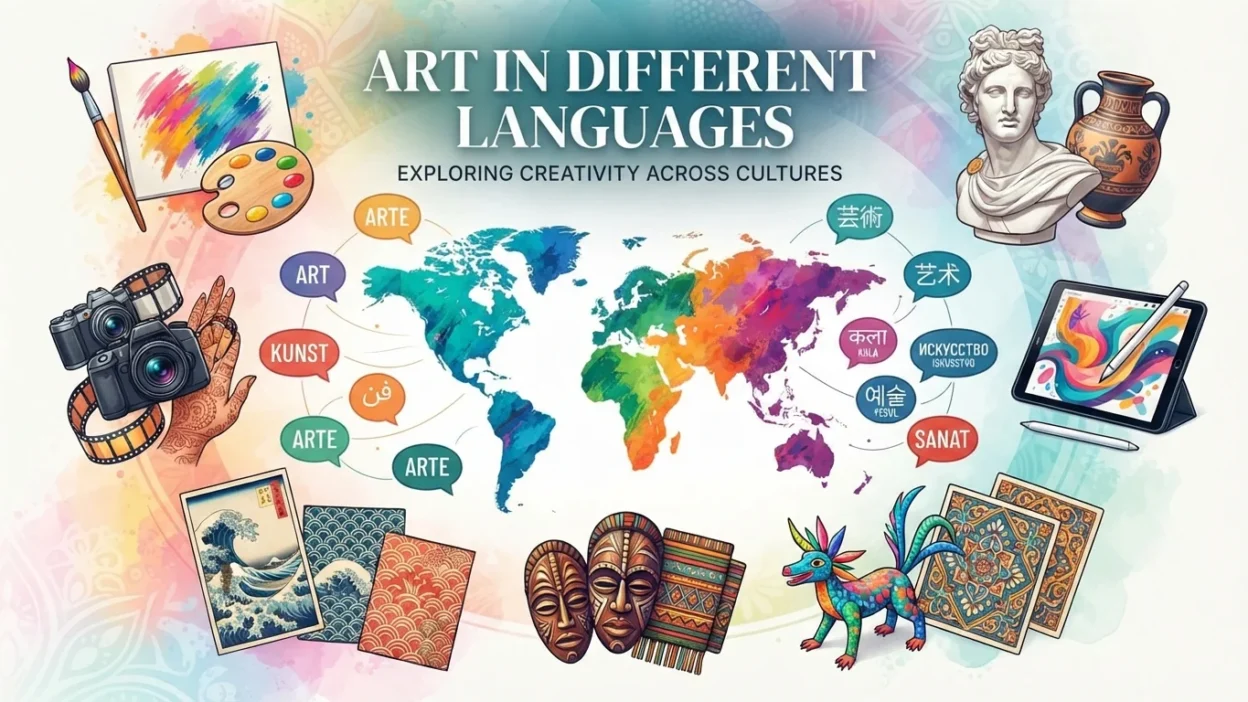
The translation of art can vary depending on the language and context. In some languages, one word covers visual and creative arts generally, while other languages may use different terms for specific artistic fields.
For example, Spanish uses arte, French uses art, German uses Kunst, Italian uses arte, and Japanese uses 芸術 (geijutsu).
The table below provides exactly art in different languages translations in a simple format that is easy to compare and useful for language learners.
Art in Different Languages Around the World
| Language | Native Phrase | Easy English Pronunciation | Example Sentence | English Meaning |
| English | Art | Aart | I love art. | I love art. |
| Spanish | Arte | Ar-teh | Me encanta el arte. | I love art. |
| French | Art | Ahr | J’aime l’art. | I love art. |
| German | Kunst | Koontst | Ich liebe Kunst. | I love art. |
| Italian | Arte | Ar-teh | Amo l’arte. | I love art. |
| Portuguese | Arte | Ar-chee | Eu amo a arte. | I love art. |
| Dutch | Kunst | Koontst | Ik hou van kunst. | I love art. |
| Russian | Искусство | Is-koos-stvo | Я люблю искусство. | I love art. |
| Ukrainian | Мистецтво | Mys-tets-tvo | Я люблю мистецтво. | I love art. |
| Polish | Sztuka | Shtoo-ka | Kocham sztukę. | I love art. |
| Czech | Umění | Oo-meh-nee | Miluji umění. | I love art. |
| Slovak | Umenie | Oo-meh-nee-eh | Milujem umenie. | I love art. |
| Hungarian | Művészet | Moo-vay-sayt | Szeretem a művészetet. | I love art. |
| Romanian | Artă | Ar-tuh | Iubesc arta. | I love art. |
| Bulgarian | Изкуство | Iz-koos-tvo | Обичам изкуството. | I love art. |
| Serbian | Уметност | Oo-met-nost | Волим уметност. | I love art. |
| Croatian | Umjetnost | Oo-myet-nost | Volim umjetnost. | I love art. |
| Bosnian | Umjetnost | Oo-myet-nost | Volim umjetnost. | I love art. |
| Slovenian | Umetnost | Oo-met-nost | Rad imam umetnost. | I love art. |
| Albanian | Art | Art | Më pëlqen arti. | I like art. |
| Greek | Τέχνη | Teh-knee | Αγαπώ την τέχνη. | I love art. |
| Turkish | Sanat | Sa-naht | Sanatı seviyorum. | I love art. |
| Arabic | فن | Fann | أحب الفن. | I love art. |
| Hebrew | אמנות | Ah-ma-noot | אני אוהב אמנות. | I love art. |
| Persian | هنر | Hon-ar | من هنر را دوست دارم. | I love art. |
| Urdu | فن | Fun | مجھے فن پسند ہے۔ | I like art. |
| Hindi | कला | Ka-la | मुझे कला पसंद है। | I like art. |
| Punjabi | ਕਲਾ | Ka-la | ਮੈਨੂੰ ਕਲਾ ਪਸੰਦ ਹੈ। | I like art. |
| Bengali | শিল্প | Shil-po | আমি শিল্প ভালোবাসি। | I love art. |
| Gujarati | કલા | Ka-la | મને કલા ગમે છે. | I like art. |
| Marathi | कला | Ka-la | मला कला आवडते. | I like art. |
| Tamil | கலை | Ka-lai | எனக்கு கலை பிடிக்கும். | I like art. |
| Telugu | కళ | Ka-la | నాకు కళ అంటే ఇష్టం. | I like art. |
| Kannada | ಕಲೆ | Ka-leh | ನನಗೆ ಕಲೆ ಇಷ್ಟ. | I like art. |
| Malayalam | കല | Ka-la | എനിക്ക് കല ഇഷ്ടമാണ്. | I like art. |
| Sinhala | කලාව | Ka-laa-va | මම කලාවට කැමතියි. | I like art. |
| Nepali | कला | Ka-la | मलाई कला मन पर्छ। | I like art. |
| Chinese (Mandarin) | 艺术 | Yee-shoo | 我喜欢艺术。 | I like art. |
| Cantonese | 藝術 | Ngai-seut | 我鍾意藝術。 | I like art. |
| Japanese | 芸術 | Gay-joot-soo | 私は芸術が好きです。 | I like art. |
| Korean | 예술 | Yeh-sool | 저는 예술을 좋아해요. | I like art. |
| Vietnamese | Nghệ thuật | Ngay thuat | Tôi thích nghệ thuật. | I like art. |
| Thai | ศิลปะ | Sin-la-pa | ฉันชอบศิลปะ | I like art. |
| Indonesian | Seni | Seh-nee | Saya suka seni. | I like art. |
| Malay | Seni | Seh-nee | Saya suka seni. | I like art. |
| Filipino | Sining | See-ning | Mahilig ako sa sining. | I like art. |
| Burmese | အနုပညာ | A-noo-pyinn-ya | အနုပညာကို ကြိုက်တယ်။ | I like art. |
| Khmer | សិល្បៈ | Sel-la-pa | ខ្ញុំចូលចិត្តសិល្បៈ។ | I like art. |
| Lao | ສິນລະປະ | Sin-la-pa | ຂ້ອຍມັກສິນລະປະ. | I like art. |
| Mongolian | Урлаг | Oor-lag | Би урлагт дуртай. | I like art. |
| Kazakh | Өнер | Uh-ner | Мен өнерді жақсы көремін. | I love art. |
| Uzbek | San’at | San-at | Men san’atni yaxshi ko’raman. | I love art. |
| Azerbaijani | İncəsənət | In-jeh-seh-net | Mən incəsənəti sevirəm. | I love art. |
| Georgian | ხელოვნება | Khe-lo-vne-ba | მე მიყვარს ხელოვნება. | I love art. |
| Armenian | Արվեստ | Ar-vest | Ես սիրում եմ արվեստը։ | I love art. |
| Swahili | Sanaa | Sa-na-a | Ninapenda sanaa. | I love art. |
| Zulu | Ubuciko | Oo-boo-chee-ko | Ngiyabuthanda ubuciko. | I love art. |
| Xhosa | Ubugcisa | Oo-boo-ghee-sa | Ndiyabuthanda ubugcisa. | I love art. |
| Afrikaans | Kuns | Koontst | Ek hou van kuns. | I love art. |
| Yoruba | Aworan | Ah-wo-ran | Mo fẹ́ràn iṣẹ́ ọnà. | I love art. |
| Igbo | Nkà | N-ka | Ahụrụ m nka n’anya. | I love art. |
| Hausa | Fasaha | Fa-sa-ha | Ina son fasaha. | I like art. |
| Amharic | ጥበብ | Ti-beb | ጥበብን እወዳለሁ። | I love art. |
| Somali | Farshaxan | Far-sha-khan | Farshaxanka waan jeclahay. | I love art. |
| Finnish | Taide | Tie-deh | Pidän taiteesta. | I like art. |
| Swedish | Konst | Koontst | Jag gillar konst. | I like art. |
| Norwegian | Kunst | Koontst | Jeg liker kunst. | I like art. |
| Danish | Kunst | Koontst | Jeg kan godt lide kunst. | I like art. |
| Icelandic | List | List | Mér líkar við list. | I like art. |
| Estonian | Kunst | Koontst | Mulle meeldib kunst. | I like art. |
| Latvian | Māksla | Maak-sla | Man patīk māksla. | I like art. |
| Lithuanian | Menas | Meh-nas | Man patinka menas. | I like art. |
| Irish | Ealaín | Ah-lawn | Is maith liom an ealaín. | I like art. |
| Welsh | Celf | Kelf | Dw i’n hoffi celf. | I like art. |
Why Learn Art in Different Languages?
Learning art in different languages is useful for students, travelers, artists, designers, and anyone interested in international culture.
The word can appear in many everyday situations, including:
- Visiting an art gallery
- Discussing paintings
- Studying art history
- Talking about photography
- Describing creative work
- Discussing traditional crafts
- Learning about different cultures
Art vocabulary is also useful when traveling because museums, galleries, exhibitions, and cultural festivals are found in cities around the world.
Art and Culture Around the World
Art is closely connected to culture. Every society has developed creative traditions that reflect its history, beliefs, environment, and values.
Painting, sculpture, pottery, textiles, architecture, calligraphy, photography, and other creative forms can tell stories about a community and its past.
For this reason, learning art in different languages around the world can be an introduction to both vocabulary and cultural understanding.
Different Types of Art
The word “art” covers many creative disciplines. Once you learn the basic translation, you can expand your vocabulary with related terms such as:
- Painting
- Drawing
- Sculpture
- Photography
- Music
- Dance
- Theater
- Literature
- Architecture
- Calligraphy
- Digital art
- Craft
Learning these related words makes it easier to have detailed conversations about creative subjects.
How to Use Art in Everyday Sentences
Learning the word by itself is helpful, but using it in complete sentences is even better.
You can practice sentences such as:
- I love art.
- Art is beautiful.
- I study art.
- This artwork is impressive.
- I visited an art gallery.
- She enjoys modern art.
- He creates digital art.
- Art is an important part of culture.
Using short sentences can help you remember vocabulary and understand how the word works naturally in each language.
Art in Different Languages Translations for Students
Students learning foreign languages can use this vocabulary for classroom activities, language projects, cultural presentations, and vocabulary exercises.
Comparing translations is particularly interesting because some languages use words that are closely related, while others have completely different structures and sounds.
For example, arte appears in several Romance languages, while Germanic languages such as German and Dutch commonly use forms related to Kunst.
Tips for Learning Art Vocabulary
To remember art in different languages translations more easily, try learning the word together with a visual image.
You can also:
- Say the word aloud.
- Write it several times.
- Use it in a short sentence.
- Compare related languages.
- Practice with native speakers.
- Connect the word with a painting or artwork.
Visual associations are especially useful for vocabulary connected with art because the subject itself is highly visual.
Conclusion
Learning art in different languages is a simple way to improve vocabulary while exploring creativity and culture around the world. From arte in Spanish and Italian to Kunst in German, sanaa in Swahili, and 芸術 (geijutsu) in Japanese, the same universal concept has many fascinating linguistic forms.
These translations provide a useful starting point for students, travelers, artists, writers, and language enthusiasts who want to discover art in different languages in all languages.
FAQs
1. How do you say art in different languages?
The word varies by language. For example, it is arte in Spanish, art in French, Kunst in German, sanat in Turkish, فن (fann) in Arabic, and 芸術 (geijutsu) in Japanese.
2. What is art in Spanish?
Art is arte in Spanish. It is pronounced approximately ar-teh.
3. What is art in French?
Art is art in French. The pronunciation is approximately ahr.
4. What is art in Japanese?
A common Japanese word for art is 芸術 (geijutsu), pronounced approximately gay-joot-soo.
5. Why learn art in different languages?
Learning the word “art” in different languages can improve vocabulary, help with travel and cultural conversations, and provide insight into how different languages describe creativity and artistic expression.