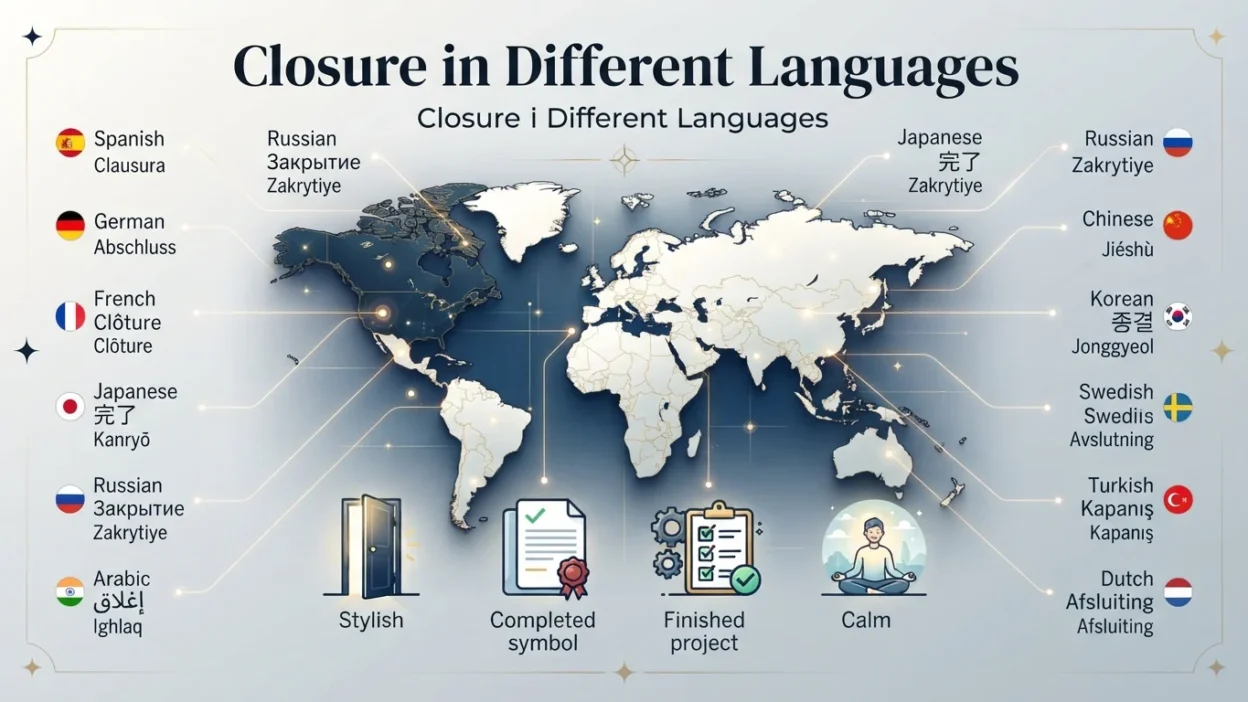
The word “closure” can have several meanings depending on the context. It may refer to the act of closing something, the end of a business or facility, emotional resolution, or the final stage of an activity or process. Because of these different meanings, translating closure in different languages requires attention to context.
Learning how to say “closure” in another language is useful for students, travelers, writers, business professionals, and language learners. Some languages use one general word, while others use different expressions depending on whether you mean physical closing, ending, or emotional closure.
In this guide, you will find closure in different languages translations, including the native phrase, easy English pronunciation, a short real-life example sentence, and its English meaning.
How to Say Closure in Different Languages
The translation of “closure” varies significantly between languages because English uses the word in several contexts.
For example, Spanish commonly uses cierre, French uses fermeture, German uses Schließung, Italian uses chiusura, and Portuguese uses fechamento.
The table below provides closure in different languages in all languages in a simple format for language learners and readers looking for quick translations.
Closure in Different Languages Around the World
| Language | Native Phrase | Easy English Pronunciation | Example Sentence | English Meaning |
| English | Closure | Kloh-zher | The store announced its closure. | The store announced its closure. |
| Spanish | Cierre | See-eh-rreh | La tienda anunció su cierre. | The store announced its closure. |
| French | Fermeture | Fair-meh-tewr | Le magasin a annoncé sa fermeture. | The store announced its closure. |
| German | Schließung | Shlee-soong | Das Geschäft kündigte seine Schließung an. | The store announced its closure. |
| Italian | Chiusura | Kyoo-zoo-rah | Il negozio ha annunciato la chiusura. | The store announced its closure. |
| Portuguese | Fechamento | Fay-shah-men-too | A loja anunciou o fechamento. | The store announced its closure. |
| Dutch | Sluiting | Sloy-ting | De winkel kondigde zijn sluiting aan. | The store announced its closure. |
| Russian | Закрытие | Zak-ry-tee-yeh | Магазин объявил о закрытии. | The store announced its closure. |
| Ukrainian | Закриття | Zak-ryt-tya | Магазин оголосив про закриття. | The store announced its closure. |
| Polish | Zamknięcie | Zam-knyen-cheh | Sklep ogłosił zamknięcie. | The store announced its closure. |
| Czech | Uzavření | Oo-za-vrzhuh-nee | Obchod oznámil uzavření. | The store announced its closure. |
| Slovak | Zatvorenie | Za-tvo-reh-nyeh | Obchod oznámil zatvorenie. | The store announced its closure. |
| Hungarian | Bezárás | Beh-zah-rash | Az üzlet bejelentette a bezárást. | The store announced its closure. |
| Romanian | Închidere | Un-kee-deh-reh | Magazinul a anunțat închiderea. | The store announced its closure. |
| Bulgarian | Закриване | Za-kree-va-neh | Магазинът обяви закриването си. | The store announced its closure. |
| Serbian | Затварање | Za-tva-ra-nyeh | Продавница је најавила затварање. | The store announced its closure. |
| Croatian | Zatvaranje | Za-tva-ra-nyeh | Trgovina je najavila zatvaranje. | The store announced its closure. |
| Bosnian | Zatvaranje | Za-tva-ra-nyeh | Prodavnica je najavila zatvaranje. | The store announced its closure. |
| Slovenian | Zaprtje | Za-pert-yeh | Trgovina je napovedala zaprtje. | The store announced its closure. |
| Albanian | Mbyllje | Mbil-lyeh | Dyqani njoftoi mbylljen. | The store announced its closure. |
| Greek | Κλείσιμο | Kleh-see-mo | Το κατάστημα ανακοίνωσε το κλείσιμό του. | The store announced its closure. |
| Turkish | Kapanış | Ka-pa-nush | Mağaza kapanışını duyurdu. | The store announced its closure. |
| Arabic | إغلاق | Egh-laaq | أعلن المتجر عن إغلاقه. | The store announced its closure. |
| Hebrew | סגירה | See-gee-rah | החנות הודיעה על סגירתה. | The store announced its closure. |
| Persian | تعطیلی | Ta-tee-lee | فروشگاه تعطیلی خود را اعلام کرد. | The store announced its closure. |
| Urdu | بندش | Ban-dish | دکان نے اپنی بندش کا اعلان کیا۔ | The store announced its closure. |
| Hindi | बंद होना | Band ho-na | दुकान ने बंद होने की घोषणा की। | The store announced its closure. |
| Punjabi | ਬੰਦ ਹੋਣਾ | Band ho-na | ਦੁਕਾਨ ਨੇ ਬੰਦ ਹੋਣ ਦਾ ਐਲਾਨ ਕੀਤਾ। | The store announced its closure. |
| Bengali | বন্ধ হওয়া | Bond-ho-ya | দোকানটি বন্ধ হওয়ার ঘোষণা দিয়েছে। | The store announced its closure. |
| Gujarati | બંધ થવું | Bandh tha-vu | દુકાને બંધ થવાની જાહેરાત કરી. | The store announced its closure. |
| Marathi | बंद होणे | Band ho-ne | दुकानाने बंद होण्याची घोषणा केली. | The store announced its closure. |
| Tamil | மூடல் | Moo-dal | கடை மூடப்படுவதாக அறிவித்தது. | The store announced its closure. |
| Telugu | మూసివేత | Moo-see-vay-ta | దుకాణం మూసివేతను ప్రకటించింది. | The store announced its closure. |
| Kannada | ಮುಚ್ಚುವಿಕೆ | Much-choo-vi-keh | ಅಂಗಡಿ ಮುಚ್ಚುವಿಕೆಯನ್ನು ಘೋಷಿಸಿತು. | The store announced its closure. |
| Malayalam | അടച്ചുപൂട്ടൽ | A-da-chu-poot-tal | കട അടച്ചുപൂട്ടുമെന്ന് അറിയിച്ചു. | The store announced its closure. |
| Sinhala | වසා දැමීම | Va-sa dae-mee-ma | වෙළඳසැල වසා දමන බව නිවේදනය කළේය. | The store announced its closure. |
| Nepali | बन्द हुनु | Band hoo-noo | पसल बन्द हुने घोषणा गर्यो। | The store announced its closure. |
| Chinese (Mandarin) | 关闭 | Gwan-byeh | 商店宣布关闭。 | The store announced its closure. |
| Cantonese | 關閉 | Gwaan-bye | 間店宣布關閉。 | The store announced its closure. |
| Japanese | 閉鎖 | Heh-sah | 店は閉鎖を発表しました。 | The store announced its closure. |
| Korean | 폐쇄 | Pyeh-swae | 가게가 폐쇄를 발표했습니다. | The store announced its closure. |
| Vietnamese | Đóng cửa | Dong koo-ah | Cửa hàng thông báo đóng cửa. | The store announced its closure. |
| Thai | การปิด | Gaan pit | ร้านประกาศการปิด | The store announced its closure. |
| Indonesian | Penutupan | Peh-noo-too-pan | Toko mengumumkan penutupan. | The store announced its closure. |
| Malay | Penutupan | Peh-noo-too-pan | Kedai mengumumkan penutupan. | The store announced its closure. |
| Filipino | Pagsasara | Pag-sa-sa-ra | Inanunsyo ng tindahan ang pagsasara nito. | The store announced its closure. |
| Burmese | ပိတ်သိမ်းခြင်း | Payt-thane-jin | ဆိုင်က ပိတ်သိမ်းမည်ဟု ကြေညာခဲ့သည်။ | The store announced its closure. |
| Khmer | ការបិទ | Ka-bit | ហាងបានប្រកាសការបិទ។ | The store announced its closure. |
| Lao | ການປິດ | Gaan pit | ຮ້ານປະກາດການປິດ. | The store announced its closure. |
| Mongolian | Хаалт | Kha-alt | Дэлгүүр хаалтаа зарлав. | The store announced its closure. |
| Kazakh | Жабылу | Zha-by-loo | Дүкен жабылатынын жариялады. | The store announced its closure. |
| Uzbek | Yopilish | Yo-pi-lish | Do‘kon yopilishini e’lon qildi. | The store announced its closure. |
| Azerbaijani | Bağlanma | Bagh-lan-ma | Mağaza bağlanacağını elan etdi. | The store announced its closure. |
| Georgian | დახურვა | Dakh-oor-va | მაღაზიამ დახურვა გამოაცხადა. | The store announced its closure. |
| Armenian | Փակում | Pa-koom | Խանութը հայտարարեց փակման մասին։ | The store announced its closure. |
| Swahili | Kufungwa | Koo-foong-wa | Duka lilitangaza kufungwa. | The store announced its closure. |
| Zulu | Ukuvalwa | Oo-koo-va-lwa | Isitolo simemezele ukuvalwa. | The store announced its closure. |
| Xhosa | Ukuvalwa | Oo-koo-va-lwa | Ivenkile ibhengeze ukuvalwa. | The store announced its closure. |
| Afrikaans | Sluiting | Sloy-ting | Die winkel het sy sluiting aangekondig. | The store announced its closure. |
| Yoruba | Ìparí | Ee-pa-ree | Ile itaja naa kede pipade rẹ. | The store announced its closure. |
| Igbo | Mmechi | Mmeh-chee | Ụlọ ahịa ahụ kwupụtara mmechi ya. | The store announced its closure. |
| Hausa | Rufewa | Roo-feh-wa | Shagon ya sanar da rufewarsa. | The store announced its closure. |
| Amharic | መዘጋት | Meh-zeh-gat | መደብሩ መዘጋቱን አስታወቀ። | The store announced its closure. |
| Somali | Xiritaan | Khee-ree-taan | Dukaanku wuxuu ku dhawaaqay xiritaankiisa. | The store announced its closure. |
| Finnish | Sulkeminen | Sool-keh-mee-nen | Kauppa ilmoitti sulkemisestaan. | The store announced its closure. |
| Swedish | Stängning | Steng-ning | Butiken meddelade sin stängning. | The store announced its closure. |
| Norwegian | Stenging | Steng-ing | Butikken kunngjorde stengingen. | The store announced its closure. |
| Danish | Lukning | Look-ning | Butikken annoncerede sin lukning. | The store announced its closure. |
| Icelandic | Lokun | Loh-kun | Verslunin tilkynnti um lokun. | The store announced its closure. |
| Estonian | Sulgemine | Sool-geh-mee-neh | Pood teatas sulgemisest. | The store announced its closure. |
| Latvian | Slēgšana | Slayg-sha-na | Veikals paziņoja par slēgšanu. | The store announced its closure. |
| Lithuanian | Uždarymas | Ooz-da-ree-mas | Parduotuvė paskelbė apie uždarymą. | The store announced its closure. |
| Irish | Dúnadh | Doon-ah | D’fhógair an siopa a dhúnadh. | The store announced its closure. |
| Welsh | Cau | Kai | Cyhoeddodd y siop ei chau. | The store announced its closure. |
What Does Closure Mean?
The English word closure has several related meanings.
The most common meaning is the act of closing something. For example, a business may announce its closure, or a road may be closed temporarily.
Closure can also refer to the ending or completion of something. A project, chapter, discussion, or process can reach closure when it comes to an end.
In emotional contexts, “closure” can mean reaching a sense of acceptance or resolution after a difficult experience.
Because of these differences, it is important to consider the context when searching for closure in different languages translations.
Closure in Business and Everyday Situations
In business English, “closure” frequently describes a company, shop, factory, office, or facility stopping operations.
Examples include:
- The store announced its closure.
- The factory faced permanent closure.
- The road closure caused delays.
- The company confirmed the closure of its branch.
In these situations, translations generally refer to closing, shutting down, or stopping operations.
Emotional Closure in Different Languages
The word “closure” can also have an emotional meaning.
For example, someone may say:
“I need closure after the relationship ended.”
Here, closure means emotional resolution or acceptance rather than physically closing something.
This meaning can be more difficult to translate directly because different languages may use phrases such as peace of mind, acceptance, resolution, or bringing something to an end.
Therefore, when looking at how to say closure in different languages, always consider whether you mean physical closure, business closure, or emotional closure.
Closure in Different Languages for Students
Learning this vocabulary can be helpful for students studying business, travel, communication, literature, or foreign languages.
The word appears in many common contexts, including:
- Business closures
- Store closures
- Road closures
- School closures
- Project completion
- Emotional resolution
- Legal proceedings
- Final decisions
Learning the word with example sentences makes it easier to understand these different uses.
How to Use Closure in a Sentence
Here are some simple English examples:
- The closure was announced yesterday.
- The road closure caused traffic.
- The store’s closure surprised everyone.
- We finally reached closure.
- The project reached closure after several months.
- She wanted emotional closure.
- The company confirmed the permanent closure.
These examples show why the exact translation can depend on the context.
Closure and Related Words
When learning closure in different languages around the world, it can also be useful to learn related vocabulary.
Some useful terms include:
- Closing
- Ending
- Completion
- Shutdown
- Resolution
- Conclusion
- Finalization
- Termination
- Acceptance
- Opening
Understanding these related words can help you recognize different translations and expressions.
Tips for Learning Closure Translations
Learning one translation is easier when you connect it with a real situation.
Try these methods:
Learn the Word With Context
Remember “closure” alongside a sentence such as “The store announced its closure.”
Compare Similar Languages
Languages from the same family may have related vocabulary, making comparisons easier.
Study Multiple Meanings
Remember that closure can mean physical closing, business shutdown, completion, or emotional resolution.
Practice Speaking
Say the native phrase aloud several times to become familiar with its pronunciation.
Conclusion
Learning closure in different languages is useful because the English word can describe several types of endings, from the closing of a store or road to the completion of a process or emotional resolution.
The translations above provide a useful starting point for understanding how different languages express the idea of closing or ending something. However, because “closure” has multiple meanings in English, the most accurate translation can depend on the context.
Whether you are searching for closure in different languages in all languages, studying vocabulary, or exploring how people around the world describe endings and closing, these translations can help expand your language knowledge.
FAQs
1. How do you say closure in different languages?
“Closure” has different translations depending on the language and context. Examples include cierre in Spanish, fermeture in French, Schließung in German, chiusura in Italian, and penutupan in Indonesian and Malay.
2. What is closure in Spanish?
The common Spanish translation of closure is cierre, pronounced approximately see-eh-rreh. It is commonly used for the closing of a business, place, or activity.
3. What does closure mean in English?
Closure can mean the act of closing something, the ending or completion of a process, or emotional resolution after a significant experience.
4. Is closure the same as closing in every language?
Not always. Some languages use a noun meaning “closing,” while others may use words for shutting, ending, completion, or resolution depending on the context.
5. How do you say emotional closure in different languages?
Emotional closure often requires a phrase rather than a direct one-word translation. The best expression depends on the language and the intended meaning, such as finding acceptance, resolution, or peace after an experience.