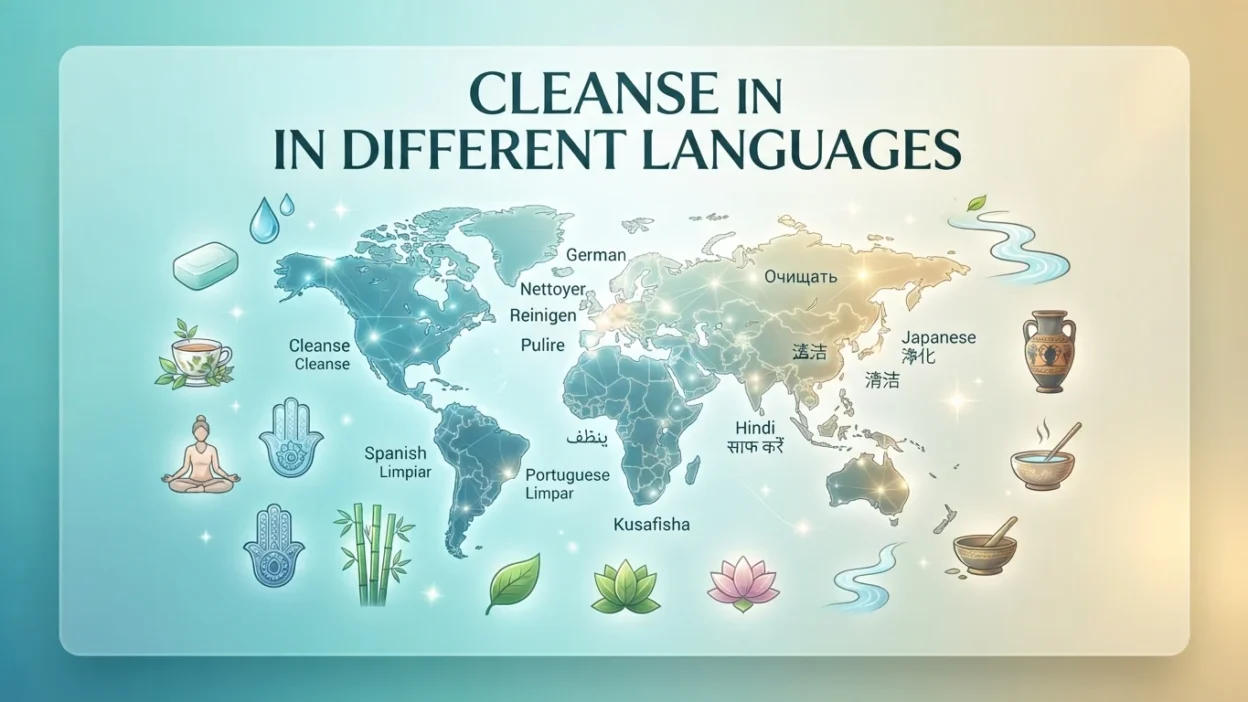
The word “cleanse” means to clean, purify, or remove unwanted substances from something. It can describe washing the body or skin, purifying an object or place, or removing something considered harmful or unwanted. In some contexts, it can also have a figurative meaning, such as cleansing the mind or spirit.
Learning cleanse in different languages is useful for language learners, travelers, writers, students, and anyone interested in international vocabulary. Because “cleanse” can have several meanings, the most natural translation may depend on the situation.
In this guide, you will discover cleanse in different languages translations, with the native word or expression, easy English pronunciation, a practical example sentence, and its English meaning.
How to Say Cleanse in Different Languages
There is no single universal translation for “cleanse.” Some languages use a general verb meaning to clean, while others have a more specific word meaning to purify or to cleanse.
For everyday contexts, translations such as limpiar in Spanish, nettoyer in French, reinigen in German, pulire in Italian, and limpar in Portuguese are commonly relevant.
For spiritual or figurative contexts, different words may be more appropriate.
Cleanse in Different Languages Around the World
| Language | Native Phrase | Easy English Pronunciation | Example Sentence | English Meaning |
| English | Cleanse | Klenz | Cleanse your face gently. | Clean your face gently. |
| Spanish | Limpiar | Leem-pyar | Limpia tu rostro suavemente. | Cleanse your face gently. |
| French | Nettoyer | Net-twah-yay | Nettoyez votre visage doucement. | Cleanse your face gently. |
| German | Reinigen | Rye-nee-gen | Reinige dein Gesicht sanft. | Cleanse your face gently. |
| Italian | Pulire | Poo-lee-reh | Pulisci delicatamente il viso. | Cleanse your face gently. |
| Portuguese | Limpar | Leem-par | Limpe o rosto suavemente. | Cleanse your face gently. |
| Dutch | Reinigen | Rye-nuh-gen | Reinig je gezicht voorzichtig. | Cleanse your face gently. |
| Russian | Очищать | O-chee-shchat | Очищай лицо мягко. | Cleanse your face gently. |
| Ukrainian | Очищати | O-chee-shcha-ty | Очищай обличчя ніжно. | Cleanse your face gently. |
| Polish | Oczyszczać | Oh-chish-chach | Oczyszczaj twarz delikatnie. | Cleanse your face gently. |
| Czech | Čistit | Chis-tit | Jemně si vyčisti obličej. | Cleanse your face gently. |
| Slovak | Čistiť | Chis-titch | Jemne si vyčisti tvár. | Cleanse your face gently. |
| Hungarian | Tisztítani | Tist-tee-ta-nee | Tisztítsd meg gyengéden az arcodat. | Cleanse your face gently. |
| Romanian | Curăța | Koo-ruh-tsa | Curăță-ți fața ușor. | Cleanse your face gently. |
| Bulgarian | Почиствам | Po-cheest-vam | Почисти лицето си нежно. | Cleanse your face gently. |
| Serbian | Чистити | Chee-stee-tee | Нежно очисти лице. | Cleanse your face gently. |
| Croatian | Očistiti | Oh-chis-tee-tee | Nježno očisti lice. | Cleanse your face gently. |
| Bosnian | Očistiti | Oh-chis-tee-tee | Nježno očisti lice. | Cleanse your face gently. |
| Slovenian | Očistiti | Oh-chis-tee-tee | Nežno očisti obraz. | Cleanse your face gently. |
| Albanian | Pastroj | Pahs-troy | Pastroje fytyrën butësisht. | Cleanse your face gently. |
| Greek | Καθαρίζω | Ka-tha-ree-zo | Καθάρισε απαλά το πρόσωπό σου. | Cleanse your face gently. |
| Turkish | Temizlemek | Teh-meez-leh-mek | Yüzünü nazikçe temizle. | Cleanse your face gently. |
| Arabic | يُنظّف | Yoo-nad-dhif | نظّف وجهك بلطف. | Cleanse your face gently. |
| Hebrew | לנקות | Leh-na-kot | נקה את הפנים בעדינות. | Cleanse your face gently. |
| Persian | پاک کردن | Paak kar-dan | صورتت را بهآرامی پاک کن. | Cleanse your face gently. |
| Urdu | صاف کرنا | Saaf kar-na | اپنا چہرہ نرمی سے صاف کریں۔ | Cleanse your face gently. |
| Hindi | साफ़ करना | Saaf kar-na | अपना चेहरा धीरे से साफ़ करें। | Cleanse your face gently. |
| Punjabi | ਸਾਫ਼ ਕਰਨਾ | Saaf kar-na | ਆਪਣਾ ਚਿਹਰਾ ਹੌਲੀ-ਹੌਲੀ ਸਾਫ਼ ਕਰੋ। | Cleanse your face gently. |
| Bengali | পরিষ্কার করা | Po-ri-shkar ko-ra | আপনার মুখ আলতো করে পরিষ্কার করুন। | Cleanse your face gently. |
| Gujarati | સાફ કરવું | Saaf kar-vu | તમારો ચહેરો હળવેથી સાફ કરો. | Cleanse your face gently. |
| Marathi | स्वच्छ करणे | Swachh kar-ne | आपला चेहरा हळूवारपणे स्वच्छ करा. | Cleanse your face gently. |
| Tamil | சுத்தம் செய் | Suth-tham sey | உங்கள் முகத்தை மெதுவாக சுத்தம் செய்யுங்கள். | Cleanse your face gently. |
| Telugu | శుభ్రం చేయడం | Shoo-bhram chey-ya-dam | మీ ముఖాన్ని సున్నితంగా శుభ్రం చేయండి. | Cleanse your face gently. |
| Kannada | ಸ್ವಚ್ಛಗೊಳಿಸು | Swach-cha-go-li-soo | ನಿಮ್ಮ ಮುಖವನ್ನು ನಿಧಾನವಾಗಿ ಸ್ವಚ್ಛಗೊಳಿಸಿ. | Cleanse your face gently. |
| Malayalam | വൃത്തിയാക്കുക | Vrit-tee-yaa-kku-ka | നിങ്ങളുടെ മുഖം മൃദുവായി വൃത്തിയാക്കുക. | Cleanse your face gently. |
| Sinhala | පිරිසිදු කරනවා | Pee-ri-see-doo ka-ra-na-va | ඔබේ මුහුණ මෘදු ලෙස පිරිසිදු කරන්න. | Cleanse your face gently. |
| Nepali | सफा गर्नु | Sa-fa gar-nu | आफ्नो अनुहार बिस्तारै सफा गर्नुहोस्। | Cleanse your face gently. |
| Chinese (Mandarin) | 清洁 | Ching-jyeh | 轻柔地清洁你的脸。 | Cleanse your face gently. |
| Cantonese | 清潔 | Ching-kit | 輕輕清潔你的面部。 | Cleanse your face gently. |
| Japanese | 清潔する | Say-ketsu soo-roo | 顔を優しく清潔にしてください。 | Cleanse your face gently. |
| Korean | 세정하다 | Seh-jung-ha-da | 얼굴을 부드럽게 세정하세요. | Cleanse your face gently. |
| Vietnamese | Làm sạch | Lam sahk | Hãy làm sạch khuôn mặt nhẹ nhàng. | Cleanse your face gently. |
| Thai | ทำความสะอาด | Tam kwaam sa-at | ทำความสะอาดใบหน้าอย่างอ่อนโยน | Cleanse your face gently. |
| Indonesian | Membersihkan | Mem-ber-see-hkan | Bersihkan wajahmu dengan lembut. | Cleanse your face gently. |
| Malay | Membersihkan | Mem-ber-see-hkan | Bersihkan wajah anda dengan lembut. | Cleanse your face gently. |
| Filipino | Linisin | Lee-nee-sin | Linisin nang marahan ang iyong mukha. | Cleanse your face gently. |
| Burmese | သန့်စင်သည် | Than-sin-thi | သင့်မျက်နှာကို နူးညံ့စွာ သန့်စင်ပါ။ | Cleanse your face gently. |
| Khmer | សម្អាត | Som-aat | សម្អាតមុខរបស់អ្នកយ៉ាងទន់ភ្លន់។ | Cleanse your face gently. |
| Lao | ເຮັດຄວາມສະອາດ | Het khwam sa-at | ເຮັດຄວາມສະອາດໃບໜ້າຢ່າງອ່ອນໂຍນ. | Cleanse your face gently. |
| Mongolian | Цэвэрлэх | Tse-ver-lekh | Нүүрээ зөөлөн цэвэрлэ. | Cleanse your face gently. |
| Kazakh | Тазалау | Ta-za-lau | Бетіңді ақырын тазала. | Cleanse your face gently. |
| Uzbek | Tozalamoq | To-za-la-mok | Yuzingizni muloyimlik bilan tozalang. | Cleanse your face gently. |
| Azerbaijani | Təmizləmək | Teh-meez-leh-mek | Üzünüzü yumşaq şəkildə təmizləyin. | Cleanse your face gently. |
| Georgian | გაწმენდა | Gats-men-da | სახე ნაზად გაიწმინდე. | Cleanse your face gently. |
| Armenian | Մաքրել | Ma-krel | Մաքրիր դեմքդ նրբորեն։ | Cleanse your face gently. |
| Swahili | Kusafisha | Koo-sa-fee-sha | Safisha uso wako kwa upole. | Cleanse your face gently. |
| Zulu | Hlanza | Hlan-za | Hlanza ubuso bakho ngobumnene. | Cleanse your face gently. |
| Xhosa | Coca | Koh-tsa | Coca ubuso bakho ngobunono. | Cleanse your face gently. |
| Afrikaans | Skoonmaak | Skone-maak | Maak jou gesig sagkens skoon. | Cleanse your face gently. |
| Yoruba | Fọ | Faw | Fọ oju rẹ rọra. | Cleanse your face gently. |
| Igbo | Sachapụ | Sa-cha-poo | Sachapụ ihu gị nwayọọ. | Cleanse your face gently. |
| Hausa | Tsaftace | Tsaf-ta-cheh | Tsaftace fuskarka a hankali. | Cleanse your face gently. |
| Amharic | ማጽዳት | Mats-da-t | ፊትዎን በቀስታ ያጽዱ። | Cleanse your face gently. |
| Somali | Nadiifin | Na-deef-in | Wajigaaga si tartiib ah u nadiifi. | Cleanse your face gently. |
| Finnish | Puhdistaa | Poo-hees-taa | Puhdista kasvosi hellästi. | Cleanse your face gently. |
| Swedish | Rengöra | Reng-uh-ra | Rengör ansiktet försiktigt. | Cleanse your face gently. |
| Norwegian | Rengjøre | Reng-yur-eh | Rengjør ansiktet forsiktig. | Cleanse your face gently. |
| Danish | Rense | Ren-seh | Rens dit ansigt forsigtigt. | Cleanse your face gently. |
| Icelandic | Hreinsa | Hrayn-sa | Hreinsaðu andlitið varlega. | Cleanse your face gently. |
| Estonian | Puhastama | Poo-has-ta-ma | Puhasta oma nägu õrnalt. | Cleanse your face gently. |
| Latvian | Tīrīt | Tee-reet | Maigi notīri seju. | Cleanse your face gently. |
| Lithuanian | Valyti | Va-lee-tee | Švelniai nuvalyk veidą. | Cleanse your face gently. |
| Irish | Glan | Glan | Glan d’aghaidh go réidh. | Cleanse your face gently. |
| Welsh | Glanhau | Glan-hai | Glanwch eich wyneb yn ysgafn. | Cleanse your face gently. |
What Does Cleanse Mean?
Cleanse generally means to clean something thoroughly or to remove dirt, impurities, or unwanted material.
It can be used in several ways:
- Physical: Cleanse the skin.
- General cleaning: Cleanse an object or surface.
- Purification: Cleanse something of impurities.
- Figurative: Cleanse the mind or spirit.
The context determines which translation sounds most natural.
Cleanse vs. Clean: What’s the Difference?
“Clean” is the more common everyday word. Cleanse can sound more deliberate, thorough, formal, or associated with purification.
For example:
Clean:
“Clean your hands.”
Cleanse:
“Cleanse your skin before applying the product.”
Both communicate cleaning, but “cleanse” often appears in skincare, religious, literary, and formal contexts.
Cleanse in Skincare
One of the most familiar modern uses of the word is skincare.
Expressions such as:
- Cleanse your face
- Cleanse the skin
- Gentle cleansing
- Facial cleanser
are common in beauty and personal-care language.
In this context, translations usually use the ordinary verb for cleaning or washing rather than a special word for purification.
Cleanse in Different Cultural Contexts
The idea of cleansing exists in many cultures, but the exact expression can vary.
Some traditions use cleansing in a physical sense, while others use it symbolically to describe purification, renewal, or removing negativity.
This is why cleanse in different languages around the world can have more than one appropriate translation.
How to Use Cleanse in a Sentence
Here are several simple English examples:
- Cleanse your face before bed.
- The ritual was believed to cleanse the spirit.
- Water can cleanse the surface.
- The product gently cleanses the skin.
- They used water to cleanse the area.
- The ceremony was intended to cleanse the mind.
These examples demonstrate the different contexts in which the word can appear.
Cleanse and Related Words
If you are learning cleanse in different languages, it can also help to learn related English vocabulary:
- Clean
- Wash
- Purify
- Rinse
- Scrub
- Remove
- Refresh
- Disinfect
- Sanitize
- Purification
- Cleanliness
These words are related but do not always have exactly the same meaning.
How to Learn Cleanse Translations
Learn the Context
First decide whether “cleanse” means ordinary cleaning, skincare, purification, or a figurative form of cleansing.
Practice With Sentences
Memorizing a translation together with an example sentence makes it easier to remember how the word is naturally used.
Listen to Pronunciation
Some native words may have sounds that do not exist in English. Repeating them aloud can improve pronunciation.
Compare Similar Words
Study “clean,” “wash,” and “purify” alongside “cleanse” to understand the differences between them.
Conclusion
Learning cleanse in different languages reveals how different languages express the ideas of cleaning, washing, and purification. While many languages use their everyday word for “clean,” the best translation can change depending on the context.
The 70 translations above provide a useful starting point for language learners looking for cleanse in different languages in all languages, practical examples, and easy pronunciation guides.
Whether you are studying vocabulary, exploring international languages, or learning how to say cleanse in different languages around the world, understanding the context will help you choose the most natural expression.
FAQs
1. How do you say cleanse in different languages?
“Cleanse” has different translations depending on the language and context. Examples include limpiar in Spanish, nettoyer in French, reinigen in German, pulire in Italian, and limpar in Portuguese.
2. What is cleanse in Spanish?
The common Spanish translation for “cleanse” is limpiar, pronounced approximately leem-pyar. Depending on context, it can mean to clean or cleanse.
3. Is cleanse the same as clean?
They are closely related, but “cleanse” can suggest thorough cleaning or purification, while “clean” is the more general everyday term.
4. How is cleanse used in skincare?
In skincare, “cleanse” usually means to clean the skin by removing dirt, oil, makeup, or other unwanted substances. For example, “Cleanse your face gently.”
5. Can cleanse have a spiritual meaning?
Yes. “Cleanse” can have a figurative or spiritual meaning related to purification, renewal, or removing something considered negative or impure. The appropriate translation depends on the cultural and linguistic context.