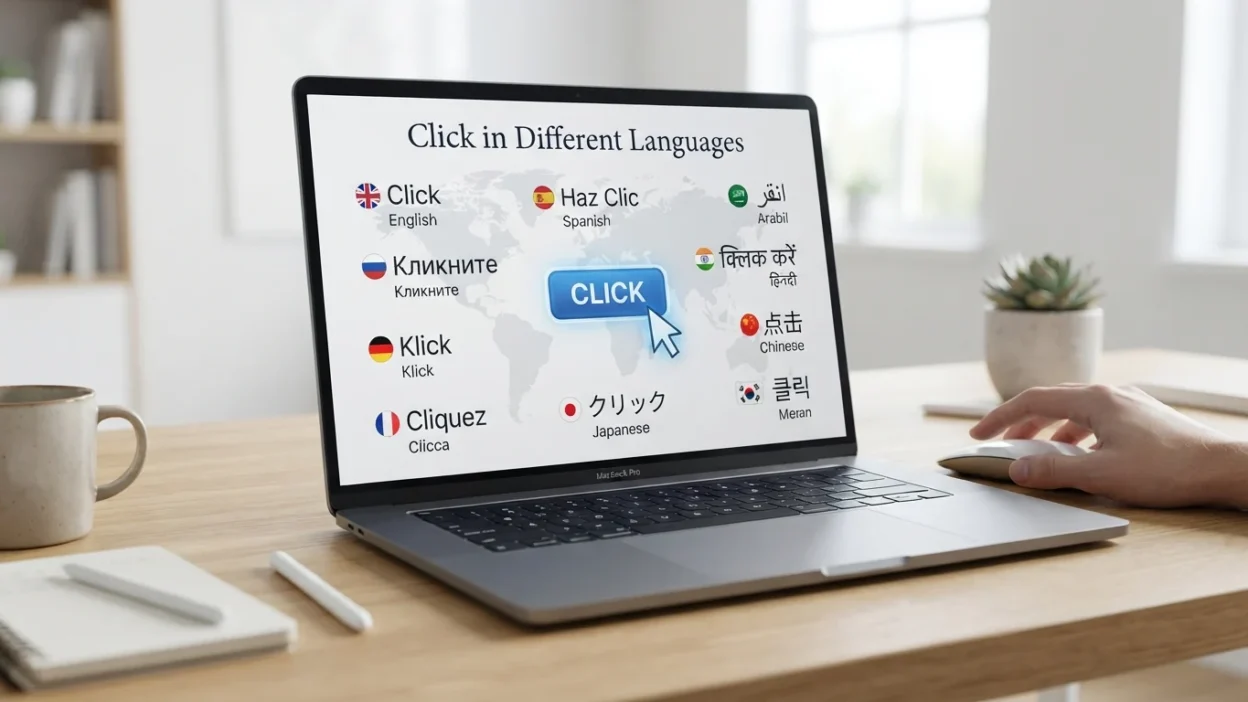
The word “click” is one of the most common instructions used on websites, apps, computers, phones, and digital devices. Whether you are telling someone to click a button, link, icon, or menu, knowing how to say click in different languages can make communication easier across cultures.
In this guide, you will discover click in different languages in all languages with the native translation, an easy English pronunciation, and a practical example sentence. If you are searching for how to say click in different languages, these translations provide a simple way to understand how this everyday digital instruction is expressed around the world.
Click in Different Languages
| Language | Native Phrase | Easy English Pronunciation | Example Sentence | English Meaning |
| English | Click | klik | Click the button to continue. | Click the button to continue. |
| Spanish | Haz clic | ahs kleek | Haz clic en el enlace. | Click the link. |
| French | Cliquez | klee-kay | Cliquez sur le bouton. | Click the button. |
| German | Klicken Sie | KLIK-en zee | Klicken Sie auf den Link. | Click the link. |
| Italian | Clicca | KLEE-kah | Clicca sul pulsante. | Click the button. |
| Portuguese | Clique | KLEE-kee | Clique no botão. | Click the button. |
| Dutch | Klik | klik | Klik op de knop. | Click the button. |
| Swedish | Klicka | KLIK-ah | Klicka på länken. | Click the link. |
| Danish | Klik | klik | Klik på knappen. | Click the button. |
| Norwegian | Klikk | klik | Klikk på lenken. | Click the link. |
| Finnish | Napsauta | NAP-sow-tah | Napsauta painiketta. | Click the button. |
| Icelandic | Smelltu | SMEL-tuh | Smelltu á hnappinn. | Click the button. |
| Irish | Cliceáil | KLIH-kale | Cliceáil ar an nasc. | Click the link. |
| Welsh | Cliciwch | KLIK-oo-ikh | Cliciwch ar y botwm. | Click the button. |
| Scottish Gaelic | Cliog | klee-og | Cliog air a’ phutan. | Click the button. |
| Polish | Kliknij | KLIK-neey | Kliknij przycisk. | Click the button. |
| Czech | Klikněte | KLIK-nyet-eh | Klikněte na tlačítko. | Click the button. |
| Slovak | Kliknite | KLIK-nee-teh | Kliknite na tlačidlo. | Click the button. |
| Slovenian | Kliknite | KLIK-nee-teh | Kliknite gumb. | Click the button. |
| Croatian | Kliknite | KLIK-nee-teh | Kliknite gumb. | Click the button. |
| Serbian | Кликните | KLIK-nee-teh | Кликните на дугме. | Click the button. |
| Bosnian | Kliknite | KLIK-nee-teh | Kliknite na dugme. | Click the button. |
| Macedonian | Кликнете | KLIK-neh-teh | Кликнете на копчето. | Click the button. |
| Bulgarian | Кликнете | KLIK-neh-teh | Кликнете върху бутона. | Click the button. |
| Russian | Нажмите | nah-ZHMEE-teh | Нажмите на кнопку. | Click the button. |
| Ukrainian | Натисніть | nah-tis-NEET | Натисніть кнопку. | Click the button. |
| Belarusian | Націсніце | nah-TSIS-nee-tseh | Націсніце кнопку. | Click the button. |
| Lithuanian | Spustelėkite | spoos-teh-LYAY-kee-teh | Spustelėkite mygtuką. | Click the button. |
| Latvian | Noklikšķiniet | nok-lik-SKHEE-nee-et | Noklikšķiniet uz pogas. | Click the button. |
| Estonian | Klõpsake | KLOPS-ah-keh | Klõpsake nuppu. | Click the button. |
| Hungarian | Kattintson | KAT-int-shon | Kattintson a gombra. | Click the button. |
| Romanian | Faceți clic | FAH-chets kleek | Faceți clic pe buton. | Click the button. |
| Albanian | Klikoni | klee-KOH-nee | Klikoni butonin. | Click the button. |
| Greek | Κάντε κλικ | KAN-teh klik | Κάντε κλικ στο κουμπί. | Click the button. |
| Turkish | Tıklayın | tuh-kuh-LUHN | Düğmeye tıklayın. | Click the button. |
| Azerbaijani | Klikləyin | klik-LAY-yin | Düyməyə klikləyin. | Click the button. |
| Georgian | დააწკაპუნეთ | dah-ats-kah-POO-net | დააწკაპუნეთ ღილაკზე. | Click the button. |
| Armenian | Սեղմեք | seh-MEK | Սեղմեք կոճակը։ | Click the button. |
| Arabic | انقر | IN-qur | انقر على الزر. | Click the button. |
| Hebrew | לחץ | LAH-ts | לחץ על הכפתור. | Click the button. |
| Persian | کلیک کنید | keh-LEEK kon-yeed | روی دکمه کلیک کنید. | Click the button. |
| Urdu | کلک کریں | klik karein | بٹن پر کلک کریں۔ | Click the button. |
| Hindi | क्लिक करें | klik karein | बटन पर क्लिक करें। | Click the button. |
| Bengali | ক্লিক করুন | klik korun | বোতামে ক্লিক করুন। | Click the button. |
| Punjabi | ਕਲਿੱਕ ਕਰੋ | klik karo | ਬਟਨ ‘ਤੇ ਕਲਿੱਕ ਕਰੋ। | Click the button. |
| Gujarati | ક્લિક કરો | klik karo | બટન પર ક્લિક કરો. | Click the button. |
| Marathi | क्लिक करा | klik kara | बटणावर क्लिक करा. | Click the button. |
| Nepali | क्लिक गर्नुहोस् | klik garnuhos | बटनमा क्लिक गर्नुहोस्। | Click the button. |
| Sinhala | ක්ලික් කරන්න | klik karanna | බොත්තම ක්ලික් කරන්න. | Click the button. |
| Tamil | கிளிக் செய்யவும் | klik seyyavum | பொத்தானைக் கிளிக் செய்யவும். | Click the button. |
| Telugu | క్లిక్ చేయండి | klik cheyandi | బటన్ను క్లిక్ చేయండి. | Click the button. |
| Kannada | ಕ್ಲಿಕ್ ಮಾಡಿ | klik maadi | ಬಟನ್ ಕ್ಲಿಕ್ ಮಾಡಿ. | Click the button. |
| Malayalam | ക്ലിക്ക് ചെയ്യുക | klik cheyyuka | ബട്ടണിൽ ക്ലിക്ക് ചെയ്യുക. | Click the button. |
| Odia | କ୍ଲିକ୍ କରନ୍ତୁ | klik karantu | ବଟନ୍ କ୍ଲିକ୍ କରନ୍ତୁ। | Click the button. |
| Assamese | ক্লিক কৰক | klik korok | বুটামটোত ক্লিক কৰক। | Click the button. |
| Chinese | 点击 | diǎn jī | 点击按钮。 | Click the button. |
| Japanese | クリックしてください | kurikku shite kudasai | ボタンをクリックしてください。 | Please click the button. |
| Korean | 클릭하세요 | keul-lik-ha-se-yo | 버튼을 클릭하세요. | Click the button. |
| Vietnamese | Nhấp vào | nyup vao | Nhấp vào nút. | Click the button. |
| Thai | คลิก | klik | คลิกปุ่ม | Click the button. |
| Indonesian | Klik | klik | Klik tombolnya. | Click the button. |
| Malay | Klik | klik | Klik butang itu. | Click that button. |
| Filipino | I-click | ee-klik | I-click ang button. | Click the button. |
| Khmer | ចុច | chooch | ចុចប៊ូតុង។ | Click the button. |
| Burmese | နှိပ်ပါ | hneit-ba | ခလုတ်ကို နှိပ်ပါ။ | Click the button. |
| Mongolian | Дарна уу | dar-na oo | Товчийг дарна уу. | Click the button. |
| Kazakh | Басыңыз | bah-suh-NGUHZ | Түймені басыңыз. | Click the button. |
| Uzbek | Bosing | boh-SING | Tugmani bosing. | Click the button. |
| Swahili | Bofya | BOF-yah | Bofya kitufe. | Click the button. |
| Afrikaans | Klik | klik | Klik op die knoppie. | Click the button. |
| Amharic | ጠቅ ያድርጉ | tek yah-der-goo | አዝራሩን ጠቅ ያድርጉ። | Click the button. |
| Somali | Guji | GOO-jee | Guji badhanka. | Click the button. |
| Hausa | Danna | DAN-nah | Danna maɓallin. | Click the button. |
| Yoruba | Tẹ | teh | Tẹ bọtini naa. | Click the button. |
How to Say Click in Different Languages
The English word “click” has many equivalents around the world. In several European languages, the English loanword itself is common, such as Spanish haz clic, Dutch klik, Swedish klicka, and Turkish tıklayın.
In Asian languages, the expression can vary considerably. Chinese uses 点击 (diǎn jī), while Japanese commonly uses クリックしてください, and Korean uses 클릭하세요. In some languages, the natural expression can be closer to “press” or “tap,” depending on the device and context.
Click in Different Languages Around the World
These click in different languages translations show how digital vocabulary has spread internationally. Modern technology has made words such as “click,” “button,” “link,” and “download” familiar in many languages.
However, a direct translation is not always the most natural choice. Some languages borrow the English term, while others use an established native verb. The correct expression can also change depending on whether you are giving a formal instruction, speaking casually, or writing instructions for a website.
Click Translations for Websites and Apps
If you are creating a multilingual website, translating click correctly can improve the clarity of buttons, tutorials, help pages, and navigation instructions.
For example, English instructions might say:
“Click the button to continue.”
A localized version may use a direct equivalent of “click,” while another language may naturally use a verb meaning “press” or “tap.” This is why context matters when translating digital instructions.
Click vs. Tap: Are They the Same?
“Click” and “tap” are related but are not always interchangeable.
Click traditionally refers to using a computer mouse or another pointing device. Tap usually refers to touching a phone or tablet screen.
For example:
- On a desktop computer: Click the link.
- On a smartphone: Tap the link.
Some languages use the same general digital verb for both actions, while others distinguish between clicking and tapping.
Why Learn Click in Different Languages?
Learning how to say everyday technology words in other languages can be useful for travelers, language learners, translators, developers, teachers, and international businesses.
It can also help you understand multilingual websites and communicate simple computer instructions with people who speak different languages.
FAQs
What is “click” in different languages?
“Click” has different translations depending on the language. Examples include Haz clic in Spanish, Cliquez in French, Klicken Sie in German, Clicca in Italian, 点击 in Chinese, and クリックしてください in Japanese.
How do you say “click” in Spanish?
In Spanish, “click” as an instruction is commonly expressed as “Haz clic.” A common example is “Haz clic en el enlace,” meaning “Click the link.”
How do you say “click” in French?
In French, “click” is commonly translated as “Cliquez” in a polite or formal instruction. For example, “Cliquez sur le bouton” means “Click the button.”
How do you say “click” in Arabic?
In Arabic, “click” can be expressed as “انقر” (in-qur). For example, “انقر على الزر” means “Click the button.”
What is the difference between “click” and “tap”?
“Click” generally refers to pressing a mouse button or similar computer control, while “tap” normally refers to touching a smartphone or tablet screen. The appropriate translation can therefore depend on the device and context.
Conclusion
Learning click in different languages is a useful way to understand how modern digital communication works around the world. From European languages such as Spanish and French to Asian languages such as Chinese, Japanese, Korean, and Hindi, the expression can vary significantly.
Whether you need click in different languages in all languages for language learning, website localization, travel, or everyday communication, these translations provide a practical starting point for understanding the word around the world.