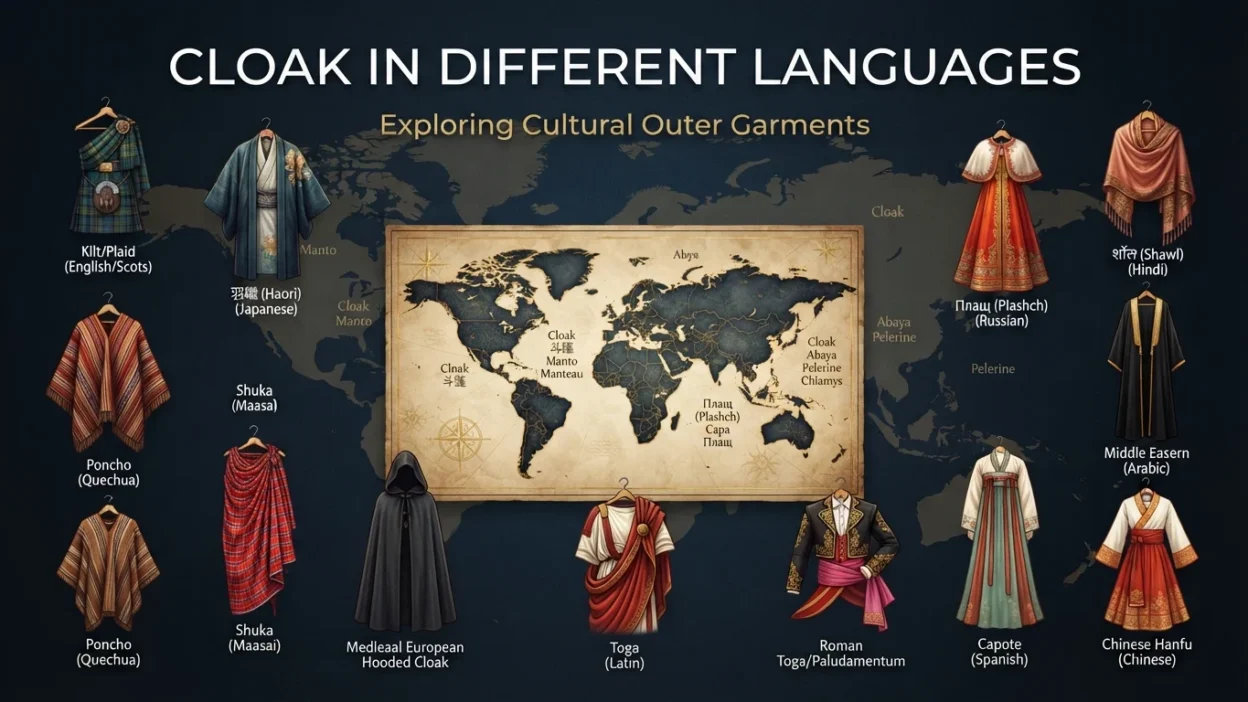
The word “cloak” refers to a loose outer garment that is usually worn over other clothing. Historically, cloaks were used for warmth, protection, travel, and ceremonial purposes. Today, the word can also appear in literature, fantasy stories, historical writing, and fashion.
Learning cloak in different languages is useful for language learners, travelers, writers, students, and anyone interested in clothing vocabulary and cultural traditions. Different languages may have separate words for a traditional cloak, cape, mantle, or similar outer garment, so context is important.
In this guide, you will find 70 cloak in different languages translations, including the native phrase, easy English pronunciation, a short real-life example sentence, and the English meaning of each example.
How to Say Cloak in Different Languages
The translation of “cloak” can vary depending on the type of garment being described. In some languages, the closest everyday word means “cape” or “mantle,” while others have a specific traditional word for a cloak.
For example, Spanish commonly uses capa, French uses cape, German uses Umhang, Italian uses mantello, and Portuguese uses capa.
The table below shows cloak in different languages in all languages with practical examples.
Cloak in Different Languages Around the World
| Language | Native Phrase | Easy English Pronunciation | Example Sentence | English Meaning |
| English | Cloak | Klohk | He wore a dark cloak. | He wore a dark cloak. |
| Spanish | Capa | Kah-pah | Llevaba una capa oscura. | He wore a dark cloak. |
| French | Cape | Kahp | Il portait une cape sombre. | He wore a dark cloak. |
| German | Umhang | Oom-hahng | Er trug einen dunklen Umhang. | He wore a dark cloak. |
| Italian | Mantello | Man-tel-lo | Indossava un mantello scuro. | He wore a dark cloak. |
| Portuguese | Capa | Kah-pah | Ele usava uma capa escura. | He wore a dark cloak. |
| Dutch | Mantel | Mahn-tel | Hij droeg een donkere mantel. | He wore a dark cloak. |
| Russian | Плащ | Plashch | Он носил тёмный плащ. | He wore a dark cloak. |
| Ukrainian | Плащ | Plashch | Він носив темний плащ. | He wore a dark cloak. |
| Polish | Płaszcz | Pwashch | Miał na sobie ciemny płaszcz. | He wore a dark cloak. |
| Czech | Plášť | Plahshch | Měl na sobě tmavý plášť. | He wore a dark cloak. |
| Slovak | Plášť | Plahshch | Mal na sebe tmavý plášť. | He wore a dark cloak. |
| Hungarian | Köpeny | Kuh-peny | Sötét köpenyt viselt. | He wore a dark cloak. |
| Romanian | Mantie | Man-tee-eh | Purta o mantie întunecată. | He wore a dark cloak. |
| Bulgarian | Пелерина | Peh-leh-ree-na | Той носеше тъмна пелерина. | He wore a dark cloak. |
| Serbian | Плашт | Plasht | Носио је тамни плашт. | He wore a dark cloak. |
| Croatian | Plašt | Plasht | Nosio je tamni plašt. | He wore a dark cloak. |
| Bosnian | Plašt | Plasht | Nosio je tamni plašt. | He wore a dark cloak. |
| Slovenian | Plašč | Plahshch | Nosil je temen plašč. | He wore a dark cloak. |
| Albanian | Mantel | Man-tel | Ai mbante një mantel të errët. | He wore a dark cloak. |
| Greek | Μανδύας | Man-thee-as | Φορούσε έναν σκούρο μανδύα. | He wore a dark cloak. |
| Turkish | Pelerin | Peh-leh-reen | Koyu renkli bir pelerin giyiyordu. | He was wearing a dark cloak. |
| Arabic | عباءة | A-baa-ah | كان يرتدي عباءة داكنة. | He was wearing a dark cloak. |
| Hebrew | גלימה | Glee-mah | הוא לבש גלימה כהה. | He wore a dark cloak. |
| Persian | شنل | She-nel | او یک شنل تیره پوشیده بود. | He was wearing a dark cloak. |
| Urdu | چغہ | Cha-gha | اس نے ایک سیاہ چغہ پہنا تھا۔ | He was wearing a dark cloak. |
| Hindi | चोगा | Cho-ga | उसने एक गहरा चोगा पहना था। | He was wearing a dark cloak. |
| Punjabi | ਚੋਗਾ | Cho-ga | ਉਸ ਨੇ ਗੂੜ੍ਹਾ ਚੋਗਾ ਪਾਇਆ ਹੋਇਆ ਸੀ। | He was wearing a dark cloak. |
| Bengali | আলখাল্লা | Al-khal-la | সে একটি গাঢ় আলখাল্লা পরেছিল। | He wore a dark cloak. |
| Gujarati | ઝભ્ભો | Jhab-bho | તેણે ઘેરો ઝભ્ભો પહેર્યો હતો. | He was wearing a dark cloak. |
| Marathi | झगा | Jha-ga | त्याने गडद झगा घातला होता. | He was wearing a dark cloak. |
| Tamil | அங்கி | An-gee | அவன் ஒரு கருமையான அங்கி அணிந்திருந்தான். | He was wearing a dark cloak. |
| Telugu | అంగీ | An-gee | అతను ముదురు రంగు అంగీ ధరించాడు. | He wore a dark cloak. |
| Kannada | ನಿಲುವಂಗಿ | Nee-la-van-gee | ಅವನು ಗಾಢ ಬಣ್ಣದ ನಿಲುವಂಗಿ ಧರಿಸಿದ್ದನು. | He wore a dark cloak. |
| Malayalam | മേലങ്കി | May-lan-gee | അവൻ ഇരുണ്ട മേലങ്കി ധരിച്ചിരുന്നു. | He was wearing a dark cloak. |
| Sinhala | සළුව | Sa-lu-va | ඔහු අඳුරු සළුවක් පැළඳ සිටියේය. | He wore a dark cloak. |
| Nepali | चोगा | Cho-ga | उसले गाढा चोगा लगाएको थियो। | He was wearing a dark cloak. |
| Chinese (Mandarin) | 斗篷 | Dohng-pung | 他穿着一件深色斗篷。 | He was wearing a dark cloak. |
| Cantonese | 斗篷 | Dau-pung | 佢着住一件深色斗篷。 | He was wearing a dark cloak. |
| Japanese | マント | Man-toh | 彼は黒いマントを着ていた。 | He was wearing a black cloak. |
| Korean | 망토 | Mang-toh | 그는 어두운 망토를 입고 있었다. | He was wearing a dark cloak. |
| Vietnamese | Áo choàng | Ow chwang | Anh ấy mặc một chiếc áo choàng tối màu. | He was wearing a dark cloak. |
| Thai | เสื้อคลุม | Suea-kloom | เขาสวมเสื้อคลุมสีเข้ม | He wore a dark cloak. |
| Indonesian | Jubah | Joo-bah | Dia mengenakan jubah gelap. | He wore a dark cloak. |
| Malay | Jubah | Joo-bah | Dia memakai jubah gelap. | He wore a dark cloak. |
| Filipino | Balabal | Ba-la-bal | Nakasuot siya ng madilim na balabal. | He was wearing a dark cloak. |
| Burmese | ဝတ်ရုံ | Wut-yone | သူက အရောင်မှောင်တဲ့ ဝတ်ရုံကို ဝတ်ထားတယ်။ | He was wearing a dark cloak. |
| Khmer | អាវធំ | Av-thom | គាត់ពាក់អាវធំពណ៌ងងឹត។ | He wore a dark cloak. |
| Lao | ເສື້ອຄຸມ | Seua-khoom | ລາວໃສ່ເສື້ອຄຸມສີເຂັ້ມ. | He wore a dark cloak. |
| Mongolian | Нөмрөг | Num-rug | Тэр хар нөмрөг өмссөн байв. | He wore a dark cloak. |
| Kazakh | Шапан | Sha-pan | Ол қара шапан киген. | He wore a dark robe. |
| Uzbek | Chopon | Cho-pon | U to‘q rangli chopon kiygan edi. | He was wearing a dark robe. |
| Azerbaijani | Paltar | Pal-tar | O, tünd rəngli paltar geyinmişdi. | He was wearing a dark outer garment. |
| Georgian | მოსასხამი | Mo-sas-kha-mee | მას მუქი მოსასხამი ეცვა. | He was wearing a dark cloak. |
| Armenian | Թիկնոց | Teek-nots | Նա մուգ թիկնոց էր հագել։ | He was wearing a dark cloak. |
| Swahili | Joho | Joh-ho | Alivaa joho jeusi. | He wore a black cloak. |
| Zulu | Ingubo | In-goo-bo | Wayegqoke ingubo emnyama. | He was wearing a dark garment. |
| Xhosa | Ingubo | In-goo-bo | Wayenxibe ingubo emnyama. | He was wearing a dark garment. |
| Afrikaans | Mantel | Man-tel | Hy het ‘n donker mantel gedra. | He wore a dark cloak. |
| Yoruba | Aṣọ àwọ̀ | Ah-shaw ah-waw | Ó wọ aṣọ àwọ̀ dúdú. | He wore a dark garment. |
| Igbo | Uwe elu | Oo-weh eh-loo | Ọ yi uwe elu gbara ọchịchịrị. | He wore a dark outer garment. |
| Hausa | Alkyabba | Al-kya-bba | Ya sa alkyabba mai duhu. | He wore a dark cloak. |
| Amharic | ካባ | Ka-ba | ጥቁር ካባ ለብሷል። | He wore a black cloak. |
| Somali | Gooni | Goo-nee | Wuxuu xirtay gooni madow. | He wore a dark cloak. |
| Finnish | Viitta | Vee-tah | Hänellä oli tumma viitta. | He had a dark cloak on. |
| Swedish | Mantel | Man-tel | Han bar en mörk mantel. | He wore a dark cloak. |
| Norwegian | Kappe | Kap-peh | Han hadde på seg en mørk kappe. | He was wearing a dark cloak. |
| Danish | Kappe | Kap-peh | Han bar en mørk kappe. | He wore a dark cloak. |
| Icelandic | Skikkja | Skik-ya | Hann var í dökkri skikkju. | He was wearing a dark cloak. |
| Estonian | Keep | Keep | Ta kandis tumedat keepi. | He wore a dark cloak. |
| Latvian | Apmetnis | Ap-met-nis | Viņš valkāja tumšu apmetni. | He wore a dark cloak. |
| Lithuanian | Apsiaustas | Ap-see-ow-stas | Jis vilkėjo tamsų apsiaustą. | He wore a dark cloak. |
| Irish | Clóca | Kloh-ka | Bhí clóca dorcha air. | He was wearing a dark cloak. |
| Welsh | Clogyn | Kloh-gin | Roedd ganddo glogyn tywyll. | He had a dark cloak. |
What Does Cloak Mean?
A cloak is traditionally a loose outer garment that hangs from the shoulders and may extend down the body. Unlike a fitted coat or jacket, a cloak is generally designed to drape over clothing.
Cloaks have been used throughout history for warmth, protection from weather, travel, ceremonies, and formal occasions.
Today, the word is also common in:
- Historical fiction
- Fantasy literature
- Movies and television
- Costume design
- Medieval history
- Fashion
- Traditional clothing
Cloak, Cape, Mantle, and Robe: What’s the Difference?
When searching for how to say cloak in different languages, it is important to remember that languages do not always divide clothing categories exactly like English.
A cloak is generally a loose outer garment covering much of the body.
A cape is usually shorter and primarily covers the shoulders and upper body.
A mantle can refer to a loose covering or ceremonial garment.
A robe is usually a long garment worn as clothing rather than an outer covering.
This is why some translations in different languages may correspond more closely to “cape,” “mantle,” “robe,” or “outer garment” depending on cultural context.
Historical Use of Cloaks
Cloaks have been worn by people in many parts of the world for centuries. They were especially useful before modern coats and waterproof clothing became common.
Travelers could use cloaks for warmth and protection from wind and rain. Soldiers, nobles, religious figures, and ordinary people could also wear different styles of outer garments.
The exact design depended on geography, climate, social status, and local traditions.
Cloak in Different Languages and Cultures
The vocabulary for clothing often reflects cultural history. Some languages have specific words for traditional garments that do not have an exact one-word equivalent in English.
For example, words such as jubah, chapan, shapan, and chogha may refer to particular styles of robes or outer garments rather than a Western-style cloak.
Therefore, when researching cloak in different languages around the world, it is useful to understand the cultural meaning of each garment rather than assuming every translation describes exactly the same piece of clothing.
How to Use Cloak in Everyday Sentences
The word “cloak” is more common in literature and historical contexts than in ordinary modern conversation.
Here are some useful examples:
- He wore a long cloak.
- The traveler wrapped himself in a cloak.
- The wizard wore a black cloak.
- Her cloak protected her from the cold.
- The character entered wearing a red cloak.
- The historical figure was shown wearing a cloak.
These sentences can help language learners understand how cloak in different languages translations are used naturally.
Cloak in Literature and Fantasy
The word cloak is particularly common in fantasy and historical storytelling.
Writers often use cloaks to create an image of mystery, adventure, travel, royalty, or magic. Characters such as warriors, wizards, travelers, and nobles are frequently described wearing cloaks.
This makes cloak-related vocabulary useful for readers and writers who enjoy fantasy books, historical novels, role-playing games, and creative writing.
Related Clothing Words to Learn
Once you learn cloak in different languages, you can expand your clothing vocabulary with related words such as:
- Coat
- Cape
- Jacket
- Robe
- Mantle
- Shawl
- Scarf
- Tunic
- Dress
- Garment
- Hood
- Clothing
Learning related vocabulary helps you understand the differences between similar garments.
Tips for Learning Cloak Translations
Learn the Word With an Image
Because clothing vocabulary is visual, connecting the word with an image of a cloak can make it easier to remember.
Practice Short Sentences
Use sentences such as “He wore a cloak” rather than memorizing only the individual translation.
Pay Attention to Cultural Context
A traditional garment may not have an exact English equivalent. Check whether the native term means cloak, robe, cape, or another outer garment.
Compare Related Languages
Comparing translations across related languages can help you notice similarities in vocabulary and pronunciation.
Conclusion
Learning cloak in different languages provides more than a simple vocabulary list. It also shows how languages describe clothing according to their own histories and cultures.
From capa in Spanish and Portuguese to Umhang in German, mantello in Italian, viitta in Finnish, and 망토 (mangto) in Korean, there are many ways to express the idea of a cloak or similar outer garment.
Whether you are studying languages, reading fantasy literature, researching historical clothing, or looking for cloak in different languages in all languages, these 70 translations provide a useful starting point.
FAQs
1. How do you say cloak in different languages?
The translation varies by language. Examples include capa in Spanish, cape in French, Umhang in German, mantello in Italian, viitta in Finnish, and 망토 in Korean.
2. What is cloak in Spanish?
Cloak is commonly translated as capa in Spanish. It is pronounced approximately kah-pah.
3. What is cloak in French?
Cloak can be translated as cape in French, pronounced approximately kahp.
4. Is a cloak the same as a cape?
Not exactly. A cloak generally covers more of the body and may extend from the shoulders downward, while a cape is usually shorter and mainly covers the shoulders and upper body.
5. Why can cloak have different translations in different languages?
Different cultures have different traditional garments and clothing categories. As a result, the closest translation may mean cloak, cape, mantle, robe, or another type of outer garment depending on the language and context.