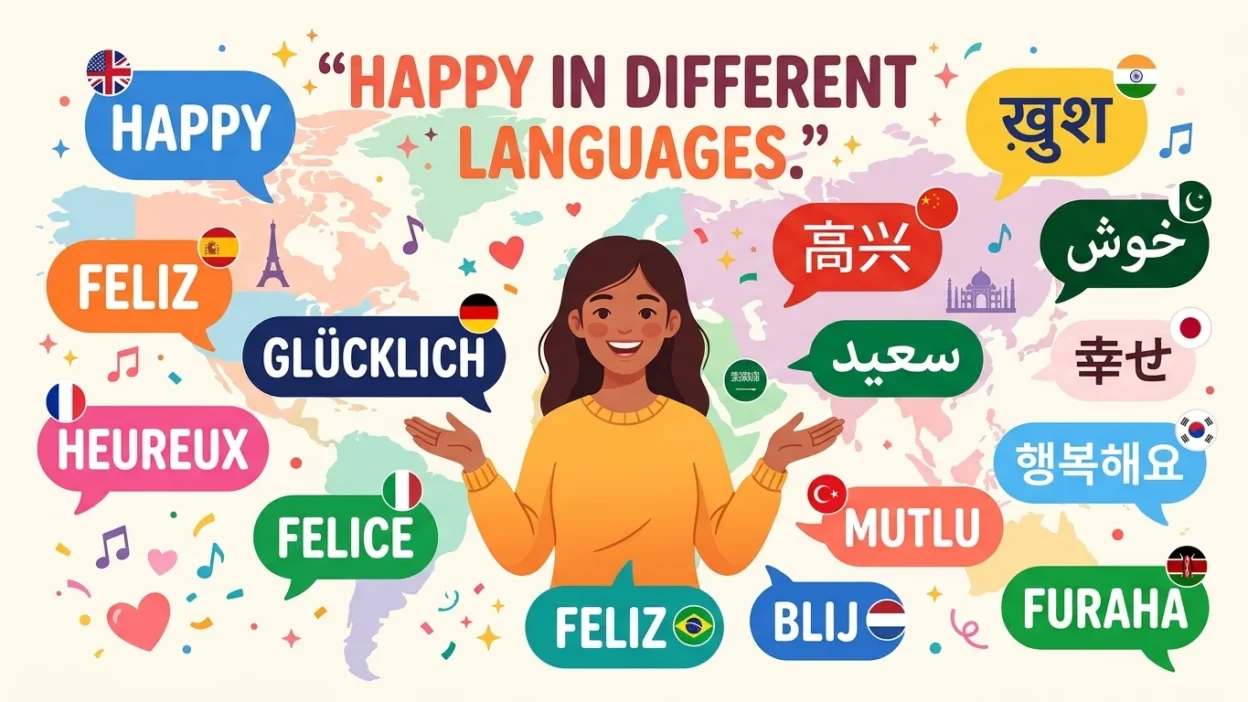
Happiness is a feeling that connects people across cultures, countries and languages. Whether you want to express joy to a friend, learn a new language, write a greeting or discover how people around the world describe positive emotions, learning how to say happy in different languages is a wonderful place to start.
The word happy can describe a joyful moment, a positive feeling or the satisfaction of something going well. However, its translation changes depending on the language and context. Some languages use different words for feeling happy, being glad or feeling fortunate.
In this guide, you will discover happy in different languages, including native translations, easy English pronunciations and short example sentences with their English meanings. This list makes it easier to understand happy in different languages in all languages covered here and learn how people express happiness around the world.
How to Say Happy in Different Languages
The English word happy is usually translated using an adjective that describes joy, contentment or pleasure. Some languages also change the form of the word depending on gender, number, grammar or the situation.
The table below includes languages, with practical translations and examples to help you understand how each expression is used in everyday conversation.
Happy in Different Languages
| Language | Native translation | Easy pronunciation | Example sentence | English meaning |
| Spanish | Feliz | feh-LEES | Estoy feliz hoy. | I am happy today. |
| French | Heureux / Heureuse | uh-RUH / uh-RUHZ | Je suis heureux. | I am happy. |
| German | Glücklich | GLUUK-likh | Ich bin glücklich. | I am happy. |
| Italian | Felice | feh-LEE-cheh | Sono felice oggi. | I am happy today. |
| Portuguese | Feliz | feh-LEES | Estou feliz hoje. | I am happy today. |
| Dutch | Blij | blay | Ik ben blij. | I am happy. |
| Swedish | Lycklig | LUUK-lig | Jag är lycklig. | I am happy. |
| Norwegian | Lykkelig | LUUK-keh-lee | Jeg er lykkelig. | I am happy. |
| Danish | Glad | glath | Jeg er glad. | I am happy. |
| Finnish | Onnellinen | ON-neh-lee-nen | Olen onnellinen. | I am happy. |
| Icelandic | Hamingjusamur / Hamingjusöm | HA-ming-yu-sa-mur / HA-ming-yu-sum | Ég er hamingjusamur. | I am happy. |
| Irish | Sásta | SAWS-tuh | Tá mé sásta. | I am happy. |
| Welsh | Hapus | HAH-pis | Dw i’n hapus. | I am happy. |
| Scottish Gaelic | Toilichte | TOY-likh-cheh | Tha mi toilichte. | I am happy. |
| Polish | Szczęśliwy / Szczęśliwa | shchen-SHLEE-vih / shchen-SHLEE-vah | Jestem szczęśliwy. | I am happy. |
| Czech | Šťastný / Šťastná | SHTYAST-nee / SHTYAST-na | Jsem šťastný. | I am happy. |
| Slovak | Šťastný / Šťastná | SHTYAST-nee / SHTYAST-na | Som šťastný. | I am happy. |
| Ukrainian | Щасливий / Щаслива | shchas-LY-viy / shchas-LY-va | Я щасливий. | I am happy. |
| Russian | Счастливый / Счастливая | shchas-LEE-viy / shchas-LEE-va-ya | Я счастлив. | I am happy. |
| Bulgarian | Щастлив / Щастлива | shchast-LEEV / shchast-LEE-va | Аз съм щастлив. | I am happy. |
| Serbian | Срећан / Срећна | SREH-chan / SREHCH-na | Срећан сам. | I am happy. |
| Croatian | Sretan / Sretna | SREH-tan / SREHT-na | Sretan sam. | I am happy. |
| Slovenian | Srečen / Srečna | SREH-chen / SREHCH-na | Srečen sem. | I am happy. |
| Greek | Ευτυχισμένος / Ευτυχισμένη | ef-tee-khee-ZMEH-nos / ef-tee-khee-ZMEH-nee | Είμαι ευτυχισμένος. | I am happy. |
| Romanian | Fericit / Fericită | feh-ree-CHEET / feh-ree-CHEE-tuh | Sunt fericit. | I am happy. |
| Hungarian | Boldog | BOL-dog | Boldog vagyok. | I am happy. |
| Turkish | Mutlu | MOOT-loo | Ben mutluyum. | I am happy. |
| Albanian | I lumtur / E lumtur | ee LOOM-toor / eh LOOM-toor | Jam i lumtur. | I am happy. |
| Lithuanian | Laimingas / Laiminga | lie-MING-gas / lie-MING-ga | Aš esu laimingas. | I am happy. |
| Latvian | Laimīgs / Laimīga | LIE-meegs / LIE-meeg-a | Es esmu laimīgs. | I am happy. |
| Estonian | Õnnelik | URN-neh-lik | Ma olen õnnelik. | I am happy. |
| Maltese | Ferħan / Ferħana | fer-HAHN / fer-HAH-na | Jien ferħan. | I am happy. |
| Arabic | سعيد / سعيدة | sa-EED / sa-EE-da | أنا سعيد. | I am happy. |
| Hebrew | שמח / שמחה | sa-ME-akh / sme-KHA | אני שמח. | I am happy. |
| Persian | خوشحال | khosh-HAAL | من خوشحالم. | I am happy. |
| Urdu | خوش | khush | میں خوش ہوں۔ | I am happy. |
| Hindi | खुश | khush | मैं खुश हूँ। | I am happy. |
| Bengali | খুশি | KHU-shee | আমি খুশি। | I am happy. |
| Punjabi | ਖੁਸ਼ | khush | ਮੈਂ ਖੁਸ਼ ਹਾਂ। | I am happy. |
| Gujarati | ખુશ | khush | હું ખુશ છું. | I am happy. |
| Marathi | आनंदी | aa-NUN-dee | मी आनंदी आहे. | I am happy. |
| Nepali | खुसी | khu-SEE | म खुसी छु। | I am happy. |
| Sinhala | සතුටු | sa-too-too | මම සතුටින් ඉන්නවා. | I am happy. |
| Tamil | மகிழ்ச்சியாக | ma-gizh-chchi-YAA-ga | நான் மகிழ்ச்சியாக இருக்கிறேன். | I am happy. |
| Telugu | సంతోషంగా | san-TO-shun-ga | నేను సంతోషంగా ఉన్నాను. | I am happy. |
| Kannada | ಸಂತೋಷದಿಂದ | san-TO-sha-din-da | ನಾನು ಸಂತೋಷವಾಗಿದ್ದೇನೆ. | I am happy. |
| Malayalam | സന്തോഷം | san-TO-sham | ഞാൻ സന്തോഷത്തിലാണ്. | I am happy. |
| Chinese (Mandarin) | 高兴 | gāo xìng | 我很高兴。 | I am happy. |
| Japanese | 幸せ | shiawase | 私は幸せです。 | I am happy. |
| Korean | 행복한 | haeng-bok-han | 저는 행복해요. | I am happy. |
| Thai | มีความสุข | mee khwaam sook | ฉันมีความสุข | I am happy. |
| Vietnamese | Vui | voo-ee | Tôi rất vui. | I am very happy. |
| Indonesian | Bahagia | ba-ha-GEE-a | Saya bahagia. | I am happy. |
| Malay | Gembira | gem-BEE-ra | Saya gembira. | I am happy. |
| Filipino (Tagalog) | Masaya | ma-SA-ya | Masaya ako. | I am happy. |
| Burmese | ပျော်ရွှင်သော | pyaw-shwin-thaw | ကျွန်တော် ပျော်ပါတယ်။ | I am happy. |
| Khmer | សប្បាយចិត្ត | sab-bai chet | ខ្ញុំសប្បាយចិត្ត។ | I am happy. |
| Lao | ມີຄວາມສຸກ | mee khwaam sook | ຂ້ອຍມີຄວາມສຸກ. | I am happy. |
| Mongolian | Аз жаргалтай | az jargal-tai | Би аз жаргалтай байна. | I am happy. |
| Kazakh | Бақытты | ba-kut-TUH | Мен бақыттымын. | I am happy. |
| Uzbek | Baxtli | bakh-LEE | Men baxtliman. | I am happy. |
| Swahili | Furaha | foo-RA-ha | Nina furaha. | I am happy. |
| Afrikaans | Gelukkig | kheh-LUK-khikh | Ek is gelukkig. | I am happy. |
| Zulu | Jabule | jah-BOO-leh | Ngijabule. | I am happy. |
| Xhosa | Ndiyavuya | ndi-ya-VOO-ya | Ndiyavuya namhlanje. | I am happy today. |
| Yoruba | Ayọ̀ | ah-YAW | Inú mi dùn. | I am happy. |
| Igbo | Añụrị | ah-NOO-ree | Obi dị m ụtọ. | I am happy. |
| Amharic | ደስተኛ | des-te-NYA | ደስተኛ ነኝ። | I am happy. |
| Haitian Creole | Kontan | kon-TAN | Mwen kontan. | I am happy. |
| Esperanto | Feliĉa | feh-LEE-cha | Mi estas feliĉa. | I am happy. |
Note: Some languages change the adjective according to the speaker’s gender or grammatical context. The examples use common everyday forms; pronunciation guides are approximate and intended for English speakers.
What Does “Happy” Mean?
The word happy describes a positive emotional state. It can mean feeling joyful, pleased, satisfied, cheerful or content with something happening in your life.
For example:
- “I am happy today” describes a current feeling.
- “She is happy with her results” describes satisfaction.
- “We are happy to help” expresses willingness and a positive attitude.
- “They look happy together” describes an appearance of joy.
The exact translation depends on context. In some languages, the most natural word for happiness is closer to “joyful,” while another may be closer to “content” or “fortunate.”
How to Say Happy in Different Languages in Everyday Conversation
When learning how to say happy in different languages, it helps to remember a complete sentence rather than learning the word alone. A short sentence gives you a clearer idea of how the word works in natural conversation.
Here are a few useful examples:
- Spanish: Estoy feliz. — I am happy.
- French: Je suis heureux. — I am happy.
- German: Ich bin glücklich. — I am happy.
- Italian: Sono felice. — I am happy.
- Japanese: 私は幸せです。 — I am happy.
- Mandarin Chinese: 我很高兴。 — I am happy.
- Hindi: मैं खुश हूँ। — I am happy.
- Urdu: میں خوش ہوں۔ — I am happy۔
Practise saying each sentence aloud, then use it when talking about your day, sharing good news or describing a positive experience.
Happy in Different Languages Around the World
Happiness is a universal feeling, but languages express it in different ways. Some words focus on joy and excitement, while others communicate a deeper sense of contentment or well-being.
For example, Spanish feliz and Portuguese feliz look and sound similar. French uses heureux or heureuse, depending on grammatical gender, while German commonly uses glücklich. In Hindi and Urdu, khush is a familiar word for being happy.
These similarities and differences make exploring happy in different languages around the world a useful way to learn about language and culture.
Happy in Different Languages: Common Translation Differences
Not every translation of happy works in every situation. A word that describes long-term happiness may not be the best choice for a brief moment of excitement.
Consider these distinctions:
- Happy: A general positive feeling.
- Glad: Often used to show pleasure or relief about a specific event.
- Joyful: Suggests strong or noticeable happiness.
- Content: Describes a peaceful feeling of satisfaction.
- Cheerful: Often describes someone who seems positive and upbeat.
When using a translation, consider whether you want to describe a temporary emotion, lasting satisfaction or a reaction to good news.
Tips for Learning Happy in Different Languages
Learning vocabulary becomes easier when you practise it in context. Try these simple techniques:
- Learn the full sentence. Remembering “I am happy” helps you understand how the adjective is used.
- Listen to native speakers. Audio examples can help you recognise natural pronunciation and rhythm.
- Practise daily. Say the word while describing your mood or writing a short journal entry.
- Check grammatical forms. Some languages change the word depending on gender, number or sentence structure.
- Use the word naturally. Try it in a message, conversation or language-learning exercise.
You do not need to memorise all translations at once. Start with three or four languages and gradually add more.
Why Learn Happy in Different Languages?
Learning how to express happiness in other languages can help you communicate with people from different backgrounds. It is useful for travellers, language learners, students, writers and anyone interested in global cultures.
It can also make greetings and personal messages feel more thoughtful. Using the right word in someone’s language can show interest and respect, particularly when you understand how it is normally used.
FAQs
1. How do you say “happy” in different languages?
The word happy has different translations across languages. Examples include feliz in Spanish, heureux in French, glücklich in German, felice in Italian, khush in Hindi and Urdu, and 高兴 (gāo xìng) in Mandarin Chinese.
2. What is the most common translation of happy?
There is no single translation that is most common across all languages. Each language has its own everyday word or expression. In English, happy is a general term for feeling joy, pleasure or satisfaction.
3. How do you say “I am happy” in Spanish?
You can say “Estoy feliz.” It means “I am happy” and is a common way to describe how you feel in Spanish.
4. Is the word for happy the same for men and women?
It depends on the language. In French, for example, heureux is the masculine form and heureuse is the feminine form. Spanish feliz generally stays the same for masculine and feminine singular subjects, although other parts of a sentence may change.
5. Why are there different translations for happy?
Languages divide meanings in different ways. One word may describe general happiness, while another expresses excitement, relief, contentment or good fortune. The best translation depends on the context and the way native speakers use the language.
Conclusion
Learning happy in different languages helps you understand how people express joy, satisfaction and positive emotions across cultures. From feliz in Spanish to glücklich in German and khush in Hindi and Urdu, each translation offers a small insight into another language.
Use the translations and example sentences in this guide to build your vocabulary, practise everyday conversations and discover more ways to express happiness around the world.