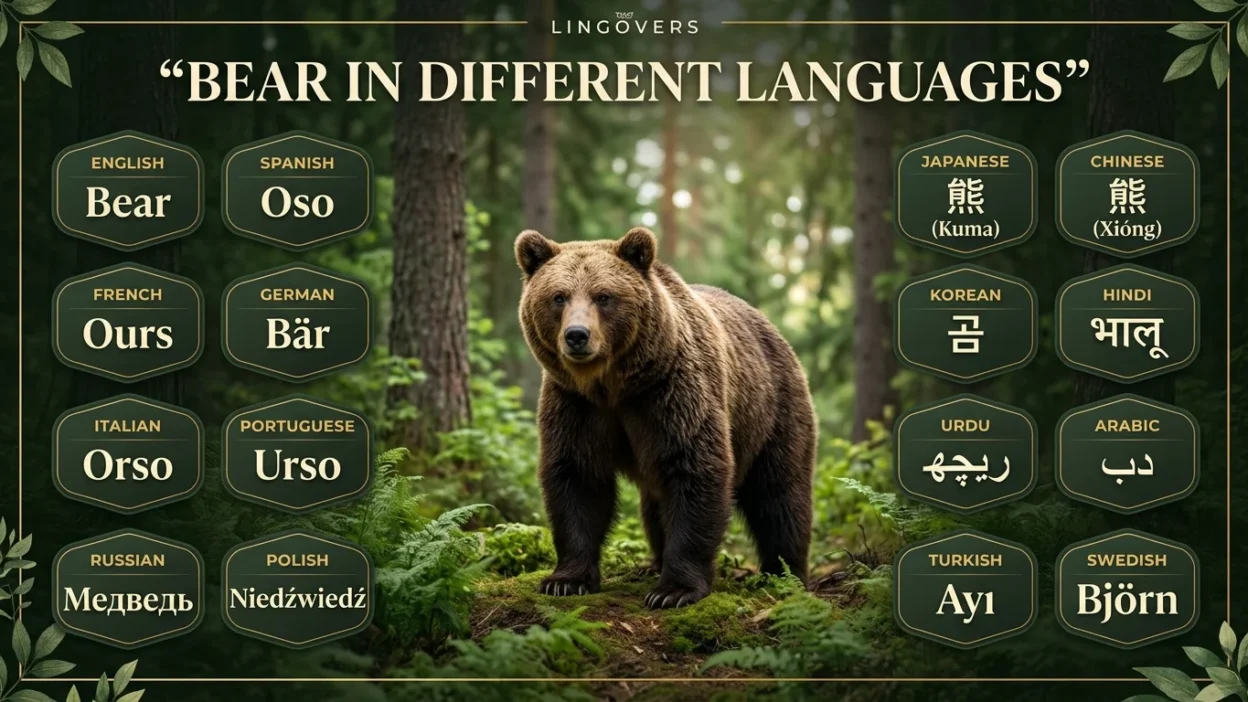
The word “bear” refers to a large, powerful mammal found in forests, mountains, and other natural habitats around the world. Bears are known for their strength, thick fur, sharp claws, and remarkable ability to adapt to different environments.
But have you ever wondered how people in other countries say bear? Different languages have their own unique words for this fascinating animal. Some words sound similar, while others have completely different pronunciations and writing systems.
In this guide, you will discover bear in different languages, including native translations, easy English pronunciations, and simple example sentences. Whether you are learning a new language, travelling, studying animals, or simply exploring vocabulary, this list will help you understand how to say bear around the world.
Bear in Different Languages
| Language | Bear Translation | Pronunciation | Example Sentence | English Meaning |
| English | Bear | Bair | The bear is sleeping. | The bear is sleeping. |
| Spanish | Oso | OH-soh | El oso es grande. | The bear is big. |
| French | Ours | OORS | L’ours est fort. | The bear is strong. |
| German | Bär | Bair | Der Bär ist groß. | The bear is big. |
| Italian | Orso | OR-soh | L’orso è marrone. | The bear is brown. |
| Portuguese | Urso | OOR-soo | O urso está dormindo. | The bear is sleeping. |
| Dutch | Beer | Bair | De beer is groot. | The bear is big. |
| Russian | Медведь | Med-VYED | Медведь живет в лесу. | The bear lives in the forest. |
| Ukrainian | Ведмідь | Ved-MEED | Ведмідь великий. | The bear is big. |
| Polish | Niedźwiedź | NYEDZ-vyedzh | Niedźwiedź jest silny. | The bear is strong. |
| Czech | Medvěd | MED-vyet | Medvěd je velký. | The bear is big. |
| Slovak | Medveď | MED-ved | Medveď je hnedý. | The bear is brown. |
| Slovenian | Medved | MED-ved | Medved spi. | The bear is sleeping. |
| Croatian | Medvjed | MED-vyed | Medvjed je velik. | The bear is big. |
| Serbian | Медвед | MED-ved | Медвед је велики. | The bear is big. |
| Bulgarian | Мечка | MECH-kah | Мечката спи. | The bear is sleeping. |
| Romanian | Urs | OORS | Ursul este mare. | The bear is big. |
| Hungarian | Medve | MED-veh | A medve erős. | The bear is strong. |
| Greek | Αρκούδα | ar-KOO-tha | Η αρκούδα είναι μεγάλη. | The bear is big. |
| Turkish | Ayı | AH-yuh | Ayı ormanda yaşıyor. | The bear lives in the forest. |
| Arabic | دب | Dubb | الدب كبير. | The bear is big. |
| Hebrew | דוב | Dov | הדוב גדול. | The bear is big. |
| Persian | خرس | Khers | خرس بزرگ است. | The bear is big. |
| Urdu | ریچھ | Reechh | ریچھ جنگل میں رہتا ہے۔ | The bear lives in the forest. |
| Hindi | भालू | Bhaa-loo | भालू जंगल में रहता है। | The bear lives in the forest. |
| Bengali | ভালুক | Bhaa-luk | ভালুকটি বড়। | The bear is big. |
| Punjabi | ਰਿੱਛ | Rिचh (Rit-chh) | ਰਿੱਛ ਜੰਗਲ ਵਿੱਚ ਰਹਿੰਦਾ ਹੈ। | The bear lives in the forest. |
| Gujarati | રીંછ | Reenchh | રીંછ મોટું છે. | The bear is big. |
| Marathi | अस्वल | Us-val | अस्वल जंगलात राहते. | The bear lives in the forest. |
| Nepali | भालु | Bhaa-lu | भालु ठूलो छ। | The bear is big. |
| Sinhala | වලසා | Wa-la-saa | වලසා විශාලයි. | The bear is big. |
| Tamil | கரடி | Ka-ra-di | கரடி காட்டில் வாழ்கிறது. | The bear lives in the forest. |
| Telugu | ఎలుగుబంటి | E-lu-gu-ban-ti | ఎలుగుబంటి పెద్దది. | The bear is big. |
| Kannada | ಕರಡಿ | Ka-ra-di | ಕರಡಿ ಕಾಡಿನಲ್ಲಿ ವಾಸಿಸುತ್ತದೆ. | The bear lives in the forest. |
| Malayalam | കരടി | Ka-ra-di | കരടി വലുതാണ്. | The bear is big. |
| Chinese (Mandarin) | 熊 | Xióng | 熊很大。 | The bear is big. |
| Japanese | 熊 | Kuma | 熊は森にいます。 | The bear is in the forest. |
| Korean | 곰 | Gom | 곰은 숲에 살아요. | The bear lives in the forest. |
| Vietnamese | Gấu | GOW | Con gấu rất lớn. | The bear is very big. |
| Thai | หมี | Mee | หมีตัวใหญ่ | The bear is big. |
| Indonesian | Beruang | Buh-roo-ang | Beruang itu besar. | The bear is big. |
| Malay | Beruang | Buh-roo-ang | Beruang itu kuat. | The bear is strong. |
| Filipino (Tagalog) | Oso | OH-soh | Malaki ang oso. | The bear is big. |
| Burmese | ဝက်ဝံ | Wet-wun | ဝက်ဝံက ကြီးတယ်။ | The bear is big. |
| Khmer | ខ្លាឃ្មុំ | Khlaa-khmum | ខ្លាឃ្មុំធំ។ | The bear is big. |
| Lao | ໝີ | Mee | ໝີໂຕໃຫຍ່. | The bear is big. |
| Mongolian | Баавгай | Baav-gai | Баавгай том. | The bear is big. |
| Kazakh | Аю | Ah-yoo | Аю үлкен. | The bear is big. |
| Uzbek | Ayiq | Ah-yik | Ayiq katta. | The bear is big. |
| Azerbaijani | Ayı | Ah-yuh | Ayı böyükdür. | The bear is big. |
| Armenian | Արջ | Arch | Արջը մեծ է։ | The bear is big. |
| Georgian | დათვი | Dat-vee | დათვი დიდია. | The bear is big. |
| Albanian | Ari | AH-ree | Ari është i madh. | The bear is big. |
| Icelandic | Björn | BYURTN | Björninn er stór. | The bear is big. |
| Swedish | Björn | Byurn | Björnen är stor. | The bear is big. |
| Norwegian | Bjørn | Byurn | Bjørnen er stor. | The bear is big. |
| Danish | Bjørn | Byurn | Bjørnen er stor. | The bear is big. |
| Finnish | Karhu | KAR-hoo | Karhu on suuri. | The bear is big. |
| Estonian | Karu | KAH-roo | Karu on suur. | The bear is big. |
| Latvian | Lācis | LAA-tsis | Lācis ir liels. | The bear is big. |
| Lithuanian | Lokys | LOH-kis | Lokys yra didelis. | The bear is big. |
| Irish | Béar | Bair | Tá an béar mór. | The bear is big. |
| Welsh | Arth | Arth | Mae’r arth yn fawr. | The bear is big. |
| Scottish Gaelic | Mathan | MAH-han | Tha am mathan mòr. | The bear is big. |
| Basque | Hartz | Harts | Hartza handia da. | The bear is big. |
| Catalan | Ós | OHS | L’ós és gran. | The bear is big. |
| Swahili | Dubu | DOO-boo | Dubu ni mkubwa. | The bear is big. |
| Afrikaans | Beer | Bair | Die beer is groot. | The bear is big. |
Note: Pronunciations are simplified English-friendly guides. Some words may have grammatical variations depending on sentence structure, gender, or regional usage.
How to Say Bear in Different Languages
Learning how to say bear in different languages is a fun way to explore vocabulary and understand cultural differences.
Although the animal is recognised worldwide, its name changes from one language to another.
For example:
- In Spanish, bear is called oso.
- In French, it is called ours.
- In German, it is called Bär.
- In Japanese, it is called kuma.
- In Hindi, it is called भालू (Bhaalu).
- In Arabic, it is called دب (Dubb).
- In Chinese, it is called 熊 (Xióng).
These translations are useful for language learners, travellers, students, and anyone interested in animal vocabulary.
Different Types of Bears Around the World
Bears belong to the family Ursidae. They are fascinating mammals with different physical characteristics, habitats, and behaviours.
Here are some well-known types of bears.
1. Brown Bear
Brown bears are powerful animals found across parts of North America, Europe, and Asia. They usually have brown fur and can live in forests, mountains, and open landscapes.
2. Polar Bear
Polar bears live in the Arctic region. They have thick white-looking fur and a layer of body fat that helps them survive extremely cold conditions.
3. Giant Panda
Giant pandas are famous for their black-and-white fur. They mainly eat bamboo and are native to China.
4. American Black Bear
American black bears are found across North America. Despite their name, their fur can also be brown, cinnamon, or other shades.
5. Sun Bear
Sun bears are the smallest living bear species. They live in tropical forests of Southeast Asia and have a distinctive golden or orange chest marking.
Why Do Bear Names Differ Between Languages?
Animal names develop differently across cultures and languages. The word for bear may come from ancient expressions, traditional beliefs, or descriptions of the animal.
Here are a few reasons why bear translations differ:
1. Historical language development: Every language has developed its own vocabulary over hundreds or thousands of years.
2. Cultural traditions: Some animal names are connected to folklore, stories, and traditional beliefs.
3. Regional differences: People in different regions may use different words or pronunciations for the same animal.
4. Writing systems: Languages use different alphabets and scripts, which makes their animal names look very different.
Understanding these differences makes learning animal vocabulary more interesting.
Bear in Different Languages: Interesting Facts
Here are some interesting facts about bear translations and the animal itself.
- The word oso is used for bear in both Spanish and Filipino (Tagalog).
- German uses the word Bär, while Dutch and Afrikaans use beer.
- Japanese uses the word 熊 (kuma).
- Mandarin Chinese uses the character 熊 (xióng).
- Finnish uses karhu, while Estonian uses karu.
- Bears have an excellent sense of smell.
- Most bear species are omnivores, although their diets vary.
- Bears live in different environments, including forests, mountains, and Arctic regions.
How to Learn Animal Names in Different Languages
Learning animal vocabulary does not have to be difficult. With regular practice, you can remember new words and improve your language skills.
Try these simple methods:
Learn a few words daily: Start with five animal names and practise them regularly.
Read the native spelling: Learning the original writing system helps you recognise words more easily.
Practise pronunciation: Read each word aloud several times to become more comfortable with its sounds.
Use example sentences: Remembering a word in a sentence is often easier than memorising it alone.
Compare languages: Notice similarities between words in related languages to improve your vocabulary.
Conclusion
The word bear has many interesting translations around the world. From oso in Spanish and ours in French to kuma in Japanese and भालू in Hindi, every language offers a different way to describe this fascinating animal.
This list of bear in different languages provides translations, pronunciation guides, and practical example sentences to help you expand your vocabulary. Keep practising these words and explore more animal names to make your language-learning journey enjoyable.
FAQs
1. How do you say bear in different languages?
Bear has different translations across languages. Some examples include Oso in Spanish, Ours in French, Bär in German, Kuma in Japanese, Xióng in Mandarin Chinese, and Bhālu (भालू) in Hindi.
2. What is the word for bear in Spanish?
The Spanish word for bear is Oso. It is pronounced OH-soh. For example, “El oso es grande” means “The bear is big.”
3. How do you say bear in Japanese?
In Japanese, bear is written as 熊 and pronounced kuma. It is commonly used when talking about bears in general.
4. What is bear called in Hindi and Urdu?
In Hindi, bear is called भालू (Bhaalu). In Urdu, it is called ریچھ (Reechh). Both words refer to the same animal.
5. What is the most common translation of bear in other languages?
There is no single translation used worldwide. Common translations include Oso, Ours, Bär, Orso, Urso, Medved, Kuma, and Beruang. Each word belongs to a different language.