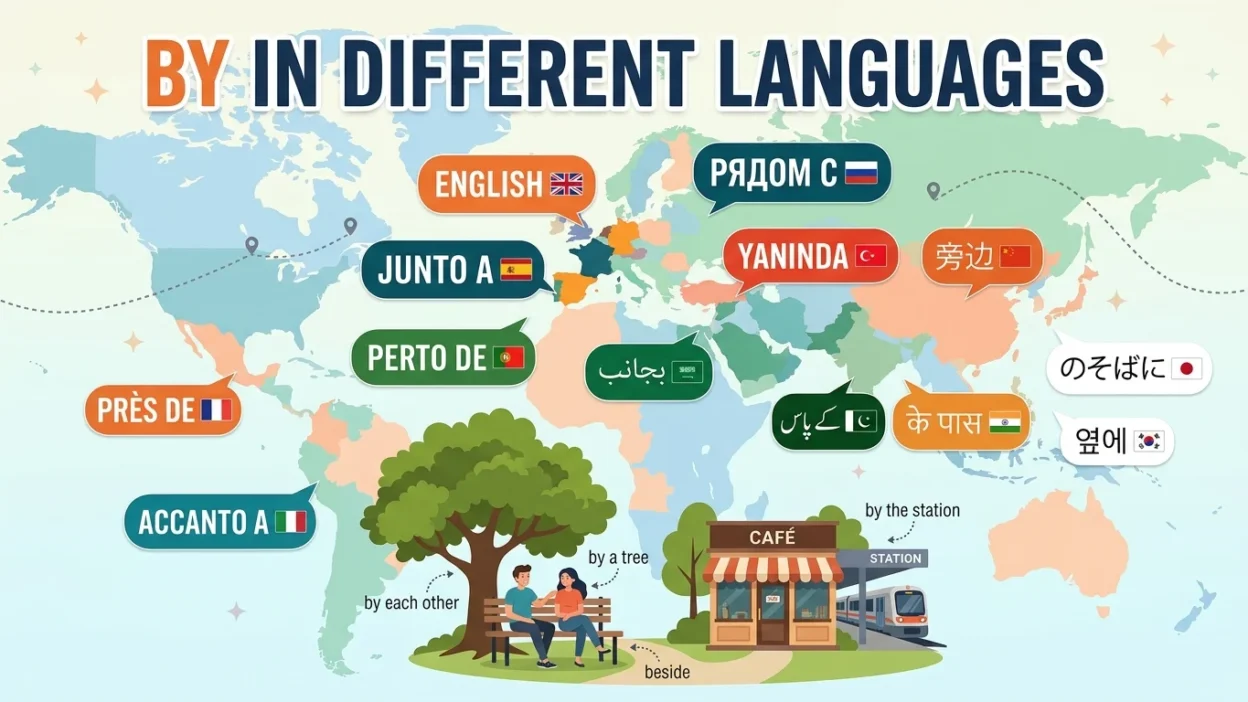
The word “by” is one of the most commonly used prepositions in English. It can describe a location, explain who performs an action, show how something happens, or indicate a deadline. However, its translation changes depending on the meaning and context.
If you want to learn how to say by in different languages, this guide will help you explore its translations, native expressions, pronunciation and everyday examples from around the world.
One important point: English “by” does not have one universal translation. To make the comparisons accurate, the main table below focuses on “by” meaning “near” or “next to”. For example, “The café is by the station.” Other meanings are explained in separate sections.
By in Different Languages
| Language | Native translation of “by” | Easy pronunciation | Example sentence | English meaning |
| Spanish | junto a | HOON-toh ah | El café está junto a la estación. | The café is by the station. |
| French | près de | preh duh | Le café est près de la gare. | The café is by the station. |
| German | neben | NAY-ben | Das Café ist neben dem Bahnhof. | The café is by the station. |
| Italian | accanto a | ah-KAHN-toh ah | Il bar è accanto alla stazione. | The café is by the station. |
| Portuguese | perto de | PEHR-too jee | O café fica perto da estação. | The café is by the station. |
| Dutch | naast | nahst | Het café is naast het station. | The café is by the station. |
| Afrikaans | langs | langs | Die kafee is langs die stasie. | The café is by the station. |
| Swedish | bredvid | breh-DVEED | Kaféet ligger bredvid stationen. | The café is by the station. |
| Norwegian | ved siden av | vehd SEE-den ahv | Kafeen ligger ved siden av stasjonen. | The café is by the station. |
| Danish | ved siden af | vehth SEE-den ah | Caféen ligger ved siden af stationen. | The café is by the station. |
| Icelandic | við hliðina á | vith HLEE-thin-ah ow | Kaffihúsið er við hliðina á stöðinni. | The café is by the station. |
| Finnish | vieressä | VYEH-rehs-sah | Kahvila on aseman vieressä. | The café is by the station. |
| Estonian | kõrval | KUR-val | Kohvik on jaama kõrval. | The café is by the station. |
| Latvian | blakus | BLAH-koos | Kafejnīca ir blakus stacijai. | The café is by the station. |
| Lithuanian | šalia | SHAH-lyah | Kavinė yra šalia stoties. | The café is by the station. |
| Polish | obok | OH-bok | Kawiarnia jest obok dworca. | The café is by the station. |
| Czech | vedle | VEH-dleh | Kavárna je vedle nádraží. | The café is by the station. |
| Slovak | vedľa | VEH-dlyah | Kaviareň je vedľa stanice. | The café is by the station. |
| Slovenian | poleg | POH-leg | Kavarna je poleg postaje. | The café is by the station. |
| Croatian | pored | POH-red | Kafić je pored stanice. | The café is by the station. |
| Serbian | поред | POH-red | Кафић је поред станице. | The café is by the station. |
| Bosnian | pored | POH-red | Kafić je pored stanice. | The café is by the station. |
| Bulgarian | до | doh | Кафенето е до гарата. | The café is by the station. |
| Macedonian | до | doh | Кафулето е до станицата. | The café is by the station. |
| Russian | рядом с | RYAH-duhm s | Кафе находится рядом со станцией. | The café is by the station. |
| Ukrainian | біля | BEE-lyah | Кафе біля вокзалу. | The café is by the station. |
| Belarusian | побач з | poh-BAHCH z | Кафэ знаходзіцца побач з вакзалам. | The café is by the station. |
| Greek | δίπλα σε | THEE-plah seh | Το καφέ είναι δίπλα στον σταθμό. | The café is by the station. |
| Albanian | pranë | PRAH-nuh | Kafeneja është pranë stacionit. | The café is by the station. |
| Romanian | lângă | LUHN-guh | Cafeneaua este lângă gară. | The café is by the station. |
| Hungarian | mellett | MEHL-lett | A kávézó az állomás mellett van. | The café is by the station. |
| Turkish | yanında | yah-NIN-dah | Kafe istasyonun yanında. | The café is by the station. |
| Azerbaijani | yanında | yah-NIN-dah | Kafe stansiyanın yanındadır. | The café is by the station. |
| Armenian | կողքին | kohgh-KEEN | Սրճարանը կայարանի կողքին է։ | The café is by the station. |
| Georgian | გვერდით | GVER-deet | კაფე სადგურის გვერდითაა. | The café is by the station. |
| Arabic | بجانب | bee-JAH-nib | المقهى بجانب المحطة. | The café is by the station. |
| Hebrew | ליד | leh-YAD | בית הקפה ליד התחנה. | The café is by the station. |
| Persian | کنار | ke-NAAR | کافه کنار ایستگاه است. | The café is by the station. |
| Urdu | کے پاس | kay paas | کیفے اسٹیشن کے پاس ہے۔ | The café is by the station. |
| Hindi | के पास | kay paas | कैफ़े स्टेशन के पास है। | The café is by the station. |
| Bengali | পাশে | PAH-sheh | ক্যাফেটি স্টেশনের পাশে। | The café is by the station. |
| Punjabi | ਕੋਲ | kol | ਕੈਫੇ ਸਟੇਸ਼ਨ ਦੇ ਕੋਲ ਹੈ। | The café is by the station. |
| Gujarati | પાસે | pah-say | કેફે સ્ટેશન પાસે છે. | The café is by the station. |
| Marathi | जवळ | juh-VUL | कॅफे स्टेशनजवळ आहे. | The café is by the station. |
| Nepali | छेउमा | chhay-oo-MAH | क्याफे स्टेशनको छेउमा छ। | The café is by the station. |
| Sinhala | අසල | AH-suh-lah | කැෆේ එක දුම්රිය ස්ථානය අසලයි. | The café is by the station. |
| Tamil | அருகில் | ah-ROO-geel | கஃபே நிலையத்திற்கு அருகில் உள்ளது. | The café is by the station. |
| Telugu | పక్కన | PUK-kuh-nuh | కేఫ్ స్టేషన్ పక్కన ఉంది. | The café is by the station. |
| Kannada | ಪಕ್ಕದಲ್ಲಿ | PUK-kuh-dul-lee | ಕೆಫೆ ನಿಲ್ದಾಣದ ಪಕ್ಕದಲ್ಲಿದೆ. | The café is by the station. |
| Malayalam | അടുത്ത് | ah-DUTTH | കഫേ സ്റ്റേഷന്റെ അടുത്താണ്. | The café is by the station. |
| Thai | ข้าง ๆ | khaang-khaang | คาเฟ่อยู่ข้างสถานี | The café is by the station. |
| Lao | ຂ້າງ | khaang | ຮ້ານກາເຟຢູ່ຂ້າງສະຖານີ | The café is by the station. |
| Khmer | ក្បែរ | kbaer | ហាងកាហ្វេនៅក្បែរស្ថានីយ៍។ | The café is by the station. |
| Vietnamese | cạnh | kahn | Quán cà phê ở cạnh nhà ga. | The café is by the station. |
| Indonesian | di dekat | dee duh-KAHT | Kafe itu berada di dekat stasiun. | The café is by the station. |
| Malay | berhampiran | ber-ham-PEE-ran | Kafe itu berhampiran stesen. | The café is by the station. |
| Filipino | katabi ng | kah-TAH-bee ng | Katabi ng istasyon ang café. | The café is by the station. |
| Swahili | karibu na | kah-REE-boo nah | Mkahawa uko karibu na kituo. | The café is by the station. |
| Zulu | eduze kwe | eh-DOO-zeh kweh | Ikhefi liseduze nesiteshi. | The café is by the station. |
| Xhosa | ecaleni kwe | eh-kah-LEH-nee kweh | Ikhefi lisecaleni kwesikhululo. | The café is by the station. |
| Yoruba | lẹ́gbẹ̀ẹ́ | leh-GHEH-eh | Kafe wa lẹ́gbẹ̀ẹ́ ibùdó ọkọ̀ ojú irin. | The café is by the station. |
| Igbo | n’akụkụ | nah-KOO-koo | Ebe a na-aṅụ kọfị dị n’akụkụ ọdụ ụgbọ oloko. | The café is by the station. |
| Hausa | kusa da | KOO-sah dah | Kafe yana kusa da tashar jirgin ƙasa. | The café is by the station. |
| Amharic | አጠገብ | ah-teh-GHEB | ካፌው ከጣቢያው አጠገብ ነው። | The café is by the station. |
| Somali | agta | AG-tah | Maqaaxidu waxay agta saldhigga ku taallaa. | The café is by the station. |
| Mandarin Chinese | 旁边 | pahng-BYEN | 咖啡馆在车站旁边。 | The café is by the station. |
| Japanese | のそばに | noh SOH-bah nee | カフェは駅のそばにあります。 | The café is by the station. |
| Korean | 옆에 | YUH-peh | 카페는 역 옆에 있어요. | The café is by the station. |
| Mongolian | хажууд | hah-JOOT | Кафе буудлын хажууд байдаг. | The café is by the station. |
What Does “By” Mean in English?
The word “by” is a preposition with several meanings. Its exact meaning depends on how it is used in a sentence.
Here are its most common meanings:
1. Near or beside: Something is located close to another thing.
Example: The house is by the river.
2. The person performing an action: It identifies who created or performed something.
Example: The book was written by a famous author.
3. The method used: It explains how an action is completed.
Example: She travelled by train.
4. A deadline: It indicates that something must happen before or no later than a particular time.
Example: Please finish the work by Monday.
5. The means of doing something: It describes the way someone achieves a result.
Example: He learned English by practising every day.
How to Say “By” in Different Languages Based on Context
Learning the correct “by” translations requires understanding the sentence. The same English word can have different equivalents in another language.
| English meaning | Example | Spanish | French | German |
| Near or beside | Sit by me. | junto a | près de | neben |
| Person responsible | Written by John. | escrito por | écrit par | geschrieben von |
| Method of travel | Travel by bus. | en autobús | en bus | mit dem Bus |
| Deadline | Finish by Friday. | para el viernes | d’ici vendredi | bis Freitag |
| Means or method | Learn by practising. | mediante la práctica | en pratiquant | durch Übung |
These examples show why context matters when translating “by” around the world.
Different Ways to Use “By” in Everyday English
The word “by” appears in conversations, books, instructions and everyday communication. Understanding its different uses can help you speak and write more naturally.
By Meaning Near or Beside
This is the meaning used in the 70-language table. It describes the position of a person or object close to something else.
Examples:
- She is standing by the door.
- There is a small shop by my house.
- He sat by his friend.
By Meaning Through or Using
When “by” describes a method, it explains how someone does something.
Examples:
- I go to work by car.
- You can improve your vocabulary by reading.
- She contacted me by email.
By Meaning Who Did Something
In passive sentences, “by” introduces the person or thing responsible for an action.
Examples:
- The painting was created by an artist.
- This song was written by my brother.
- The cake was made by my mother.
By Meaning Before a Deadline
When used with time, “by” usually means that something should happen no later than the specified time.
Examples:
- Submit your application by Monday.
- Please arrive by 9 a.m.
- I will complete the project by tomorrow.
Why Does “By” Have Different Translations Around the World?
Languages have different grammar rules, sentence structures and ways of expressing relationships. As a result, a single English preposition may require several different words in another language.
For example, Spanish uses junto a to express being beside something, but it commonly uses por or de in other contexts involving “by”.
Similarly, French uses près de for proximity, par for the person performing an action, and en for certain methods of transport.
This is why translating complete sentences is often more reliable than translating individual words.
Common Words and Expressions Related to “By”
Understanding related expressions can make it easier to recognise the meaning of “by” in everyday communication.
| English expression | Meaning | Example |
| By the way | Introducing an additional point | By the way, I called you yesterday. |
| By myself | Alone or without help | I completed the task by myself. |
| By hand | Using your hands | She made the decoration by hand. |
| By chance | Accidentally or unexpectedly | We met by chance. |
| By mistake | Accidentally | I sent the wrong message by mistake. |
| By heart | From memory | He knows the poem by heart. |
| By now | Before or at the present time | You should be home by now. |
| By far | To a great degree | This is by far the best option. |
Tips for Learning “By” in Different Languages
Learning prepositions can be challenging because their meanings do not always match across languages. These simple tips can make the process easier.
- Learn complete sentences: Memorise expressions in context instead of learning isolated translations.
- Practise everyday examples: Use sentences about travel, locations, people and deadlines.
- Compare similar expressions: Notice how different languages express the same idea.
- Listen to native speakers: Pay attention to how prepositions are used in natural conversations.
- Learn the grammar: Understand whether a language uses a preposition, a postposition or another grammatical structure.
- Review regularly: Repeat new expressions and use them in your own sentences.
Conclusion
The word “by” has several meanings in English, and its translation depends on the context. In this guide, you explored ways to express “by” meaning “near” or “beside” in different languages, along with native phrases, pronunciations and practical examples.
Whether you are learning Spanish, French, German, Hindi, Urdu, Japanese or another language, understanding the context will help you choose the right expression. Remember that learning complete sentences is one of the best ways to use translations naturally.
FAQs
1. How do you say “by” in different languages?
The translation depends on the meaning. For example, Spanish uses junto a for “by” meaning beside, French uses près de, German uses neben, and Hindi uses के पास.
2. What is the meaning of “by” in English?
“By” is a preposition that can describe location, the person performing an action, a method, or a deadline. Its meaning changes depending on the sentence.
3. How do you say “by” in Spanish?
For the meaning “near” or “beside”, Spanish commonly uses junto a. For example, “The café is by the station” can be translated as “El café está junto a la estación.”
4. What is the difference between “by” and “near”?
“Near” generally means close to something, while “by” can also mean beside something. “By” has additional meanings, including describing a method, an agent or a deadline.
5. Why does “by” have different translations in different languages?
Languages use different grammatical structures and expressions. A translation that works for location may not work for describing an action, method or deadline. Therefore, the correct translation depends on context.