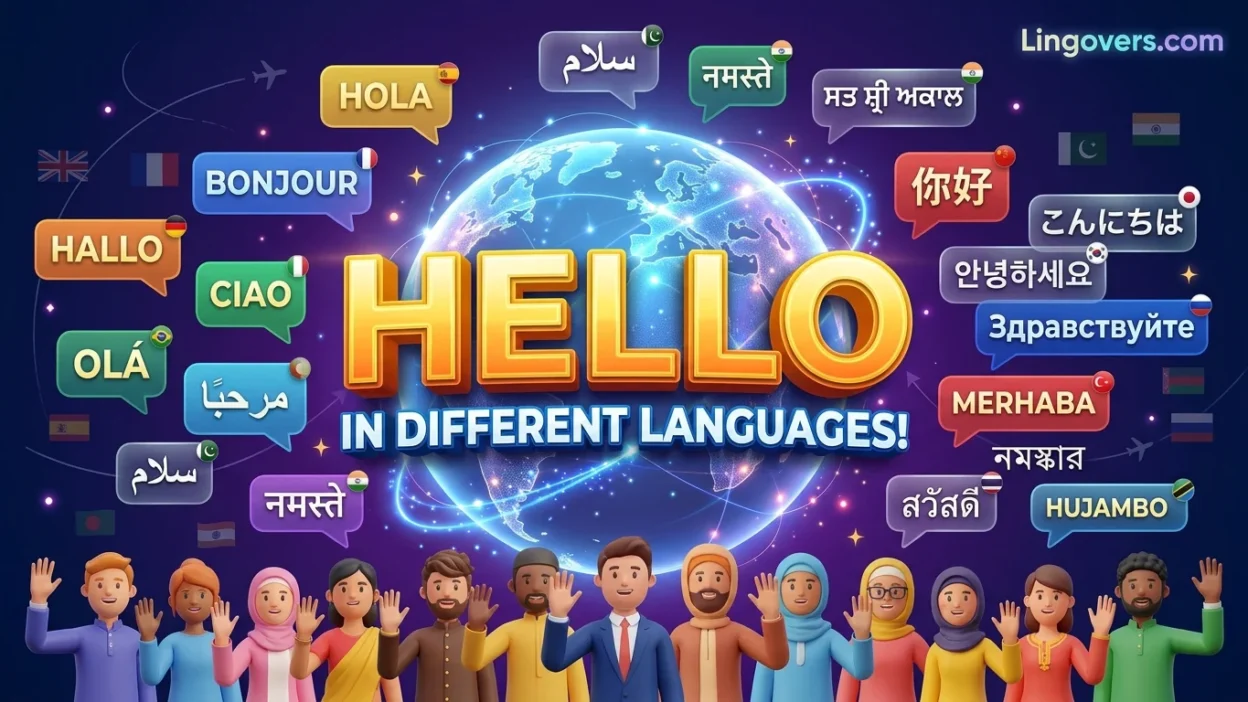
A simple “hello” can open a conversation, make someone feel welcome, and help people connect across cultures. Although English speakers commonly use the word “hello”, every language has its own greetings, expressions, and customs.
Learning how to say hello in different languages is useful when travelling, meeting people from other countries, learning a new language, or communicating with international friends. Some greetings are formal and polite, while others are casual and friendly.
In this guide, you will discover hello in different languages, including the correct native phrases, easy English pronunciations, and short real-life example sentences with their meanings.
Hello in Different Languages
| Language | Hello in Native Language | Easy Pronunciation | Example Sentence | English Meaning |
| English | Hello | Heh-loh | Hello, how are you today? | Hello, how are you today? |
| Spanish | Hola | Oh-lah | ¡Hola! ¿Cómo estás? | Hello! How are you? |
| French | Bonjour | Bohn-zhoor | Bonjour, comment allez-vous? | Hello, how are you? |
| German | Hallo | Hah-loh | Hallo, wie geht es dir? | Hello, how are you? |
| Italian | Ciao | Chow | Ciao, come stai? | Hello, how are you? |
| Portuguese | Olá | Oh-lah | Olá, tudo bem? | Hello, is everything okay? |
| Dutch | Hallo | Hah-loh | Hallo, hoe gaat het? | Hello, how are you? |
| Afrikaans | Hallo | Hah-loh | Hallo, hoe gaan dit? | Hello, how are you? |
| Swedish | Hej | Hey | Hej, hur mår du? | Hello, how are you? |
| Norwegian | Hei | Hay | Hei, hvordan har du det? | Hello, how are you? |
| Danish | Hej | Hi | Hej, hvordan går det? | Hello, how are things? |
| Icelandic | Halló | Hah-loh | Halló, hvernig hefurðu það? | Hello, how are you? |
| Finnish | Hei | Hay | Hei, mitä kuuluu? | Hello, how are you? |
| Estonian | Tere | Teh-reh | Tere, kuidas läheb? | Hello, how are you? |
| Latvian | Sveiki | Svay-kee | Sveiki, kā jums klājas? | Hello, how are you? |
| Lithuanian | Labas | Lah-bahs | Labas, kaip sekasi? | Hello, how are you? |
| Polish | Cześć | Cheshch | Cześć, jak się masz? | Hello, how are you? |
| Czech | Ahoj | Ah-hoy | Ahoj, jak se máš? | Hello, how are you? |
| Slovak | Ahoj | Ah-hoy | Ahoj, ako sa máš? | Hello, how are you? |
| Slovenian | Živjo | Zheev-yoh | Živjo, kako si? | Hello, how are you? |
| Croatian | Bok | Bohk | Bok, kako si? | Hello, how are you? |
| Serbian | Здраво | Zdra-voh | Здраво, како си? | Hello, how are you? |
| Bosnian | Zdravo | Zdra-voh | Zdravo, kako si? | Hello, how are you? |
| Bulgarian | Здравейте | Zdra-vey-teh | Здравейте, как сте? | Hello, how are you? |
| Macedonian | Здраво | Zdra-voh | Здраво, како си? | Hello, how are you? |
| Russian | Здравствуйте | Zdra-stvooy-tyeh | Здравствуйте, как дела? | Hello, how are you? |
| Ukrainian | Привіт | Pry-veet | Привіт, як справи? | Hello, how are you? |
| Belarusian | Прывітанне | Pry-vee-tan-nyeh | Прывітанне, як справы? | Hello, how are you? |
| Greek | Γεια σου | Yah-soo | Γεια σου, τι κάνεις; | Hello, how are you? |
| Albanian | Përshëndetje | Per-shen-det-yeh | Përshëndetje, si jeni? | Hello, how are you? |
| Romanian | Bună | Boo-nuh | Bună, ce mai faci? | Hello, how are you? |
| Hungarian | Szia | See-yah | Szia, hogy vagy? | Hello, how are you? |
| Turkish | Merhaba | Mehr-hah-bah | Merhaba, nasılsınız? | Hello, how are you? |
| Arabic | مرحبًا | Mar-ha-ban | مرحبًا، كيف حالك؟ | Hello, how are you? |
| Hebrew | שלום | Shah-lohm | שלום, מה שלומך? | Hello, how are you? |
| Persian | سلام | Sa-laam | سلام، حال شما چطور است؟ | Hello, how are you? |
| Urdu | سلام | Sa-laam | سلام، آپ کیسے ہیں؟ | Hello, how are you? |
| Hindi | नमस्ते | Na-mas-tay | नमस्ते, आप कैसे हैं? | Hello, how are you? |
| Bengali | নমস্কার | Noh-mosh-kar | নমস্কার, আপনি কেমন আছেন? | Hello, how are you? |
| Punjabi | ਸਤ ਸ੍ਰੀ ਅਕਾਲ | Sat Sri Ah-kaal | ਸਤ ਸ੍ਰੀ ਅਕਾਲ, ਤੁਸੀਂ ਕਿਵੇਂ ਹੋ? | Hello, how are you? |
| Gujarati | નમસ્તે | Na-mas-tay | નમસ્તે, તમે કેમ છો? | Hello, how are you? |
| Marathi | नमस्कार | Na-mas-kaar | नमस्कार, तुम्ही कसे आहात? | Hello, how are you? |
| Nepali | नमस्ते | Na-mas-tay | नमस्ते, तपाईंलाई कस्तो छ? | Hello, how are you? |
| Sinhala | ආයුබෝවන් | Aa-yu-bo-wan | ආයුබෝවන්, ඔබට කොහොමද? | Hello, how are you? |
| Tamil | வணக்கம் | Va-na-kkam | வணக்கம், நீங்கள் எப்படி இருக்கிறீர்கள்? | Hello, how are you? |
| Telugu | నమస్కారం | Na-mas-kaa-ram | నమస్కారం, మీరు ఎలా ఉన్నారు? | Hello, how are you? |
| Kannada | ನಮಸ್ಕಾರ | Na-mas-kaa-ra | ನಮಸ್ಕಾರ, ನೀವು ಹೇಗಿದ್ದೀರಿ? | Hello, how are you? |
| Malayalam | നമസ്കാരം | Na-mas-kaa-ram | നമസ്കാരം, സുഖമാണോ? | Hello, are you well? |
| Thai | สวัสดี | Sa-wat-dee | สวัสดี คุณสบายดีไหม? | Hello, are you well? |
| Lao | ສະບາຍດີ | Sa-bai-dee | ສະບາຍດີ, ສະບາຍດີບໍ? | Hello, how are you? |
| Khmer | សួស្តី | Suor-sdei | សួស្តី អ្នកសុខសប្បាយទេ? | Hello, how are you? |
| Vietnamese | Xin chào | Sin chow | Xin chào, bạn khỏe không? | Hello, how are you? |
| Chinese (Mandarin) | 你好 | Nee-how | 你好,你好吗? | Hello, how are you? |
| Japanese | こんにちは | Kohn-nee-chee-wah | こんにちは、お元気ですか? | Hello, how are you? |
| Korean | 안녕하세요 | An-nyeong-ha-se-yo | 안녕하세요, 잘 지내세요? | Hello, are you doing well? |
| Mongolian | Сайн байна уу | Sain bai-naa oo | Сайн байна уу, та сайн уу? | Hello, how are you? |
| Indonesian | Halo | Hah-loh | Halo, apa kabar? | Hello, how are you? |
| Malay | Helo | Heh-loh | Helo, apa khabar? | Hello, how are you? |
| Filipino | Kumusta | Koo-moos-tah | Kumusta, kamusta ka? | Hello, how are you? |
| Swahili | Hujambo | Hoo-jahm-boh | Hujambo, habari gani? | Hello, how are you? |
| Amharic | ሰላም | Seh-lam | ሰላም፣ እንዴት ነዎት? | Hello, how are you? |
| Somali | Salaan | Sah-laan | Salaan, sidee tahay? | Hello, how are you? |
| Yoruba | Ẹ n lẹ | Eh-n-leh | Ẹ n lẹ, ṣé àlàáfíà ni? | Hello, are you well? |
| Igbo | Ndewo | N-deh-woh | Ndewo, kedụ ka ị mere? | Hello, how are you? |
| Zulu | Sawubona | Sah-woo-boh-nah | Sawubona, unjani? | Hello, how are you? |
| Xhosa | Molo | Moh-loh | Molo, unjani? | Hello, how are you? |
| Shona | Mhoro | M-hoh-roh | Mhoro, wakadini? | Hello, how are you? |
| Irish | Dia dhuit | Dee-ah gwit | Dia dhuit, conas atá tú? | Hello, how are you? |
| Welsh | Helo | Heh-loh | Helo, sut wyt ti? | Hello, how are you? |
| Basque | Kaixo | Kai-shoh | Kaixo, zer moduz? | Hello, how are you? |
Note: Some languages have different greetings depending on formality, time of day, region, and the relationship between speakers. The examples above show common ways to greet someone.
Why Do Different Languages Have Different Words for Hello?
Every language develops greetings through its own history, culture, and social customs. Although the purpose is usually the same—to acknowledge someone and begin a conversation—the expressions can be very different.
For example, Spanish speakers commonly say “Hola”, French speakers use “Bonjour”, and Japanese speakers often say “Konnichiwa” during the day.
Some greetings are connected to respect and politeness. Others are short, relaxed expressions used between friends and family.
Learning these differences helps you understand not only the words but also the cultures in which they are spoken.
Formal and Informal Ways to Say Hello
Not every greeting is suitable for every situation. Some expressions are better for professional conversations, while others are more natural among friends.
Here are a few examples:
| Language | Formal Greeting | Informal Greeting |
| English | Good morning | Hi |
| Spanish | Buenos días | Hola |
| French | Bonjour | Salut |
| German | Guten Tag | Hallo |
| Italian | Buongiorno | Ciao |
| Portuguese | Bom dia | Oi |
| Japanese | こんにちは | やあ |
| Korean | 안녕하세요 | 안녕 |
| Arabic | السلام عليكم | أهلًا |
| Hindi | नमस्ते | नमस्कार |
When speaking to someone for the first time, a polite or formal greeting is generally a safe choice. With friends, family, and people you know well, casual greetings may sound more natural.
How to Say Hello in Different Languages Around the World
Greetings can tell us a lot about the people and traditions of a country. Here are some interesting examples from different regions.
Greetings in Europe
European languages have a wide variety of greetings. Some are similar in spelling or sound, while others have distinctive forms.
- Spanish: Hola
- French: Bonjour
- German: Hallo
- Italian: Ciao
- Polish: Cześć
- Greek: Γεια σου
- Russian: Здравствуйте
- Swedish: Hej
In several European languages, one greeting can be used casually, while another is preferred in formal situations.
Greetings in Asia
Asian languages often use greetings that reflect politeness, respect, and social relationships.
- Hindi: नमस्ते
- Urdu: سلام
- Chinese: 你好
- Japanese: こんにちは
- Korean: 안녕하세요
- Thai: สวัสดี
- Vietnamese: Xin chào
- Bengali: নমস্কার
In Japanese and Korean, the choice of greeting can depend on the speaker’s relationship with the listener and the level of formality.
Greetings in Africa
Africa is home to thousands of languages, each with its own expressions and cultural traditions.
Some examples include:
- Swahili: Hujambo
- Zulu: Sawubona
- Xhosa: Molo
- Yoruba: Ẹ n lẹ
- Igbo: Ndewo
- Amharic: ሰላም
- Somali: Salaan
- Shona: Mhoro
These greetings are useful examples of the linguistic diversity found across the African continent.
What Is the Most Common Way to Say Hello?
“Hello” is one of the most widely recognised English greetings. However, there is no single greeting used by everyone around the world.
Some widely used greetings include:
| Language | Common Greeting |
| English | Hello |
| Spanish | Hola |
| French | Bonjour |
| German | Hallo |
| Arabic | Marhaba |
| Hindi | Namaste |
| Chinese | Nǐ hǎo |
| Japanese | Konnichiwa |
| Korean | Annyeonghaseyo |
| Portuguese | Olá |
The best greeting depends on the language, location, and situation. Learning even one simple greeting in another language can make a conversation feel warmer and more welcoming.
Why Is Learning Hello in Other Languages Useful?
Learning greetings in other languages offers several practical benefits.
1. Makes travelling easier
Knowing how to greet people can help you start conversations when visiting another country. It can also make everyday interactions more comfortable.
2. Shows respect for other cultures
Using a local greeting shows that you appreciate the language and customs of the people you meet.
3. Helps you learn new languages
Greetings are usually among the first expressions language learners study. They provide a simple way to practise pronunciation and basic conversation.
4. Builds international connections
A friendly greeting can help you connect with classmates, colleagues, customers, and friends from different parts of the world.
5. Improves communication
Understanding common greetings makes it easier to recognise when someone is welcoming you or starting a conversation.
Tips for Pronouncing Greetings Correctly
Reading a greeting is one thing, but saying it naturally takes a little practice. These tips can help:
- Listen carefully: Pay attention to how native speakers pronounce each word.
- Practise slowly: Start with individual sounds before saying the complete greeting.
- Notice the accent: Some languages use sounds that may not exist in English.
- Learn the context: Check whether a greeting is formal, informal, or suitable for a particular time of day.
- Repeat regularly: Practising a few greetings each day can improve your confidence.
Remember that pronunciation guides written in English are only approximations. Listening to native speakers is the best way to learn the exact sounds.
Conclusion
Learning how to say hello in different languages is a simple way to explore the world’s cultures and connect with people. From “Hola” in Spanish and “Bonjour” in French to “你好” in Chinese and “नमस्ते” in Hindi, every greeting offers a friendly way to begin a conversation.
With these 70 hello translations, you can practise greetings, prepare for international travel, and make a positive first impression wherever you go.
FAQs
1. How do you say hello in different languages?
You can say hello in many ways, including Hola in Spanish, Bonjour in French, Hallo in German, Ciao in Italian, Namaste in Hindi, Nǐ hǎo in Chinese, and Konnichiwa in Japanese. The table above includes greetings with native spelling and pronunciation guides.
2. What is the most widely used word for hello?
“Hello” is widely recognised and commonly used in English-speaking countries. Other popular greetings include Hola, Bonjour, Hallo, and Ciao, depending on the language and region.
3. How do you say hello in different languages in writing?
Each language has its own written form. For example, hello is written as Hola in Spanish, Bonjour in French, 你好 in Chinese, नमस्ते in Hindi, and 안녕하세요 in Korean.
4. What is a polite way to say hello in another language?
A polite greeting depends on the language and situation. Examples include Bonjour in French, Guten Tag in German, 안녕하세요 in Korean, नमस्ते in Hindi, and مرحبًا in Arabic.
5. Why should I learn hello in different languages?
Learning greetings helps you communicate when travelling, understand other cultures, practise new languages, and make friendly connections with people around the world.