The word “baby” is one of the sweetest and most widely recognised words around the world. It refers to a very young child and is often associated with love, happiness, innocence, and family. Although babies are part of every culture, the word used to describe them sounds different in every language.
Have you ever wondered how to say baby in Spanish, French, Japanese, Arabic, or Hindi? Each language has its own special word, pronunciation, and cultural expressions for a little child.
In this guide, you will discover baby in different languages in all languages, with translations, easy English pronunciations, and simple real-life example sentences. Whether you are learning a new language, exploring international vocabulary, or simply curious about words around the world, this list will help you discover how people say baby across different cultures.
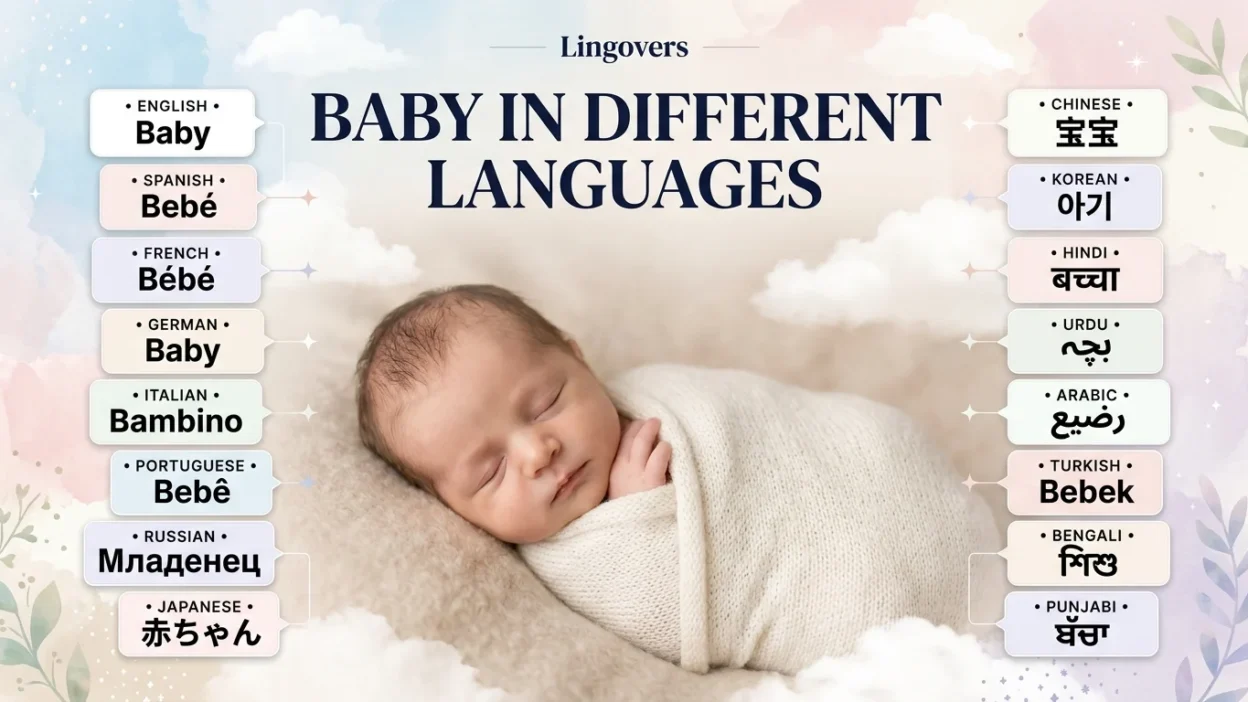
Baby in Different Languages
| Language | Native Word | Pronunciation | Example Sentence | English Meaning |
| English | Baby | BAY-bee | The baby is sleeping. | The baby is sleeping. |
| Spanish | Bebé | Beh-BEH | El bebé está durmiendo. | The baby is sleeping. |
| French | Bébé | Bay-BAY | Le bébé est mignon. | The baby is cute. |
| German | Baby | BAY-bee | Das Baby schläft. | The baby is sleeping. |
| Italian | Bambino | Bam-BEE-noh | Il bambino dorme. | The baby is sleeping. |
| Portuguese | Bebê | Beh-BEH | O bebê está dormindo. | The baby is sleeping. |
| Dutch | Baby | BAY-bee | De baby slaapt. | The baby is sleeping. |
| Russian | Младенец | Mlah-DYE-nets | Младенец спит. | The baby is sleeping. |
| Ukrainian | Немовля | Neh-mov-LYAH | Немовля спить. | The baby is sleeping. |
| Polish | Niemowlę | Nyeh-MOV-lyeh | Niemowlę śpi. | The baby is sleeping. |
| Czech | Miminko | MEE-meen-koh | Miminko spí. | The baby is sleeping. |
| Slovak | Bábätko | BAA-byet-koh | Bábätko spí. | The baby is sleeping. |
| Slovenian | Dojenček | Doh-YEN-chek | Dojenček spi. | The baby is sleeping. |
| Croatian | Beba | BEH-bah | Beba spava. | The baby is sleeping. |
| Serbian | Беба | BEH-bah | Беба спава. | The baby is sleeping. |
| Bulgarian | Бебе | BEH-beh | Бебето спи. | The baby is sleeping. |
| Romanian | Bebeluș | Beh-beh-LOOSH | Bebelușul doarme. | The baby is sleeping. |
| Hungarian | Baba | BAH-bah | A baba alszik. | The baby is sleeping. |
| Greek | Μωρό | Moh-ROH | Το μωρό κοιμάται. | The baby is sleeping. |
| Turkish | Bebek | Beh-BEK | Bebek uyuyor. | The baby is sleeping. |
| Arabic | رضيع | Ra-DEE | الرضيع نائم. | The baby is sleeping. |
| Hebrew | תינוק | Tee-NOHK | התינוק ישן. | The baby is sleeping. |
| Persian | نوزاد | Noo-ZAAD | نوزاد خواب است. | The baby is asleep. |
| Urdu | بچہ | Bach-cha | بچہ سو رہا ہے۔ | The baby is sleeping. |
| Hindi | बच्चा | Bach-chaa | बच्चा सो रहा है। | The baby is sleeping. |
| Bengali | শিশু | Shee-shoo | শিশুটি ঘুমাচ্ছে। | The baby is sleeping. |
| Punjabi | ਬੱਚਾ | Bach-chaa | ਬੱਚਾ ਸੌਂ ਰਿਹਾ ਹੈ। | The baby is sleeping. |
| Gujarati | બાળક | Baa-lak | બાળક સૂઈ રહ્યું છે. | The baby is sleeping. |
| Marathi | बाळ | Baal | बाळ झोपले आहे. | The baby is sleeping. |
| Nepali | शिशु | Shee-shoo | शिशु सुतिरहेको छ। | The baby is sleeping. |
| Sinhala | බිළිඳා | Bi-lin-daa | බිළිඳා නිදාගෙන සිටියි. | The baby is sleeping. |
| Tamil | குழந்தை | Koo-lun-thai | குழந்தை தூங்குகிறது. | The baby is sleeping. |
| Telugu | శిశువు | Shi-shu-vu | శిశువు నిద్రపోతోంది. | The baby is sleeping. |
| Kannada | ಮಗು | Ma-gu | ಮಗು ನಿದ್ರಿಸುತ್ತಿದೆ. | The baby is sleeping. |
| Malayalam | കുഞ്ഞ് | Kunj | കുഞ്ഞ് ഉറങ്ങുന്നു. | The baby is sleeping. |
| Chinese (Mandarin) | 宝宝 | Bǎo-bǎo | 宝宝在睡觉。 | The baby is sleeping. |
| Japanese | 赤ちゃん | Akachan | 赤ちゃんが寝ています。 | The baby is sleeping. |
| Korean | 아기 | A-gi | 아기가 자고 있어요. | The baby is sleeping. |
| Vietnamese | Em bé | Em-BEH | Em bé đang ngủ. | The baby is sleeping. |
| Thai | ทารก | Thaa-rok | ทารกกำลังนอนหลับ | The baby is sleeping. |
| Indonesian | Bayi | BAA-yee | Bayi itu sedang tidur. | The baby is sleeping. |
| Malay | Bayi | BAA-yee | Bayi itu sedang tidur. | The baby is sleeping. |
| Filipino (Tagalog) | Sanggol | Sang-GOL | Natutulog ang sanggol. | The baby is sleeping. |
| Burmese | ကလေးငယ် | Ka-lay-ngè | ကလေးငယ် အိပ်နေတယ်။ | The baby is sleeping. |
| Khmer | ទារក | Thia-rok | ទារកកំពុងគេង។ | The baby is sleeping. |
| Lao | ເດັກນ້ອຍ | Dek-noy | ເດັກນ້ອຍກຳລັງນອນ. | The baby is sleeping. |
| Mongolian | Нярай | Nyaa-rai | Нярай унтаж байна. | The baby is sleeping. |
| Kazakh | Нәресте | Nuh-res-teh | Нәресте ұйықтап жатыр. | The baby is sleeping. |
| Uzbek | Chaqaloq | Cha-qa-loq | Chaqaloq uxlayapti. | The baby is sleeping. |
| Azerbaijani | Körpə | Kur-pah | Körpə yatır. | The baby is sleeping. |
| Armenian | Մանուկ | Mah-nook | Մանուկը քնած է։ | The baby is sleeping. |
| Georgian | ჩვილი | Chvee-lee | ჩვილს სძინავს. | The baby is sleeping. |
| Albanian | Foshnjë | FOSH-nyeh | Foshnja po fle. | The baby is sleeping. |
| Icelandic | Barn | BARTN | Barnið sefur. | The baby is sleeping. |
| Swedish | Bebis | BEH-bis | Bebisen sover. | The baby is sleeping. |
| Norwegian | Baby | BAH-bee | Babyen sover. | The baby is sleeping. |
| Danish | Baby | BAY-bee | Babyen sover. | The baby is sleeping. |
| Finnish | Vauva | VOW-vah | Vauva nukkuu. | The baby is sleeping. |
| Estonian | Beebi | BAY-bee | Beebi magab. | The baby is sleeping. |
| Latvian | Mazulis | MAH-zoo-lis | Mazulis guļ. | The baby is sleeping. |
| Lithuanian | Kūdikis | KOO-di-kis | Kūdikis miega. | The baby is sleeping. |
| Irish | Leanbh | LAN-iv | Tá an leanbh ina chodladh. | The baby is sleeping. |
| Welsh | Babi | BAH-bee | Mae’r babi’n cysgu. | The baby is sleeping. |
| Scottish Gaelic | Pàisde | PAASH-cheh | Tha am pàisde na chadal. | The baby is sleeping. |
| Basque | Haurtxo | HOWR-cho | Haurtxoa lo dago. | The baby is sleeping. |
| Catalan | Nadó | Nah-THOH | El nadó dorm. | The baby is sleeping. |
| Swahili | Mtoto mchanga | M-TOH-toh m-CHAN-gah | Mtoto mchanga amelala. | The baby is sleeping. |
| Afrikaans | Baba | BAH-bah | Die baba slaap. | The baby is sleeping. |
Note: Pronunciations are approximate English-friendly guides. Some languages have different words for a newborn, an infant, and a young child. The translations above generally refer to a baby or infant.
How to Say Baby in Different Languages
The word baby can be expressed in several ways depending on the language and cultural context. Some languages use a word specifically for infants, while others use affectionate terms for little children.
Here are some popular examples:
- Spanish: Bebé
- French: Bébé
- German: Baby
- Italian: Bambino
- Japanese: 赤ちゃん (Akachan)
- Korean: 아기 (Agi)
- Chinese: 宝宝 (Bǎobǎo)
- Hindi: बच्चा (Bachcha)
- Urdu: بچہ (Bachcha)
- Arabic: رضيع (Radee)
These words are useful when travelling, learning a foreign language, communicating with international friends, or exploring vocabulary related to family and children.
Different Ways to Say Baby Around the World
Not every language uses the same type of expression for a baby. Some words are formal, while others are commonly used in everyday conversations.
For example:
Formal words: Terms such as infant, newborn, and their equivalents are often used in medical or educational situations.
Everyday words: Words such as bebé, baby, and beba are commonly heard in ordinary conversations.
Affectionate words: Families often use sweet nicknames and expressions when speaking to or about their little ones.
Understanding these differences helps you choose the right word for different situations.
Two More Baby Translations
These additional languages complete the collection of 70 translations.
| Language | Native Word | Pronunciation | Example Sentence | English Meaning |
| Zulu | Usana | Oo-SAH-nah | Usana lulele. | The baby is sleeping. |
| Yoruba | Ọmọ ọwọ́ | Oh-moh aw-WAW | Ọmọ ọwọ́ ń sùn. | The baby is sleeping. |
Why Do Baby Words Differ Between Languages?
Every language has its own history, vocabulary, and cultural expressions. This is why the word baby can sound completely different across countries.
Here are some reasons behind these differences:
1. Historical development: Words have developed over generations, influenced by older languages and local traditions.
2. Cultural expressions: Some cultures use special affectionate words when talking about babies and young children.
3. Regional vocabulary: Different regions may use different words for newborns, infants, and toddlers.
4. Language structure: Some languages use one general word for a baby, while others distinguish between age groups or stages of childhood.
Cute and Affectionate Words for Baby in Different Languages
Many languages have adorable words that parents use when talking to their little ones.
Here are some popular examples:
| Language | Word | Meaning |
| Spanish | Bebito / Bebita | Little baby |
| French | Petit bébé | Little baby |
| Italian | Piccolino / Piccolina | Little one |
| Portuguese | Bebezinho | Little baby |
| German | Babychen | Little baby |
| Japanese | 赤ちゃん | Baby |
| Korean | 아가 | Little baby |
| Hindi | नन्हा बच्चा | Tiny baby |
| Urdu | ننھا بچہ | Little baby |
| Arabic | صغير | Little one |
These expressions are especially common in affectionate conversations, family settings, and interactions with young children.
Baby-Related Vocabulary in Different Languages
Learning related words can help you expand your vocabulary beyond the word baby itself.
| English Word | Spanish | French | German | Hindi |
| Baby | Bebé | Bébé | Baby | बच्चा |
| Mother | Madre | Mère | Mutter | माँ |
| Father | Padre | Père | Vater | पिता |
| Child | Niño | Enfant | Kind | बच्चा |
| Family | Familia | Famille | Familie | परिवार |
| Milk | Leche | Lait | Milch | दूध |
| Toy | Juguete | Jouet | Spielzeug | खिलौना |
| Cradle | Cuna | Berceau | Wiege | पालना |
Tips for Learning Baby in Different Languages
Learning new vocabulary becomes easier when you practise regularly. Here are some simple ways to remember baby translations:
- Start with familiar languages: Learn words in languages you already recognise.
- Practise pronunciation: Say each word aloud several times.
- Learn native spelling: Become familiar with different alphabets and writing systems.
- Use example sentences: Practise using each word in everyday conversations.
- Compare similar words: Notice how some languages share similar vocabulary.
- Revise regularly: Spend a few minutes reviewing previously learned translations.
These simple techniques can help you remember new words and improve your language skills.
Conclusion
The word baby has many beautiful translations around the world. From bebé in Spanish and French to akachan in Japanese, bǎobǎo in Chinese, and bachcha in Hindi and Urdu, every language has its own way of expressing this special word.
This collection of 70 baby translations, pronunciations, and example sentences makes it easier to explore international vocabulary. Keep practising these words and discover how different cultures express love and affection for little ones.
FAQs
1. How do you say baby in different languages?
Baby is expressed differently across languages. Some popular translations include Bebé in Spanish, Bébé in French, Baby in German, Bambino in Italian, Akachan in Japanese, and Bachcha in Hindi.
2. What is baby called in Spanish?
Baby is called Bebé in Spanish. It is pronounced Beh-BEH and is commonly used when talking about infants and young children.
3. How do you say baby in Japanese?
In Japanese, baby is called 赤ちゃん (Akachan). It is a common and affectionate expression used when referring to a baby.
4. What is the word for baby in Hindi and Urdu?
In Hindi, baby is commonly called बच्चा (Bachcha). In Urdu, it is written as بچہ (Bachcha). Both words can refer to a baby or young child.
5. What is the difference between baby, infant, and newborn?
A newborn is a recently born baby, generally during the first 28 days of life. An infant is a young child under one year old. Baby is a more general everyday word that can refer to a newborn or a young infant.