When someone sneezes, saying “bless you” is a simple way to show kindness and good manners. Although the phrase is common in English-speaking countries, people around the world use different words and expressions to respond to a sneeze.
Learning how to say bless you in different languages helps you understand cultural traditions, communicate naturally with people from other countries, and learn useful everyday vocabulary. Some languages use a direct equivalent of “bless you”, while others express good health, offer a religious blessing, or wish the person well.
In this guide, you will discover expressions for saying “bless you” in different languages, along with native spellings, easy English pronunciations, practical example sentences, and their English meanings.
How Do You Say Bless You in Different Languages?
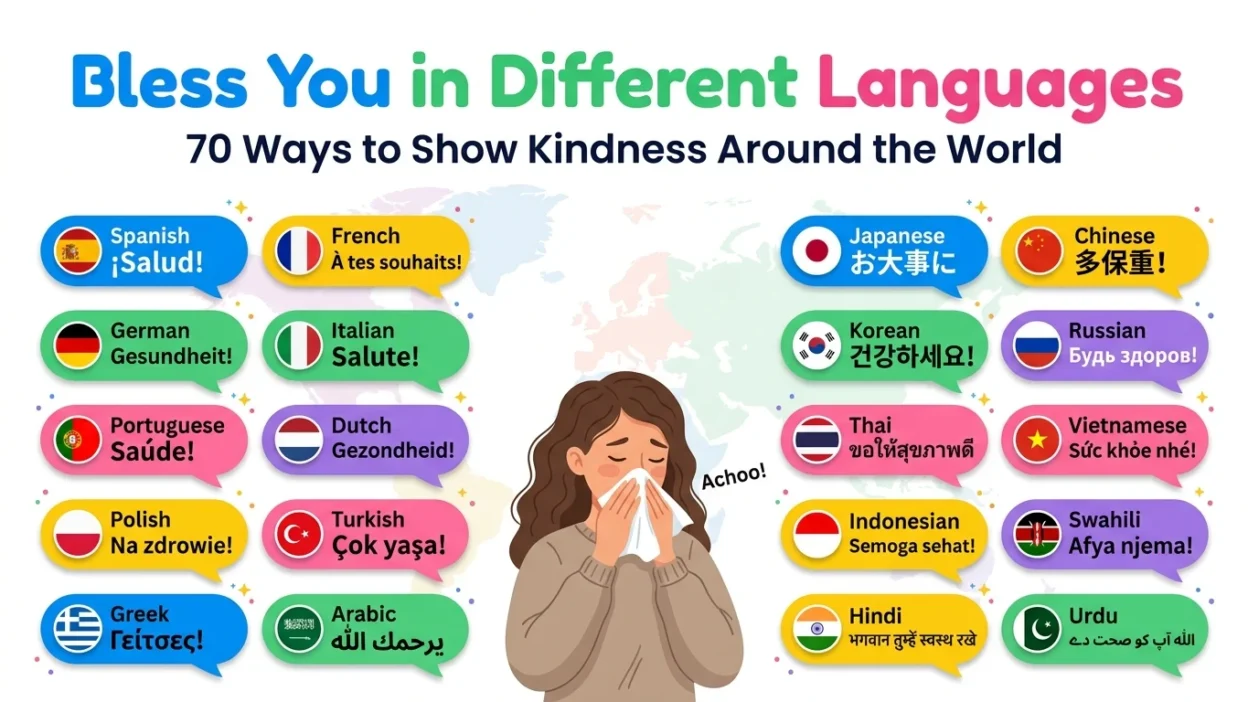
The expression depends on the language and cultural context. For example, Spanish speakers commonly say “¡Salud!”, French speakers say “À tes souhaits!” to someone they know, and German speakers often say “Gesundheit!”
In some languages, the expression changes depending on whether you are speaking to a friend, a family member, or someone you should address politely.
Bless You in Different Languages
| Language | Native phrase | Easy English pronunciation | Example sentence | English meaning |
| English | Bless you! | Bless yoo | Bless you! Are you feeling okay? | Bless you! Are you feeling okay? |
| Spanish | ¡Salud! | Sah-LOOD | ¡Salud! Espero que estés bien. | Bless you! I hope you are well. |
| French | À tes souhaits ! | Ah tay sweh | À tes souhaits ! | Bless you! |
| German | Gesundheit! | Geh-ZOONT-hайт | Gesundheit! Take care of yourself. | Bless you! Take care of yourself. |
| Italian | Salute! | Sah-LOO-teh | Salute! Stai bene? | Bless you! Are you okay? |
| Portuguese | Saúde! | Sah-OO-jeh | Saúde! Espero que esteja bem. | Bless you! I hope you are well. |
| Dutch | Gezondheid! | Geh-ZONT-hайт | Gezondheid! Gaat het goed? | Bless you! Are you feeling well? |
| Afrikaans | Gesondheid! | Khuh-SONT-hайт | Gesondheid! Voel jy goed? | Bless you! Are you feeling well? |
| Swedish | Prosit! | PROH-sit | Prosit! Går det bra? | Bless you! Is everything okay? |
| Norwegian | Prosit! | PROH-sit | Prosit! Håper du har det bra. | Bless you! I hope you are well. |
| Danish | Prosit! | PROH-sit | Prosit! Er du okay? | Bless you! Are you okay? |
| Finnish | Terveydeksi! | TEHR-vey-dehk-see | Terveydeksi! Toivottavasti voit hyvin. | Bless you! I hope you feel well. |
| Icelandic | Guð hjálpi þér! | Gvuth hyowl-pih thyair | Guð hjálpi þér! | May God help you! |
| Irish | Dia linn! | Dee-ah lin | Dia linn! | God be with us! |
| Scottish Gaelic | Slàinte! | SLAAN-chuh | Slàinte! | Health! |
| Welsh | Bendith arnat ti! | BEN-dith AR-nat tee | Bendith arnat ti! | Blessing upon you! |
| Polish | Na zdrowie! | Nah zdroh-vyeh | Na zdrowie! Wszystko dobrze? | Bless you! Is everything okay? |
| Czech | Na zdraví! | Nah zdrah-vee | Na zdraví! | Bless you! |
| Slovak | Na zdravie! | Nah zdrah-vyeh | Na zdravie! Dúfam, že si v poriadku. | Bless you! I hope you are okay. |
| Slovenian | Na zdravje! | Nah zdrahv-yeh | Na zdravje! | Bless you! |
| Croatian | Nazdravlje! | Nahz-drahv-lyeh | Nazdravlje! | Bless you! |
| Serbian | Наздравље! | Nahz-drahv-lyeh | Наздравље! | Bless you! |
| Bosnian | Nazdravlje! | Nahz-drahv-lyeh | Nazdravlje! | Bless you! |
| Bulgarian | Наздраве! | Nahz-drah-veh | Наздраве! | Bless you! |
| Macedonian | На здравје! | Nah zdrahv-yeh | На здравје! | Bless you! |
| Russian | Будь здоров! | Boot zdah-ROHF | Будь здоров! | Be healthy! |
| Ukrainian | Будь здоров! | Boot zdoh-ROHF | Будь здоров! | Be healthy! |
| Belarusian | Будзь здаровы! | Bootz dzah-ROH-vih | Будзь здаровы! | Be healthy! |
| Greek | Γείτσες! | YEE-tsehs | Γείτσες! | Bless you! |
| Romanian | Noroc! | NOH-rohk | Noroc! | Good health! |
| Hungarian | Egészségedre! | EH-gaysh-shay-ged-reh | Egészségedre! | To your health! |
| Estonian | Terviseks! | TEHR-vee-sehks | Terviseks! | To your health! |
| Latvian | Uz veselību! | Ooz VEH-seh-lee-boo | Uz veselību! | To your health! |
| Lithuanian | Į sveikatą! | Ee svei-KAH-tah | Į sveikatą! | To your health! |
| Albanian | Shëndet! | SHUN-det | Shëndet! | Health! |
| Turkish | Çok yaşa! | Chok yah-SHAH | Çok yaşa! | Live long! |
| Arabic | يرحمك الله | Yarhamuk Allah | يرحمك الله | May God have mercy on you. |
| Hebrew | לבריאות! | Liv-ree-OOT | לבריאות! | To your health! |
| Persian | عافیت باشه | Aa-fee-yat baa-sheh | عافیت باشه | May you be well. |
| Urdu | اللہ آپ کو صحت دے | Allah aap ko sehat de | اللہ آپ کو صحت دے | May God grant you health. |
| Hindi | भगवान तुम्हें स्वस्थ रखे | Bhagwan tumhein swasth rakhe | भगवान तुम्हें स्वस्थ रखे | May God keep you healthy. |
| Bengali | সুস্থ থাকুন | Shustho thaakun | সুস্থ থাকুন | Stay healthy. |
| Punjabi | ਰੱਬ ਤੈਨੂੰ ਤੰਦਰੁਸਤ ਰੱਖੇ | Rabb tainu tandurust rakkhe | ਰੱਬ ਤੈਨੂੰ ਤੰਦਰੁਸਤ ਰੱਖੇ | May God keep you healthy. |
| Gujarati | ભગવાન તને સ્વસ્થ રાખે | Bhagwan tane swasth raakhe | ભગવાન તને સ્વસ્થ રાખે | May God keep you healthy. |
| Marathi | देव तुला निरोगी ठेवो | Dev tula nirogi thevo | देव तुला निरोगी ठेवो | May God keep you healthy. |
| Nepali | भगवानले तिमीलाई स्वस्थ राखून् | Bhagwanle timilai swastha raakhuun | भगवानले तिमीलाई स्वस्थ राखून् | May God keep you healthy. |
| Sinhala | ඔබට සුවය ලැබේවා | Obata suwaya labewa | ඔබට සුවය ලැබේවා | May you have good health. |
| Tamil | ஆரோக்கியமாக இருங்கள் | Aarokkiyamaaga irungal | ஆரோக்கியமாக இருங்கள் | Stay healthy. |
| Telugu | ఆరోగ్యంగా ఉండండి | Aarogyanga undandi | ఆరోగ్యంగా ఉండండి | Stay healthy. |
| Kannada | ಆರೋಗ್ಯವಾಗಿರಿ | Aarogyavaagiri | ಆರೋಗ್ಯವಾಗಿರಿ | Stay healthy. |
| Malayalam | ആരോഗ്യത്തോടെ ഇരിക്കട്ടെ | Aarogyathode irikkatte | ആരോഗ്യത്തോടെ ഇരിക്കട്ടെ | May you remain healthy. |
| Chinese (Mandarin) | 多保重! | Duō bǎo zhòng | 多保重! | Take good care of yourself! |
| Japanese | お大事に | O-daiji ni | お大事に。 | Take care of yourself. |
| Korean | 건강하세요! | Geon-gang-ha-se-yo | 건강하세요! | Stay healthy! |
| Vietnamese | Sức khỏe nhé! | Sook kweh nyeh | Sức khỏe nhé! | Wishing you good health! |
| Thai | ขอให้สุขภาพดี | Kho hai suk-kha-phap dee | ขอให้สุขภาพดี | May you have good health. |
| Indonesian | Semoga sehat! | Seh-moh-gah seh-haht | Semoga sehat! | Hope you stay healthy! |
| Malay | Semoga sihat! | Seh-moh-gah see-haht | Semoga sihat! | Hope you stay healthy! |
| Filipino (Tagalog) | Pagpalain ka! | Pag-pah-LAH-in kah | Pagpalain ka! | May you be blessed! |
| Swahili | Afya njema! | AHF-yah n-JEH-mah | Afya njema! | Good health! |
| Amharic | ጤና ይስጥልኝ | Te-na yis-til-lyin | ጤና ይስጥልኝ | May health be given to me/us. |
| Yoruba | Aláfíà fún ọ! | Ah-LAH-fee-ah foon aw | Aláfíà fún ọ! | Peace and health to you! |
| Igbo | Ka ahụ dị gị mma! | Kah ah-hoo dee ghee mah | Ka ahụ dị gị mma! | May you be healthy! |
| Hausa | Lafiya lau! | Lah-fee-yah low | Lafiya lau! | Good health! |
| Zulu | Uphile kahle! | Oo-pee-leh KAH-hleh | Uphile kahle! | Be well! |
| Xhosa | Phila kakuhle! | Pee-lah kah-KOO-hleh | Phila kakuhle! | Be well! |
| Māori | Kia ora! | Kee-ah OH-rah | Kia ora! | Be well; greetings and good health. |
| Hawaiian | E ola! | Eh OH-lah | E ola! | Live; be well! |
| Esperanto | Sanon! | SAH-non | Sanon! | Health! |
Important language note: Not every expression above is a fixed, traditional response to a sneeze. In several languages, the phrase is a general wish for good health, a blessing, or a polite expression of care. Usage also varies by region, formality, and relationship. In German, for example, “Gesundheit!” is the conventional sneeze response, while some other phrases in the table are broader well-wishes.
Why Do People Say “Bless You” After a Sneeze?
People say “bless you” after a sneeze as a social gesture of kindness and concern. The custom has historical connections to religious blessings and traditional beliefs about health and protection.
Today, many people use the expression simply because it is polite. They may not attach any religious meaning to it.
Different cultures developed their own responses. Some focus on health, some offer a blessing, and others use a short conventional phrase that is understood by everyone in that community.
How to Say Bless You in Popular Languages
Here are some widely recognised expressions that are useful for everyday conversations.
Spanish: ¡Salud!
Spanish speakers commonly say “¡Salud!” after someone sneezes. The word is associated with health and is also used in toasts.
Example: “¡Salud! ¿Estás bien?”
Meaning: “Bless you! Are you okay?”
French: À tes souhaits!
In French, “À tes souhaits!” is commonly used when speaking informally to a friend or family member. For a more formal situation, people may say “À vos souhaits!”
Example: “À tes souhaits, Marie!”
Meaning: “Bless you, Marie!”
German: Gesundheit!
“Gesundheit!” is a standard German response to a sneeze. It literally relates to health and is easy to recognise in everyday conversation.
Example: “Gesundheit! Geht es dir gut?”
Meaning: “Bless you! Are you feeling okay?”
Italian: Salute!
“Salute!” is a common Italian expression associated with health. It can be used after a sneeze and in other social situations.
Example: “Salute! Tutto bene?”
Meaning: “Bless you! Everything okay?”
Portuguese: Saúde!
Portuguese speakers often use “Saúde!” after a sneeze. The expression literally means “health”.
Example: “Saúde! Espero que esteja bem.”
Meaning: “Bless you! I hope you are well.”
Arabic: يرحمك الله
The Arabic expression “يرحمك الله” means “May God have mercy on you.” It is commonly used in Muslim cultural contexts after someone sneezes, with responses and etiquette shaped by religious tradition.
Example: “يرحمك الله”
Meaning: “May God have mercy on you.”
Urdu: اللہ آپ کو صحت دے
In Urdu, “اللہ آپ کو صحت دے” means “May God grant you health.” It is an understandable well-wish, although people may use different expressions depending on their family, region, and religious customs.
Example: “اللہ آپ کو صحت دے۔”
Meaning: “May God grant you health.”
Japanese: お大事に
The Japanese expression “お大事に” means “Take care” or “Get well soon” and is usually associated with concern for someone who is unwell. It is not the standard fixed response to every sneeze, but it can express care in an appropriate context.
Example: “お大事にしてください。”
Meaning: “Please take care of yourself.”
Bless You in Different Languages Around the World
The way people respond to a sneeze reflects the language and customs of their communities.
- Europe: Expressions such as German “Gesundheit!”, French “À tes souhaits!” and Spanish “¡Salud!” are widely recognisable.
- South Asia: People may use a religious blessing, a health-related wish, or a local expression depending on their language and cultural background.
- East Asia: Expressions of care and good health exist, but the exact words and whether they are used specifically after sneezing vary by language.
- The Middle East: Some Arabic-speaking communities use traditional religious expressions after a sneeze.
- Africa: Many languages have ways to express health, blessing, and well-being, although the exact customary response differs among communities.
- Oceania: Expressions such as Māori “Kia ora” communicate greetings and well-being, though they are not exclusively sneeze responses.
These differences show why translating “bless you” word for word does not always produce the most natural expression in another language.
Are “Bless You” and “Good Health” the Same in Every Language?
No. Although the expressions can serve a similar purpose, their literal meanings are not always identical.
For example, German “Gesundheit!” directly refers to health and is a conventional response to sneezing. French “À tes souhaits!” refers to wishes, while Arabic “يرحمك الله” expresses a religious blessing.
In some languages, a phrase that means “stay healthy” may be understandable but not the customary response after a sneeze. When learning a new language, it is helpful to learn both the literal meaning and the social situation in which a phrase is used.
Tips for Using Bless You Translations Correctly
Follow these simple tips when using a phrase in another language:
- Consider formality. French has informal and formal versions, so choose the phrase that suits the person you are addressing.
- Learn the cultural context. Some expressions have religious meaning, while others are everyday social conventions.
- Practise pronunciation. Saying the phrase clearly can help you sound more natural and confident.
- Avoid literal translation alone. A phrase that means “good health” may not be the standard response to a sneeze in every language.
- Pay attention to local usage. Regional preferences can differ even among speakers of the same language.
Conclusion
Learning how to say “bless you” in different languages is a useful way to explore everyday expressions and cultural traditions. From “¡Salud!” in Spanish to “Gesundheit!” in German, these phrases show how people express kindness and concern in different ways.
Although some expressions are direct sneeze responses and others are broader wishes for health or blessings, understanding their meanings helps you communicate more thoughtfully around the world.
FAQs
1. How do you say “bless you” in 10 different languages?
Examples include Spanish “¡Salud!”, French “À tes souhaits!”, German “Gesundheit!”, Italian “Salute!”, Portuguese “Saúde!”, Dutch “Gezondheid!”, Polish “Na zdrowie!”, Greek “Γείτσες!”, Turkish “Çok yaşa!” and Arabic “يرحمك الله”.
2. What is the most common way to say “bless you” in Spanish?
The common expression is “¡Salud!” It literally means “health” and is widely used after someone sneezes.
3. How do you say “bless you” in French?
The informal expression is “À tes souhaits!” For a more formal situation, use “À vos souhaits!”
4. What does “Gesundheit” mean in English?
“Gesundheit” is a German word meaning “health”. It is also the conventional German response when someone sneezes.
5. Do all languages have a phrase for “bless you”?
Not every language uses a fixed phrase specifically for sneezing. Some cultures use a blessing, a wish for good health, or no special expression at all. The most natural choice depends on local customs and context.