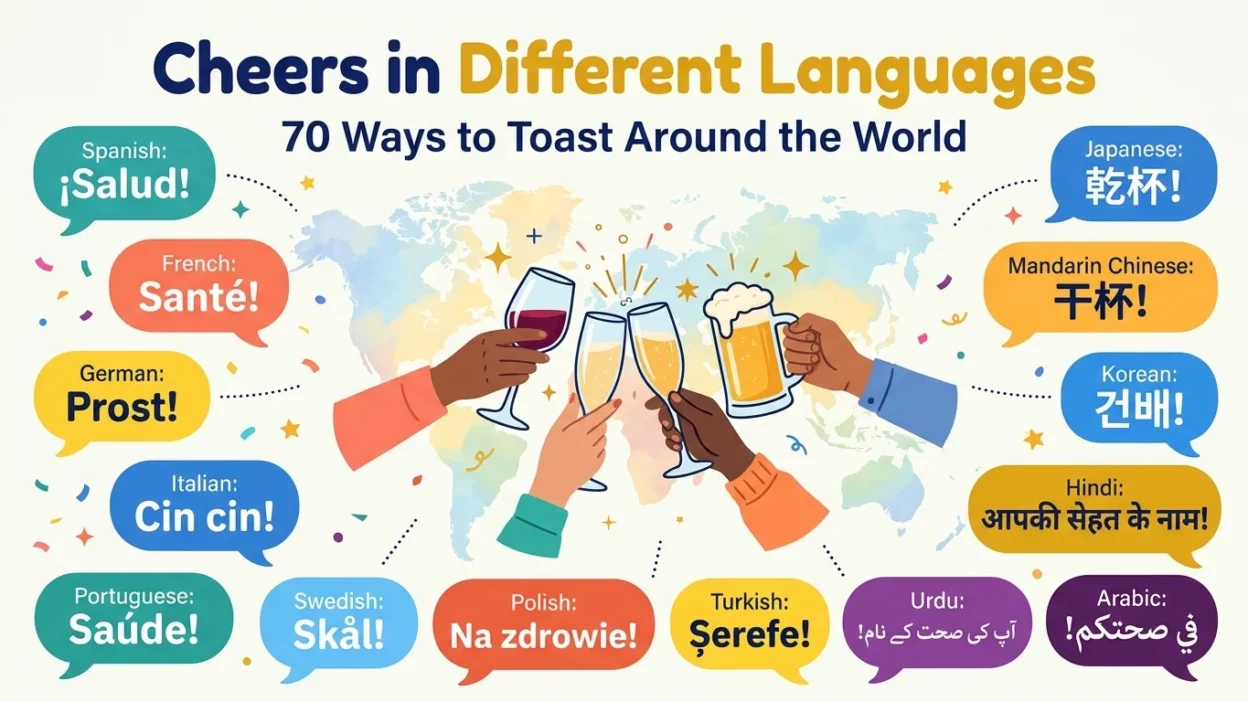
Whether you are celebrating a birthday, enjoying dinner with friends, attending a wedding, or raising a glass to a special moment, knowing how to say cheers in different languages is a fun way to connect with people around the world. A simple toast can express friendship, happiness, gratitude, and good wishes.
The word “cheers” has different meanings depending on the situation. In English, it can be used when raising a glass, thanking someone, or wishing others well. Other languages have their own traditional expressions for making a toast, celebrating an occasion, or wishing everyone good health.
In this guide, you will discover ways to say cheers in different languages, with native phrases, easy English pronunciations, practical example sentences, and their English meanings. These translations will help you understand how people celebrate and share joyful moments across cultures.
How to Say Cheers in Different Languages
The best translation depends on the language and context. Some expressions specifically mean “to your health,” while others are traditional phrases used when people raise their glasses together.
The table below includes different languages, making it easy to explore cheers translations in one place.
Cheers in Different Languages
| Language | Native phrase | Easy English pronunciation | Example sentence | English meaning |
| English | Cheers! | Cheerz | Cheers to our friendship! | Cheers to our friendship! |
| Spanish | ¡Salud! | Sah-lood | ¡Salud, amigos! | Cheers, friends! |
| French | Santé ! | Sahn-tay | Santé à notre bonheur ! | Cheers to our happiness! |
| German | Prost! | Prohst | Prost, auf unsere Freundschaft! | Cheers to our friendship! |
| Italian | Cin cin! | Chin chin | Cin cin, a tutti! | Cheers, everyone! |
| Portuguese | Saúde! | Sow-oo-jeh | Saúde, meus amigos! | Cheers, my friends! |
| Dutch | Proost! | Prohst | Proost op onze vriendschap! | Cheers to our friendship! |
| Swedish | Skål! | Skawl | Skål för vår vänskap! | Cheers to our friendship! |
| Norwegian | Skål! | Skawl | Skål for gode venner! | Cheers to good friends! |
| Danish | Skål! | Skawl | Skål for en fin kveld! | Cheers to a lovely evening! |
| Finnish | Kippis! | Kip-piss | Kippis ystäville! | Cheers to friends! |
| Icelandic | Skál! | Skowl | Skál fyrir vináttu okkar! | Cheers to our friendship! |
| Irish | Sláinte! | Slawn-cha | Sláinte, a chairde! | Cheers, friends! |
| Scottish Gaelic | Slàinte mhath! | Slan-juh vah | Slàinte mhath dhuibh! | Good health to you all! |
| Welsh | Iechyd da! | Yeh-khid dah | Iechyd da, bawb! | Cheers, everyone! |
| Polish | Na zdrowie! | Nah zdroh-vyeh | Na zdrowie, przyjaciele! | Cheers, friends! |
| Czech | Na zdraví! | Nah zdrah-vee | Na zdraví, kamarádi! | Cheers, friends! |
| Slovak | Na zdravie! | Nah zdrah-vyeh | Na zdravie, priatelia! | Cheers, friends! |
| Slovenian | Na zdravje! | Nah zdrahv-yeh | Na zdravje, prijatelji! | Cheers, friends! |
| Croatian | Živjeli! | Zhee-vyeh-lee | Živjeli, prijatelji! | Cheers, friends! |
| Serbian | Живели! (Živeli!) | Zhee-veh-lee | Живели, пријатељи! | Cheers, friends! |
| Bosnian | Živjeli! | Zhee-vyeh-lee | Živjeli, prijatelji! | Cheers, friends! |
| Bulgarian | Наздраве! | Naz-drah-veh | Наздраве, приятели! | Cheers, friends! |
| Macedonian | Наздравје! | Naz-drahv-yeh | Наздравје, пријатели! | Cheers, friends! |
| Romanian | Noroc! | No-rok | Noroc, prieteni! | Cheers, friends! |
| Hungarian | Egészségedre! | Eh-gaysh-shay-ged-reh | Egészségedre, barátaim! | Cheers, my friends! |
| Greek | Στην υγειά μας! | Steen ee-YA mas | Στην υγειά μας, φίλοι μου! | Cheers, my friends! |
| Russian | За здоровье! | Zah zda-ROV-yeh | За здоровье, друзья! | Cheers, friends! |
| Ukrainian | Будьмо! | Bood-mo | Будьмо, друзі! | Cheers, friends! |
| Belarusian | Будзьма! | Boodz-mah | Будзьма, сябры! | Cheers, friends! |
| Lithuanian | Į sveikatą! | Ee svei-ka-ta | Į sveikatą, draugai! | Cheers, friends! |
| Latvian | Priekā! | Pree-eh-kah | Priekā, draugi! | Cheers, friends! |
| Estonian | Terviseks! | Ter-vee-seks | Terviseks, sõbrad! | Cheers, friends! |
| Albanian | Gëzuar! | Guh-zoo-ar | Gëzuar, miqtë e mi! | Cheers, my friends! |
| Turkish | Şerefe! | Sheh-reh-feh | Şerefe, arkadaşlar! | Cheers, friends! |
| Arabic | في صحتكم! | Fee seh-hat-kum | في صحتكم يا أصدقائي! | To your health, my friends! |
| Hebrew | לחיים! | Le-kha-yim | לחיים, חברים! | Cheers, friends! |
| Persian (Farsi) | به سلامتی! | Beh sa-la-ma-tee | به سلامتی دوستان! | Cheers to friends! |
| Hindi | आपकी सेहत के नाम! | Aap-kee seh-hat keh naam | आपकी सेहत के नाम, दोस्तों! | To your health, friends! |
| Urdu | آپ کی صحت کے نام! | Aap kee sehat ke naam | آپ کی صحت کے نام، دوستو! | To your health, friends! |
| Bengali | আপনার সুস্বাস্থ্যের জন্য! | Ap-naar shush-shas-thyer jon-no | আপনার সুস্বাস্থ্যের জন্য, বন্ধুরা! | To your good health, friends! |
| Punjabi | ਚੜ੍ਹਦੀ ਕਲਾ! | Charh-dee ka-laa | ਚੜ੍ਹਦੀ ਕਲਾ, ਦੋਸਤੋ! | Cheers to rising spirits, friends! |
| Gujarati | તમારી તંદુરસ્તી માટે! | Tam-a-ree tan-du-rus-tee ma-te | તમારી તંદુરસ્તી માટે, મિત્રો! | To your health, friends! |
| Marathi | तुमच्या आरोग्यासाठी! | Tum-chya aa-ro-gyaa-saa-thee | तुमच्या आरोग्यासाठी, मित्रांनो! | To your health, friends! |
| Nepali | तपाईंको स्वास्थ्यको लागि! | Tap-aa-ee-ko swaas-thya-ko laa-gee | तपाईंको स्वास्थ्यको लागि, साथीहरू! | To your health, friends! |
| Sinhala | ඔබේ සෞඛ්යයට! | O-bay sau-khya-ya-ta | ඔබේ සෞඛ්යයට, මිතුරනි! | To your health, friends! |
| Tamil | உங்கள் ஆரோக்கியத்திற்காக! | Un-gal aa-ro-kki-ya-thir-kaa-ga | உங்கள் ஆரோக்கியத்திற்காக, நண்பர்களே! | To your health, friends! |
| Telugu | మీ ఆరోగ్యం కోసం! | Mee aa-ro-gyam ko-sam | మీ ఆరోగ్యం కోసం, స్నేహితులారా! | To your health, friends! |
| Kannada | ನಿಮ್ಮ ಆರೋಗ್ಯಕ್ಕಾಗಿ! | Nim-ma aa-ro-gyaa-kaag-ee | ನಿಮ್ಮ ಆರೋಗ್ಯಕ್ಕಾಗಿ, ಸ್ನೇಹಿತರೇ! | To your health, friends! |
| Malayalam | നിങ്ങളുടെ ആരോഗ്യത്തിന്! | Ning-ga-lu-de aa-ro-gya-thin | നിങ്ങളുടെ ആരോഗ്യത്തിന്, സുഹൃത്തുക്കളേ! | To your health, friends! |
| Thai | ชนแก้ว! | Chon gaew | ชนแก้ว เพื่อน ๆ! | Cheers, friends! |
| Vietnamese | Chúc sức khỏe! | Chook sook kweh | Chúc sức khỏe, các bạn! | Cheers to good health, friends! |
| Indonesian | Bersulang! | Ber-soo-lang | Bersulang, teman-teman! | Cheers, friends! |
| Malay | Minum! | Mee-noom | Minum, kawan-kawan! | Cheers, friends! |
| Filipino (Tagalog) | Tagay! | Tah-guy | Tagay, mga kaibigan! | Cheers, friends! |
| Mandarin Chinese | 干杯! | Gān bēi | 朋友们,干杯! | Cheers, friends! |
| Cantonese | 乾杯! | Gon bui | 朋友,乾杯! | Cheers, friends! |
| Japanese | 乾杯! | Kanpai | 皆さん、乾杯! | Cheers, everyone! |
| Korean | 건배! | Geon-bae | 친구들아, 건배! | Cheers, friends! |
| Mongolian | Төлөө! | Tuh-loh | Найзуудынхаа төлөө! | Cheers to our friends! |
| Kazakh | Денсаулық үшін! | Den-sow-lik oo-shin | Достар, денсаулық үшін! | To good health, friends! |
| Uzbek | Sog‘lig‘ingiz uchun! | Sog-lig-ing-iz oo-choon | Do‘stlar, sog‘lig‘ingiz uchun! | To your health, friends! |
| Swahili | Maisha marefu! | My-ee-sha ma-re-foo | Maisha marefu, marafiki! | Long life, friends! |
| Afrikaans | Gesondheid! | Guh-sund-hate | Gesondheid, vriende! | Cheers, friends! |
| Zulu | Impilo! | Im-pee-lo | Impilo, bangane! | To health, friends! |
| Haitian Creole | Sante! | Sahn-teh | Sante, zanmi m yo! | Cheers, my friends! |
| Esperanto | Je via sano! | Yeh vee-ah sah-no | Je via sano, amikoj! | To your health, friends! |
Pronunciations are approximate guides for English speakers. Some expressions are traditional toasts rather than literal, word-for-word translations of “cheers.” Usage may also vary by region and social setting.
| Amharic | ጤና ይስጥልን! | Te-na yis-tel-in | ጤና ይስጥልን፣ ጓደኞቼ! | Cheers, my friends! |
| Yoruba | Àlàáfíà! | Ah-laa-fee-ah | Àlàáfíà fún gbogbo wa! | Good health to all of us! |
| Igbo | Ka ọ dịrị anyị mma! | Kah aw dee-ree ah-mma | Ka ọ dịrị anyị mma, ndị enyi! | May things go well for us, friends! |
What Does “Cheers” Mean?
The word “cheers” has several meanings in everyday English. Its meaning depends on the situation and the people using it.
- When making a toast: It expresses good wishes, often for health, happiness, or friendship.
- When celebrating: It marks a happy occasion, such as a birthday, wedding, or achievement.
- When thanking someone: In informal British English, “cheers” can mean “thank you.”
- When saying goodbye: In some informal conversations, especially in British English, it can be used as a casual sign-off.
When learning cheers in different languages, it is important to choose an expression that fits the occasion. A phrase used for raising glasses may not be appropriate as a general thank-you.
Popular Ways to Say Cheers Around the World
Some toasts are especially recognisable because of their cultural traditions and frequent use in social gatherings.
- Spanish — ¡Salud! A common toast that wishes people good health.
- French — Santé! A familiar French expression used when raising glasses.
- German — Prost! A traditional and widely used German toast.
- Italian — Cin cin! A cheerful expression often heard at celebrations.
- Japanese — Kanpai! A common toast at dinners, parties, and social events.
- Mandarin Chinese — 干杯 (Gān bēi). A familiar toast used during meals and celebrations.
- Russian — За здоровье! A phrase meaning “to health,” although other toast expressions are also common.
- Swedish — Skål! A traditional Scandinavian toast.
Learning even a few of these phrases can make travelling, meeting international friends, and attending celebrations more enjoyable.
How to Use Cheers in Different Languages Correctly
Knowing the translation is only the first step. Using it naturally also means understanding the setting and local customs.
1. Match the phrase to the occasion
Some expressions are specifically associated with drinking a toast, while others wish someone good health or long life. Choose a phrase that fits the situation rather than translating the English word mechanically.
2. Practise the pronunciation
Read the pronunciation guide aloud before using a new phrase. Pay attention to unfamiliar sounds, syllable stress, and tones in languages such as Mandarin Chinese and Thai.
3. Observe local customs
In some cultures, a toast involves a short speech or a specific gesture. Watch what others do and follow their lead, especially at formal dinners or cultural celebrations.
4. Be respectful of the setting
Not every gathering involves alcohol. You can often use a toast expression with water, juice, tea, or another non-alcoholic drink when the occasion is suitable.
5. Remember regional differences
People may use different expressions depending on the country, region, language variety, or level of formality. A common phrase in one place may sound unusual somewhere else.
Why Learn Cheers in Different Languages?
Learning international toast expressions is a simple way to explore language and culture. These phrases can help you feel more comfortable in unfamiliar social situations and show appreciation for the people around you.
Here are a few reasons to learn them:
- Travel: Make a friendly impression when visiting another country.
- Friendship: Share a meaningful moment with friends who speak different languages.
- Celebrations: Join in at weddings, birthdays, dinners, and other special events.
- Language learning: Build vocabulary through short, memorable expressions.
- Cultural understanding: Discover how different communities express good wishes and togetherness.
Whether you are preparing for a trip or simply curious about world languages, these expressions are useful additions to your vocabulary.
Conclusion
Learning how to say cheers in different languages opens a small but enjoyable window into cultures around the world. From Spanish “¡Salud!” and French “Santé!” to German “Prost!” and Japanese “Kanpai!”, each expression offers a way to share good wishes and celebrate together.
Explore the translations in this guide, practise your favourite phrases, and use them respectfully in the right context. Even a few words in another language can help turn an ordinary gathering into a memorable experience.
FAQs
1. How do you say cheers in different languages?
Common translations include “¡Salud!” in Spanish, “Santé!” in French, “Prost!” in German, “Cin cin!” in Italian, and “Kanpai!” in Japanese. The appropriate expression depends on the language and cultural context.
2. What is the most common word for cheers around the world?
There is no single expression used everywhere. “Cheers,” “Salud,” “Santé,” “Prost,” and “Skål” are well-known examples, but each is associated with particular languages and cultures.
3. Does cheers mean the same thing in every language?
No. Some expressions literally refer to health, while others are conventional toasts used during celebrations. In English, “cheers” can also mean “thank you” or serve as an informal goodbye.
4. How do you say cheers in Spanish, French, and German?
In Spanish, say “¡Salud!” In French, say “Santé!” In German, say “Prost!” All three are commonly used when making a toast.
5. Can you say cheers without drinking alcohol?
Yes. Depending on the culture and occasion, you can make a toast with water, juice, tea, or another non-alcoholic drink. The expression can celebrate friendship, happiness, or good health without requiring alcohol.