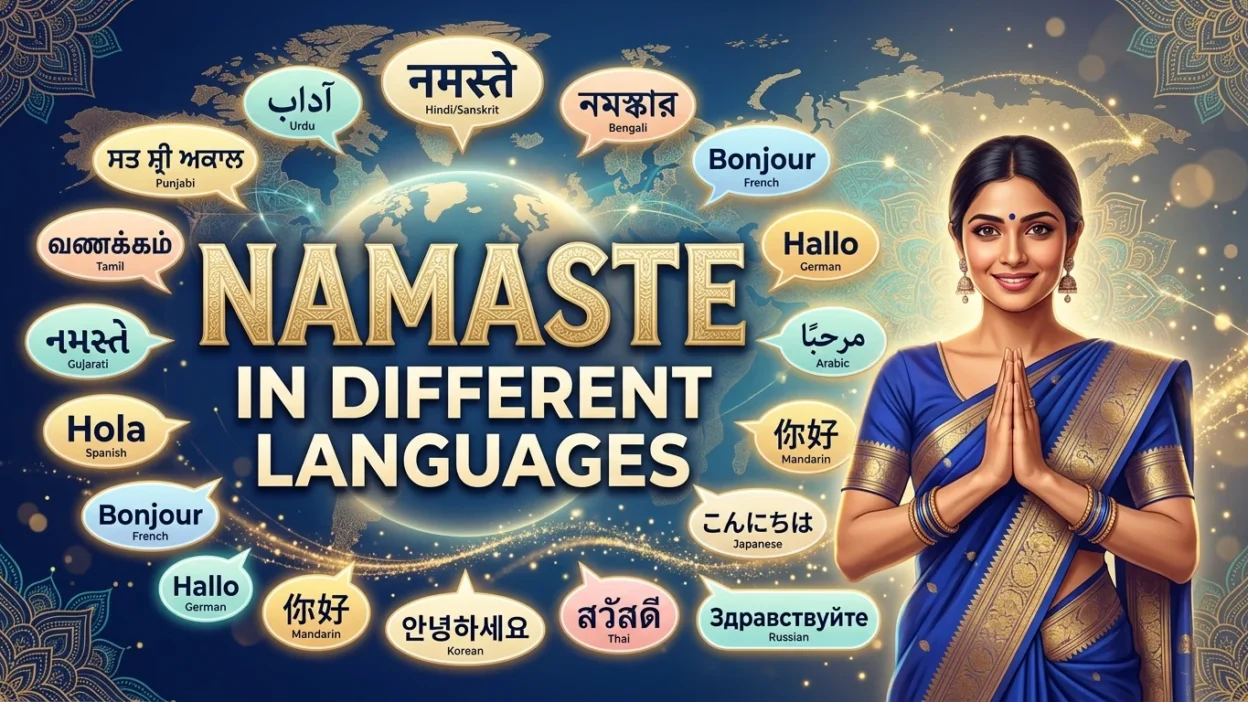
Namaste is a traditional greeting widely associated with India and South Asian culture. It is often used to say hello, welcome someone, or show respect. The word is especially recognised through the Indian greeting accompanied by palms pressed together in front of the chest and a slight bow.
If you want to learn how to say Namaste in different languages, it is important to understand that not every language has an exact equivalent. Some languages use a simple greeting, while others have expressions that communicate respect, peace, or a warm welcome.
In this guide, you will discover languages, their common greetings, easy English pronunciations, and short examples to help you understand how to use them in everyday conversations.
Namaste in Different Languages
| Language | Native greeting | Easy pronunciation | Example sentence | English meaning |
| Hindi | नमस्ते | Nuh-muh-stay | नमस्ते, आप कैसे हैं? | Hello, how are you? |
| Urdu | آداب | Aa-daab | آداب، آپ کیسے ہیں؟ | Greetings, how are you? |
| Bengali | নমস্কার | Nomoshkar | নমস্কার, আপনি কেমন আছেন? | Hello, how are you? |
| Punjabi | ਸਤ ਸ੍ਰੀ ਅਕਾਲ | Sut Sri Akaal | ਸਤ ਸ੍ਰੀ ਅਕਾਲ, ਤੁਸੀਂ ਕਿਵੇਂ ਹੋ? | Hello, how are you? |
| Gujarati | નમસ્તે | Nuh-mus-tay | નમસ્તે, તમે કેમ છો? | Hello, how are you? |
| Marathi | नमस्कार | Nuh-mus-kaar | नमस्कार, तुम्ही कसे आहात? | Hello, how are you? |
| Nepali | नमस्ते | Nuh-mus-tay | नमस्ते, तपाईंलाई कस्तो छ? | Hello, how are you? |
| Sanskrit | नमस्ते | Nuh-mus-tay | नमस्ते, भवान् कथम् अस्ति? | Greetings, how are you? |
| Tamil | வணக்கம் | Vuh-nuh-kkam | வணக்கம், நீங்கள் எப்படி இருக்கிறீர்கள்? | Hello, how are you? |
| Telugu | నమస్కారం | Nuh-mus-kaa-ram | నమస్కారం, మీరు ఎలా ఉన్నారు? | Hello, how are you? |
| Kannada | ನಮಸ್ಕಾರ | Nuh-mus-kaa-ra | ನಮಸ್ಕಾರ, ನೀವು ಹೇಗಿದ್ದೀರಿ? | Hello, how are you? |
| Malayalam | നമസ്കാരം | Nuh-mus-kaa-ram | നമസ്കാരം, സുഖമാണോ? | Hello, are you well? |
| Odia | ନମସ୍କାର | Nuh-mus-kaar | ନମସ୍କାର, ଆପଣ କେମିତି ଅଛନ୍ତି? | Hello, how are you? |
| Assamese | নমস্কাৰ | Nomosh-kaar | নমস্কাৰ, আপুনি কেনে আছে? | Hello, how are you? |
| Maithili | प्रणाम | Pruh-naam | प्रणाम, अहाँ केहन छी? | Greetings, how are you? |
| Bhojpuri | प्रणाम | Pruh-naam | प्रणाम, रउआ कइसन बानी? | Greetings, how are you? |
| Dogri | नमस्कार | Nuh-mus-kaar | नमस्कार, तुस केह् हाल ओ? | Hello, how are you? |
| Kashmiri | آداب | Aa-daab | آداب، تُہۍ چھِو واریاہ؟ | Greetings, how are you? |
| Sindhi | نمستي | Nuh-mus-tee | نمستي، توھان ڪيئن آھيو؟ | Hello, how are you? |
| Konkani | नमस्कार | Nuh-mus-kaar | नमस्कार, तुमी कसो आसा? | Hello, how are you? |
| English | Hello | Huh-loh | Hello, how are you? | Hello, how are you? |
| Spanish | Hola | Oh-lah | Hola, ¿cómo estás? | Hello, how are you? |
| French | Bonjour | Bon-zhoor | Bonjour, comment allez-vous? | Hello, how are you? |
| German | Hallo | Hah-loh | Hallo, wie geht es dir? | Hello, how are you? |
| Italian | Ciao | Chow | Ciao, come stai? | Hello, how are you? |
| Portuguese | Olá | Oh-lah | Olá, tudo bem? | Hello, is everything well? |
| Dutch | Hallo | Hah-loh | Hallo, hoe gaat het? | Hello, how are you? |
| Swedish | Hej | Hay | Hej, hur mår du? | Hello, how are you? |
| Norwegian | Hei | Hay | Hei, hvordan har du det? | Hello, how are you? |
| Danish | Hej | Hi | Hej, hvordan har du det? | Hello, how are you? |
| Finnish | Hei | Hay | Hei, mitä kuuluu? | Hello, how are you? |
| Icelandic | Halló | Hah-loh | Halló, hvernig hefurðu það? | Hello, how are you? |
| Irish | Dia dhuit | Dee-uh ghwitch | Dia dhuit, conas atá tú? | Hello, how are you? |
| Welsh | Helo | Heh-loh | Helo, sut wyt ti? | Hello, how are you? |
| Polish | Cześć | Cheshch | Cześć, jak się masz? | Hello, how are you? |
| Czech | Ahoj | Ah-hoy | Ahoj, jak se máš? | Hello, how are you? |
| Slovak | Ahoj | Ah-hoy | Ahoj, ako sa máš? | Hello, how are you? |
| Ukrainian | Вітаю | Vee-tah-yoo | Вітаю, як справи? | Hello, how are you? |
| Russian | Здравствуйте | Zdrast-vuy-tye | Здравствуйте, как дела? | Hello, how are you? |
| Greek | Γεια σας | Ya sas | Γεια σας, τι κάνετε; | Hello, how are you? |
| Turkish | Merhaba | Mehr-hah-bah | Merhaba, nasılsınız? | Hello, how are you? |
| Arabic | مرحبًا | Mar-ha-ban | مرحبًا، كيف حالك؟ | Hello, how are you? |
| Hebrew | שלום | Sha-lom | שלום, מה שלומך? | Hello, how are you? |
| Persian | سلام | Sa-laam | سلام، حال شما چطور است؟ | Hello, how are you? |
| Pashto | سلام | Sa-laam | سلام، څنګه یې؟ | Hello, how are you? |
| Mandarin Chinese | 你好 | Nee-how | 你好,你好吗? | Hello, how are you? |
| Japanese | こんにちは | Kon-nee-chee-wah | こんにちは、お元気ですか? | Hello, how are you? |
| Korean | 안녕하세요 | An-nyeong-ha-se-yo | 안녕하세요, 어떻게 지내세요? | Hello, how are you? |
| Thai | สวัสดี | Sa-wat-dee | สวัสดี คุณสบายดีไหม? | Hello, are you well? |
| Vietnamese | Xin chào | Sin chow | Xin chào, bạn khỏe không? | Hello, how are you? |
| Indonesian | Halo | Hah-loh | Halo, apa kabar? | Hello, how are you? |
| Malay | Helo | Heh-loh | Helo, apa khabar? | Hello, how are you? |
| Filipino (Tagalog) | Kumusta | Koo-moos-tah | Kumusta, ka na? | Hello, how are you? |
| Burmese | မင်္ဂလာပါ | Min-guh-lah-bah | မင်္ဂလာပါ၊ နေကောင်းလား။ | Hello, are you well? |
| Khmer | សួស្តី | Suor-sdey | សួស្តី តើអ្នកសុខសប្បាយទេ? | Hello, how are you? |
| Lao | ສະບາຍດີ | Sa-bai-dee | ສະບາຍດີ, ສະບາຍດີບໍ? | Hello, are you well? |
| Swahili | Hujambo | Hoo-jam-boh | Hujambo, habari yako? | Hello, how are you? |
| Amharic | ሰላም | Seh-lam | ሰላም፣ እንዴት ነዎት? | Hello, how are you? |
| Somali | Salaan | Sah-laan | Salaan, sidee tahay? | Hello, how are you? |
| Zulu | Sawubona | Sah-woo-boh-nah | Sawubona, unjani? | Hello, how are you? |
| Xhosa | Molo | Moh-loh | Molo, unjani? | Hello, how are you? |
| Afrikaans | Hallo | Hah-loh | Hallo, hoe gaan dit? | Hello, how are you? |
| Yoruba | Ẹ káàbọ̀ | Eh kah-boh | Ẹ n lẹ, ṣé àlàáfíà ni? | Hello, are you well? |
| Igbo | Ndewo | Nn-deh-woh | Ndewo, kedụ ka ị mere? | Hello, how are you? |
| Hausa | Sannu | Sah-noo | Sannu, ya kake? | Hello, how are you? |
| Māori | Kia ora | Kee-ah oh-rah | Kia ora, kei te pēhea koe? | Hello, how are you? |
| Hawaiian | Aloha | Ah-loh-hah | Aloha, pehea ʻoe? | Hello, how are you? |
| Samoan | Talofa | Tah-loh-fah | Talofa, o ā mai oe? | Hello, how are you? |
| Esperanto | Saluton | Sah-loo-ton | Saluton, kiel vi fartas? | Hello, how are you? |
What Does Namaste Mean?
Namaste is a greeting with roots in Sanskrit. It is commonly understood as “I bow to you” or “I bow to you respectfully.” In everyday use, it can mean hello, goodbye, or a respectful acknowledgement, depending on the situation.
The greeting is often accompanied by bringing the palms together near the chest and slightly bowing the head. This gesture is widely associated with respect and welcome in India and Nepal.
How to Say Namaste in Different Languages
If you want to know how to say Namaste in different languages, remember that a natural greeting is usually more useful than a word-for-word translation.
For example, Spanish speakers commonly say “Hola,” French speakers say “Bonjour,” and Mandarin speakers say “你好” (Nǐ hǎo). These expressions serve a similar everyday purpose to Namaste, but they do not carry exactly the same cultural meaning.
In several South Asian languages, greetings such as “Namaskar,” “Pranam,” and “Vanakkam” are used to welcome people or show respect.
Is Namaste Used Around the World?
Namaste is recognised internationally through yoga, meditation, travel, and cultural exchange. It is frequently heard outside South Asia, especially in yoga classes and settings influenced by Indian traditions.
However, it is not the usual greeting in every country. When speaking with someone from another culture, using their language’s familiar greeting can be a thoughtful way to show interest and respect.
Namaste vs. Namaskar: What Is the Difference?
“Namaste” and “Namaskar” are closely related respectful greetings used in South Asia. Their usage can vary by language, region, and context.
- Namaste: Widely used in Hindi and Nepali conversations as a polite greeting.
- Namaskar: Common in several Indian languages and often used as a formal or respectful greeting.
Neither expression is limited to a single setting, and regional customs influence how people use them.
Tips for Using Namaste Correctly
- Use Namaste when greeting someone in a context where the expression is familiar and appropriate.
- Pronounce the word clearly and naturally rather than rushing through its syllables.
- The palms-together gesture is common but is not compulsory in every situation.
- When travelling, learn the local greeting as well as Namaste.
- Remember that greetings can carry cultural meanings beyond their simple English translation.
Conclusion
Namaste is more than a way to say hello. It is a respectful greeting associated with South Asian traditions and recognised in many parts of the world. Learning greetings in 70 languages can help you communicate more naturally, appreciate cultural differences, and welcome people from different backgrounds.
FAQs
1. What does Namaste mean in English?
Namaste is commonly interpreted as “I bow to you” or “I bow to you respectfully.” In everyday conversation, it is often used to say hello or offer a respectful greeting.
2. How do you say Namaste in different languages?
The equivalent depends on the language. Examples include “Hola” in Spanish, “Bonjour” in French, “Merhaba” in Turkish, “你好” in Mandarin Chinese, and “Vanakkam” in Tamil.
3. Is Namaste the same as hello?
Not exactly. Namaste can function as hello, but it also conveys respect and has cultural and linguistic roots in South Asia. The meaning and use of other greetings differ by language and culture.
4. Can Namaste be used in any country?
People may recognise Namaste in many countries, particularly in yoga and meditation settings. However, local greetings are usually more common in everyday conversations.
5. What is the difference between Namaste and Namaskar?
Both are respectful greetings with related Sanskrit roots. Namaste is widely used in Hindi and Nepali, while Namaskar is also common in several Indian languages. Their usage depends on regional and cultural conventions.