Money is an essential part of everyday life. We use it to buy food, pay bills, travel, save for the future, and support our families. Although money is important everywhere, people around the world use different words to describe it.
Learning how to say money in different languages is a useful way to explore new cultures, improve your vocabulary, and communicate more confidently when travelling or speaking with people from other countries.
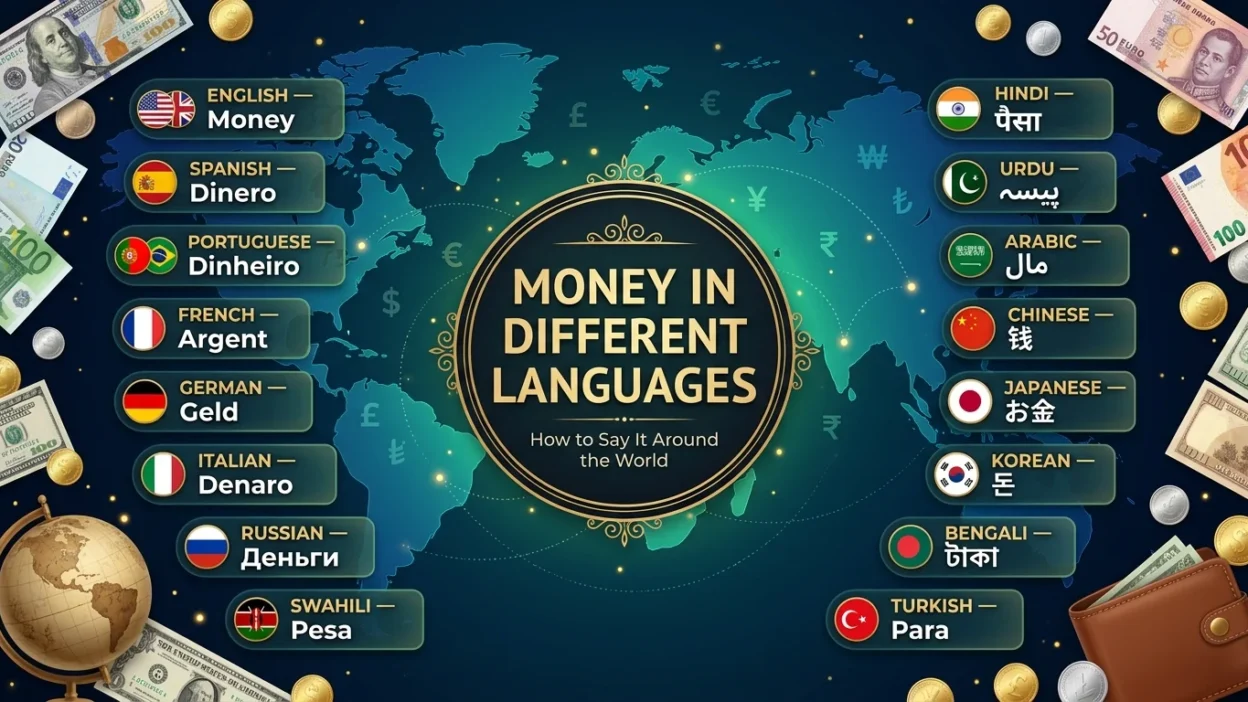
For example, money is called dinero in Spanish, argent in French, Geld in German, and paisa in Hindi. Some languages also have informal words for cash or currency that people commonly use in everyday conversations.
In this guide, you will discover money in 70 languages, including native translations, easy English pronunciations, practical example sentences, and their English meanings. Whether you are learning a new language or researching money translations for educational purposes, this list will help you understand how people talk about money around the world.
Money in Different Languages: A Quick Overview
The word for money varies across languages, but its meaning is widely understood. Some languages use a general word for money, while others distinguish between money, cash, and currency.
Here are a few popular examples:
- Spanish: Dinero
- French: Argent
- German: Geld
- Italian: Denaro
- Portuguese: Dinheiro
- Hindi: पैसा (Paisa)
- Arabic: مال (Māl)
- Japanese: お金 (O-kane)
- Korean: 돈 (Don)
- Chinese: 钱 (Qián)
These examples provide a starting point for understanding how to say money in different languages.
Money in Different Languages
| Language | Native Word | Easy English Pronunciation | Example Sentence | English Meaning |
| English | Money | MUH-nee | I need money for lunch. | I need money for lunch. |
| Spanish | Dinero | dee-NEH-roh | Necesito dinero para comer. | I need money to eat. |
| French | Argent | ar-ZHAHN | J’ai besoin d’argent. | I need money. |
| German | Geld | gelt | Ich brauche Geld. | I need money. |
| Italian | Denaro | deh-NAH-roh | Ho bisogno di denaro. | I need money. |
| Portuguese | Dinheiro | dee-NYAY-roo | Preciso de dinheiro. | I need money. |
| Dutch | Geld | kheld | Ik heb geld nodig. | I need money. |
| Swedish | Pengar | PENG-ar | Jag behöver pengar. | I need money. |
| Norwegian | Penger | PENG-er | Jeg trenger penger. | I need money. |
| Danish | Penge | PEN-uh | Jeg har brug for penge. | I need money. |
| Finnish | Raha | RAH-hah | Tarvitsen rahaa. | I need money. |
| Icelandic | Peningar | PEN-ing-ar | Ég þarf peninga. | I need money. |
| Irish | Airgead | AR-ig-ud | Tá airgead ag teastáil uaim. | I need money. |
| Welsh | Arian | AR-y an | Mae angen arian arnaf. | I need money. |
| Polish | Pieniądze | pyeh-NYON-dzeh | Potrzebuję pieniędzy. | I need money. |
| Czech | Peníze | PEH-nee-zeh | Potřebuji peníze. | I need money. |
| Slovak | Peniaze | PEH-nyah-zeh | Potrebujem peniaze. | I need money. |
| Ukrainian | Гроші | HROH-shee | Мені потрібні гроші. | I need money. |
| Russian | Деньги | DYEN-gee | Мне нужны деньги. | I need money. |
| Belarusian | Грошы | HROH-shuh | Мне патрэбны грошы. | I need money. |
| Bulgarian | Пари | PAH-ree | Имам нужда от пари. | I need money. |
| Serbian | Новац | NOH-vats | Треба ми новац. | I need money. |
| Croatian | Novac | NOH-vats | Trebam novac. | I need money. |
| Slovenian | Denar | deh-NAR | Potrebujem denar. | I need money. |
| Romanian | Bani | BAH-nee | Am nevoie de bani. | I need money. |
| Hungarian | Pénz | painz | Pénzre van szükségem. | I need money. |
| Greek | Χρήματα | KHREE-mah-tah | Χρειάζομαι χρήματα. | I need money. |
| Albanian | Para | PAH-rah | Kam nevojë për para. | I need money. |
| Turkish | Para | PAH-rah | Paraya ihtiyacım var. | I need money. |
| Azerbaijani | Pul | pool | Mənə pul lazımdır. | I need money. |
| Persian | پول | pool | من پول لازم دارم. | I need money. |
| Arabic | مال | maal | أحتاج إلى المال. | I need money. |
| Hebrew | כסף | KEH-sef | אני צריך כסף. | I need money. |
| Hindi | पैसा | PAI-saa | मुझे पैसे चाहिए। | I need money. |
| Urdu | پیسہ | PAY-sah | مجھے پیسے چاہئیں۔ | I need money. |
| Bengali | টাকা | TAH-ka | আমার টাকা দরকার। | I need money. |
| Punjabi | ਪੈਸਾ | PAI-saa | ਮੈਨੂੰ ਪੈਸੇ ਚਾਹੀਦੇ ਹਨ। | I need money. |
| Gujarati | પૈસા | PAI-saa | મને પૈસાની જરૂર છે. | I need money. |
| Marathi | पैसा | PAI-saa | मला पैसे हवे आहेत. | I need money. |
| Nepali | पैसा | PAI-saa | मलाई पैसा चाहिन्छ। | I need money. |
| Sinhala | මුදල් | moo-dal | මට මුදල් අවශ්යයි. | I need money. |
| Tamil | பணம் | puh-nam | எனக்குப் பணம் வேண்டும். | I need money. |
| Telugu | డబ్బు | DUB-boo | నాకు డబ్బు కావాలి. | I need money. |
| Kannada | ಹಣ | huh-nuh | ನನಗೆ ಹಣ ಬೇಕು. | I need money. |
| Malayalam | പണം | puh-nam | എനിക്ക് പണം വേണം. | I need money. |
| Odia | ଟଙ୍କା | TUN-kah | ମୋତେ ଟଙ୍କା ଦରକାର। | I need money. |
| Assamese | টকা | TOH-kah | মোক টকা লাগে। | I need money. |
| Mandarin Chinese | 钱 | chyen | 我需要钱。 | I need money. |
| Japanese | お金 | oh-KAH-neh | お金が必要です。 | I need money. |
| Korean | 돈 | don | 돈이 필요해요. | I need money. |
| Vietnamese | Tiền | tyee-en | Tôi cần tiền. | I need money. |
| Thai | เงิน | ngern | ฉันต้องการเงิน | I need money. |
| Indonesian | Uang | OO-ahng | Saya membutuhkan uang. | I need money. |
| Malay | Wang | wahng | Saya perlukan wang. | I need money. |
| Filipino | Pera | PEH-rah | Kailangan ko ng pera. | I need money. |
| Burmese | ပိုက်ဆံ | paiʔ-san | ကျွန်တော် ပိုက်ဆံလိုတယ်။ | I need money. |
| Khmer | លុយ | loo-y | ខ្ញុំត្រូវការលុយ។ | I need money. |
| Lao | ເງິນ | ngern | ຂ້ອຍຕ້ອງການເງິນ. | I need money. |
| Mongolian | Мөнгө | MUNG-guh | Надад мөнгө хэрэгтэй. | I need money. |
| Swahili | Pesa | PEH-sah | Ninahitaji pesa. | I need money. |
| Amharic | ገንዘብ | gen-zehb | ገንዘብ ያስፈልገኛል። | I need money. |
| Somali | Lacag | LAH-chag | Waxaan u baahanahay lacag. | I need money. |
| Hausa | Kuɗi | KOO-dee | Ina bukatar kuɗi. | I need money. |
| Yoruba | Owo | OH-woh | Mo nílò owó. | I need money. |
| Zulu | Imali | ee-MAH-lee | Ngidinga imali. | I need money. |
| Afrikaans | Geld | kheld | Ek het geld nodig. | I need money. |
| Malagasy | Vola | VOO-lah | Mila vola aho. | I need money. |
| Haitian Creole | Lajan | lah-ZHAHN | Mwen bezwen lajan. | I need money. |
| Esperanto | Mono | MOH-noh | Mi bezonas monon. | I need money. |
Note: Some example sentences use common conversational forms, and gender, politeness, or regional conventions may affect the most natural wording. In several languages, the grammatical form of the word for money changes within a sentence.
How to Say Money in Different Languages
The easiest way to learn money translations is to group languages by region and notice similarities between their words.
For example, several European languages have distinct but sometimes historically related terms. Spanish uses dinero, Italian uses denaro, and Portuguese uses dinheiro. French uses argent, which can also refer to silver.
In South Asia, Hindi, Punjabi, Marathi, and Nepali commonly use words related to paisa for money, although everyday vocabulary differs by language and context. Urdu speakers also frequently use paisa and paise in daily conversation.
In East Asia, Mandarin Chinese uses qián, Japanese uses okane, and Korean uses don. Each language has its own pronunciation system and cultural conventions.
Learning these words helps you recognise money-related vocabulary when shopping, travelling, studying, or communicating with native speakers.
Different Words for Money, Cash, and Currency
Although money, cash, and currency are closely related, they do not always mean exactly the same thing.
- Money: A general term for the means used to buy goods and services.
- Cash: Physical banknotes and coins.
- Currency: The monetary system or official money used in a country, such as the euro or Japanese yen.
For example, someone may have money in a bank account without carrying cash. Similarly, a person travelling abroad may need to exchange one currency for another.
When learning money in different languages, remember that a general word for money may not be the correct translation for cash or currency in every situation.
Why Learn Money Translations in Different Languages?
Understanding money vocabulary can be useful in many everyday situations.
Travel and shopping: Knowing how to ask about prices, payments, and cash can make shopping abroad easier.
Language learning: Money is a common topic in beginner vocabulary lessons because it appears in practical conversations.
Cultural understanding: Different words reflect the history, language, and traditions of communities around the world.
Business communication: Basic financial vocabulary can help people communicate during international transactions and travel.
Everyday conversations: Words for money are useful when discussing budgets, savings, salaries, and expenses with speakers of other languages.
Common Money-Related Words Around the World
Once you know the basic word for money, learning a few related expressions can make your vocabulary more useful.
| English Word | Spanish | French | German | Hindi |
| Money | Dinero | Argent | Geld | पैसा (Paisa) |
| Cash | Efectivo | Espèces | Bargeld | नकद (Nakad) |
| Price | Precio | Prix | Preis | कीमत (Keemat) |
| Bank | Banco | Banque | Bank | बैंक (Bank) |
| Coin | Moneda | Pièce | Münze | सिक्का (Sikka) |
| Wallet | Cartera | Portefeuille | Geldbörse | बटुआ (Batua) |
| Savings | Ahorros | Économies | Ersparnisse | बचत (Bachat) |
These translations are useful starting points, although the most natural word can vary with context and regional usage.
Tips for Learning the Word Money in Other Languages
You do not need to memorise all 70 translations at once. A few simple techniques can make learning easier.
- Start with five languages: Choose languages that interest you or that you encounter regularly.
- Practise pronunciation: Read each word aloud and pay attention to unfamiliar sounds.
- Learn complete sentences: Remembering a word in context is often easier than memorising it alone.
- Use flashcards: Put the English word on one side and the native translation on the other.
- Compare related languages: Notice similarities between words without assuming they are pronounced the same way.
- Review regularly: Short daily practice sessions can help you remember new vocabulary.
For the best results, practise both recognising the word and using it in a simple sentence.
Conclusion
Money is a universal part of daily life, but its name changes from one language to another. From dinero in Spanish and argent in French to qián in Chinese and paisa in Hindi, each translation offers a small insight into how people communicate around the world.
This list of money in 70 different languages provides a practical starting point for language learners, travellers, students, and anyone interested in global vocabulary. Practise the native words, learn their pronunciations, and use the example sentences to build confidence in everyday conversations.
FAQs
1. How do you say money in different languages?
Money is dinero in Spanish, argent in French, Geld in German, dinheiro in Portuguese, paisa in Hindi, qián in Mandarin Chinese, and okane in Japanese.
2. What is the most common word for money around the world?
There is no single word used worldwide. Every language has its own vocabulary, and some languages have several words depending on whether the speaker means money, cash, or currency.
3. How do you say money in Hindi and Urdu?
In Hindi, money is commonly called पैसा (paisa) or पैसे (paise). In Urdu, the corresponding words are پیسہ (paisa) and پیسے (paise). The appropriate form depends on the sentence and context.
4. What is the difference between money and currency?
Money is a general term for something used to pay for goods and services. Currency refers to the monetary system or official money used in a particular country or region, such as the US dollar or the euro.
5. Why are money translations useful when travelling?
Knowing money-related words can help travellers understand prices, ask about payments, communicate while shopping, and handle basic financial conversations in another language.