The moon has fascinated people for thousands of years. It lights up the night sky, inspires poetry and stories, and plays an important role in cultures around the world. Although the moon is the same natural satellite for everyone, its name changes from one language to another.
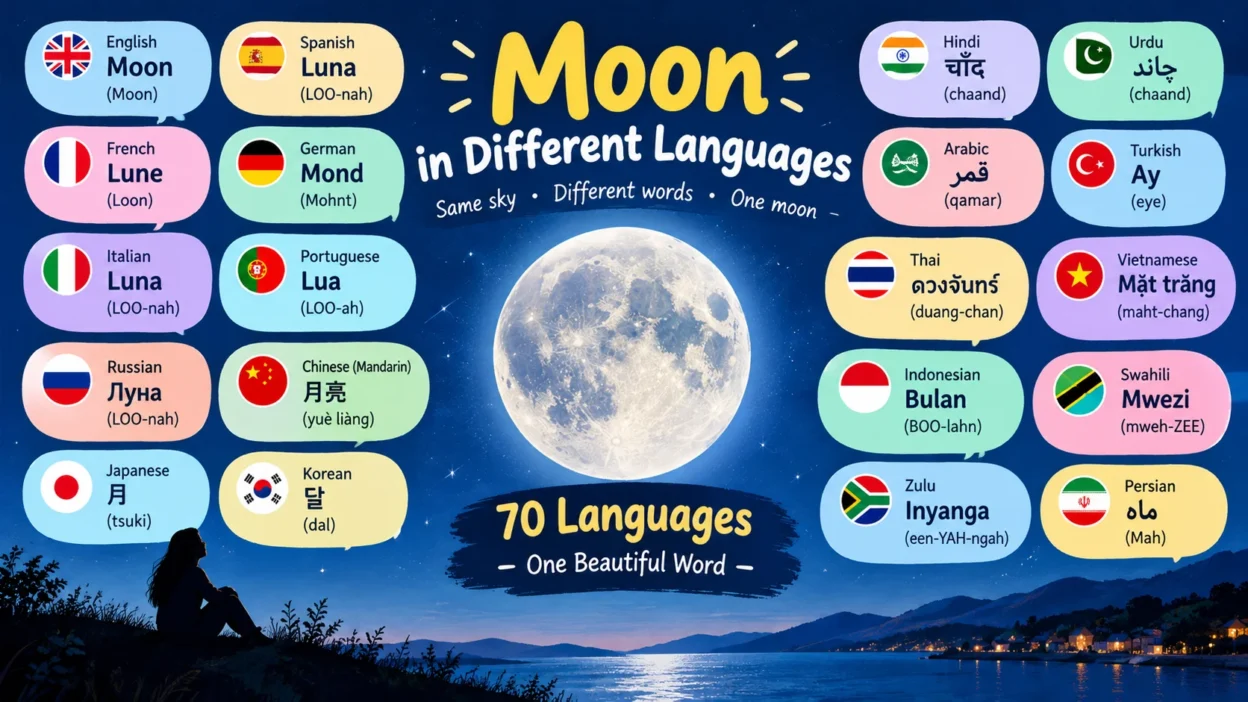
If you want to learn how to say moon in different languages, this guide brings together 70 languages with their native translations, easy English pronunciations, example sentences, and English meanings. It is useful for language learners, travellers, writers, students, and anyone curious about words from different cultures.
From luna in Spanish and Italian to lune in French and 月 in Chinese, these translations show how languages express the beauty of the night sky.
Moon in Different Languages: Quick Translation Table
The word “moon” refers to Earth’s natural satellite. In some languages, the same word can also refer to the moon as seen in the night sky or appear in expressions connected with lunar phases.
Here is a quick look at how to say moon in several widely spoken languages.
| Language | Word for Moon |
| English | Moon |
| Spanish | Luna |
| French | Lune |
| German | Mond |
| Italian | Luna |
| Portuguese | Lua |
| Dutch | Maan |
| Russian | Луна |
| Chinese (Mandarin) | 月亮 |
| Japanese | 月 |
| Korean | 달 |
| Arabic | قمر |
| Hindi | चाँद |
| Urdu | چاند |
| Turkish | Ay |
Moon in Different Languages
| Language | Native Word | Easy English Pronunciation | Example Sentence | English Meaning |
| English | Moon | Moon | The moon looks bright tonight. | The moon looks bright tonight. |
| Spanish | Luna | LOO-nah | La luna está brillante esta noche. | The moon is bright tonight. |
| French | Lune | Loon | La lune est belle ce soir. | The moon is beautiful tonight. |
| German | Mond | Mohnt | Der Mond ist heute hell. | The moon is bright today. |
| Italian | Luna | LOO-nah | La luna è molto luminosa. | The moon is very bright. |
| Portuguese | Lua | LOO-ah | A lua está bonita hoje. | The moon looks beautiful today. |
| Dutch | Maan | Mahn | De maan schijnt vannacht. | The moon is shining tonight. |
| Swedish | Måne | MOH-neh | Månen lyser i natt. | The moon shines tonight. |
| Norwegian | Måne | MOH-neh | Månen er klar i kveld. | The moon is clear this evening. |
| Danish | Måne | MOH-neh | Månen er smuk i aften. | The moon is beautiful this evening. |
| Finnish | Kuu | Koo | Kuu näkyy taivaalla. | The moon is visible in the sky. |
| Icelandic | Tungl | TOONG-tl | Tunglið skín í nótt. | The moon shines tonight. |
| Irish | Gealach | GYAL-akh | Tá an ghealach geal anocht. | The moon is bright tonight. |
| Welsh | Lleuad | HLYE-ad | Mae’r lleuad yn disgleirio. | The moon is shining. |
| Scottish Gaelic | Gealach | GYAL-akh | Tha a’ ghealach soilleir. | The moon is bright. |
| Polish | Księżyc | KSHEN-zhits | Księżyc świeci nocą. | The moon shines at night. |
| Czech | Měsíc | MYEH-seets | Měsíc je dnes jasný. | The moon is bright today. |
| Slovak | Mesiac | MEH-see-ats | Mesiac svieti na oblohe. | The moon shines in the sky. |
| Slovenian | Luna | LOO-nah | Luna je danes svetla. | The moon is bright today. |
| Croatian | Mjesec | MYEH-sehts | Mjesec je večeras lijep. | The moon is beautiful tonight. |
| Serbian | Месец | MEH-sehts | Месец је вечерас леп. | The moon is beautiful tonight. |
| Bulgarian | Луна | LOO-nah | Луната е ярка тази вечер. | The moon is bright this evening. |
| Macedonian | Месечина | meh-seh-CHEE-nah | Месечината свети ноќе. | The moon shines at night. |
| Russian | Луна | LOO-nah | Луна светит ночью. | The moon shines at night. |
| Ukrainian | Місяць | MEE-syats | Місяць яскравий сьогодні. | The moon is bright today. |
| Greek | Φεγγάρι | feh-GHAH-ree | Το φεγγάρι είναι όμορφο. | The moon is beautiful. |
| Romanian | Lună | LOO-nuh | Luna este strălucitoare. | The moon is shining brightly. |
| Hungarian | Hold | Hold | A hold ma este fényes. | The moon is bright tonight. |
| Estonian | Kuu | Koo | Kuu paistab taevas. | The moon shines in the sky. |
| Latvian | Mēness | MEH-ness | Mēness šovakar ir spožs. | The moon is bright tonight. |
| Lithuanian | Mėnulis | MEH-noo-lis | Mėnulis šviečia naktį. | The moon shines at night. |
| Albanian | Hënë | HUH-nuh | Hëna duket e bukur. | The moon looks beautiful. |
| Armenian | Լուսին | loo-SEEN | Լուսինը պայծառ է։ | The moon is bright. |
| Georgian | მთვარე | MT-vah-reh | მთვარე ნათელია։ | The moon is bright. |
| Turkish | Ay | Eye | Ay bu gece çok güzel. | The moon is very beautiful tonight. |
| Azerbaijani | Ay | Eye | Ay bu gecə parlaqdır. | The moon is bright tonight. |
| Arabic | قمر | QAH-mar | القمر جميل الليلة. | The moon is beautiful tonight. |
| Hebrew | ירח | YAH-re-akh | הירח מאיר בלילה. | The moon shines at night. |
| Persian | ماه | Mah | ماه امشب زیباست. | The moon is beautiful tonight. |
| Pashto | سپوږمۍ | spog-MAI | سپوږمۍ روښانه ده. | The moon is bright. |
| Urdu | چاند | Chaand | آج چاند بہت خوبصورت ہے۔ | The moon is very beautiful today. |
| Hindi | चाँद | Chaand | आज चाँद बहुत सुंदर है। | The moon is very beautiful today. |
| Bengali | চাঁদ | Chaand | আজ চাঁদ খুব সুন্দর। | The moon is very beautiful today. |
| Punjabi | ਚੰਦ | Chund | ਅੱਜ ਚੰਦ ਬਹੁਤ ਸੋਹਣਾ ਹੈ। | The moon is very beautiful today. |
| Gujarati | ચંદ્ર | CHUN-dra | આજે ચંદ્ર સુંદર દેખાય છે. | The moon looks beautiful today. |
| Marathi | चंद्र | CHUN-dra | आज चंद्र सुंदर दिसतो. | The moon looks beautiful today. |
| Nepali | चन्द्रमा | chun-druh-MAA | आज चन्द्रमा चम्किलो छ। | The moon is bright today. |
| Sinhala | සඳ | Sanda | සඳ අද ලස්සනයි. | The moon is beautiful today. |
| Tamil | நிலா | nih-LAA | நிலா அழகாக இருக்கிறது. | The moon is beautiful. |
| Telugu | చంద్రుడు | CHUN-druh-doo | చంద్రుడు చాలా అందంగా ఉన్నాడు. | The moon is very beautiful. |
| Kannada | ಚಂದ್ರ | CHUN-dra | ಚಂದ್ರನು ಸುಂದರವಾಗಿ ಕಾಣುತ್ತಾನೆ. | The moon looks beautiful. |
| Malayalam | ചന്ദ്രൻ | CHUN-dran | ചന്ദ്രൻ മനോഹരമാണ്. | The moon is beautiful. |
| Thai | ดวงจันทร์ | duang-jan | ดวงจันทร์สวยมากคืนนี้ | The moon is very beautiful tonight. |
| Lao | ດວງຈັນ | duang-chan | ດວງຈັນງາມຫຼາຍ. | The moon is very beautiful. |
| Khmer | ព្រះច័ន្ទ | preah-chan | ព្រះច័ន្ទស្អាតណាស់។ | The moon is very beautiful. |
| Vietnamese | Mặt trăng | maht-chang | Mặt trăng rất đẹp tối nay. | The moon is very beautiful tonight. |
| Chinese (Mandarin) | 月亮 | yuè liàng | 今晚的月亮很美。 | The moon is beautiful tonight. |
| Japanese | 月 | tsuki | 月がきれいです。 | The moon is beautiful. |
| Korean | 달 | Dal | 오늘 밤 달이 밝아요. | The moon is bright tonight. |
| Indonesian | Bulan | BOO-lahn | Bulan terlihat indah malam ini. | The moon looks beautiful tonight. |
| Malay | Bulan | BOO-lahn | Bulan sangat cantik malam ini. | The moon is very beautiful tonight. |
| Filipino (Tagalog) | Buwan | BOO-wahn | Maganda ang buwan ngayong gabi. | The moon is beautiful tonight. |
| Burmese | လ | La | လက လှတယ်။ | The moon is beautiful. |
| Mongolian | Сар | Sar | Сар өнөөдөр тод байна. | The moon is bright today. |
| Kazakh | Ай | Eye | Ай бүгін жарық. | The moon is bright today. |
| Uzbek | Oy | Oy | Oy bugun juda chiroyli. | The moon is very beautiful today. |
| Swahili | Mwezi | mweh-ZEE | Mwezi unaangaza usiku huu. | The moon shines tonight. |
| Afrikaans | Maan | Mahn | Die maan is vanaand helder. | The moon is bright tonight. |
| Zulu | Inyanga | een-YAH-ngah | Inyanga ikhanya ebusuku. | The moon shines at night. |
How to Say Moon in Different Languages
Learning the word for moon in another language is a simple way to explore vocabulary and culture. Start with languages you already know or languages spoken in places you hope to visit.
Here are a few helpful examples:
- Luna is used for “moon” in Spanish and Italian.
- Lune is the French word for moon.
- Mond is the German word for moon.
- Lua is the Portuguese word for moon.
- Chand is a common word for moon in Hindi and Urdu.
- Bulan means moon in Indonesian and Malay.
- Tsuki is the Japanese word for moon.
- Yue liang is the Mandarin Chinese word for moon, written as 月亮.
Remember that pronunciation guides are approximate. Listening to native speakers can help you learn the sounds more accurately.
Why Does the Word for Moon Change Across Languages?
Languages develop through history, migration, cultural contact, and changes in pronunciation. As a result, the word for the moon can sound very different across regions.
Some languages use words with shared historical roots. For example, Spanish luna, Italian luna, and Romanian lună are related through Latin. Other languages use distinct words that developed through their own linguistic histories.
The moon also has a strong place in folklore, poetry, calendars, and traditional celebrations. This cultural importance has helped make it a familiar and meaningful word in languages around the world.
Moon Translations Around the World
The moon is a universal object, but the words people use for it reflect the diversity of human language.
In many European languages, words such as luna and lune are common. In South Asian languages, words such as chaand and chandra are widely recognised, although their usage varies by language and context. In East Asia, Chinese 月亮, Japanese 月, and Korean 달 are common ways to refer to the moon.
These translations are useful when learning new vocabulary, reading foreign-language poems, travelling, or creating educational content about the natural world.
Is “Moon” the Same as “Month” in Every Language?
No. In some languages, the word for the moon is also used for a month or is historically related to a word for a month. In Indonesian and Malay, for example, bulan can mean both “moon” and “month,” depending on the context.
In English, “moon” and “month” are separate words, although the words are historically related. The connection reflects the traditional use of lunar cycles to measure time.
Moon vs Lunar: What Is the Difference?
The word moon is a noun that names a natural satellite, especially Earth’s moon. The word lunar is an adjective that means “related to the moon.”
Examples:
- Moon: The moon is visible tonight.
- Lunar: Scientists studied the lunar surface.
- Moonlight: The light that comes from the moon.
- Moon phase: The changing appearance of the moon as seen from Earth.
Understanding these related words can help you describe the moon more clearly in everyday conversation and writing.
Interesting Facts About the Moon
The moon is more than a bright object in the night sky. It has a fascinating relationship with Earth and human history.
- The moon is Earth’s only natural satellite.
- It reflects sunlight rather than producing its own visible light.
- The moon’s gravitational pull contributes to Earth’s ocean tides.
- The moon appears to change shape throughout the month because we see different portions of its sunlit side.
- Many cultures use lunar calendars to track dates and traditional festivals.
- The same side of the moon generally faces Earth because its rotation and orbit are synchronised.
These facts explain why the moon remains an important subject in science, culture, language, and storytelling.
Conclusion
Learning how to say moon in different languages is a simple way to discover the variety of words used around the world. From luna and lune to chaand, 月亮, and 달, each language offers its own expression for the same familiar object in the sky.
Use this list of moon translations to expand your vocabulary, practise pronunciation, and explore how languages connect people across cultures.
FAQs
1. How do you say moon in different languages?
The word for moon varies by language. Examples include luna in Spanish, lune in French, Mond in German, lua in Portuguese, chaand in Hindi and Urdu, and 月亮 in Mandarin Chinese.
2. What is the word for moon in the most languages?
There is no single word used in the most languages. Words such as luna are common across several languages, especially those influenced by Latin, while other language families use different words.
3. How do you say moon in Japanese, Chinese, and Korean?
In Japanese, moon is 月 (tsuki). In Mandarin Chinese, it is commonly 月亮 (yuè liàng). In Korean, it is 달 (dal).
4. What is the Hindi and Urdu word for moon?
The common word for moon in Hindi is चाँद (chaand), and in Urdu it is چاند (chaand). Both are widely used in everyday speech and poetry.
5. Which languages use the same word for moon and month?
Some languages use one word for both meanings. For example, Indonesian and Malay use bulan for both “moon” and “month.” The intended meaning depends on the sentence.