The word “know” is an important part of everyday communication. We use it to share information, express understanding, talk about people we recognise, and explain what we have learned. Whether you are speaking with a friend, studying a new language, or travelling abroad, knowing how to express this simple word can make conversations easier.
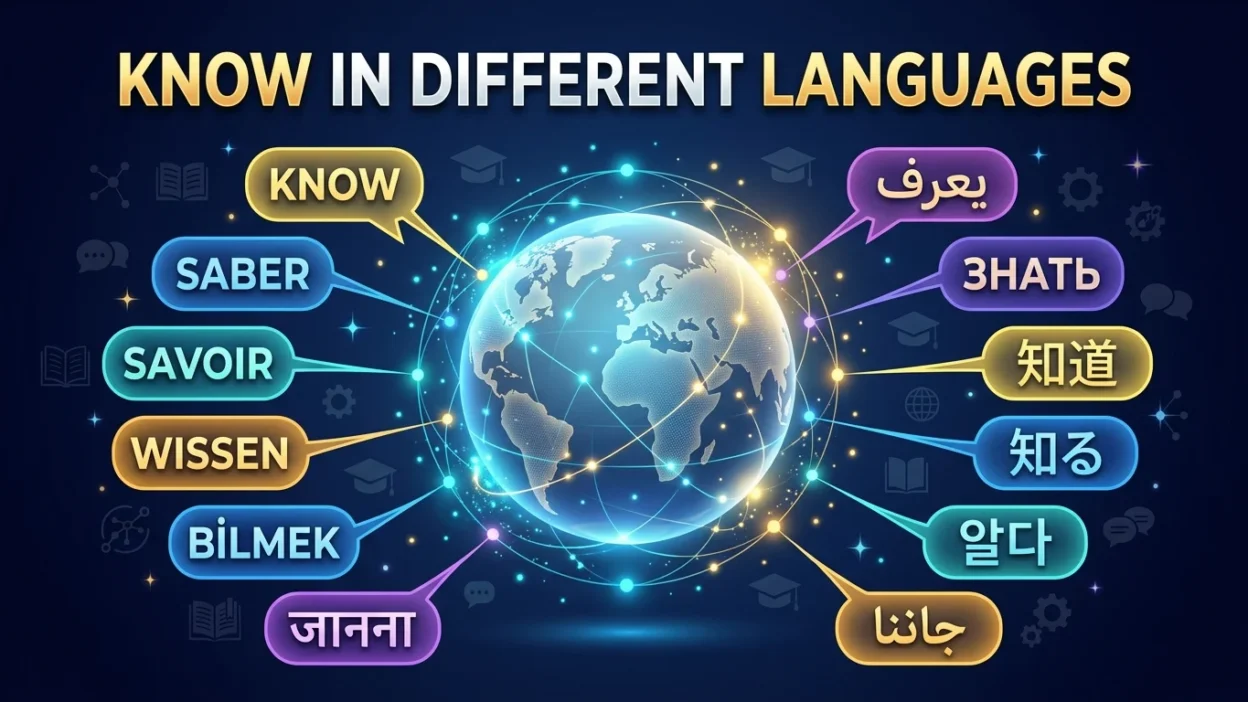
If you want to learn know in different languages, this guide covers languages with native translations, easy English pronunciations, real-life example sentences, and their English meanings. From saber in Spanish to savoir in French and जानना in Hindi, you will discover how different languages express the idea of knowing.
One important detail is that “know” does not translate into the same form in every situation. Some languages use different verbs for knowing a fact, knowing a person, or knowing how to do something. The translations below focus on common ways to express knowledge or understanding.
Know in Different Languages
| Language | Translation of “Know” |
| English | Know |
| Spanish | Saber / Conocer |
| French | Savoir / Connaître |
| German | Wissen / Kennen |
| Italian | Sapere / Conoscere |
| Portuguese | Saber / Conhecer |
| Dutch | Weten / Kennen |
| Russian | Знать |
| Chinese (Mandarin) | 知道 |
| Japanese | 知る |
| Korean | 알다 |
| Arabic | يعرف |
| Hindi | जानना |
| Urdu | جاننا |
| Turkish | Bilmek |
Know in Different Languages
| Language | Native Word or Phrase | Easy English Pronunciation | Example Sentence | English Meaning |
| English | Know | Noh | I know the answer. | I know the answer. |
| Spanish | Saber | sah-BEHR | Sé la respuesta. | I know the answer. |
| French | Savoir | sah-VWAHR | Je sais la réponse. | I know the answer. |
| German | Wissen | VIH-sen | Ich weiß die Antwort. | I know the answer. |
| Italian | Sapere | sah-PEH-reh | So la risposta. | I know the answer. |
| Portuguese | Saber | sah-BEHR | Eu sei a resposta. | I know the answer. |
| Dutch | Weten | VAY-tuhn | Ik weet het antwoord. | I know the answer. |
| Swedish | Veta | VEH-tah | Jag vet svaret. | I know the answer. |
| Norwegian | Vite | VEE-teh | Jeg vet svaret. | I know the answer. |
| Danish | Vide | VEE-thuh | Jeg ved svaret. | I know the answer. |
| Finnish | Tietää | TEE-eh-tah | Tiedän vastauksen. | I know the answer. |
| Icelandic | Vita | VIH-tah | Ég veit svarið. | I know the answer. |
| Irish | A bheith ar an eolas | eh veh ar un OH-lus | Tá an freagra ar eolas agam. | I know the answer. |
| Welsh | Gwybod | GWUH-bod | Dw i’n gwybod yr ateb. | I know the answer. |
| Polish | Wiedzieć | VYEH-jetch | Znam odpowiedź. | I know the answer. |
| Czech | Vědět | VYEH-dyet | Znám odpověď. | I know the answer. |
| Slovak | Vedieť | VEH-dyeht | Poznám odpoveď. | I know the answer. |
| Slovenian | Vedeti | veh-DEH-tee | Vem odgovor. | I know the answer. |
| Croatian | Znati | ZNAH-tee | Znam odgovor. | I know the answer. |
| Serbian | Знати | ZNAH-tee | Знам одговор. | I know the answer. |
| Bulgarian | Зная | ZNAH-yah | Зная отговора. | I know the answer. |
| Macedonian | Знае | ZNAH-eh | Го знам одговорот. | I know the answer. |
| Russian | Знать | Znaht | Я знаю ответ. | I know the answer. |
| Ukrainian | Знати | ZNAH-tee | Я знаю відповідь. | I know the answer. |
| Greek | Ξέρω | KSEH-roh | Ξέρω την απάντηση. | I know the answer. |
| Romanian | A ști | ah shtee | Știu răspunsul. | I know the answer. |
| Hungarian | Tudni | TOOD-nee | Tudom a választ. | I know the answer. |
| Estonian | Teadma | TEHD-mah | Ma tean vastust. | I know the answer. |
| Latvian | Zināt | ZEE-naht | Es zinu atbildi. | I know the answer. |
| Lithuanian | Žinoti | zhee-NOH-tee | Aš žinau atsakymą. | I know the answer. |
| Albanian | Di | Dee | E di përgjigjen. | I know the answer. |
| Armenian | Գիտենալ | gee-teh-NAHL | Ես գիտեմ պատասխանը։ | I know the answer. |
| Georgian | ცოდნა | TSOD-nah | პასუხი ვიცი. | I know the answer. |
| Turkish | Bilmek | BEEL-mek | Cevabı biliyorum. | I know the answer. |
| Azerbaijani | Bilmək | beel-MEK | Cavabı bilirəm. | I know the answer. |
| Arabic | يعرف | YAH-rif | أعرف الإجابة. | I know the answer. |
| Hebrew | לדעת | lah-DAH-at | אני יודע את התשובה. | I know the answer. |
| Persian | دانستن | daa-nes-TAN | جواب را میدانم. | I know the answer. |
| Urdu | جاننا | JAAN-na | مجھے جواب معلوم ہے۔ | I know the answer. |
| Hindi | जानना | JAA-nuh-naa | मुझे जवाब पता है। | I know the answer. |
| Bengali | জানা | JAA-na | আমি উত্তরটা জানি। | I know the answer. |
| Punjabi | ਜਾਣਨਾ | JAA-nuh-naa | ਮੈਨੂੰ ਜਵਾਬ ਪਤਾ ਹੈ। | I know the answer. |
| Gujarati | જાણવું | JAA-nuh-vuh | મને જવાબ ખબર છે. | I know the answer. |
| Marathi | जाणणे | JAA-nuh-neh | मला उत्तर माहीत आहे. | I know the answer. |
| Nepali | जान्नु | JAAN-noo | मलाई उत्तर थाहा छ। | I know the answer. |
| Sinhala | දැනගන්නවා | deh-nuh-GUN-nuh-wah | මම පිළිතුර දන්නවා. | I know the answer. |
| Tamil | தெரியும் | teh-REE-yoom | எனக்கு பதில் தெரியும். | I know the answer. |
| Telugu | తెలుసు | teh-LOO-soo | నాకు సమాధానం తెలుసు. | I know the answer. |
| Kannada | ತಿಳಿದಿದೆ | tih-LEE-dih-deh | ನನಗೆ ಉತ್ತರ ತಿಳಿದಿದೆ. | I know the answer. |
| Malayalam | അറിയാം | uh-REE-yahm | എനിക്ക് ഉത്തരം അറിയാം. | I know the answer. |
| Thai | รู้ | Roo | ฉันรู้คำตอบ | I know the answer. |
| Lao | ຮູ້ | Hoo | ຂ້ອຍຮູ້ຄໍາຕອບ. | I know the answer. |
| Khmer | ដឹង | Deung | ខ្ញុំដឹងចម្លើយ។ | I know the answer. |
| Vietnamese | Biết | Bee-et | Tôi biết câu trả lời. | I know the answer. |
| Chinese (Mandarin) | 知道 | zhī dào | 我知道答案。 | I know the answer. |
| Japanese | 知る | Shee-roo | 答えを知っています。 | I know the answer. |
| Korean | 알다 | Al-da | 저는 답을 알아요. | I know the answer. |
| Indonesian | Tahu | TAH-hoo | Saya tahu jawabannya. | I know the answer. |
| Malay | Tahu | TAH-hoo | Saya tahu jawapannya. | I know the answer. |
| Filipino (Tagalog) | Alam | AH-lam | Alam ko ang sagot. | I know the answer. |
| Burmese | သိသည် | Thee-deh | အဖြေကို သိတယ်။ | I know the answer. |
| Mongolian | Мэдэх | MEH-dekh | Би хариултыг мэднэ. | I know the answer. |
| Kazakh | Білу | bee-LOO | Мен жауапты білемін. | I know the answer. |
| Uzbek | Bilmoq | beel-MOK | Men javobni bilaman. | I know the answer. |
| Swahili | Kujua | koo-JOO-ah | Ninajua jibu. | I know the answer. |
| Afrikaans | Weet | Veet | Ek weet die antwoord. | I know the answer. |
| Zulu | Ukwazi | ook-WAH-zee | Ngiyayazi impendulo. | I know the answer. |
How to Say Know in Different Languages
The best way to learn how to say “know” in different languages is to practise it in complete sentences. The correct verb often depends on what you know and how you know it.
Here are a few useful examples:
- Spanish: Sé la respuesta. — I know the answer.
- French: Je sais la réponse. — I know the answer.
- German: Ich weiß die Antwort. — I know the answer.
- Italian: So la risposta. — I know the answer.
- Hindi: मुझे जवाब पता है। — I know the answer.
- Urdu: مجھے جواب معلوم ہے۔ — I know the answer.
- Japanese: 答えを知っています。 — I know the answer.
- Mandarin Chinese: 我知道答案。 — I know the answer.
Learning the verb through a sentence helps you understand how it changes with the subject, tense, and context.
What Does the Word “Know” Mean?
The verb know means to have information, understanding, awareness, or familiarity with something or someone.
It has several common uses:
- Knowing a fact: I know the capital city.
- Knowing a person: I know your teacher.
- Knowing a place: I know this neighbourhood.
- Knowing a skill: I know how to swim.
- Knowing information: She knows the truth.
Because these meanings are slightly different, languages may use separate verbs for facts, people, places, and abilities.
Know vs Understand: What Is the Difference?
“Know” and “understand” are related words, but they are not identical.
| Word | Meaning | Example |
| Know | To have information or familiarity | I know the answer. |
| Understand | To grasp the meaning of something | I understand the answer. |
| Recognise | To identify someone or something familiar | I recognise his face. |
| Learn | To gain knowledge or a skill | I want to learn French. |
For example, you might know a word’s definition without fully understanding how to use it. Recognising this distinction can help you choose more accurate translations.
Why Does “Know” Change Across Languages?
Languages organise knowledge and familiarity in different ways. Some use one common verb for many meanings, while others distinguish between knowing a fact and being familiar with a person.
For example, Spanish often uses saber for facts and skills and conocer for people or places. French similarly distinguishes savoir from connaître. German uses wissen for facts and kennen for familiarity.
These distinctions are important when learning know in different languages because a dictionary translation alone may not tell you which word sounds natural in a particular sentence.
Common Phrases Using the Word “Know”
Learning everyday expressions makes it easier to use the word naturally in conversation.
| English Phrase | Meaning |
| I know | I have the information or understand. |
| I don’t know | I do not have the answer or information. |
| Do you know? | Asking whether someone has information. |
| I know him | I am familiar with that person. |
| I know the way | I am familiar with the route. |
| Let me know | Tell me or inform me. |
| As far as I know | Based on the information I currently have. |
When translating these phrases, remember that the most natural expression may differ from a direct word-for-word translation.
Conclusion
Learning know in different languages helps you communicate more confidently and understand how languages express facts, awareness, and familiarity. From saber in Spanish to bilmek in Turkish, जानना in Hindi, and 知道 in Mandarin Chinese, each language offers its own way to describe knowledge.
Use this collection of 70 languages to practise vocabulary, build useful sentences, and explore the differences between languages around the world.
FAQs
1. How do you say “know” in different languages?
“Know” is saber in Spanish, savoir in French, wissen in German, bilmek in Turkish, जानना in Hindi, and 知道 in Mandarin Chinese. The correct form depends on the sentence and context.
2. What is the difference between “saber” and “conocer” in Spanish?
Saber is generally used for facts, information, and skills, while conocer is commonly used for being familiar with people, places, or things. For example, sé la respuesta means “I know the answer,” while conozco a María means “I know María.”
3. How do you say “I know” in Hindi and Urdu?
In Hindi, you can say मुझे पता है (mujhe pata hai), and in Urdu, مجھے معلوم ہے (mujhe maloom hai). Both expressions commonly mean “I know” or “I am aware.”
4. How do you say “I don’t know” in different languages?
Examples include No lo sé in Spanish, Je ne sais pas in French, Ich weiß es nicht in German, मुझे नहीं पता in Hindi, and مجھے نہیں معلوم in Urdu. These expressions are useful in everyday conversations.
5. Why can the word “know” have more than one translation?
Some languages distinguish between knowing facts, recognising people, being familiar with places, and knowing how to perform a skill. The correct translation depends on the meaning you want to express and the grammar of the target language.