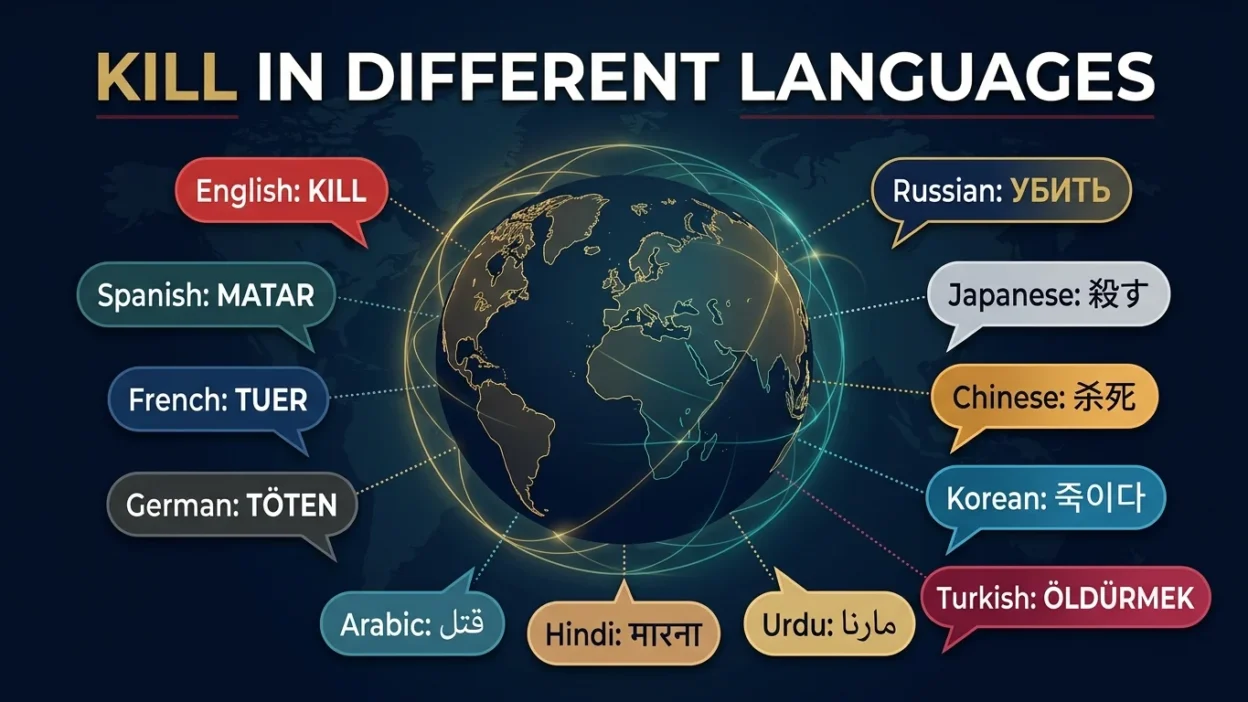
The word “kill” has a serious meaning and is used in different contexts, including news reports, literature, history, and everyday expressions. Learning how to say “kill” in different languages can help you understand translations, recognise words in books and films, and explore how different cultures express the same concept.
In this guide, you will find the word “kill” translated into languages, along with easy English pronunciations, short example sentences, and their English meanings. Some languages use different words depending on whether the context involves a person, an animal, a fictional character, or something metaphorical.
Kill in Different Languages
| Language | Native phrase | Easy English pronunciation | Example sentence | English meaning |
| English | To kill | tuh kil | The villain wants to kill the monster. | The villain wants to kill the monster. |
| Spanish | Matar | mah-TAR | El personaje quiere matar al monstruo. | The character wants to kill the monster. |
| French | Tuer | tweh | Le héros doit tuer le monstre. | The hero must kill the monster. |
| German | Töten | TUR-ten | Der Jäger musste das Tier töten. | The hunter had to kill the animal. |
| Italian | Uccidere | oot-chee-DEH-reh | Il personaggio vuole uccidere il mostro. | The character wants to kill the monster. |
| Portuguese | Matar | mah-TAR | O vilão quer matar o monstro. | The villain wants to kill the monster. |
| Dutch | Doden | DOH-den | De jager moest het dier doden. | The hunter had to kill the animal. |
| Swedish | Döda | DUR-dah | Han ville döda monstret. | He wanted to kill the monster. |
| Norwegian | Drepe | DRAY-peh | Jegeren måtte drepe dyret. | The hunter had to kill the animal. |
| Danish | Dræbe | DREH-beh | Helten må dræbe monstret. | The hero must kill the monster. |
| Finnish | Tappaa | TAP-pah | Hän aikoi tappaa hirviön. | They intended to kill the monster. |
| Icelandic | Drepa | DREH-pah | Hann ætlaði að drepa skrímslið. | He intended to kill the monster. |
| Irish | Maraigh | MAH-ree | Ná maraigh an t-ainmhí. | Do not kill the animal. |
| Welsh | Lladd | thlath (approx.) | Peidiwch â lladd yr anifail. | Do not kill the animal. |
| Polish | Zabić | ZAH-beetch | Nie wolno zabijać zwierząt. | One must not kill animals. |
| Czech | Zabít | ZAH-beet | Niechce zabít potvory. | He wants to kill the monster. |
| Slovak | Zabiť | ZAH-beet | Nechce zabiť zviera. | He does not want to kill the animal. |
| Slovenian | Ubiti | oo-BEE-tee | Ne smemo ubiti živali. | We must not kill the animal. |
| Croatian | Ubiti | OO-bee-tee | Ne želim ubiti životinju. | I do not want to kill the animal. |
| Serbian | Убити | OO-bee-tee | Не желим да убијем животињу. | I do not want to kill the animal. |
| Bosnian | Ubiti | OO-bee-tee | Ne smijemo ubiti životinju. | We must not kill the animal. |
| Bulgarian | Убивам | oo-BEE-vam | Не трябва да убиваме животни. | We should not kill animals. |
| Macedonian | Убие | OO-bee-eh | Не сака да го убие чудовиштето. | He does not want to kill the monster. |
| Russian | Убить | oo-BYEET | Он хочет убить монстра. | He wants to kill the monster. |
| Ukrainian | Убити | oo-BY-ty | Він не хоче вбивати тварин. | He does not want to kill animals. |
| Greek | Σκοτώνω | sko-TOH-no | Δεν θέλει να σκοτώσει το τέρας. | He does not want to kill the monster. |
| Romanian | A ucide | ah oo-CHEE-deh | Nu vrea să ucidă animalul. | He does not want to kill the animal. |
| Hungarian | Megölni | MEG-ur-lnee | Nem akarja megölni az állatot. | He does not want to kill the animal. |
| Albanian | Vras | vras | Mos e vrit kafshën. | Do not kill the animal. |
| Lithuanian | Nužudyti | noo-ZHOO-dih-tee | Jis nenori nužudyti gyvūno. | He does not want to kill the animal. |
| Latvian | Nogalināt | noh-gah-lee-NAHT | Viņš negrib nogalināt dzīvnieku. | He does not want to kill the animal. |
| Estonian | Tapma | TAP-mah | Ta ei taha looma tappa. | They do not want to kill the animal. |
| Turkish | Öldürmek | urld-UR-mek | Canavarı öldürmek istemiyor. | He does not want to kill the monster. |
| Arabic | قتل | qatala | لا نريد قتل الحيوان. | We do not want to kill the animal. |
| Hebrew | להרוג | lah-hah-ROHG | אסור להרוג את החיה. | It is forbidden to kill the animal. |
| Persian | کشتن | kosh-TAN | او نمیخواهد حیوان را بکشد. | He does not want to kill the animal. |
| Urdu | مارنا | MAAR-na | ہمیں جانور کو نہیں مارنا چاہیے۔ | We should not kill the animal. |
| Hindi | मारना | MAAR-na | हमें जानवर को नहीं मारना चाहिए। | We should not kill the animal. |
| Bengali | হত্যা করা | hot-ta KOH-rah | আমাদের প্রাণীটিকে হত্যা করা উচিত নয়। | We should not kill the animal. |
| Punjabi | ਮਾਰਨਾ | MAAR-na | ਸਾਨੂੰ ਜਾਨਵਰ ਨੂੰ ਨਹੀਂ ਮਾਰਨਾ ਚਾਹੀਦਾ। | We should not kill the animal. |
| Gujarati | મારી નાખવું | MAH-ree NAAKH-voo | આપણે પ્રાણીને મારી નાખવું નહીં. | We should not kill the animal. |
| Marathi | मारणे | MAA-ruh-nay | आपण प्राण्याला मारू नये. | We should not kill the animal. |
| Nepali | मार्नु | MAAR-noo | हामीले जनावरलाई मार्नु हुँदैन। | We should not kill the animal. |
| Sinhala | මරනවා | mah-rah-nah-wah | සතුන් මරන්න එපා. | Do not kill animals. |
| Tamil | கொல்ல | KOL-la | விலங்குகளைக் கொல்லாதீர்கள். | Do not kill animals. |
| Telugu | చంపడం | cham-pa-DAM | జంతువులను చంపకూడదు. | We should not kill animals. |
| Kannada | ಕೊಲ್ಲು | KOL-loo | ಪ್ರಾಣಿಗಳನ್ನು ಕೊಲ್ಲಬಾರದು. | We should not kill animals. |
| Malayalam | കൊല്ലുക | KOL-loo-kah | മൃഗങ്ങളെ കൊല്ലരുത്. | Do not kill animals. |
| Thai | ฆ่า | khâa | อย่าฆ่าสัตว์ | Do not kill animals. |
| Lao | ຂ້າ | khaa | ຢ່າຂ້າສັດ | Do not kill animals. |
| Khmer | សម្លាប់ | som-LAP | កុំសម្លាប់សត្វ។ | Do not kill animals. |
| Vietnamese | Giết | zee-et (approx.) | Đừng giết động vật. | Do not kill animals. |
| Indonesian | Membunuh | mem-BOO-nooh | Kita tidak boleh membunuh hewan. | We must not kill animals. |
| Malay | Membunuh | mem-BOO-nooh | Kita tidak patut membunuh haiwan. | We should not kill animals. |
| Filipino (Tagalog) | Pumatay | poo-mah-TAY | Huwag pumatay ng hayop. | Do not kill an animal. |
| Chinese (Mandarin) | 杀死 | shā sǐ | 不要杀死动物。 | Do not kill animals. |
| Japanese | 殺す | korosu | 動物を殺してはいけません。 | You must not kill animals. |
| Korean | 죽이다 | ju-gi-da | 동물을 죽이면 안 됩니다. | You must not kill animals. |
| Mongolian | Алах | AH-lakh | Амьтныг алж болохгүй. | You must not kill animals. |
| Kazakh | Өлтіру | ul-TEE-roo | Жануарларды өлтіруге болмайды. | You must not kill animals. |
| Uzbek | O‘ldirmoq | ul-deer-MOK | Hayvonlarni o‘ldirmaslik kerak. | We should not kill animals. |
| Azerbaijani | Öldürmək | ul-dur-MAK | Heyvanları öldürmək olmaz. | We must not kill animals. |
| Armenian | Սպանել | spa-NEL | Պետք չէ սպանել կենդանիներին։ | We should not kill animals. |
| Georgian | მოკვლა | mok-vlah | ცხოველები არ უნდა მოვკლათ. | We should not kill animals. |
| Swahili | Kuua | koo-OO-ah | Hatupaswi kuua wanyama. | We should not kill animals. |
| Afrikaans | Doodmaak | DOHT-mahk | Ons moet nie diere doodmaak nie. | We should not kill animals. |
| Zulu | Ukubulala | oo-koo-boo-LAH-lah | Akufanele sibulale izilwane. | We should not kill animals. |
| Xhosa | Ukubulala | oo-koo-boo-LAH-lah | Asifanele sibulale izilwanyana. | We should not kill animals. |
Translation note: Verb forms change with tense, subject, politeness, and context. Pronunciation spellings are simplified approximations; for formal, legal, or literary translation, consult a fluent speaker.
What Does “Kill” Mean?
The verb kill generally means to cause the death of a living being. It can appear in discussions of crime, history, wildlife, fiction, medicine, and other subjects. Its exact meaning and emotional force depend on the situation.
The word can also be used figuratively. For example, “kill time” means to spend time while waiting, and “the joke killed the mood” means the joke changed the atmosphere negatively. These expressions do not describe literal killing.
How to Say “Kill” in Different Languages
When learning how to say “kill” in different languages, it is important to understand the context. A dictionary translation may not fit every sentence.
For instance, some languages use different verbs for killing a person, slaughtering an animal, destroying a fictional monster, or ending something metaphorically. Grammar also changes the form of the verb depending on who performs the action and when it happens.
For accurate communication, learn the word alongside a complete example sentence rather than memorising the translation alone.
“Kill” Translations Around the World
The translations of “kill” around the world reflect the structure and vocabulary of each language. Some languages use a single common verb across several contexts, while others distinguish between different kinds of actions.
- European languages: Words such as matar, tuer, töten, and zabić are common translations, though their usage differs by context.
- South Asian languages: Hindi, Urdu, Bengali, Punjabi, and other languages have their own verbs and expressions, with differences in formality and grammar.
- East Asian languages: Mandarin, Japanese, and Korean use distinct written forms and grammatical patterns.
- Middle Eastern languages: Arabic, Hebrew, and Persian have their own verb forms, which vary with sentence structure.
- African languages: Swahili, Zulu, Xhosa, and Afrikaans express the concept using their own vocabulary and grammatical conventions.
These differences show why context is essential when interpreting translations.
Common Expressions That Use “Kill”
English includes several expressions that use the word “kill” in a non-literal sense. Their translations may not use the equivalent word in another language.
- Kill time: Spend time while waiting.
- Kill a conversation: Bring a conversation to an abrupt or uncomfortable end.
- Kill the mood: Spoil the atmosphere of a situation.
- Kill a process: Stop a running process in a computing context.
- Killing it: Perform exceptionally well, as in “She is killing it on stage.”
When translating these expressions, focus on the intended meaning instead of translating every word literally.
Tips for Learning “Kill” in Another Language
If you are learning vocabulary or writing multilingual content, these tips can help you use translations more accurately:
- Learn the context: Identify whether the sentence is literal, figurative, fictional, or technical.
- Study complete sentences: Examples reveal how the verb works in natural speech.
- Practise pronunciation: Listen to native speakers when possible, especially for unfamiliar sounds.
- Check grammar: Verb forms may change with tense, person, and sentence structure.
- Consider tone: This is a strong word, so make sure it is appropriate for the situation.
Conclusion
Learning “kill” in different languages offers insight into vocabulary, grammar, and cultural expression across the world. The language table provides a starting point for comparing translations and understanding how the word appears in short sentences. For the most accurate use, always consider the context, grammar, and tone of the original sentence.
FAQs
1. How do you say “kill” in different languages?
The word has different translations depending on the language. Examples include matar in Spanish, tuer in French, töten in German, قتل in Arabic, and 殺す in Japanese.
2. What is the Hindi word for “kill”?
A common Hindi translation is मारना (maarna). The appropriate form depends on the sentence and context.
3. What is “kill” in Spanish?
The common Spanish verb is matar. Its form changes according to the subject and tense.
4. Do all languages use the same word for every meaning of “kill”?
No. Languages may distinguish between literal killing, killing an animal, destroying something, or figurative expressions such as “kill time.” Context determines the most suitable translation.
5. Why should I learn example sentences with translations?
Example sentences show how a word is used naturally, helping you understand grammar, pronunciation, and meaning more accurately than a standalone translation.