The word king represents leadership, authority, royalty, and tradition. Across the world, different languages have their own words for a king, reflecting centuries of history, culture, and royal customs. Some languages use ancient terms associated with monarchs, while others have words that are commonly used in modern conversations, books, and historical stories.
If you want to learn how to say king in different languages, this guide provides translations in languages, along with easy English pronunciations and simple example sentences. Whether you are learning a new language, researching royal traditions, writing a story, or exploring world vocabulary, these translations will help you understand how the word is used around the world.
From Spanish rey and French roi to Arabic ملك and Japanese 王, each translation offers a useful glimpse into another language.
King in Different Languages: Quick Overview
The English word king generally refers to a male monarch who rules a kingdom, either as a sovereign or as part of a royal system. Its precise meaning can vary according to a country’s history, traditions, and political structure.
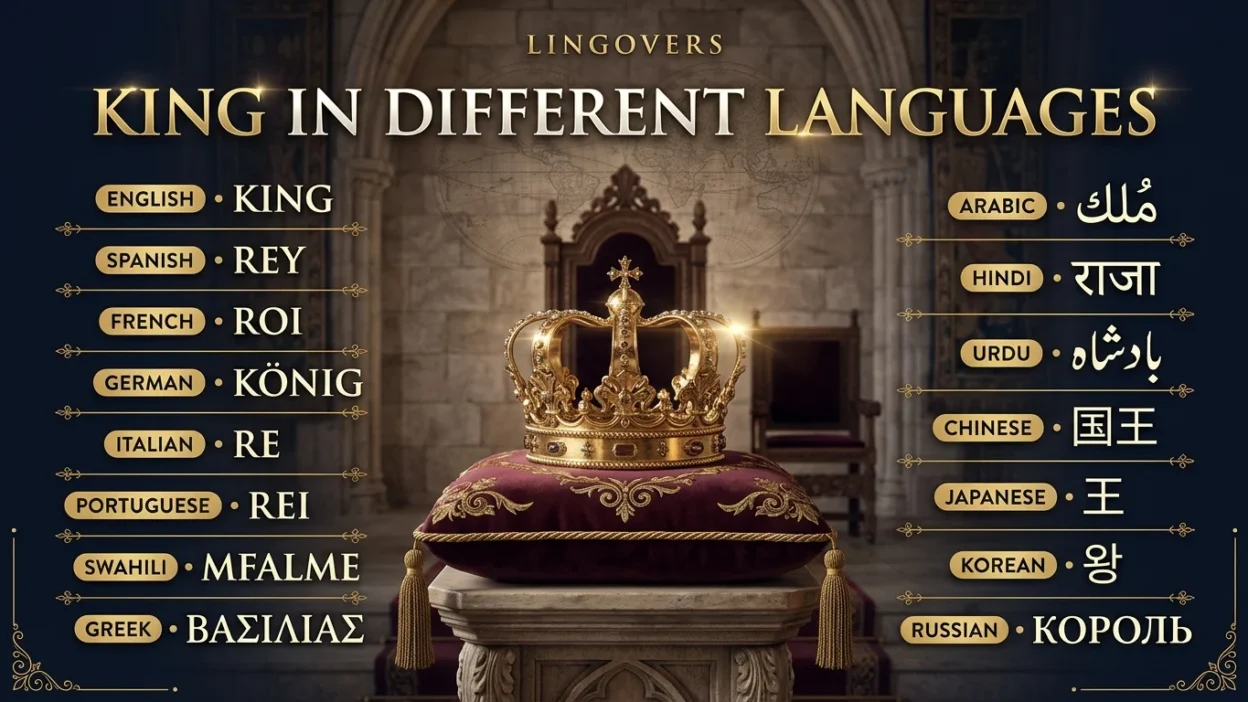
Here are a few popular translations:
- Spanish: Rey
- French: Roi
- German: König
- Italian: Re
- Portuguese: Rei
- Arabic: ملك
- Hindi: राजा
- Chinese: 国王
- Japanese: 王
- Korean: 왕
King in Different Languages
| Language | Native word | Easy English pronunciation | Example sentence | English meaning |
| Spanish | Rey | Ray | El rey vive en el palacio. | The king lives in the palace. |
| French | Roi | Rwah | Le roi entre dans le château. | The king enters the castle. |
| German | König | KUR-nikh | Der König trägt eine Krone. | The king wears a crown. |
| Italian | Re | Ray | Il re visita il villaggio. | The king visits the village. |
| Portuguese | Rei | Ray | O rei mora no palácio. | The king lives in the palace. |
| Dutch | Koning | KOH-ning | De koning spreekt met het volk. | The king speaks with the people. |
| Swedish | Kung | Koong | Kungen bor i ett slott. | The king lives in a castle. |
| Norwegian | Konge | KONG-eh | Kongen besøker byen. | The king visits the city. |
| Danish | Konge | KONG-eh | Kongen holder en tale. | The king gives a speech. |
| Icelandic | Konungur | KOH-nung-ur | Konungurinn býr í höllinni. | The king lives in the palace. |
| Finnish | Kuningas | KOO-ning-as | Kuningas saapuu linnaan. | The king arrives at the castle. |
| Estonian | Kuningas | KOO-ning-as | Kuningas elab lossis. | The king lives in the castle. |
| Latvian | Karalis | KAH-rah-lis | Karalis apmeklē pili. | The king visits the palace. |
| Lithuanian | Karalius | kah-RAH-lyoos | Karalius gyvena pilyje. | The king lives in the castle. |
| Polish | Król | Krool | Król mieszka w zamku. | The king lives in the castle. |
| Czech | Král | Kraal | Král vstupuje do hradu. | The king enters the castle. |
| Slovak | Kráľ | Kraal | Kráľ býva na hrade. | The king lives in the castle. |
| Slovenian | Kralj | KRAH-ly | Kralj obišče mesto. | The king visits the city. |
| Croatian | Kralj | KRAH-ly | Kralj ulazi u dvorac. | The king enters the castle. |
| Serbian | Краљ | Krahly | Краљ живи у дворцу. | The king lives in the castle. |
| Bosnian | Kralj | KRAH-ly | Kralj posjećuje grad. | The king visits the city. |
| Bulgarian | Крал | Kral | Кралят живее в дворец. | The king lives in a palace. |
| Macedonian | Крал | Kral | Кралот влегува во замокот. | The king enters the castle. |
| Russian | Король | kah-ROL | Король живёт во дворце. | The king lives in a palace. |
| Ukrainian | Король | kah-ROL | Король відвідує місто. | The king visits the city. |
| Belarusian | Кароль | kah-ROL | Кароль жыве ў палацы. | The king lives in a palace. |
| Greek | Βασιλιάς | vah-see-LYAS | Ο βασιλιάς μένει στο παλάτι. | The king stays in the palace. |
| Albanian | Mbret | Mbret | Mbreti jeton në pallat. | The king lives in the palace. |
| Romanian | Rege | REH-jeh | Regele locuiește în castel. | The king lives in the castle. |
| Hungarian | Király | KEE-raay | A király belép a kastélyba. | The king enters the castle. |
| Turkish | Kral | Kral | Kral saraya gelir. | The king comes to the palace. |
| Arabic | ملك | MA-lik | الملك يعيش في القصر. | The king lives in the palace. |
| Hebrew | מלך | MEH-lekh | המלך גר בארמון. | The king lives in the palace. |
| Persian | پادشاه | paaad-shaah | پادشاه وارد قصر میشود. | The king enters the palace. |
| Urdu | بادشاہ | baa-dshah | بادشاہ محل میں رہتا ہے۔ | The king lives in the palace. |
| Hindi | राजा | RAA-jaa | राजा महल में रहता है। | The king lives in the palace. |
| Bengali | রাজা | RAA-ja | রাজা প্রাসাদে থাকেন। | The king lives in the palace. |
| Punjabi | ਰਾਜਾ | RAA-jaa | ਰਾਜਾ ਮਹਿਲ ਵਿੱਚ ਰਹਿੰਦਾ ਹੈ। | The king lives in the palace. |
| Gujarati | રાજા | RAA-jaa | રાજા મહેલમાં રહે છે. | The king lives in the palace. |
| Marathi | राजा | RAA-jaa | राजा राजवाड्यात राहतो. | The king lives in the palace. |
| Nepali | राजा | RAA-jaa | राजा दरबारमा बस्छन्। | The king lives in the palace. |
| Sinhala | රජු | RAH-joo | රජු මාලිගයේ සිටී. | The king is in the palace. |
| Tamil | அரசன் | ah-rah-san | அரசன் அரண்மனையில் வாழ்கிறான். | The king lives in the palace. |
| Telugu | రాజు | RAA-joo | రాజు రాజభవనంలో నివసిస్తాడు. | The king lives in the palace. |
| Kannada | ರಾಜ | RAA-ja | ರಾಜನು ಅರಮನೆಯಲ್ಲಿ ವಾಸಿಸುತ್ತಾನೆ. | The king lives in the palace. |
| Malayalam | രാജാവ് | RAA-jaa-vu | രാജാവ് കൊട്ടാരത്തിൽ താമസിക്കുന്നു. | The king lives in the palace. |
| Thai | กษัตริย์ | ga-sat | กษัตริย์ประทับอยู่ในพระราชวัง | The king resides in the royal palace. |
| Vietnamese | Vua | Voo-ah | Nhà vua sống trong cung điện. | The king lives in the palace. |
| Indonesian | Raja | RAA-ja | Raja tinggal di istana. | The king lives in the palace. |
| Malay | Raja | RAA-ja | Raja tinggal di istana. | The king lives in the palace. |
| Filipino | Hari | HAH-ree | Ang hari ay nakatira sa palasyo. | The king lives in the palace. |
| Chinese (Mandarin) | 国王 | GWO-wang | 国王住在王宫里。 | The king lives in the royal palace. |
| Japanese | 王 | Oh | 王は城に住んでいます。 | The king lives in the castle. |
| Korean | 왕 | Wang | 왕은 궁전에 살아요. | The king lives in the palace. |
| Mongolian | Хаан | Khaan | Хаан ордонд амьдардаг. | The king lives in the palace. |
| Kazakh | Патша | Pat-sha | Патша сарайда тұрады. | The king lives in the palace. |
| Uzbek | Podshoh | Pod-shoh | Podshoh saroyda yashaydi. | The king lives in the palace. |
| Azerbaijani | Kral | Kral | Kral sarayda yaşayır. | The king lives in the palace. |
| Armenian | Թագավոր | tah-ga-VOR | Թագավորը ապրում է պալատում։ | The king lives in the palace. |
| Georgian | მეფე | MEH-peh | მეფე სასახლეში ცხოვრობს. | The king lives in the palace. |
| Swahili | Mfalme | m-fahl-meh | Mfalme anaishi katika ikulu. | The king lives in the palace. |
| Zulu | Inkosi | een-KOH-see | Inkosi ihlala esigodlweni. | The king lives in the palace. |
| Afrikaans | Koning | KOH-ning | Die koning woon in die paleis. | The king lives in the palace. |
| Yoruba | Ọba | AW-bah | Ọba ń gbé ní ààfin. | The king lives in the palace. |
| Igbo | Eze | EH-zeh | Eze bi n’obí eze. | The king lives in the royal palace. |
| Amharic | ንጉሥ | nih-GOOS | ንጉሡ በቤተ መንግሥት ይኖራል። | The king lives in the palace. |
| Irish | Rí | Ree | Tá an rí sa chaisleán. | The king is in the castle. |
| Welsh | Brenin | BREN-in | Mae’r brenin yn byw yn y castell. | The king lives in the castle. |
| Scottish Gaelic | Rìgh | Ree | Tha an rìgh anns a’ chaisteal. | The king is in the castle. |
How to Say King in Different Languages
Learning how to say king in different languages is easier when you group words by region. Many European languages have related terms because of shared linguistic histories, while Asian and African languages have their own distinctive words shaped by local traditions.
For example, Spanish uses rey, French uses roi, and Italian uses re. These words look and sound different, but all refer to a king.
In South Asia, Hindi, Bengali, Punjabi, Gujarati, and Marathi use forms related to raja. In Arabic, the common word is malik, while Urdu and Persian commonly use badshah and padshah, respectively.
In East Asia, Mandarin Chinese uses guówáng, Japanese commonly uses ō for king, and Korean uses wang. These terms may differ in their historical and contemporary applications.
King Translations Around the World
The word king has a strong connection to monarchy, but its meaning depends on the context in which it appears.
In some countries, a king is a constitutional monarch whose duties are largely ceremonial. In other historical settings, kings held extensive political, military, and judicial authority.
Translations also depend on the type of ruler being discussed. Some languages distinguish between a king, an emperor, a prince, and a tribal or traditional ruler. Therefore, the most appropriate translation may change according to the person, period, or institution involved.
For example, the Spanish word rey and the French word roi are standard translations for king. However, a historical title may require a more specific term to preserve its original meaning.
What Is the Difference Between King and Emperor?
A king traditionally rules a kingdom, while an emperor traditionally rules an empire, which may include several territories or kingdoms. An emperor is often considered to hold a higher imperial rank than a king, although historical systems have varied.
The words are not interchangeable in every situation. For instance, the English word king should not automatically be translated using the word for emperor when describing a specific historical monarch.
When translating royal titles, consider the ruler’s actual title rather than relying only on general definitions.
Why Do Different Languages Have Different Words for King?
Languages develop through migration, trade, cultural exchange, conquest, and historical change. As communities developed their own systems of government, they also developed words for rulers and royal institutions.
Some royal words share common linguistic roots. Others entered a language through contact with neighbouring societies or through historical political relationships.
For example, several European languages use similar words for king, including German König, Swedish kung, and Dutch koning. Meanwhile, the South Asian word raja appears in several regional languages, reflecting shared cultural and historical influences.
These similarities make royal vocabulary an interesting way to explore language families and cultural connections.
How to Use the Word King in Everyday English
The word king can appear in conversations, historical writing, literature, games, and popular culture.
Here are a few common examples:
- The king ruled the kingdom wisely. This sentence describes a monarch’s leadership.
- The king wore a golden crown. This sentence describes a traditional symbol of royalty.
- The story is about a brave king. This sentence introduces a royal character in a story.
- The king welcomed his guests. This sentence describes a royal event.
- He was known as the king of chess. This sentence uses king figuratively to describe someone highly accomplished.
The word can also refer to a playing card, a chess piece, or someone regarded as exceptionally successful in a particular field. These meanings depend on context and should not be confused with the literal royal title.
Tips for Learning King Translations
If you want to remember the translations of king, practise a few languages at a time instead of memorising all at once.
Start with familiar languages, such as Spanish, French, German, and Italian. Then move to languages that use different writing systems, including Arabic, Hindi, Chinese, Japanese, and Korean.
Read each native word aloud and compare it with the pronunciation guide. Remember that English pronunciation guides are approximate, especially for tones and sounds that do not exist in English.
Finally, practise each word in a complete sentence. Seeing a translation in context helps you understand how it is used and makes it easier to remember.
Conclusion
The word king has many translations around the world, from Spanish rey and French roi to Hindi raja, Arabic malik, and Japanese ō. Although the words differ in spelling, pronunciation, and cultural background, they share a connection to monarchy and royal leadership.
Learning king in different languages is a useful way to expand your vocabulary, explore linguistic diversity, and understand how cultures express similar ideas in different ways. Use the 70-language table as a reference, practise the pronunciation guides, and remember that historical and cultural context can influence the most accurate translation.
FAQs
1. How do you say king in different languages?
Some common translations are rey in Spanish, roi in French, König in German, re in Italian, raja in Hindi, malik in Arabic, vua in Vietnamese, and wang in Korean.
2. What is the most common translation of king in other languages?
There is no single translation used by every language. Common equivalents include rey in Spanish, roi in French, rei in Portuguese, raja in several South Asian languages, and koning in Dutch and Afrikaans.
3. How do you say king in Japanese and Chinese?
In Japanese, a common word for king is 王, pronounced ō. In Mandarin Chinese, 国王, pronounced guówáng, is a common word for king.
4. What is the difference between king and raja?
King is the English word for a male monarch. Raja is a royal title used in South Asian languages and traditions. Depending on historical context, it may refer to a king, prince, or other ruler.
5. Why is learning king in different languages useful?
Learning these translations can help with language study, travel, cultural research, historical reading, creative writing, and understanding royal titles in books, films, and conversations.